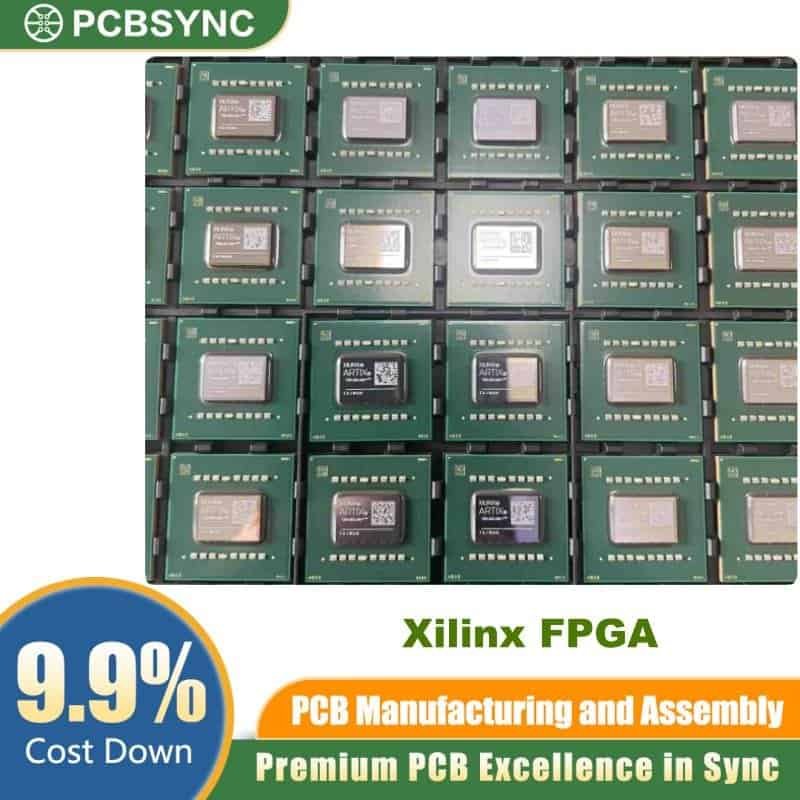
Meta Description: The XC2S200-6FGG1157C is a high-performance Xilinx Spartan-II FPGA with 200K gates, 5,292 logic cells, speed grade -6, and a 1157-ball Pb-free BGA package. Learn full specs, features, and applications.
The XC2S200-6FGG1157C is a field-programmable gate array (FPGA) from Xilinx’s Spartan-II family — one of the most capable and cost-effective programmable logic devices available in its class. Featuring 200,000 system gates, 5,292 configurable logic cells, and a -6 speed grade in a 1157-ball Pb-free fine-pitch BGA package, this FPGA delivers robust performance for commercial-grade digital design applications. Whether you are working in communications, industrial automation, or embedded processing, the XC2S200-6FGG1157C offers the logic density, I/O flexibility, and speed you need.
What Is the XC2S200-6FGG1157C?
The XC2S200-6FGG1157C belongs to Xilinx’s Spartan-II FPGA family, a line designed to give engineers a programmable alternative to mask-programmed ASICs. The part number breaks down as follows:
| Part Number Segment |
Meaning |
| XC2S200 |
Spartan-II device, 200K system gates |
| -6 |
Speed grade (fastest available for Spartan-II Commercial) |
| FGG |
Pb-free (lead-free) Fine-Pitch Ball Grid Array package |
| 1157 |
Number of package balls (1157-ball BGA) |
| C |
Commercial temperature range (0°C to +85°C) |
This device is built on Xilinx’s 0.18µm process technology and operates at a 2.5V core voltage, making it well-suited for modern, low-power digital systems. If you need broader Xilinx programmable logic options, explore the full range of Xilinx FPGA products available for your design requirements.
XC2S200-6FGG1157C Key Specifications
Core Logic and Memory Resources
The XC2S200-6FGG1157C provides an impressive logic capacity for its class. The table below summarizes the core resources available on this device.
| Specification |
Value |
| System Gates |
200,000 |
| Logic Cells (CLBs) |
5,292 |
| CLB Array |
28 × 42 |
| Total CLBs |
1,176 |
| Distributed RAM Bits |
75,264 bits |
| Block RAM Bits |
56K (56,000 bits) |
| Maximum User I/O Pins |
284 |
| Delay-Locked Loops (DLLs) |
4 |
Speed, Power, and Package
| Specification |
Value |
| Speed Grade |
-6 (fastest commercial grade) |
| Maximum System Performance |
Up to 200 MHz |
| Process Technology |
0.18µm CMOS |
| Core Supply Voltage (VCCINT) |
2.5V |
| Package Type |
FGG (Pb-free Fine-Pitch BGA) |
| Pin Count |
1,157 balls |
| Temperature Range |
Commercial (0°C to +85°C) |
| RoHS Compliance |
Pb-Free (lead-free) |
XC2S200-6FGG1157C Architecture Overview
Configurable Logic Blocks (CLBs)
The heart of the XC2S200-6FGG1157C is its array of Configurable Logic Blocks (CLBs). Each CLB contains:
- Look-Up Tables (LUTs): Implement combinational logic functions with fast propagation delay.
- Flip-Flops: Store state information and enable synchronous digital design.
- Multiplexers: Provide flexible routing and function selection.
- Carry Logic: Accelerates arithmetic operations like addition and comparison.
The 28 × 42 CLB grid delivers a total of 1,176 CLBs, providing ample logic capacity for complex digital systems.
Block RAM Architecture
The XC2S200-6FGG1157C includes two columns of dedicated block RAM, positioned symmetrically on opposite sides of the die between the CLB array and the I/O blocks. Each block RAM supports:
- Dual-port operation for simultaneous read and write access
- Configurable word widths
- Synchronous read and write operations
- A combined total of 56K bits of on-chip block storage
This embedded memory is ideal for FIFOs, lookup tables, and data buffers in high-speed data paths.
Delay-Locked Loops (DLLs)
Four Delay-Locked Loops (DLLs) are placed at each corner of the die. These DLLs provide:
- Clock edge alignment and deskewing
- Clock frequency multiplication and division
- Phase shifting for timing margin optimization
- Low-jitter clocking across the full device
Input/Output Blocks (IOBs)
The XC2S200-6FGG1157C supports up to 284 user I/O pins, each individually programmable. The IOBs support multiple I/O standards including LVTTL, LVCMOS, GTL, HSTL, and more, giving designers wide flexibility for board-level interfacing.
Spartan-II Family Comparison Table
The XC2S200 is the largest member of the Spartan-II family. The table below shows how it compares against other family members.
| Device |
Logic Cells |
System Gates |
CLB Array |
Total CLBs |
Max User I/O |
Dist. RAM (bits) |
Block RAM (bits) |
| XC2S15 |
432 |
15,000 |
8 × 12 |
96 |
86 |
6,144 |
16K |
| XC2S30 |
972 |
30,000 |
12 × 18 |
216 |
92 |
13,824 |
24K |
| XC2S50 |
1,728 |
50,000 |
16 × 24 |
384 |
176 |
24,576 |
32K |
| XC2S100 |
2,700 |
100,000 |
20 × 30 |
600 |
176 |
38,400 |
40K |
| XC2S150 |
3,888 |
150,000 |
24 × 36 |
864 |
260 |
55,296 |
48K |
| XC2S200 |
5,292 |
200,000 |
28 × 42 |
1,176 |
284 |
75,264 |
56K |
The XC2S200-6FGG1157C’s 1157-ball package maximizes pin accessibility, making it ideal for designs that require the highest I/O density within the Spartan-II family.
Why Choose Speed Grade -6?
The -6 speed grade is the fastest available for Spartan-II devices in the Commercial temperature range. It delivers:
- Higher clock frequencies compared to -5 and -4 speed grades
- Lower propagation delay through logic and routing
- Better timing margin for high-speed interfaces
- Exclusive availability in the Commercial temperature range (0°C to +85°C)
For designs running at or near the maximum system performance of 200 MHz, the -6 speed grade ensures that critical timing paths close reliably.
XC2S200-6FGG1157C Applications
The XC2S200-6FGG1157C is a versatile device suited for a wide range of industries and applications.
Communications and Networking
- Protocol bridging and conversion (UART, SPI, I2C, Ethernet MAC)
- Packet processing and filtering
- High-speed serial data interfaces
- Network router and switch logic implementation
Industrial Automation and Control
- Motor drive control with PWM generation
- Real-time process monitoring and feedback control
- PLC (Programmable Logic Controller) replacement
- Sensor data acquisition and processing
Embedded Processing Systems
- Custom co-processor acceleration
- Data compression and encryption engines
- Image and video preprocessing pipelines
- DSP filter implementation (FIR/IIR)
Medical and Scientific Instrumentation
- Patient monitoring and waveform analysis
- Diagnostic imaging signal processing
- High-precision data acquisition front-ends
- Portable medical device control logic
Security and Surveillance
- Real-time video processing and analysis
- Biometric authentication logic
- Cryptographic algorithm acceleration
- Access control system management
XC2S200-6FGG1157C vs. Common Alternatives
When selecting an FPGA for your project, it helps to compare the XC2S200-6FGG1157C against similar-class devices.
| Feature |
XC2S200-6FGG1157C |
XC2S150-6FGG456C |
XC3S200-5FGG256C |
| Family |
Spartan-II |
Spartan-II |
Spartan-3 |
| System Gates |
200,000 |
150,000 |
200,000 |
| Logic Cells |
5,292 |
3,888 |
4,320 |
| Max User I/O |
284 |
260 |
173 |
| Block RAM |
56K bits |
48K bits |
216K bits |
| Core Voltage |
2.5V |
2.5V |
1.2V |
| Package Pins |
1,157 |
456 |
256 |
| Speed Grade |
-6 |
-6 |
-5 |
| Process Node |
0.18µm |
0.18µm |
90nm |
The XC2S200-6FGG1157C excels in maximum I/O count and logic density within the Spartan-II generation, while the 1157-ball package provides unmatched pin access for complex, multi-board designs.
Ordering Information and Part Number Decoder
Understanding the Full Part Number: XC2S200-6FGG1157C
XC 2S 200  -  6  FGG  1157  C
|  |  |       |   |    |     |
|  |  |       |   |    |     +-- Temperature: C = Commercial (0°C to +85°C)
|  |  |       |   |    +-------- Pin Count: 1157 balls
|  |  |       |   +------------- Package: FGG = Pb-free Fine-Pitch BGA
|  |  |       +----------------- Speed Grade: -6 (fastest)
|  |  +------------------------- Logic Density: 200K gates
|  +---------------------------- Series: Spartan-II (2S)
+------------------------------ Xilinx FPGA (XC)
#### Package Overview: FGG1157
| Package Attribute |
Detail |
| Package Style |
Fine-Pitch Ball Grid Array (FBGA) |
| Ball Count |
1,157 |
| Lead-Free (Pb-Free) |
Yes (denoted by double “GG” in FGG) |
| Pitch |
Fine-pitch (1.0mm or 0.8mm ball pitch) |
| RoHS |
Compliant |
Configuration and Programming
The XC2S200-6FGG1157C supports SRAM-based configuration, which means it must be programmed on every power-up using an external configuration source. Supported configuration modes include:
- Master Serial – Uses an external Xilinx PROM (Platform Flash or XCF series)
- Slave Serial – Configuration driven by an external microcontroller or processor
- Master Parallel (SelectMAP) – High-speed parallel configuration for faster startup
- JTAG (IEEE 1149.1 Boundary Scan) – In-system programming and debug via standard JTAG interface
For production systems, Xilinx Platform Flash PROMs (XCF01S, XCF02S, XCF04S) are the most common companion devices for storing and delivering the configuration bitstream.
Design Tools and Development Support
Xilinx provides full development support for the XC2S200-6FGG1157C through its ISE Design Suite (the primary toolchain for Spartan-II devices). Key tools include:
| Tool |
Function |
| ISE Project Navigator |
RTL design entry, synthesis, and implementation |
| XST (Xilinx Synthesis Technology) |
HDL synthesis for VHDL and Verilog |
| CPLD/FPGA Constraints Editor (UCF) |
Timing and pin assignment |
| iMPACT |
Configuration file generation and JTAG programming |
| ChipScope Pro |
In-system logic analysis and debug |
Note: The ISE Design Suite is required for Spartan-II device support. Vivado does not support the Spartan-II family.
What does the “C” suffix mean in XC2S200-6FGG1157C?
The “C” designates the Commercial temperature range: 0°C to +85°C operating junction temperature. Industrial-grade versions (rated –40°C to +100°C) carry an “I” suffix.
Is the XC2S200-6FGG1157C still in production?
The Spartan-II family has been designated as Not Recommended for New Design (NRND) by Xilinx/AMD. However, the XC2S200-6FGG1157C remains available through authorized distributors and component brokers for maintenance and legacy system support.
What is the difference between FG and FGG packages?
The extra “G” in FGG indicates Pb-free (lead-free) packaging, compliant with RoHS regulations. The FG package uses standard tin-lead (SnPb) solder balls, while FGG packages use lead-free alloys.
Can the XC2S200-6FGG1157C be replaced with a Spartan-3 device?
In many cases, yes. The XC3S200 or XC3S400 from the Spartan-3 family offer similar or greater logic capacity at lower core voltages (1.2V). However, pin compatibility is not guaranteed, and the configuration bitstream must be regenerated.
What configuration PROM is compatible with the XC2S200-6FGG1157C?
Compatible Xilinx Platform Flash PROMs include the XCF01S, XCF02S, and XCF04S, all of which store the required bitstream and configure the device at power-up via Master Serial mode.
Conclusion
The XC2S200-6FGG1157C stands out as the top-tier member of the Xilinx Spartan-II FPGA family, combining 200,000 system gates, 5,292 logic cells, four DLLs, 284 user I/O pins, and 56K bits of block RAM in a Pb-free 1157-ball BGA package. Its -6 speed grade ensures the highest performance achievable within the Spartan-II commercial lineup, making it a strong fit for high-density communications, industrial control, medical instrumentation, and embedded logic applications.
For those working with legacy Xilinx designs or sourcing components for existing platforms, the XC2S200-6FGG1157C remains a reliable and capable choice — backed by a comprehensive ecosystem of design tools, configuration PROMs, and technical documentation.