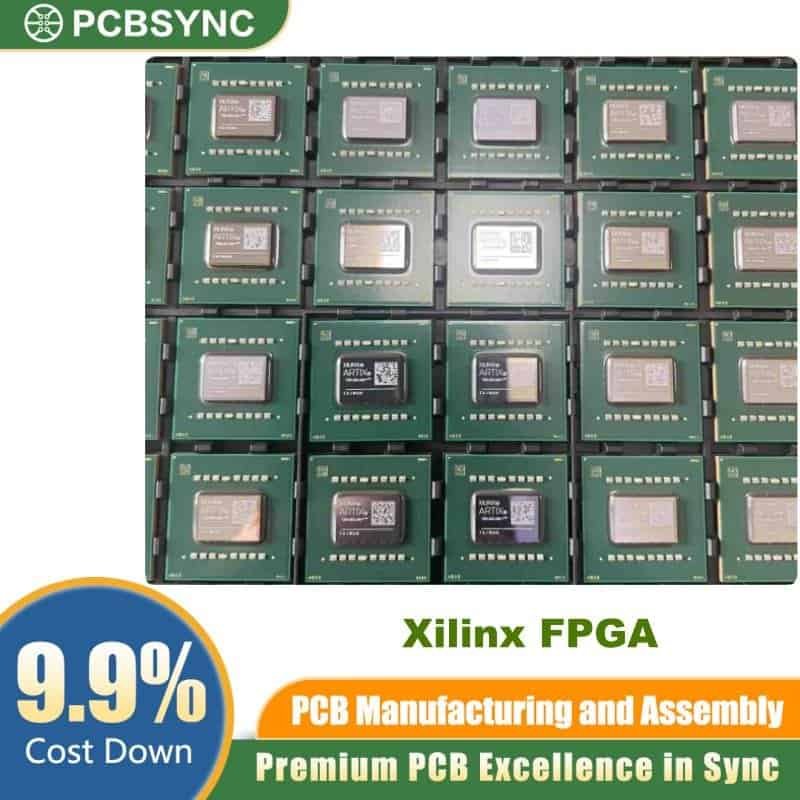
The XCKU085-L1FLVB1760I is a high-performance, low-power Xilinx FPGA from the Kintex® UltraScale™ family, manufactured by AMD (formerly Xilinx). Designed for demanding applications that require the optimal balance of signal processing capability, low power consumption, and cost-effectiveness, this device is a go-to solution for engineers working on 100G networking, data center infrastructure, medical imaging, 8K video processing, and wireless communications.
Built on TSMC’s 20nm process node and packaged in a 1760-pin FCBGA (Flip-Chip Ball Grid Array), the XCKU085-L1FLVB1760I delivers massive logic density, next-generation multi-gigabit transceivers, and an ASIC-like clocking architecture — all while operating at reduced core voltage for lower static power.
What Is the XCKU085-L1FLVB1760I? Overview and Part Number Breakdown
Understanding the part number helps buyers immediately identify the device’s key characteristics:
| Segment |
Value |
Meaning |
| XC |
XC |
Xilinx Commercial Product |
| KU |
KU |
Kintex UltraScale Family |
| 085 |
085 |
Device Size (Logic Density Tier) |
| L1 |
L1 |
Low-power speed grade (-1L), lowest static power |
| FLV |
FLV |
Package Type: Flip-chip Low Voltage BGA |
| B |
B |
Package Size Variant |
| 1760 |
1760 |
Pin Count: 1760 pins |
| I |
I |
Temperature Grade: Industrial (-40°C to +100°C) |
The -L1 speed grade designates this as a low-voltage variant screened for lower maximum static power. When operated at VCCINT = 0.90V, it achieves the smallest power envelope in the XCKU085 lineup, making it ideal for power-sensitive industrial deployments.
XCKU085-L1FLVB1760I Key Specifications at a Glance
| Parameter |
Value |
| Manufacturer |
AMD (Xilinx) |
| Product Family |
Kintex® UltraScale™ |
| Part Number |
XCKU085-L1FLVB1760I |
| Logic Cells |
1,088,325 |
| CLB LUTs |
497,520 |
| CLB Flip-Flops |
~995,040 |
| Block RAM (Mb) |
58.27 Mb |
| DSP Slices |
2,760 |
| Max User I/O |
676 |
| GTH Transceivers |
32 |
| Maximum Transceiver Speed |
16.3 Gb/s |
| PCIe Blocks |
3 (Gen3 x8) |
| Memory Controller |
Hard DDR4 |
| Package |
1760-BBGA, FCBGA |
| Package Dimensions |
45mm × 45mm |
| Technology Node |
20nm |
| Speed Grade |
-1L (Low Voltage) |
| VCCINT (Nominal) |
0.90V / 0.95V |
| Temperature Grade |
Industrial (-40°C to +100°C) |
| RoHS Compliance |
Yes |
XCKU085-L1FLVB1760I Logic Resources – In Depth
## Configurable Logic Blocks (CLBs) and LUT Architecture
The XCKU085 features Xilinx’s UltraScale CLB architecture, which delivers significantly higher utilization efficiency compared to previous 7-Series devices. Each CLB contains two slices, and each slice includes eight 6-input LUTs (Look-Up Tables) along with flip-flops and carry logic. With 497,520 CLB LUTs and over 995,000 flip-flops, the XCKU085-L1FLVB1760I supports highly parallel, pipelined designs that require both high logic density and register depth.
## Block RAM and Distributed Memory
The device integrates 58.27 Mb of Block RAM organized as 36K and 18K True Dual-Port BRAM cells. This on-chip memory reduces dependence on external memory for latency-sensitive buffering, FIFO management, and coefficient storage. For DSP-heavy designs, the high BRAM-to-logic ratio is a significant advantage over competing mid-range FPGAs.
## DSP48E2 Slices for High-Performance Signal Processing
With 2,760 DSP48E2 slices, the XCKU085-L1FLVB1760I delivers exceptional arithmetic throughput for applications including:
- FIR/IIR digital filters
- FFT engines
- Matrix multiplication for machine learning inference
- Channel equalization in wireless baseband processing
- Radar and sonar signal processing
Each DSP48E2 slice provides a 27×18-bit multiplier followed by a 48-bit accumulator, supporting cascading for wide multiply-accumulate operations without consuming fabric routing resources.
I/O and Connectivity Capabilities
## User I/O and SelectIO Technology
The XCKU085-L1FLVB1760I provides 676 user-configurable I/O pins through the 1760-FCBGA package. These I/Os support a wide range of single-ended and differential standards via the UltraScale SelectIO™ technology, including LVDS, SSTL, HSUL, and POD standards — covering interfaces for DDR4 memory, video, and general-purpose logic.
## GTH Multi-Gigabit Transceivers
| Transceiver Type |
Count |
Max Line Rate |
| GTH (16G class) |
32 |
16.3 Gb/s |
The 32 GTH transceivers support protocols including:
- PCIe Gen3 (up to x8 per block, 3 hard blocks)
- 100G Ethernet (with external MAC/PCS IP)
- CPRI / OBSAI for wireless fronthaul
- Aurora, SRIO for chip-to-chip links
- Interlaken up to 150G aggregate
Each GTH transceiver features low-latency clocking, integrated equalization, and optional 8B/10B, 64B/66B, and 64B/67B encoding — reducing soft logic resource usage.
## Hard PCIe and Memory Interface Blocks
| Hard Block |
Count |
Specification |
| PCIe Blocks |
3 |
Gen3 x8, compliant to PCIe 3.0 |
| Memory Controllers |
Integrated |
DDR4 / DDR3L support |
| CMAC (100G Ethernet) |
Available via IP |
With GTH |
The integrated PCIe Gen3 x8 blocks enable direct, low-latency connectivity to host CPUs, accelerator cards, and storage controllers without consuming DSP or LUT resources.
Power Architecture and Low-Power Design
The -L1 speed grade in the XCKU085-L1FLVB1760I specifically targets power-sensitive designs. This variant is screened for low maximum static power and operates at a VCCINT of 0.90V for minimum power consumption.
| Voltage Rail |
Nominal Value |
Purpose |
| VCCINT |
0.90V (–1LV mode) or 0.95V |
Core logic supply |
| VCCAUX |
1.8V |
Auxiliary and I/O circuits |
| VCCO |
1.0V – 3.3V (bank dependent) |
I/O bank supply |
| VCCBRAM |
0.90V or 0.95V |
Block RAM supply |
| MGTAVCC |
1.0V |
GTH transceiver analog core |
| MGTAVTT |
1.2V |
GTH transceiver termination |
Compared to previous-generation 28nm Kintex-7 FPGAs, AMD Kintex UltraScale devices deliver up to 40% lower power versus the previous generation, thanks to fine-granular clock gating and the ASIC-like clocking architecture at 20nm.
UltraScale Clock Management Architecture
UltraScale devices contain powerful clock management circuitry, including clock synthesis, buffering, and routing components that together provide a highly capable framework to meet design requirements. This clock network enables extremely flexible distribution to minimize skew, power consumption, and propagation delay.
## Clock Resources Summary
| Resource |
Count (XCKU085) |
| CMT (Clock Management Tiles) |
10 |
| MMCM (Mixed-Mode Clock Managers) |
10 |
| PLL |
20 |
| Global Clock Buffers (BUFG) |
32 |
| Regional Clock Buffers (BUFR) |
Numerous |
The CMTs integrate seamlessly with the hard memory controller circuitry, enabling support for high-performance DDR4 interfaces at frequencies exceeding 2400 MT/s.
Package and PCB Design Considerations
## 1760-FCBGA Package Details
| Parameter |
Value |
| Package Type |
Flip-Chip BGA (FCBGA) |
| Total Ball Count |
1760 |
| Package Body Size |
45mm × 45mm |
| Ball Pitch |
1.0mm |
| Mounting Style |
Surface Mount (SMD) |
| Thermal Resistance (θJA) |
Application dependent |
The 1760-ball FCBGA package requires careful PCB layout practices including controlled impedance routing for high-speed signals, proper power delivery network (PDN) design, and thermal via arrays for heat dissipation. Xilinx’s PCB design guidelines and the UltraScale PCB Design User Guide (UG583) provide detailed routing rules for this package.
Industrial Temperature Grade: –40°C to +100°C
The trailing “I” in XCKU085-L1FLVB1760I denotes the Industrial temperature grade, specifying reliable operation across the full –40°C to +100°C junction temperature range. This makes the device well-suited for:
- Industrial automation and motion control systems
- Ruggedized communications equipment
- Defense and aerospace ground support systems
- Medical imaging equipment
- Transportation and railway electronics
Unlike commercial-grade parts, the industrial-grade XCKU085-L1FLVB1760I is characterized and guaranteed to meet all DC and AC electrical specifications across the full temperature range.
Target Applications for XCKU085-L1FLVB1760I
The Kintex UltraScale family is ideal for packet processing in 100G networking and data center applications as well as DSP-intensive processing needed in next-generation medical imaging, 8K4K video, and heterogeneous wireless infrastructure.
| Application Segment |
Use Case |
| Data Center / Networking |
100G/400G line cards, packet classification, network acceleration |
| Wireless Communications |
LTE/5G baseband, Remote Radio Head DFE, Massive MIMO |
| Medical Imaging |
CT/MRI reconstruction, ultrasound beamforming |
| Video Processing |
8K4K real-time encoding/decoding, multi-channel SDI |
| Defense & Aerospace |
Radar DSP, SIGINT, Electronic Warfare (EW) |
| Industrial Automation |
Machine vision, motor control, high-speed I/O bridging |
| Test & Measurement |
High-bandwidth signal capture and analysis |
| High-Performance Computing |
Hardware acceleration for AI/ML inference |
XCKU085-L1FLVB1760I vs. Related Kintex UltraScale Variants
| Part Number |
Speed Grade |
VCCINT |
Temp Grade |
Package |
Key Difference |
| XCKU085-L1FLVB1760I |
-1L |
0.90V |
Industrial |
1760 FCBGA |
Lowest power, industrial |
| XCKU085-1FLVB1760I |
-1 |
0.95V |
Industrial |
1760 FCBGA |
Standard -1 speed, industrial |
| XCKU085-2FLVB1760I |
-2 |
0.95V |
Industrial |
1760 FCBGA |
Higher performance |
| XCKU085-3FLVB1760E |
-3 |
1.0V |
Extended |
1760 FCBGA |
Highest performance |
| XCKU085-L1FLVA1517I |
-1L |
0.90V |
Industrial |
1517 FCBGA |
Same grade, smaller package |
The -L1 (labeled as -1LV in Vivado Design Suite when at 0.90V) provides the same timing performance as the -1 speed grade when operated at 0.95V, but allows designers to reduce VCCINT to 0.90V for power savings — a compelling trade-off for battery-powered or thermally constrained systems.
Development Tools and Software Support
The XCKU085-L1FLVB1760I is fully supported by AMD’s Vivado Design Suite, the unified design environment for UltraScale and UltraScale+ devices.
| Tool |
Purpose |
| Vivado Design Suite |
Synthesis, implementation, bitstream generation |
| Vitis HLS |
High-level synthesis from C/C++ |
| Vitis AI |
AI inference deployment on FPGAs |
| Xilinx Power Estimator (XPE) |
Pre-implementation power analysis |
| Signal Integrity Toolbox |
PCB and SI analysis for high-speed design |
| Vivado IP Integrator |
Block-design-based subsystem assembly |
The device is also supported by third-party tools from Synopsys (Synplify Pro), Mentor (ModelSim/Questa), and Cadence (Genus, Innovus), enabling integration into existing ASIC-style design flows.
Ordering and Compliance Information
| Attribute |
Detail |
| Manufacturer |
AMD / Xilinx |
| Full Part Number |
XCKU085-L1FLVB1760I |
| DigiKey Part Number |
Available via DigiKey Electronics |
| Packaging |
Tray |
| RoHS Status |
RoHS Compliant |
| REACH Compliant |
Yes |
| Lead Free |
Yes (Pb-Free) |
| ECCN (Export Control) |
3A001.a.7 (verify current classification) |
| Moisture Sensitivity Level (MSL) |
MSL 3 (168 hours floor life) |
Frequently Asked Questions – XCKU085-L1FLVB1760I
#### What does the “L1” speed grade mean on the XCKU085-L1FLVB1760I?
The “L1” designates a low-voltage, low-power variant screened for reduced maximum static power. It can operate at VCCINT = 0.90V (listed as -1LV in Vivado) for the lowest power, or at 0.95V where it performs identically to the standard -1 speed grade.
#### Is the XCKU085-L1FLVB1760I pin-compatible with the XCKU085-1FLVB1760I?
Yes. Both parts use the identical 1760-pin FCBGA package, making them pin-compatible. This allows designers to prototype with a standard -1 part and migrate to the -L1 variant for production power optimization without PCB redesign.
#### What memory interfaces does the XCKU085-L1FLVB1760I support?
The device supports DDR4, DDR3, DDR3L, LPDDR4, QDR II+, RLDRAM 3, and HMC (Hybrid Memory Cube) via the UltraScale memory IP and hard memory controller blocks.
#### What is the maximum transceiver speed on the XCKU085-L1FLVB1760I?
The 32 integrated GTH transceivers support line rates up to 16.3 Gb/s, suitable for PCIe Gen3, CPRI, OBSAI, 10/25/100G Ethernet, and other serial protocols.
#### What design software supports the XCKU085-L1FLVB1760I?
AMD’s Vivado Design Suite (2019.1 and later) fully supports this device. The part identifier in Vivado is listed as XCKU085-L1FLVB1760I or XCKU085-1LVB1760I depending on the VCCINT operating voltage setting.
Conclusion: Why Choose the XCKU085-L1FLVB1760I?
The XCKU085-L1FLVB1760I stands out as a premier choice for engineers who need large-scale logic density, high DSP throughput, and robust serial connectivity in an industrial-grade, power-optimized package. Its combination of 1,088,325 logic cells, 2,760 DSP slices, 32 GTH transceivers at 16.3 Gb/s, and operation at as low as 0.90V VCCINT makes it uniquely positioned for next-generation 100G networking, 5G wireless infrastructure, and high-performance computing acceleration — all backed by AMD’s mature Vivado design ecosystem and long product lifecycle commitment.
Whether you are designing a cutting-edge radar system, a multi-channel video processing platform, or a high-throughput data center accelerator card, the XCKU085-L1FLVB1760I delivers the performance, flexibility, and power efficiency demanded by modern FPGA applications.