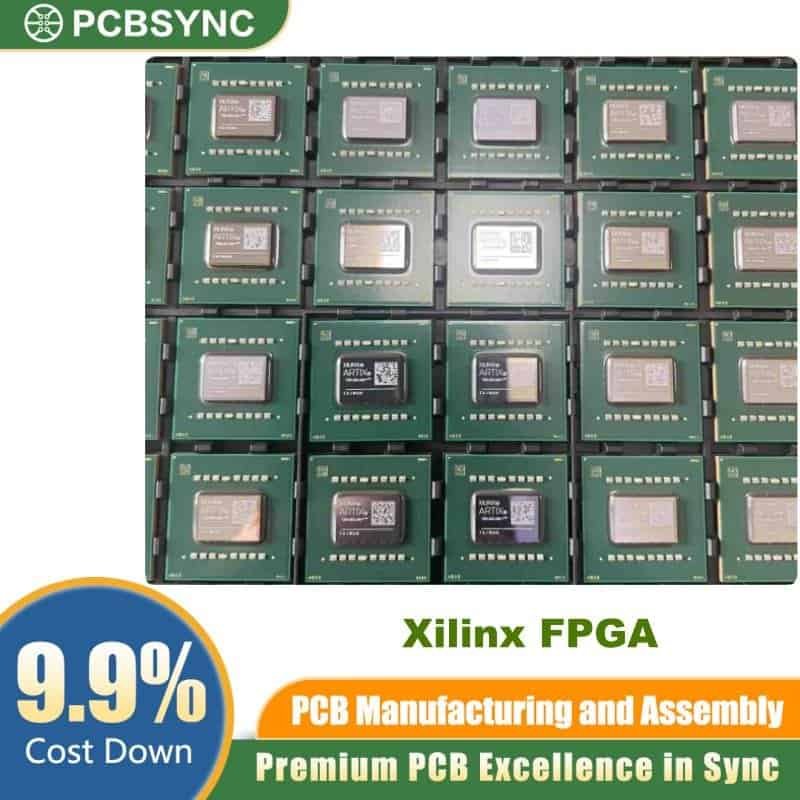
The XCKU115-1FLVB2104I is a high-performance Xilinx FPGA from the Kintex® UltraScale™ family, manufactured by AMD (formerly Xilinx). Designed for demanding industrial and defense-grade applications, this device delivers an exceptional balance of signal processing bandwidth, logic density, and power efficiency on a 20nm process node. Whether you are developing 100G networking equipment, next-generation medical imaging systems, or advanced DSP-intensive platforms, the XCKU115-1FLVB2104I offers the raw capability needed for modern high-performance designs.
What Is the XCKU115-1FLVB2104I?
The XCKU115-1FLVB2104I belongs to AMD’s Kintex UltraScale FPGA series — the flagship mid-range FPGA family built on the UltraScale architecture. The part number breaks down as follows:
| Part Number Segment |
Meaning |
| XC |
Xilinx commercial/industrial device |
| KU115 |
Kintex UltraScale, density grade 115 (largest in family) |
| -1 |
Speed grade –1 (standard performance) |
| FLV |
Package type: Flip-chip LGA, Very-thin profile |
| B2104 |
2104-pin ball count, B-pitch variant |
| I |
Industrial temperature range (–40°C to +100°C) |
This device is the largest member of the Kintex UltraScale family, offering the highest logic capacity in the line, making it the go-to choice for designs that require maximum resources within the mid-range price tier.
XCKU115-1FLVB2104I Key Specifications
Core Device Specifications
| Parameter |
Value |
| Manufacturer |
AMD (Xilinx) |
| Part Number |
XCKU115-1FLVB2104I |
| FPGA Family |
Kintex UltraScale |
| Architecture |
UltraScale (20nm process) |
| System Logic Cells |
1,451,100 |
| CLB Flip-Flops |
1,326,720 |
| Logic Blocks (CLBs) |
663,360 |
| Speed Grade |
–1 (Industrial) |
| Core Voltage (VCCINT) |
0.95V |
| Package |
FCBGA-2104 (Flip-Chip BGA) |
| Package Pin Count |
2104 |
| User I/O Count |
702 |
| Operating Temperature |
–40°C to +100°C (Industrial) |
| Technology Node |
20nm |
| RoHS Compliance |
Yes |
Memory and DSP Resources
| Resource |
Quantity |
| Block RAM (36Kb tiles) |
3,456 |
| Block RAM Total Capacity |
~162 Mb |
| DSP48E2 Slices |
5,520 |
| Ultra RAMs (288Kb) |
0 (UltraScale, not UltraScale+) |
| CMTs (Clock Management Tiles) |
20 |
| MMCMs |
20 |
| PLLs |
20 |
High-Speed Serial Transceivers
| Transceiver Type |
Count |
Max Line Rate |
| GTH Transceivers |
64 |
16.3 Gb/s |
| Supported Protocols |
PCIe Gen3, SATA, SFP+, CPRI, JESD204B, and more |
— |
I/O and Connectivity
| Parameter |
Value |
| Total User I/O |
702 |
| HP (High-Performance) I/O Banks |
Supported |
| HR (High-Range) I/O Banks |
Supported |
| Max I/O Voltage (HP Banks) |
1.8V |
| Max I/O Voltage (HR Banks) |
3.3V |
| SelectIO Standards Supported |
LVDS, SSTL, HSTL, LVCMOS, and more |
| On-Die Termination (DCI) |
Yes (HP I/O banks) |
XCKU115-1FLVB2104I Part Number Variants — Speed Grade & Package Comparison
The XCKU115 die is available in multiple speed grades and package configurations. Understanding these variants helps engineers select the right device for their application.
| Part Number |
Speed Grade |
Package |
Pins |
I/O Count |
Temperature |
| XCKU115-1FLVB2104I |
–1 |
FCBGA-2104 |
2104 |
702 |
Industrial |
| XCKU115-2FLVB2104I |
–2 |
FCBGA-2104 |
2104 |
702 |
Industrial |
| XCKU115-3FLVB2104E |
–3 |
FCBGA-2104 |
2104 |
702 |
Extended |
| XCKU115-2FLVA2104I |
–2 |
FCBGA-2104 |
2104 |
832 |
Industrial |
| XCKU115-2FLVF1924I |
–2 |
FCBGA-1924 |
1924 |
728 |
Industrial |
| XCKU115-2FLVA1517I |
–2 |
FCBGA-1517 |
1517 |
624 |
Industrial |
The XCKU115-1FLVB2104I uses the –1 speed grade (mid-tier performance) and is specified for the industrial temperature range, making it a strong choice for systems exposed to harsh or thermally demanding environments.
UltraScale Architecture Highlights
The UltraScale architecture from AMD/Xilinx is designed to eliminate the traditional FPGA performance bottlenecks found in previous generations. Key innovations in the architecture that benefit XCKU115-1FLVB2104I users include:
ASIC-Like Clocking Structure
The UltraScale architecture introduces a routing-based clocking methodology that mirrors ASIC design practices. This eliminates dedicated global buffers as bottlenecks and allows for fine-grained clock gating across the entire fabric — delivering up to 40% lower power consumption compared to previous-generation Kintex 7 FPGAs.
Stacked Silicon Interconnect (SSI) Technology
The XCKU115 die uses SSI technology to achieve its high logic density within cost-effective packaging. This allows AMD to deliver a device with over 1.45 million logic cells — a density level previously reserved for flagship devices — within the mid-range Kintex price tier.
Enhanced DSP48E2 Slices
The XCKU115-1FLVB2104I contains 5,520 DSP48E2 slices, each capable of 27×18-bit multiplications with cascaded pre-adder stages. This makes the device exceptionally suited for applications requiring massive parallel arithmetic, including FFT engines, FIR filters, radar processing, and machine learning inference workloads.
High-Speed GTH Transceivers
With 64 GTH transceivers operating at up to 16.3 Gb/s per lane, the XCKU115-1FLVB2104I provides an aggregate serial bandwidth that supports multiple simultaneous 100G Ethernet or high-speed backplane interfaces without the need for an external PHY in many applications.
Vivado Design Suite Compatibility
The XCKU115-1FLVB2104I is fully supported by the AMD Vivado Design Suite, which includes synthesis, place-and-route, simulation, and IP integration tools co-optimized for the UltraScale architecture. Design engineers benefit from:
- Integrated IP for PCIe Gen3, DDR4, and 100G Ethernet
- Xilinx Power Estimator (XPE) for accurate power budgeting
- Partial reconfiguration support for dynamic logic updates
- Hardware-in-the-loop (HIL) simulation via ChipScope Pro / ILA cores
Target Applications for the XCKU115-1FLVB2104I
The combination of high logic density, abundant DSP resources, 64 high-speed transceivers, and industrial-grade temperature specification makes the XCKU115-1FLVB2104I well-suited for:
| Application Domain |
Specific Use Cases |
| 100G Networking & Data Centers |
Packet processing, switching, OTN framing, Interlaken |
| Wireless Infrastructure |
TD-LTE/5G baseband, Remote Radio Head (RRH) DFE |
| Medical Imaging |
CT reconstruction, ultrasound beamforming, MRI processing |
| Defense & Aerospace |
Radar signal processing, SIGINT, EW systems |
| Video Broadcast |
8K4K video processing, H.265/HEVC encoding |
| Industrial Automation |
Motor control, vision processing, real-time control |
| High-Performance Computing |
FPGA-accelerated offload engines, PCIe co-processors |
Power Supply Requirements
Proper power delivery is critical for reliable XCKU115-1FLVB2104I operation. The device requires multiple supply rails with a specific power-on sequence.
| Power Rail |
Typical Voltage |
Description |
| VCCINT |
0.95V |
Core logic supply |
| VCCAUX |
1.8V |
Auxiliary logic and I/O support |
| VCCO |
1.0V – 3.3V |
I/O bank supply (per bank) |
| VMGTAVCC |
1.0V |
GTH transceiver analog supply |
| VMGTAVTT |
1.2V |
GTH transceiver termination supply |
| VMGTVCCAUX |
1.8V |
GTH auxiliary supply |
Important: The recommended power-on sequence is VCCINT → VMGTAVCC → VMGTAVTT (or VMGTAVCC and VCCINT simultaneously, followed by VMGTAVTT). Deviating from this sequence may result in higher-than-specified current draw on the GTH transceiver rails.
Thermal and Packaging Information
The XCKU115-1FLVB2104I is housed in a 2104-pin FCBGA (Flip-Chip Ball Grid Array) package. Key packaging and thermal data:
| Parameter |
Value |
| Package Type |
FCBGA (Flip-Chip BGA) |
| Pin Count |
2104 |
| Package Designation |
FLVB2104 |
| Operating Temperature (Tj) |
–40°C to +100°C |
| Thermal Management |
External heatsink or active cooling recommended for full-power operation |
| Moisture Sensitivity Level (MSL) |
Per JEDEC J-STD-020 |
For soldering guidelines and detailed thermal modeling, refer to AMD UltraScale and UltraScale+ FPGAs Packaging and Pinout Specifications (UG575).
Frequently Asked Questions
What is the difference between XCKU115-1FLVB2104I and XCKU115-2FLVB2104I?
The key difference is speed grade. The –1 variant (XCKU115-1FLVB2104I) operates at standard –1 timing specifications, while the –2 variant offers higher internal clock performance. Both share the same logic resources, package, and industrial temperature range. The –1 speed grade is often preferred for cost-sensitive industrial designs where maximum clock frequency is not required.
Is the XCKU115-1FLVB2104I footprint-compatible with Virtex UltraScale devices?
Yes. AMD designed the Kintex UltraScale family with footprint compatibility with Virtex UltraScale devices in the same package. This allows design teams to develop with the XCKU115 and migrate to a higher-capacity Virtex UltraScale device later in the product lifecycle without a PCB redesign.
What programming tools support the XCKU115-1FLVB2104I?
The device is supported by AMD Vivado Design Suite 2015.1 and later. It is also compatible with the Xilinx Platform Cable USB II and JTAG-HS3 programming cables.
Does the XCKU115-1FLVB2104I support partial reconfiguration?
Yes. The UltraScale architecture supports dynamic partial reconfiguration (DPR), allowing specific regions of the FPGA to be reprogrammed while the rest of the device continues to operate. This is particularly valuable in telecommunications and defense applications.
Summary
The XCKU115-1FLVB2104I is one of the most capable mid-range FPGAs available today. With over 1.45 million logic cells, 5,520 DSP48E2 slices, 3,456 block RAM tiles, and 64 GTH transceivers running at up to 16.3 Gb/s, it delivers flagship-class performance at a mid-range price point. The industrial-grade temperature specification (–40°C to +100°C) and AMD’s co-optimized Vivado toolchain make it the preferred choice for engineers developing next-generation networking, wireless infrastructure, medical imaging, and defense systems.
For engineers evaluating this part, the XCKU115-1FLVB2104I represents a compelling combination of logic density, DSP throughput, serial bandwidth, and industrial reliability — all within a single, well-supported device from AMD’s mature UltraScale ecosystem.