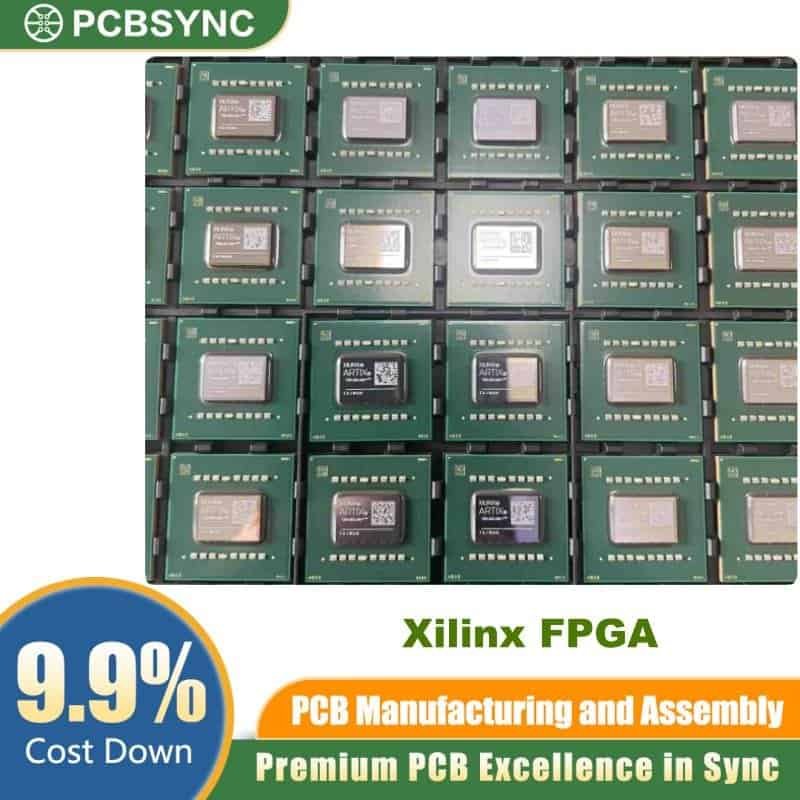
The XCKU115-2FLVB2104E is a high-performance Field Programmable Gate Array (FPGA) from AMD Xilinx, belonging to the flagship Kintex® UltraScale™ family. Built on an advanced 20nm process node, this device delivers an exceptional balance of processing power, logic density, and cost efficiency — making it one of the most capable mid-range FPGAs available for demanding applications in data centers, wireless communications, and high-performance computing.
Whether you are designing signal processing pipelines, accelerating machine learning workloads, or building next-generation network infrastructure, the XCKU115-2FLVB2104E offers the raw resources and architectural sophistication to meet the challenge.
What Is the XCKU115-2FLVB2104E?
The XCKU115-2FLVB2104E is part of Xilinx’s Xilinx FPGA UltraScale architecture generation, designed to address the performance gap between mid-range and high-end programmable logic devices. The part number breaks down as follows:
- XC – Xilinx Commercial device
- KU115 – Kintex UltraScale, 115 size (largest in the Kintex UltraScale family)
- -2 – Speed grade 2 (standard commercial speed)
- FLVB – Flip-chip Low Voltage Ball Grid Array package variant
- 2104 – 2104 pin count
- E – Extended temperature or packaging suffix
This FPGA is housed in a 2104-pin FCBGA (Flip Chip Ball Grid Array) package measuring 47.5 mm × 47.5 mm, making it suitable for high-density PCB designs requiring maximum I/O bandwidth.
XCKU115-2FLVB2104E Key Specifications at a Glance
| Parameter |
Value |
| Manufacturer |
AMD Xilinx |
| Part Number |
XCKU115-2FLVB2104E |
| FPGA Family |
Kintex® UltraScale™ |
| Process Node |
20nm |
| Logic Cells |
1,160,880 |
| CLB Logic Blocks |
663,360 |
| Macrocells |
1,451,100 |
| User I/O Pins |
702 |
| Total RAM Bits |
77,721,600 (77,722 Kbit) |
| Package Type |
FCBGA (Flip Chip Ball Grid Array) |
| Pin Count |
2104 |
| Package Dimensions |
47.5 mm × 47.5 mm × 3.41 mm |
| Pin Pitch |
1.0 mm |
| Core Supply Voltage |
0.922V – 0.979V (nominal 0.95V) |
| I/O Supply Voltage |
3.3V |
| Maximum Operating Frequency |
725 MHz |
| Speed Grade |
-2 |
| Clock Management |
MMCM, PLL |
| Operating Temperature |
0°C to 100°C (TJ) |
| Mounting Type |
Surface Mount (SMD) |
| RoHS Compliant |
Yes |
| MSL Rating |
4 |
| Maximum Reflow Temperature |
245°C |
XCKU115-2FLVB2104E Detailed Architecture Overview
UltraScale Architecture: The Foundation of Performance
The XCKU115-2FLVB2104E is built on Xilinx’s UltraScale™ architecture, which introduced a series of improvements over the previous 7-Series generation. This architecture incorporates ASIC-like routing to eliminate inter-die speed penalties while improving timing closure across large designs. The result is a device that achieves near-ASIC performance while retaining the flexibility and reprogrammability that defines FPGAs.
Key architectural benefits include:
- Massively parallel data processing capability across 663,360 configurable logic blocks
- Advanced memory hierarchy with Block RAM and UltraRAM options for minimizing BOM cost
- Next-generation high-speed transceivers for multi-protocol serial connectivity
- Hardened PCIe blocks for reduced latency and resource usage in PCIe-based designs
Logic Resources and CLB Structure
With 1,451,100 macrocells and 663,360 logic blocks, the XCKU115-2FLVB2104E sits at the top of the Kintex UltraScale family. Each Configurable Logic Block (CLB) in the UltraScale architecture contains two slices with look-up tables (LUTs), flip-flops, and carry chains, enabling dense packing of both combinatorial and sequential logic.
Memory Architecture
| Memory Type |
Details |
| Total RAM Bits |
77,721,600 bits (approx. 9.72 MB) |
| Block RAM (BRAM) |
Distributed across the die in 36Kb tiles |
| FIFO Support |
Built-in FIFO logic within BRAM primitives |
| Shift Register Support |
Distributed RAM usable as SRL shift registers |
The large on-chip memory capacity reduces the need for external memory interfaces in many applications, cutting system BOM cost and PCB complexity.
I/O and Connectivity
| I/O Feature |
Specification |
| Total User I/O |
702 |
| I/O Banks |
15 I/O banks |
| I/O Supply Voltage |
Up to 3.3V |
| I/O Standards Supported |
LVCMOS, LVDS, HSTL, SSTL, HSUL, and more |
| Differential Pairs |
Supported for high-speed I/O interfaces |
| High-Speed Transceivers (GTH) |
Up to 66 GTH transceivers at up to 16.3 Gb/s |
Clock Management
The XCKU115-2FLVB2104E integrates both MMCMs (Mixed-Mode Clock Managers) and PLLs (Phase-Locked Loops) to provide flexible, low-jitter clocking throughout the design. These resources support frequency synthesis, phase adjustment, and dynamic reconfiguration — critical for designs that need to adapt clock domains on the fly.
XCKU115-2FLVB2104E Package and Physical Specifications
| Physical Parameter |
Value |
| Package Type |
FCBGA (Flip Chip Ball Grid Array) |
| Total Ball Count |
2104 |
| Package Length |
47.5 mm |
| Package Width |
47.5 mm |
| Package Height |
3.41 mm |
| Ball Pitch |
1.0 mm |
| Package Material |
Plastic |
| Lead Shape |
Ball (solder ball) |
| JEDEC Outline |
MS-034AAY-2 |
| MSL (Moisture Sensitivity Level) |
4 |
| Maximum Reflow Temperature |
245°C |
| Maximum Reflow Time |
30 seconds |
| Number of Reflow Cycles |
Up to 3 |
The FCBGA package provides excellent electrical performance due to shorter interconnect paths between the die and the PCB, which is especially important at high operating frequencies and for high-speed serial links.
Power Specifications and Thermal Management
The XCKU115-2FLVB2104E operates at a nominal core voltage of 0.95V, with the valid range spanning from 0.922V to 0.979V. This low core voltage is a direct result of the 20nm process geometry and helps reduce dynamic power consumption even at high utilization levels.
| Power Parameter |
Value |
| Core Supply Voltage (VCC) |
0.95V (nominal) |
| Core Voltage Min |
0.922V |
| Core Voltage Max |
0.979V |
| I/O Supply Voltage (VCCO) |
Up to 3.3V (bank-configurable) |
| Junction Temperature Range |
0°C to 100°C |
For thermal management in demanding designs, Xilinx provides power estimation tools (XPE – Xilinx Power Estimator) and recommends the use of heat spreaders or custom heat sinks for designs that approach maximum power dissipation limits. The Kintex UltraScale family achieves up to 40% lower power compared to previous-generation equivalent devices.
Supported I/O Standards
The XCKU115-2FLVB2104E supports a comprehensive range of I/O standards to interface with a wide variety of external devices and buses:
| I/O Standard Category |
Examples |
| Single-Ended |
LVCMOS 1.2V / 1.5V / 1.8V / 2.5V / 3.3V |
| Differential |
LVDS, LVDS_25, BLVDS, LVPECL |
| Memory Interface |
HSTL, SSTL, POD |
| High-Speed Serial |
GTH Transceivers (up to 16.3 Gb/s) |
| Advanced |
HSUL_12, HSTL_12 |
DSP and High-Performance Processing Capabilities
The Kintex UltraScale family features a high ratio of DSP48E2 slices to logic resources, making the XCKU115-2FLVB2104E an excellent choice for DSP-heavy applications. The DSP48E2 slices support:
- 27×18 signed multipliers with pre-adder
- Cascadable DSP chains for FIR filters and FFTs
- Wide-bus arithmetic for floating-point operations
- Pattern detection for state machine optimization
This makes the device ideally suited for radar signal processing, software-defined radio (SDR), image processing pipelines, and financial modeling workloads that require sustained arithmetic throughput.
High-Speed Serial Transceivers (GTH)
The XCKU115 integrates GTH (Gigabit Transceiver H-type) transceivers that support a wide range of serial protocols:
| GTH Feature |
Specification |
| Transceiver Type |
GTH |
| Maximum Line Rate |
16.3 Gb/s |
| Supported Protocols |
PCIe Gen3, 100GbE, Interlaken, CPRI, JESD204B, Aurora |
| Reference Clock Sources |
Dedicated REFCLK pins per quad |
| PCIe Hard Block |
Yes – PCIe Gen3 x8/x16 hardened IP |
The availability of hardened PCIe Gen3 blocks significantly reduces FPGA fabric resource usage for PCIe implementations compared to soft-IP solutions.
XCKU115-2FLVB2104E vs. Other Kintex UltraScale Devices
| Feature |
XCKU040 |
XCKU060 |
XCKU115-2FLVB2104E |
| Logic Cells |
~530,000 |
~726,000 |
1,160,880 |
| CLB Logic Blocks |
~242,400 |
~331,200 |
663,360 |
| Total RAM Bits |
~21,000 Kbit |
~38,000 Kbit |
77,722 Kbit |
| User I/O |
Up to 520 |
Up to 520 |
702 |
| Pin Count |
1156 |
1517 |
2104 |
| Speed Grade |
-2 |
-2 |
-2 |
| Process Node |
20nm |
20nm |
20nm |
The XCKU115-2FLVB2104E is the largest and most resource-rich device in the Kintex UltraScale family, making it the natural choice for designs that have outgrown smaller Kintex parts but do not require the full complexity or cost of the Virtex UltraScale family.
Typical Applications for XCKU115-2FLVB2104E
The combination of high logic density, large on-chip memory, fast transceivers, and DSP resources makes this FPGA suitable for a broad range of demanding applications:
| Application Area |
Use Case |
| Data Center Acceleration |
Machine learning inference, network packet processing, storage acceleration |
| Wireless Communications |
5G baseband processing, massive MIMO, CPRI fronthaul |
| Wired Networking |
100GbE line cards, Interlaken switching, OTN transport |
| Radar & Defense |
Synthetic aperture radar (SAR), electronic warfare, signal intelligence |
| Medical Imaging |
Ultrasound beamforming, CT/MRI data reconstruction |
| Test & Measurement |
High-speed data acquisition, protocol analysis, signal generation |
| High-Performance Computing |
FPGA-accelerated HPC offload, co-processors |
Development Tools and Design Flow
Vivado Design Suite
The XCKU115-2FLVB2104E is fully supported by Xilinx Vivado Design Suite, the industry-leading FPGA design environment. Vivado provides:
- Integrated synthesis and implementation with timing-driven optimization
- IP Integrator for block diagram-based system design
- Partial reconfiguration support for dynamic design updates
- High-Level Synthesis (HLS) for C/C++ to FPGA design flows
- Power analysis and thermal estimation tools
Supported IP Cores and Reference Designs
AMD Xilinx provides a rich library of verified IP cores targeting the UltraScale architecture, including:
- PCIe Gen3 DMA subsystem
- DDR4 Memory Controller
- 100G Ethernet MAC
- JESD204B/C interface IP
- Floating-Point IP
- Video processing IP (HDMI, DisplayPort)
Configuration Methods
| Method |
Description |
| JTAG |
Primary debug and programming via Platform Cable USB II |
| Quad SPI Flash |
Boot from external QSPI NOR flash |
| BPI Flash |
Parallel flash boot option |
| SelectMAP |
Processor-controlled configuration |
Ordering Information
| Parameter |
Detail |
| Manufacturer Part Number |
XCKU115-2FLVB2104E |
| Manufacturer |
AMD Xilinx |
| DigiKey Part Number |
XCKU115-2FLVB2104E-ND |
| Package |
2104-BBGA, FCBGA |
| Temperature Grade |
Commercial (0°C to 100°C TJ) |
| Speed Grade |
-2 |
| Packaging |
Tray |
| RoHS Status |
RoHS Compliant |
| SVHC Status |
No SVHC (per 15-Jan-2018 ECHA list) |
Note: The XCKU115-2FLVB2104E is a high-demand component. Lead times may be extended due to market conditions. It is strongly recommended to confirm availability and pricing with authorized distributors before committing to design schedules.
Why Choose the XCKU115-2FLVB2104E?
The XCKU115-2FLVB2104E stands out in the FPGA market for several compelling reasons:
1. Maximum Kintex Density – As the largest member of the Kintex UltraScale family, this device offers the highest available logic and memory resources within the Kintex product tier, eliminating the need to step up to more expensive Virtex-class devices for many high-end designs.
2. Cost-Optimized Performance – The Kintex architecture is specifically engineered to deliver high performance at a lower cost than Virtex-class FPGAs, with up to 60% BOM cost reduction and 40% power reduction versus previous-generation high-performance devices.
3. Future-Proof Connectivity – Support for PCIe Gen3, 100GbE, and Interlaken via hardened IP and GTH transceivers ensures this device remains compatible with current and evolving high-speed interconnect standards.
4. Extensive Ecosystem – Full support from the Vivado Design Suite, Xilinx IP catalog, and a broad range of third-party development tools and evaluation boards (such as the KCU1500 Data Center Acceleration Development Kit) accelerates time-to-market.
5. Proven Reliability – Built on a mature 20nm process with a 12-month manufacturer warranty and a well-established supply chain through authorized global distributors.
Frequently Asked Questions (FAQ)
Q: What is the difference between XCKU115-2FLVB2104E and XCKU115-1FLVB2104E? The primary difference is the speed grade. The -2 speed grade offers better timing performance and higher maximum operating frequency than the -1 grade. Both devices share identical logic resources and package.
Q: Is the XCKU115-2FLVB2104E supported in Vivado? Yes. The XCKU115-2FLVB2104E is fully supported in Xilinx Vivado Design Suite version 2014.2 and all subsequent releases, including the latest versions available through AMD’s website.
Q: What evaluation board is recommended for the XCKU115-2FLVB2104E? Xilinx’s KCU1500 Data Center Acceleration Development Kit features the XCKU115-2FLVB2104E as its primary FPGA, providing DDR4 memory, PCIe Gen3, QSFP+ ports, and USB-JTAG for comprehensive development and testing.
Q: Does this FPGA support partial reconfiguration? Yes. The Kintex UltraScale architecture supports partial reconfiguration (PR), enabling sections of the FPGA to be reprogrammed while the rest of the design continues to operate — a critical feature for adaptive computing and multi-mode radio applications.
Q: What are the storage and handling requirements? As an MSL-4 device, the XCKU115-2FLVB2104E requires careful moisture control. Devices should be stored in sealed dry bags with desiccant and used within the floor life specified for MSL-4 (72 hours at ≤30°C/60% RH) once the bag is opened. Baking may be required if floor life is exceeded.