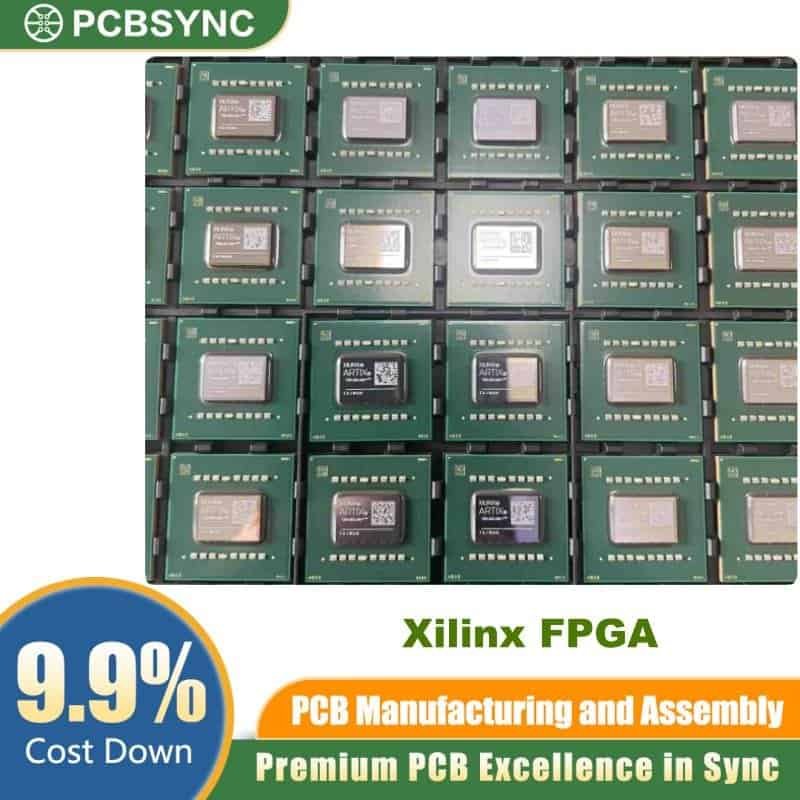
The XCKU115-3FLVB2104E is a high-performance Xilinx FPGA from AMD’s Kintex UltraScale family, engineered for demanding signal processing, networking, and compute-intensive applications. Built on 20nm process technology with a 2104-pin FCBGA package, this device delivers an exceptional balance of logic density, DSP throughput, high-speed transceiver bandwidth, and cost-efficiency — making it one of the most capable mid-range FPGAs available today.
What Is the XCKU115-3FLVB2104E?
The XCKU115-3FLVB2104E is a member of AMD Xilinx’s Kintex UltraScale FPGA product line. It belongs to the XCKU115 device grade — the largest and most resource-rich device in the Kintex UltraScale family. The part number decodes as follows:
| Part Number Segment |
Meaning |
| XCKU115 |
Kintex UltraScale, 115 device (largest in family) |
| -3 |
Speed grade 3 (fastest commercial speed grade) |
| FLVB |
Flip-chip low-voltage B package variant |
| 2104 |
2104-pin count |
| E |
Extended commercial temperature range (0°C to 100°C) |
This makes the XCKU115-3FLVB2104E the highest speed grade (-3) variant in its package class, ideal for designs that require maximum clock frequencies and performance margins.
XCKU115-3FLVB2104E Key Specifications
Core Device Specifications
| Parameter |
Value |
| Manufacturer / Brand |
AMD (formerly Xilinx) |
| Part Number |
XCKU115-3FLVB2104E |
| FPGA Family |
Kintex UltraScale |
| Process Node |
20nm |
| Core Supply Voltage |
0.95V |
| Package Type |
FCBGA (Flip-Chip Ball Grid Array) |
| Pin Count |
2104 pins |
| Package Designation |
FLVB2104 |
| Speed Grade |
-3 (fastest commercial) |
| Temperature Range |
0°C to 100°C (Commercial/Extended) |
| RoHS Compliance |
Yes |
Logic and Memory Resources
| Resource |
Quantity |
| System Logic Cells |
1,451,100 |
| CLB Flip-Flops |
1,326,720 |
| Logic Blocks (LUT equivalents) |
663,360 |
| Block RAM (Total Bits) |
77,722 Kbits (~9.7 MB) |
| DSP Slices |
5,520 |
| UltraRAM (URAM) |
Available |
| MMCMs / PLLs |
Multiple (for clocking) |
I/O and Transceiver Resources
| Parameter |
Value |
| User I/O (General Purpose) |
702 |
| GTH Transceivers (16.3 Gbps) |
64 |
| I/O Standards Supported |
LVCMOS, LVDS, SSTL, HSTL, and more |
| Maximum Single-Ended I/O |
Up to 702 per package |
Package Physical Specifications
| Parameter |
Value |
| Package Body Size |
45mm × 45mm |
| Mounting Type |
Surface Mount |
| Ball Pitch |
1.0mm |
| Package Type |
FCBGA |
XCKU115-3FLVB2104E Detailed Features
#### Advanced UltraScale Architecture
The XCKU115-3FLVB2104E is built on AMD Xilinx’s UltraScale architecture, which delivers ASIC-like clocking, routing, and logic efficiency. Unlike previous-generation 7 Series devices, the UltraScale platform eliminates routing congestion bottlenecks through a next-generation interconnect fabric that scales efficiently from small to very large designs.
Key architectural advantages include fine-grained clock gating, hierarchical clocking, and a deeply pipelined DSP48E2 slice structure — enabling sustained high-throughput arithmetic operations critical in signal processing workloads.
#### 5,520 DSP Slices for Signal Processing Dominance
With 5,520 DSP slices, the XCKU115-3FLVB2104E carries more DSP resources than virtually any other mid-range FPGA solution on the market. Each DSP48E2 slice supports operations including multiply-accumulate (MAC), addition, subtraction, and pattern detection — making this device ideal for applications demanding massive parallel arithmetic throughput such as radar processing, software-defined radio, and machine learning inference.
#### 64x GTH High-Speed Transceivers
The device integrates 64 GTH transceivers, each capable of operating at up to 16.3 Gbps. These next-generation transceivers support a wide range of industry-standard protocols including:
- PCIe Gen3 (up to x16)
- 100G Ethernet (via multiple 10G lanes)
- Interlaken for high-bandwidth chip-to-chip links
- CPRI / OBSAI for wireless fronthaul
- Aurora for serial interconnects
- Serial RapidIO (SRIO)
This transceiver density makes the XCKU115-3FLVB2104E exceptionally well-suited for 100G networking line cards, multi-channel wireless infrastructure equipment, and high-speed data acquisition systems.
#### High-Density Block RAM
The device provides approximately 77,722 Kbits (≈9.7 MB) of on-chip block RAM, organized as cascadable 36Kb RAMB36 and 18Kb RAMB18 primitives. This on-chip memory enables large look-up tables, FIFO buffers, and packet buffers to be implemented entirely within the FPGA fabric — reducing the need for external memory in many designs and substantially cutting system BOM cost.
#### Speed Grade -3: Maximum Performance Headroom
The -3 speed grade is the fastest commercial-grade variant of the XCKU115. Designs that operate near the performance limits of -2 speed grade parts can be reliably implemented with margin using the -3 grade, enabling higher clock frequencies, tighter timing constraints, and improved throughput in critical paths.
XCKU115-3FLVB2104E: Part Number Comparison Table
The XCKU115 is available in multiple speed grades and packages. The table below shows where the XCKU115-3FLVB2104E fits within the family:
| Part Number |
Speed Grade |
Package |
Pins |
Temp Range |
I/O Count |
| XCKU115-3FLVB2104E |
-3 (Fastest) |
FLVB |
2104 |
0–100°C |
702 |
| XCKU115-2FLVB2104E |
-2 (Mid) |
FLVB |
2104 |
0–100°C |
702 |
| XCKU115-2FLVB2104I |
-2 (Mid) |
FLVB |
2104 |
-40–100°C |
702 |
| XCKU115-2FLVD1924E |
-2 (Mid) |
FLVD |
1924 |
0–100°C |
832 |
| XCKU115-L1FLVB2104I |
-L1 (Low power) |
FLVB |
2104 |
-40–100°C |
702 |
Target Applications for the XCKU115-3FLVB2104E
The combination of extreme logic density, DSP horsepower, transceiver bandwidth, and the highest speed grade makes this device a strong fit for the following application domains:
#### 100G Networking and Data Center
The XCKU115-3FLVB2104E is purpose-built for 100G Ethernet packet processing, OTN switching, and network function virtualization (NFV). Its 64 GTH transceivers at 16.3 Gbps can support multiple 100GbE interfaces simultaneously, while the large block RAM enables deep packet buffers and flow tables.
#### Wireless Infrastructure (4G/5G)
Heterogeneous wireless infrastructure designs — including remote radio heads (RRH), digital front-end (DFE) units, and massive MIMO beamforming engines — leverage the device’s high DSP slice count for real-time signal processing. The CPRI/OBSAI-capable transceivers enable direct fronthaul interface implementation.
#### Medical Imaging
Demanding medical imaging applications such as MRI reconstruction, ultrasound beamforming, and CT image processing require both high-throughput arithmetic (met by 5,520 DSPs) and large on-chip memory for intermediate data. The 0–100°C commercial temperature range fits most clinical equipment environments.
#### High-Performance DSP and RADAR
Defense and scientific instrumentation applications — including synthetic aperture radar (SAR), electronic warfare (EW) signal analysis, and software-defined radio (SDR) — make heavy use of the XCKU115-3FLVB2104E’s DSP slice density and high-speed serial interfaces.
#### 8K/4K Video Processing
Real-time 8K and 4K video processing chains for broadcast, studio production, and professional AV equipment benefit from the device’s massive logic capacity and high-bandwidth transceiver interfaces supporting protocols like SDI and DisplayPort.
#### ASIC Prototyping
The XCKU115-3FLVB2104E’s 1.45 million logic cells make it a strong single-device prototyping platform for large ASIC designs, enabling full-chip functional emulation at near-hardware speeds before tape-out.
Development Tools and Ecosystem
#### Vivado Design Suite
AMD Xilinx’s Vivado Design Suite is the primary development environment for the XCKU115-3FLVB2104E. Vivado provides a complete RTL-to-bitstream flow including:
- Synthesis and implementation
- Timing analysis and constraint management
- IP Integrator for block design
- Simulation and functional verification
- In-system debug via ChipScope/ILA
#### High-Level Synthesis (HLS) with Vitis HLS
For algorithm-centric teams, Vitis HLS enables C/C++ and OpenCL-based algorithm description to be synthesized directly to RTL, accelerating the development of DSP, machine learning, and data processing pipelines on this device.
#### Supported IP Cores
The Kintex UltraScale platform is well-supported by Xilinx’s IP catalog, including:
| IP Category |
Examples |
| Networking |
100G Ethernet MAC, PCIe Gen3 |
| Memory Controllers |
DDR4, LPDDR4, QDR-II |
| Signal Processing |
FIR Compiler, FFT, DDS |
| Video |
HDMI, SDI, DisplayPort |
| Wireless |
JESD204B, CPRI |
| System |
DMA, AXI Interconnect |
Ordering and Compliance Information
| Parameter |
Detail |
| Manufacturer Part Number |
XCKU115-3FLVB2104E |
| Manufacturer |
AMD (Xilinx) |
| Product Category |
Embedded FPGAs (Field Programmable Gate Array) |
| RoHS Status |
RoHS Compliant |
| Warranty |
12 months from date of purchase (standard Xilinx terms) |
| Export Classification |
Subject to US EAR; verify ECCN before export |
| Moisture Sensitivity Level (MSL) |
Refer to manufacturer datasheet |
| Packaging |
Tray |
Note: The XCKU115-3FLVB2104E is a Non-Cancellable, Non-Returnable (NCNR) product at most authorized distributors due to the nature of programmable semiconductor devices. Confirm lead times with your distributor before placing production orders.
Frequently Asked Questions (FAQ)
What does the -3 speed grade mean on the XCKU115-3FLVB2104E?
The -3 speed grade designates the fastest commercially available timing variant of the XCKU115 device. A higher speed grade number means tighter (faster) internal timing arcs, allowing designs to run at higher clock frequencies and meet more aggressive setup and hold time requirements.
What is the difference between XCKU115-3FLVB2104E and XCKU115-2FLVB2104E?
Both parts are pin-compatible and share the same package, logic resources, and I/O count. The key difference is performance: the -3 variant supports higher maximum operating frequencies than the -2 variant. If your design does not require the extra speed headroom, the -2 grade may be more cost-effective.
Is the XCKU115-3FLVB2104E suitable for industrial temperature applications?
This specific variant (suffix E) is rated for the extended commercial range of 0°C to 100°C. For designs requiring operation below 0°C (e.g., -40°C), you should select the industrial-grade I suffix variant such as XCKU115-2FLVB2104I.
How many PCIe lanes does the XCKU115-3FLVB2104E support?
The device supports PCIe Gen3 x8 and x16 configurations using its GTH transceivers and integrated PCIe hard block, enabling high-bandwidth host interface connectivity in FPGA accelerator cards and I/O processing boards.
What programming tool is used for the XCKU115-3FLVB2104E?
AMD Xilinx’s Vivado Design Suite (including free Vivado ML Standard edition for supported device sizes) is the recommended tool. Configuration is delivered via JTAG for development or through an external flash memory (SPI/BPI) for production deployment.
Summary
The XCKU115-3FLVB2104E stands as one of the most resource-dense and highest-performing devices in the Kintex UltraScale lineup. With 1.45 million logic cells, 5,520 DSP slices, 64 GTH transceivers at 16.3 Gbps, approximately 9.7 MB of block RAM, 702 user I/Os, and the fastest commercial speed grade (-3) — all in a 2104-pin FCBGA package operating on a 20nm process — it delivers exceptional capability for 100G networking, 5G wireless, high-performance computing, medical imaging, and broadcast video applications. Paired with AMD Xilinx’s mature Vivado design ecosystem and a rich IP catalog, the XCKU115-3FLVB2104E offers a compelling combination of performance, flexibility, and time-to-market advantage for demanding FPGA-based system designs.