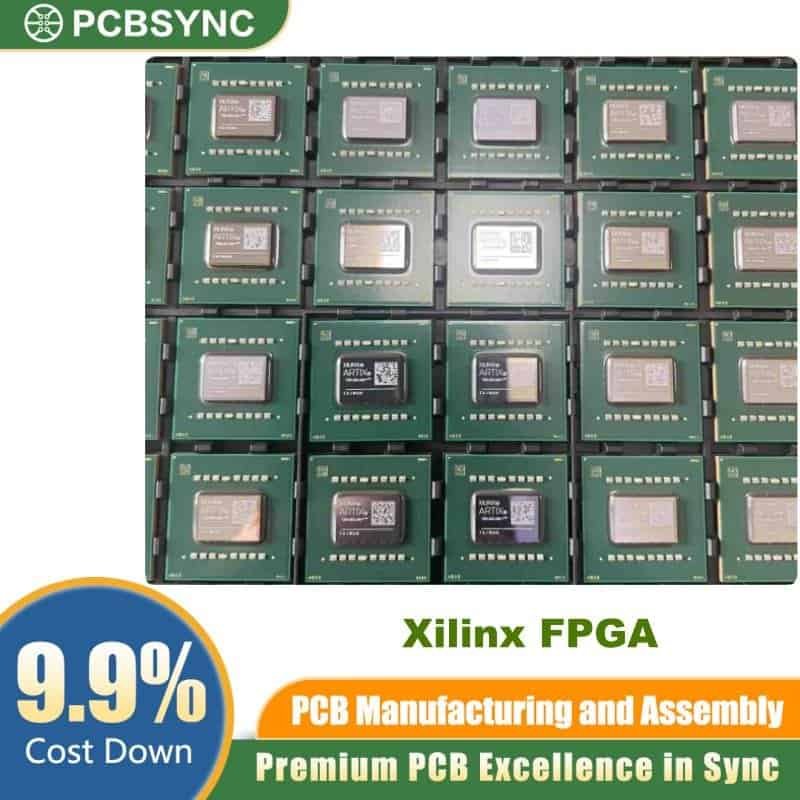
The XCKU115-3FLVD1517E is a high-performance Xilinx FPGA from the Kintex® UltraScale™ family, manufactured by AMD (formerly Xilinx). Engineered for demanding applications that require maximum logic density, high-speed DSP processing, and next-generation transceiver bandwidth, this device stands at the top of the Kintex UltraScale lineup. With the -3 speed grade — the highest performance tier in the family — the XCKU115-3FLVD1517E delivers best-in-class timing performance in a 1517-pin FCBGA package optimized for cost-sensitive, high-throughput designs.
Whether you are developing 100G networking infrastructure, data center acceleration, advanced medical imaging systems, or 8K video processing pipelines, the XCKU115-3FLVD1517E provides the programmable logic resources, memory bandwidth, and I/O flexibility to meet your design requirements.
What Is the XCKU115-3FLVD1517E?
The XCKU115-3FLVD1517E is a Field Programmable Gate Array (FPGA) belonging to AMD Xilinx’s Kintex UltraScale product family. Built on TSMC’s 20nm planar process node, it implements the UltraScale architecture — the industry’s first ASIC-class All-Programmable Architecture — enabling multi-hundred Gbps system throughput with intelligent, on-chip data routing and processing.
Key Highlights at a Glance
| Feature |
Value |
| Manufacturer |
AMD (Xilinx) |
| Part Number |
XCKU115-3FLVD1517E |
| FPGA Family |
Kintex UltraScale |
| Speed Grade |
-3 (Highest Performance) |
| Package |
1517-Pin FCBGA (FLVD) |
| Process Node |
20nm |
| System Logic Cells |
1,451,100 |
| CLB Flip-Flops |
1,326,720 |
| Logic Blocks (LUTs) |
663,360 |
| Operating Voltage (VCCINT) |
0.95V |
| Temperature Range |
Extended (0°C to 100°C) |
| Total I/O Pins |
338 (user I/O) |
| Total RAM Bits |
77,722 Kb |
| DSP Performance |
8.2 TeraMACs |
| RoHS Status |
Compliant |
XCKU115-3FLVD1517E Full Technical Specifications
Logic Resources
| Resource |
Quantity |
| System Logic Cells |
1,451,100 |
| CLB Look-Up Tables (LUTs) |
663,360 |
| CLB Flip-Flops |
1,326,720 |
| Distributed RAM (Kb) |
9,180 |
| Block RAM (36Kb blocks) |
2,160 |
| Total Block RAM (Mb) |
75.9 |
| UltraRAM (288Kb blocks) |
0 |
DSP and Arithmetic Performance
| Parameter |
Value |
| DSP48E2 Slices |
5,520 |
| Peak DSP Performance |
8.2 TeraMACs |
| Maximum Operating Frequency |
Up to 725 MHz (speed-grade dependent) |
I/O and Transceiver Resources
| Resource |
Quantity / Spec |
| Maximum User I/O |
338 |
| GTH Transceivers (16.3 Gb/s) |
64 |
| GTY Transceivers |
0 |
| PCIe Gen3 Integrated Blocks |
4 |
| 100G Ethernet (CAUI-4) |
2 |
| Interlaken |
2 |
| CMAC (100G MAC) |
2 |
| DDR4 Max Data Rate |
2,400 Mb/s |
| XADC (12-bit ADC) |
1 |
| Maximum I/O Banks |
20 |
Clock Management
| Resource |
Quantity |
| MMCM (Mixed-Mode Clock Manager) |
20 |
| PLL |
20 |
| Global Clock Buffers |
128 |
| Regional Clock Buffers |
480 |
Package and Physical Characteristics
| Parameter |
Value |
| Package Type |
FCBGA (Flip-Chip Ball Grid Array) |
| Package Code |
FLVD |
| Pin Count |
1517 |
| Package Dimensions |
45 mm × 45 mm |
| Ball Pitch |
1.0 mm |
| Number of SLRs (Super Logic Regions) |
3 |
Part Number Decoder: Understanding XCKU115-3FLVD1517E
The part number encodes critical ordering information. Here is how to read it:
| Segment |
Meaning |
| XC |
Xilinx Commercial |
| KU |
Kintex UltraScale |
| 115 |
Device density tier (largest in the Kintex UltraScale family) |
| -3 |
Speed grade (-3 = highest performance) |
| F |
Package series (FCBGA) |
| LV |
Low Voltage designation |
| D |
Extended temperature range (0°C to 100°C) |
| 1517 |
Pin count (1517-ball FCBGA) |
| E |
Commercial temperature suffix |
Understanding the part number allows engineers to quickly identify the correct variant for their thermal, performance, and footprint requirements.
Speed Grade Comparison: Why Choose the -3 Grade?
The Kintex UltraScale family is offered in -3, -2, -1, and -1L speed grades. The -3 grade represents the fastest timing characteristics in the family, making the XCKU115-3FLVD1517E the top-performance option when design closure at maximum frequency is required.
| Speed Grade |
Performance Level |
Typical Use Case |
| -3 |
Highest |
Maximum frequency designs, high-speed I/O, tight timing budgets |
| -2 |
Mid-High |
Balanced performance/power, general purpose |
| -1 |
Standard |
Cost-optimized, standard throughput |
| -1L |
Low Power |
Power-sensitive applications, same timing as -1 at 0.95V VCCINT |
For designs operating at multi-hundred MHz clock domains — such as 100G Ethernet MAC processing, high-speed DSP pipelines, or PCI Express Gen3 endpoints — the -3 speed grade provides the timing margin necessary to achieve design closure with confidence.
XCKU115-3FLVD1517E vs. Related Variants
Engineers often compare this part against similar XCKU115 variants differing in speed grade and package. The table below clarifies the primary differences:
| Part Number |
Speed Grade |
Package |
I/O Count |
Temp Range |
| XCKU115-3FLVD1517E |
-3 (Fastest) |
1517 FCBGA |
338 |
0°C – 100°C |
| XCKU115-2FLVA1517E |
-2 |
1517 FCBGA |
624 |
0°C – 100°C |
| XCKU115-2FLVA1517I |
-2 |
1517 FCBGA |
624 |
–40°C – 100°C (Industrial) |
| XCKU115-1FLVA1517E |
-1 |
1517 FCBGA |
624 |
0°C – 100°C |
Note: The FLVD package exposes a reduced I/O footprint compared to the FLVA variant — a key distinction for board designs with constrained routing. Always verify pinout compatibility against your PCB layout before substitution.
Core Architecture: UltraScale Technology Inside
ASIC-Class Routing Architecture
The UltraScale architecture introduces a fundamentally redesigned routing fabric compared to previous Xilinx 7-series devices. It employs ASIC-like clocking with fine-granular clock gating across the device, enabling dynamic power reduction without sacrificing performance. The routing architecture eliminates the performance degradation traditionally associated with high-utilization designs, delivering up to 2 speed-grade improvement at high utilization levels compared to the 7-series.
3D IC Stacked Silicon Interconnect (SSI) Technology
The XCKU115 leverages second-generation 3D IC SSI technology, integrating multiple silicon dies (Super Logic Regions, or SLRs) on a single silicon interposer. With three SLRs, the device achieves the logic density of a single monolithic die while maintaining yield and cost efficiency. Inter-SLR communication is handled through thousands of programmable Super Long Line (SLL) routing resources, keeping cross-SLR latency minimal.
Next-Generation GTH Transceivers
With 64 GTH transceivers capable of up to 16.3 Gb/s per lane, the XCKU115-3FLVD1517E delivers massive serial bandwidth for backplane, optical, and chip-to-chip interconnect applications. The transceivers support a wide range of protocols including PCIe Gen3, 10GbE, 40GbE, 100GbE (CAUI-4), JESD204B, and CPRI/OBSAI for wireless infrastructure.
Integrated Hard IP Blocks
Reducing fabric LUT consumption and improving timing predictability, the device includes multiple hard IP blocks:
- 4× PCIe Gen3 ×8/×16 integrated endpoints
- 2× 100G Ethernet CMAC cores
- 2× Interlaken cores (up to 150 Gb/s)
- 20× MMCM / 20× PLL for comprehensive clock synthesis
Target Applications for XCKU115-3FLVD1517E
100G Networking and Data Centers
The combination of 64 GTH transceivers, integrated 100G Ethernet MAC cores, and Interlaken IP makes this device ideal for line-card FPGA acceleration, OpenFlow-based packet processing, and switch fabric designs at 100 Gb/s and beyond.
High-Performance DSP and Signal Processing
With 5,520 DSP48E2 slices delivering 8.2 TeraMACs of compute performance, the XCKU115-3FLVD1517E is well-suited for:
- Software-Defined Radio (SDR) and massive MIMO beamforming
- JESD204B high-speed ADC/DAC interface and digital front-end processing
- LTE/5G base station digital pre-distortion (DPD)
- Radar signal processing and SAR imaging
Medical Imaging
Next-generation CT, MRI, and ultrasound systems increasingly demand real-time processing of massive data streams. The device’s large logic density, DDR4 memory bandwidth, and high transceiver count make it a proven choice for medical imaging reconstruction engines requiring deterministic, low-latency processing.
8K/4K Video Processing
Broadcast and professional AV systems processing 8K4K video streams at 60+ fps require enormous pixel-processing bandwidth. The XCKU115-3FLVD1517E provides the logic depth, DSP resources, and memory bandwidth to implement real-time video pipelines including multi-channel encode/decode, color space conversion, and video transport stream processing.
ASIC Prototyping
The density of the XCKU115 — with over 1.4 million system logic cells across three SLRs — enables direct ASIC prototyping at scale, reducing pre-silicon verification time for SoC designs.
Design and Development Toolchain
The XCKU115-3FLVD1517E is fully supported by the AMD Vivado™ Design Suite and Vitis™ development environment.
| Tool |
Purpose |
| Vivado Design Suite |
RTL synthesis, implementation, place-and-route, bitstream generation |
| Vitis HLS |
High-level synthesis from C/C++ to RTL |
| Vitis AI |
AI/ML inference acceleration on FPGA |
| Xilinx Power Estimator (XPE) |
Pre-implementation power analysis |
| ChipScope Pro / ILA |
In-system logic analysis and debug |
| Vivado IP Integrator |
Block design environment for IP integration |
Ordering and Compliance Information
| Attribute |
Detail |
| Full Part Number |
XCKU115-3FLVD1517E |
| Manufacturer |
AMD (Xilinx) |
| Product Category |
FPGA – Kintex UltraScale |
| Packaging |
Tray |
| RoHS Compliance |
Yes – RoHS Compliant |
| REACH Compliance |
Compliant |
| Export Control (ECCN) |
3A001.a.7 (verify with your compliance team) |
| Warranty |
12 months from date of purchase (standard Xilinx semiconductor warranty) |
| Lead-Free |
Yes |
Procurement Note: The XCKU115-3FLVD1517E is classified as Non-Cancellable / Non-Returnable (NCNR) by most authorized distributors. Verify stock availability and lead times with your distributor before committing to a design.
Frequently Asked Questions (FAQ)
What is the difference between XCKU115-3FLVD1517E and XCKU115-2FLVA1517E?
The primary differences are the speed grade (-3 vs. -2, where -3 is faster) and the package variant (FLVD vs. FLVA). The FLVD package supports 338 user I/Os, while the FLVA package supports 624 user I/Os. Both use the same 1517-ball FCBGA footprint, but the I/O bank configuration differs, meaning they are not pin-compatible for I/O signals despite sharing the same ball count.
What design tools support the XCKU115-3FLVD1517E?
AMD Vivado Design Suite (2014.1 and later) fully supports this device. It is recommended to use the latest Vivado release to benefit from updated timing models, IP libraries, and DRC rules for the Kintex UltraScale family.
What memory interfaces does the XCKU115-3FLVD1517E support?
The device supports DDR3 and DDR4 at up to 2,400 Mb/s data rate, LPDDR3, QDR-II+, and RLDRAM 3 through its HP (High-Performance) I/O banks. The MIG (Memory Interface Generator) IP in Vivado automates the design of compliant memory controllers.
Is the XCKU115-3FLVD1517E suitable for safety-critical applications?
This commercial-grade device is specified for 0°C to 100°C operation. For functional safety (IEC 61508, ISO 26262) or defense applications requiring extended temperature ranges (–40°C to 100°C industrial), consider industrial-grade variants such as XCKU115-2FLVA1517I or consult AMD’s defense-grade (XQKU115) offerings.
Where can I find the official datasheet?
The Kintex UltraScale DC and AC Characteristics datasheet (DS892) is available directly from AMD’s documentation portal at docs.amd.com. The UltraScale Architecture and Product Data Sheet Overview (DS890) provides a comprehensive family comparison.
Summary
The XCKU115-3FLVD1517E is AMD Xilinx’s flagship Kintex UltraScale FPGA in its highest-performance speed grade (-3), packaged in the 1517-ball FCBGA form factor. With 1.45 million system logic cells, 8.2 TeraMACs of DSP throughput, 64 GTH transceivers at 16.3 Gb/s, and four integrated PCIe Gen3 cores, it addresses the most demanding programmable logic workloads across networking, data center, medical, broadcast, and wireless infrastructure markets. Built on 20nm technology with ASIC-class UltraScale architecture and supported by the complete AMD Vivado and Vitis toolchain, this device enables engineers to achieve rapid design closure and maximum system performance.
For expert guidance on selecting the right Kintex UltraScale variant for your application, explore our full range of Xilinx FPGA solutions.