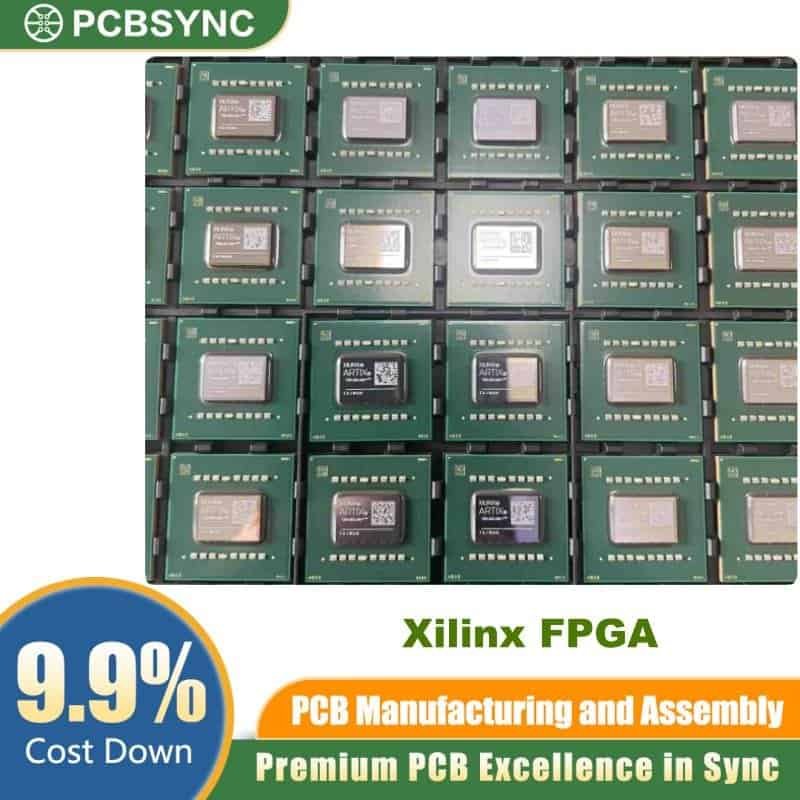
The XCKU115-3FLVD1924E is a high-performance Xilinx FPGA from AMD’s Kintex® UltraScale™ family, engineered for demanding applications that require maximum logic density, high-speed serial connectivity, and exceptional DSP throughput. Built on a 20nm process node with SSI (Stacked Silicon Interconnect) technology, this device delivers the highest speed grade (-3) available in the XCKU115 lineup — making it the ideal choice for applications where timing margin and raw compute performance are non-negotiable.
Whether your design targets 100G networking, next-generation medical imaging, 8K video processing, or heterogeneous wireless infrastructure, the XCKU115-3FLVD1924E provides the logic capacity, memory bandwidth, and transceiver performance to meet the challenge.
What Is the XCKU115-3FLVD1924E?
The XCKU115-3FLVD1924E is part of AMD Xilinx’s flagship mid-range FPGA family. The part number encodes critical device attributes:
| Part Number Segment |
Meaning |
| XC |
Xilinx Commercial Device |
| KU115 |
Kintex UltraScale, 115 device (largest in family) |
| -3 |
Speed Grade 3 — highest performance tier |
| FLVD |
Flip-chip Land Grid Array, Low-Voltage, D-package variant |
| 1924 |
1924-pin ball count |
| E |
Commercial temperature range (0°C to +100°C) |
This is the fastest, commercially-rated variant of the XCKU115 device in the FLVD1924 package, offering the lowest logic delays and tightest timing performance available in this footprint.
Key Technical Specifications
XCKU115-3FLVD1924E Core Specifications
| Parameter |
Value |
| FPGA Family |
Kintex® UltraScale™ |
| Part Number |
XCKU115-3FLVD1924E |
| Manufacturer |
AMD (Xilinx) |
| Process Node |
20nm |
| Speed Grade |
-3 (Highest Performance) |
| Logic Cells |
1,451,100 |
| CLB Logic Blocks |
663,360 |
| DSP Slices |
5,520 |
| Block RAM |
75.9 Mb total |
| Total RAM Bits |
~77,722 Kb |
| Max HP I/O |
832 |
| Package |
FCBGA-1924 (FLVD) |
| Pin Count |
1924 |
| Operating Temperature |
0°C to +100°C (Commercial) |
| VCCINT |
0.922V – 0.979V (nominal 0.95V) |
| Clock Management |
MMCM + PLL |
I/O and Transceiver Summary
| Resource |
Count / Specification |
| Max HP I/O Pins |
832 |
| GTH Transceivers |
64 |
| GTH Max Data Rate |
Up to 16.3 Gb/s |
| PCIe Support |
Gen3 x8 / x16 integrated block |
| 100G Ethernet |
Supported |
| CMAC (100G MAC) |
Integrated |
| MMCM |
Yes |
| PLL |
Yes |
Memory Resources
| Memory Type |
Quantity / Capacity |
| Block RAM (36Kb tiles) |
2,160 |
| Block RAM (18Kb tiles) |
4,320 |
| Total Block RAM |
75.9 Mb |
| Distributed RAM |
~9.8 Mb (from LUT fabric) |
| FIFO Support |
Yes (via RAMB primitives) |
XCKU115-3FLVD1924E vs. Other XCKU115 Speed Grades
Choosing the right speed grade matters for timing-critical designs. Here is how the -3 grade compares to lower-speed options in the same package:
| Variant |
Speed Grade |
Temp Range |
Use Case |
| XCKU115-3FLVD1924E |
-3 (Fastest) |
0°C to 100°C |
Max performance, commercial |
| XCKU115-2FLVD1924E |
-2 |
0°C to 100°C |
Balanced perf/cost, commercial |
| XCKU115-2FLVD1924I |
-2 |
–40°C to 100°C |
Industrial temperature |
| XCKU115-1FLVD1924C |
-1 |
0°C to 85°C |
Cost-optimized, commercial |
| XCKU115-L1FLVD1924I |
-1L |
–40°C to 100°C |
Low power, industrial |
Design tip: The -3 speed grade provides the lowest propagation delays and maximum achievable clock frequencies. It is the preferred choice when your design has the tightest setup/hold timing margins or when you need to push clock rates to their absolute limit.
XCKU115-3FLVD1924E vs. XCKU115-3FLVF1924E Package Comparison
The XCKU115 device is offered in multiple 1924-pin packages. The difference between FLVD and FLVF matters for PCB design:
| Feature |
FLVD1924 |
FLVF1924 |
| Package Type |
Flip-chip LGA |
Flip-chip LGA |
| Package Size |
47.5 × 47.5 mm |
52.5 × 52.5 mm (overhang) |
| Ball Footprint |
Standard |
Same PCB footprint as FLVD |
| Max I/O |
832 |
728 (HP I/O only) |
| GTY Transceiver Rate |
N/A |
Up to 16.3 Gb/s (package-limited) |
| PCB Migration |
Footprint compatible with other UltraScale FLVD packages |
Footprint compatible with other FLVF packages |
Performance Highlights: Why the -3 Speed Grade?
Highest DSP Throughput in the Mid-Range Segment
With 5,520 DSP48E2 slices, the XCKU115-3FLVD1924E delivers more DSP capacity than virtually any other mid-range FPGA on the market. The -3 speed grade unlocks the highest achievable multiply-accumulate (MAC) rates, making it the right choice for:
- Radar and Electronic Warfare signal processing
- Medical imaging reconstruction (CT, MRI, ultrasound)
- 5G baseband processing and DFE (Digital Front-End)
- High-frequency trading algorithms
- Computer vision and AI inferencing pipelines
Best-in-Class Serial Bandwidth
The device integrates 64 GTH transceivers capable of up to 16.3 Gb/s per lane, providing over 1 Tb/s of aggregate serial bandwidth. Combined with integrated PCIe Gen3 and 100G Ethernet IP cores, this makes the XCKU115-3FLVD1924E a powerful platform for:
- 100G/400G networking line cards
- Storage controllers (NVMe, SAS)
- High-speed data acquisition systems
- Backplane interconnects
Large Logic Fabric for Complex Designs
At 1,451,100 logic cells across 663,360 CLB slices, the XCKU115-3FLVD1924E can accommodate even the most logic-intensive designs. Multi-core processor implementations, large state machines, and complex bus fabric designs all benefit from this density.
Target Applications
The XCKU115-3FLVD1924E excels in a broad range of high-performance applications:
Networking and Data Centers
- 100G/400G line cards and switch fabrics
- Deep packet inspection (DPI)
- Network function virtualization (NFV) acceleration
- SmartNIC implementations
Wireless Infrastructure
- 5G Massive MIMO baseband processing
- Remote Radio Head (RRH) Digital Front-End
- TD-LTE and NR (New Radio) PHY processing
- Heterogeneous RAN architectures
Defense and Aerospace
- Radar signal processing
- Software-defined radio (SDR)
- Electronic warfare systems
- SIGINT processing
Medical and Scientific
- Next-generation CT and MRI image reconstruction
- High-speed data acquisition
- Real-time signal processing instruments
High-Performance Computing
- Reconfigurable computing acceleration
- Financial modeling and algorithmic trading
- Scientific simulation offload
Package and Physical Specifications
| Attribute |
Value |
| Package Style |
FCBGA (Flip-Chip Ball Grid Array) |
| Package Designator |
FLVD |
| Total Pins |
1924 |
| Package Size |
47.5 × 47.5 mm |
| Mounting Type |
Surface Mount |
| RoHS Compliant |
Yes |
| Lead-Free |
Yes |
Power Supply Requirements
The XCKU115-3FLVD1924E uses a multi-rail power architecture typical of advanced FPGA devices:
| Supply Rail |
Nominal Voltage |
Purpose |
| VCCINT |
0.95V |
Core logic and CLB fabric |
| VCCAUX |
1.8V |
Auxiliary circuits, XADC |
| VCCO |
1.0V – 3.3V |
I/O bank output drive |
| VMGTAVCC |
1.0V |
GTH/GTY transceiver analog supply |
| VMGTAVTT |
1.2V |
GTH/GTY transceiver termination |
| VMGTVCCAUX |
1.8V |
GTH/GTY auxiliary supply |
Power design note: AMD recommends powering VCCINT before or simultaneously with VMGTAVCC for correct transceiver power-on sequencing. Use the Xilinx Power Estimator (XPE) tool to accurately model your design’s power consumption before committing to a power supply design.
Development Tools and Ecosystem
The XCKU115-3FLVD1924E is fully supported by AMD’s industry-leading toolchain:
Vivado Design Suite
The primary design environment for all UltraScale devices. Vivado provides synthesis, place-and-route, timing closure, and bitstream generation in a single integrated environment. The XCKU115 device is supported from Vivado 2015.1 and all subsequent releases.
Vitis Unified Software Platform
For designs incorporating embedded processors or high-level synthesis (HLS), the Vitis platform provides C/C++/OpenCL-based development flows that target the FPGA fabric directly.
IP Catalog and Reference Designs
AMD offers an extensive library of verified IP cores for the XCKU115, including:
- 100G Ethernet MAC/PCS (CMAC)
- PCIe Gen3 Integrated Block
- DDR4 Memory Controller
- JESD204B/C interface cores
- Video processing cores
Ordering Information and Part Number Decoder
| Field |
Code |
Description |
| Family |
XC |
Xilinx Commercial |
| Device |
KU115 |
Kintex UltraScale 115 |
| Speed Grade |
-3 |
Highest performance |
| Package Code |
FLV |
Flip-chip, Low-Voltage |
| Package Variant |
D |
D-style 47.5mm body |
| Pin Count |
1924 |
1924-ball BGA |
| Temperature |
E |
Commercial (0°C to +100°C) |
Full Part Number: XCKU115-3FLVD1924E
Frequently Asked Questions
What is the difference between XCKU115-3FLVD1924E and XCKU115-2FLVD1924E?
The only difference is the speed grade. The -3 variant offers higher maximum clock frequencies and tighter timing margins than the -2 variant. Both devices are pin-compatible in the same FLVD1924 package. The -3 grade should be selected when your design requires the absolute best timing performance or when post-layout timing closure is marginal with the -2 grade.
Is the XCKU115-3FLVD1924E footprint compatible with Virtex UltraScale devices?
Yes. Packages sharing the same last letter and number sequence (e.g., FLVD1924) are footprint-compatible across Kintex and Virtex UltraScale families. This allows PCB designers to target a lower-cost Kintex device during prototyping and scale to a higher-density Virtex part if needed, without a PCB respin.
What temperature range does the “E” suffix indicate?
The E suffix designates the commercial temperature range: junction temperature from 0°C to +100°C. For industrial temperature operation (–40°C to +100°C), select the I suffix variant (e.g., XCKU115-3FLVD1924I if available, or a comparable -2I grade).
Does this device support partial reconfiguration?
Yes. Like all UltraScale FPGAs, the XCKU115-3FLVD1924E supports Dynamic Partial Reconfiguration (DPR), which allows portions of the FPGA fabric to be reconfigured at runtime without disrupting the rest of the running design. This feature is invaluable for multi-protocol systems and adaptive computing applications.
What EDA tools are required for XCKU115 design?
AMD’s Vivado Design Suite (2015.1 or later) is required. Third-party synthesis tools such as Synopsys Synplify and Mentor Precision are also supported for RTL synthesis, with Vivado handling implementation (place, route, and bitstream generation).
Summary
The XCKU115-3FLVD1924E is AMD Xilinx’s highest-performance commercial-temperature offering in the Kintex UltraScale FLVD1924 package. With 1.45 million logic cells, 5,520 DSP slices, 75.9 Mb of block RAM, 832 HP I/Os, and 64 GTH transceivers operating at up to 16.3 Gb/s, it sets the benchmark for mid-range FPGA performance at 20nm. The -3 speed grade ensures maximum timing headroom and clock rate for designs where performance is the primary constraint.
For engineers working on 100G networking, 5G wireless, high-speed signal processing, or any application demanding the utmost from a mid-range FPGA, the XCKU115-3FLVD1924E delivers an unmatched combination of logic density, memory bandwidth, and serial connectivity in a production-ready, RoHS-compliant package.