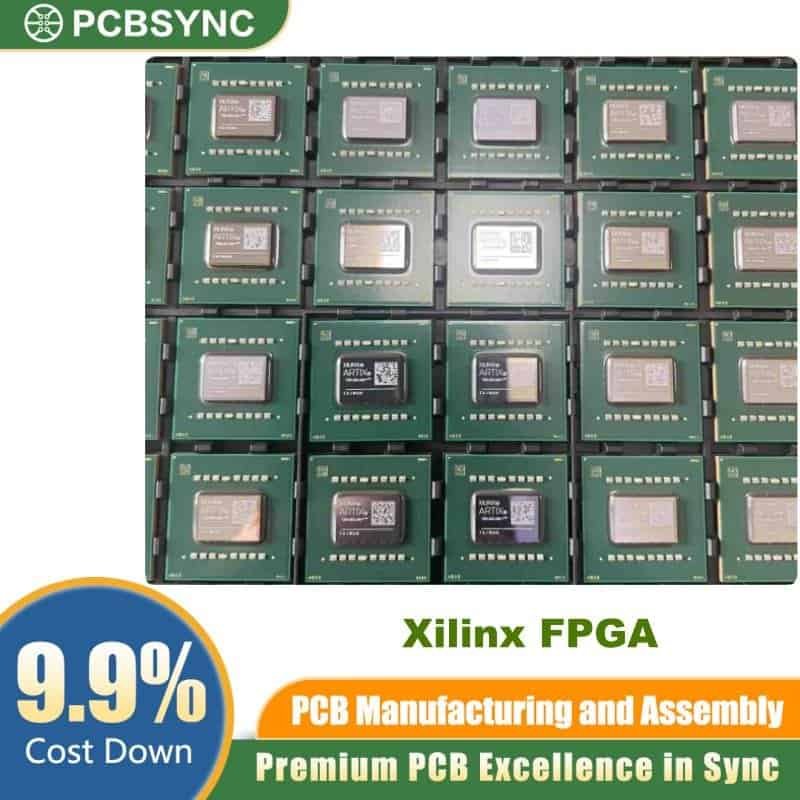
The XC3S4000-4FGG900I is a high-density Field-Programmable Gate Array (FPGA) from the Xilinx Spartan®-3 family, now managed under AMD. Designed for high-volume, cost-sensitive applications, this device delivers 4 million system gates, 62,208 logic cells, and a rich set of on-chip resources — all in an industrial-grade 900-pin Fine-pitch Ball Grid Array (FBGA) package. Whether you are prototyping complex digital logic, building consumer electronics, or replacing ASICs in production designs, the XC3S4000-4FGG900I offers outstanding programmable logic performance at a competitive price point.
If you are sourcing programmable logic devices for your embedded or digital design project, explore our complete line of Xilinx FPGA solutions.
What Is the XC3S4000-4FGG900I?
The XC3S4000-4FGG900I is a member of the Xilinx Spartan-3 FPGA family, an eight-member product line offering system gate densities ranging from 50,000 to 5,000,000 gates. The XC3S4000 variant sits near the top of the Spartan-3 lineup, making it ideal for logic-intensive designs that demand large on-chip resources without the cost of higher-end Virtex-class devices.
Part Number Breakdown
Understanding the part number helps engineers quickly identify device characteristics:
| Segment |
Value |
Meaning |
| XC |
XC |
Xilinx FPGA product |
| 3S |
3S |
Spartan-3 family |
| 4000 |
4000 |
~4,000,000 system gates |
| 4 |
-4 |
Speed grade (-4 is slower than -5) |
| FGG |
FGG |
Fine-pitch BGA package type |
| 900 |
900 |
900 total package pins |
| I |
I |
Industrial temperature range (−40°C to +100°C) |
XC3S4000-4FGG900I Key Specifications
The table below summarizes the primary technical parameters of the XC3S4000-4FGG900I as published in the Xilinx DS099 Spartan-3 datasheet.
| Parameter |
Value |
| Manufacturer |
AMD (Xilinx) |
| Series |
Spartan®-3 |
| Part Number |
XC3S4000-4FGG900I |
| System Gates |
4,000,000 |
| Logic Cells (Equivalent) |
62,208 |
| Configurable Logic Blocks (CLBs) |
7,776 |
| Flip-Flops / Registers |
124,416 |
| Block RAM |
1,728 Kbits (96 × 18 Kbit blocks) |
| Distributed RAM |
432 Kbits |
| Dedicated 18×18 Multipliers |
96 |
| Digital Clock Managers (DCMs) |
4 |
| Maximum User I/O Pins |
633 |
| Maximum Clock Frequency |
630 MHz (Speed Grade -4) |
| Process Technology |
90 nm |
| Core Supply Voltage (VCCINT) |
1.2V |
| Package Type |
900-Pin FBGA (FGG900) |
| Package Dimensions |
31 mm × 31 mm |
| Temperature Range |
Industrial: −40°C to +100°C |
| RoHS Compliance |
Not Compliant (legacy device) |
XC3S4000-4FGG900I Detailed Features
Configurable Logic Blocks (CLBs)
The XC3S4000-4FGG900I contains 7,776 CLBs, each built around four slices. Every slice includes two 4-input Look-Up Tables (LUTs) and two flip-flops, enabling flexible implementation of both combinational and registered logic. CLBs support shift register operation, wide multiplexers, and fast look-ahead carry chains — critical for building efficient arithmetic and state-machine circuits.
Block RAM and Distributed RAM Architecture
The XC3S4000 uses four columns of 18-Kbit dual-port block RAM, providing a total of 1,728 Kbits of on-chip block memory. This configuration is unique to the XC3S4000 and XC3S5000 devices within the Spartan-3 family. In addition, CLB LUTs can be configured as distributed RAM, yielding up to 432 Kbits of additional fast, distributed storage. The combination of block and distributed RAM addresses diverse buffering, FIFO, and data pipeline requirements.
Dedicated 18×18 Multiplier Blocks
Each 18-Kbit block RAM is paired with a dedicated 18×18 binary multiplier, giving the XC3S4000-4FGG900I a total of 96 hardware multipliers. These significantly accelerate DSP workloads — including filtering, FFT computations, and motor control algorithms — without consuming CLB resources.
Digital Clock Managers (DCMs)
Four on-chip Digital Clock Managers provide comprehensive clock control capabilities:
| DCM Feature |
Description |
| Clock Skew Elimination |
Removes internal and external clock distribution delays |
| Frequency Synthesis |
Multiplies or divides input clock frequencies |
| High-Resolution Phase Shifting |
Adjusts clock phase in fine increments |
| Eight Global Clock Lines |
Dedicated low-skew routing for system-wide clocks |
DCMs enable the XC3S4000-4FGG900I to support complex multi-clock-domain designs with deterministic timing.
SelectIO™ Interface and I/O Standards
The device supports up to 633 user I/O pins, with a comprehensive SelectIO™ interface offering:
| I/O Feature |
Detail |
| Single-Ended Standards |
18 standards (including LVCMOS, LVTTL, HSTL, SSTL) |
| Differential Standards |
8 standards including LVDS and RSDS |
| Maximum Data Rate |
622+ Mb/s per I/O |
| Signal Swing |
1.14V to 3.465V |
| Double Data Rate (DDR) |
Supported; DDR/DDR2 SDRAM up to 333 Mb/s |
| Digitally Controlled Impedance |
On-chip termination, simplifying PCB design |
| 3-State Operation |
Bidirectional I/O with 3-state support |
Package Information: 900-Pin FBGA (FGG900)
The FGG900 package is a Fine-pitch Ball Grid Array with a 1.0 mm ball pitch. Its compact footprint makes it suitable for space-constrained PCB designs.
| Package Attribute |
Value |
| Package Code |
FGG900 |
| Total Pins |
900 |
| User I/O Pins |
633 |
| Ball Pitch |
1.0 mm |
| Body Size |
31 mm × 31 mm |
| Mounting |
Surface-mount (SMT) |
The industrial temperature suffix “I” confirms this variant is rated for environments from −40°C to +100°C, making it suitable for outdoor equipment, industrial automation, and rugged embedded systems.
Speed Grade -4 vs. -5: What Does It Mean?
The -4 speed grade in XC3S4000-4FGG900I indicates a maximum internal clock frequency of approximately 630 MHz (worst-case). A -5 speed grade variant achieves approximately 725 MHz. The -4 grade is typically chosen when:
- The design operates below 630 MHz and full speed is not needed
- Cost reduction is a priority
- Industrial temperature range is required alongside a specific speed-performance balance
For timing-critical paths, engineers should run Xilinx ISE or Vivado timing analysis to confirm that the -4 speed grade meets all setup and hold requirements.
XC3S4000 Spartan-3 Family Comparison
The table below positions the XC3S4000 within the wider Spartan-3 lineup to help engineers select the right density.
| Device |
System Gates |
Logic Cells |
Block RAM (Kbits) |
Multipliers |
Max I/O |
| XC3S50 |
50,000 |
1,728 |
72 |
4 |
124 |
| XC3S200 |
200,000 |
4,320 |
216 |
12 |
173 |
| XC3S400 |
400,000 |
8,064 |
288 |
16 |
264 |
| XC3S1000 |
1,000,000 |
17,280 |
432 |
24 |
391 |
| XC3S1500 |
1,500,000 |
29,952 |
648 |
32 |
487 |
| XC3S2000 |
2,000,000 |
46,080 |
864 |
40 |
565 |
| XC3S4000 |
4,000,000 |
62,208 |
1,728 |
96 |
633 |
| XC3S5000 |
5,000,000 |
74,880 |
1,872 |
104 |
633 |
Typical Applications for XC3S4000-4FGG900I
The XC3S4000-4FGG900I is well-suited for a broad range of applications:
| Application Area |
Use Case Examples |
| Broadband Communications |
DSL, cable modem, and Ethernet interface processing |
| Consumer Electronics |
HDTV decoding, display controllers, set-top boxes |
| Home Networking |
Packet forwarding engines, protocol bridge logic |
| Industrial Automation |
Motor control, machine vision pre-processing |
| Test & Measurement |
Data acquisition front-ends, signal generation |
| Embedded Processing |
MicroBlaze™ soft-processor SoC implementations |
| Prototyping / ASIC Replacement |
Logic emulation and pre-production verification |
Development Tools and Programming Support
The XC3S4000-4FGG900I is supported by a mature Xilinx toolchain:
| Tool |
Description |
| Xilinx ISE Design Suite |
Traditional RTL synthesis, implementation, and bitstream generation for Spartan-3 |
| Vivado Design Suite |
Modern Xilinx design environment (limited Spartan-3 support; ISE preferred) |
| WebPACK™ |
Free entry-level version of ISE for smaller designs |
| ChipScope Pro |
On-chip logic analyzer for real-time debug |
| MicroBlaze™ |
Configurable 32-bit soft-processor for embedded applications |
| JTAG (IEEE 1149.1/1532) |
In-circuit configuration and boundary-scan testing |
Configuration is loaded via standard JTAG, Master Serial, Slave Serial, Master SPI, or BPI modes, enabling flexible production programming workflows.
Why Choose the XC3S4000-4FGG900I Over a Custom ASIC?
The Spartan-3 FPGA family was explicitly designed as a superior alternative to mask-programmed ASICs for high-volume consumer and industrial applications. Key advantages include:
- No NRE (Non-Recurring Engineering) costs — eliminates expensive mask set charges
- Faster time-to-market — design iterations take hours, not months
- Field upgradability — bitstream updates allow bug fixes and feature additions after deployment
- Design reuse — the same silicon can host entirely different logic functions
- Lower risk — design errors do not require costly silicon respins
For designs requiring the combination of 4 million gate density, industrial-grade operating conditions, and a 900-pin BGA footprint, the XC3S4000-4FGG900I provides a compelling, proven solution.
Ordering Information
| Attribute |
Detail |
| Manufacturer Part Number |
XC3S4000-4FGG900I |
| Manufacturer |
AMD (formerly Xilinx) |
| Product Family |
Spartan®-3 FPGA |
| Package |
900-BBGA (FGG900) |
| Temperature Grade |
Industrial (−40°C to +100°C) |
| Speed Grade |
-4 |
| DigiKey Part Number |
1951737 |
| Availability |
Check distributor stock for current availability |
Note: The XC3S4000-4FGG900I is a mature/legacy product. Verify stock availability with authorized distributors before designing into new projects. For new designs requiring similar density, consider evaluating more recent AMD/Xilinx Spartan-7 or Artix-7 devices.
Frequently Asked Questions
What is the difference between XC3S4000-4FGG900I and XC3S4000-4FGG900C?
The only difference is the temperature grade. The “I” suffix indicates an Industrial temperature range (−40°C to +100°C), while the “C” suffix is Commercial grade (0°C to +85°C). All other specifications — gates, I/Os, block RAM, multipliers, and package — are identical.
What speed grade options are available for the XC3S4000 FGG900 package?
The XC3S4000 in the 900-pin FGG package is available in -4 and -5 speed grades. The -4 grade targets approximately 630 MHz internal performance; the -5 grade reaches approximately 725 MHz.
Is the XC3S4000-4FGG900I RoHS compliant?
No. This is a legacy device and is not RoHS compliant. Engineers targeting RoHS-compliant designs should verify with their distributor or consider newer AMD/Xilinx devices that carry RoHS certification.
What configuration interfaces does the XC3S4000-4FGG900I support?
The device supports Master Serial, Slave Serial, Master SPI (with external SPI Flash), Slave Parallel, and JTAG configuration modes. The IEEE 1149.1/1532 JTAG interface also enables in-system programming and boundary-scan testing.
Can the XC3S4000-4FGG900I be used for a MicroBlaze soft-processor design?
Yes. The XC3S4000-4FGG900I has sufficient logic resources — 62,208 logic cells, 1,728 Kbits of block RAM, and 96 hardware multipliers — to host one or more MicroBlaze™ 32-bit soft-processor cores alongside peripheral logic and memory controllers.