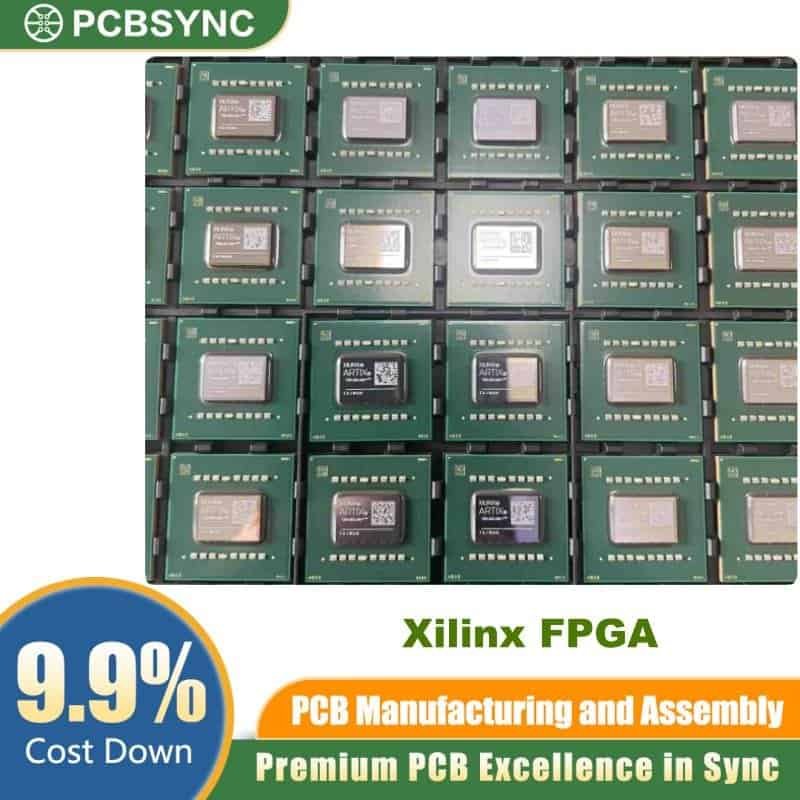
The XC3S4000-5FG676C is a high-capacity, commercially graded field-programmable gate array (FPGA) from Xilinx (now AMD), part of the widely adopted Spartan-3 family. With 4 million system gates, 676-pin Fine-pitch Ball Grid Array (FBGA) packaging, and a –5 speed grade, this device delivers a compelling balance of logic density, I/O flexibility, and cost efficiency for high-volume embedded and industrial applications.
If you are looking for a versatile and proven Xilinx FPGA for your next design, the XC3S4000-5FG676C is a strong candidate worth evaluating.
XC3S4000-5FG676C Key Specifications at a Glance
| Parameter |
Value |
| Manufacturer |
Xilinx (AMD) |
| Part Number |
XC3S4000-5FG676C |
| FPGA Family |
Spartan-3 |
| System Gates |
4,000,000 |
| Logic Cells |
62,208 |
| CLB Array (Rows × Columns) |
96 × 72 |
| CLB Flip-Flops |
49,152 |
| Distributed RAM |
720 Kb |
| Block RAM |
864 Kb |
| 18×18 Multipliers |
96 |
| DCM (Digital Clock Managers) |
4 |
| Max User I/O Pins |
489 |
| Speed Grade |
–5 |
| Package |
FG676 (FBGA, 676-pin) |
| Temperature Grade |
Commercial (0°C to +85°C) |
| Supply Voltage (VCC_INT) |
1.2 V |
| Supply Voltage (VCC_AUX) |
2.5 V |
| I/O Supply (VCCO) |
1.2 V – 3.3 V |
| Configuration Interfaces |
Master Serial, Slave Serial, SelectMAP, JTAG |
What Is the XC3S4000-5FG676C? – Product Overview
Spartan-3 Family Background
The Spartan-3 series was designed by Xilinx to bring high-density programmable logic to cost-sensitive markets. Built on a 90 nm process node, Spartan-3 devices feature an architecture optimized for high-volume production without sacrificing design flexibility. The XC3S4000 sits near the top of the Spartan-3 density range, providing designers with over 62,000 logic cells—enough for complex state machines, multi-channel data paths, and soft processor implementations.
Part Number Breakdown
Understanding the part number helps engineers quickly identify device parameters:
| Code Segment |
Meaning |
| XC |
Xilinx commercial product |
| 3S |
Spartan-3 family |
| 4000 |
~4 million system gate equivalents |
| -5 |
Speed grade (–5 = slowest/most conservative of Spartan-3 grades) |
| FG |
Fine-pitch Ball Grid Array package type |
| 676 |
676 total pins |
| C |
Commercial temperature range (0°C to +85°C) |
XC3S4000-5FG676C Detailed Technical Specifications
Logic Resources
The XC3S4000-5FG676C is built around Xilinx’s Configurable Logic Blocks (CLBs). Each CLB contains four slices, and each slice contains two 4-input Look-Up Tables (LUTs) and two flip-flops. This gives the device a substantial combinational and registered logic capacity.
| Logic Resource |
Quantity |
| CLBs |
15,552 |
| Slices |
62,208 |
| 4-Input LUTs |
124,416 |
| Flip-Flops |
49,152 |
| Maximum Distributed RAM |
720 Kb |
Memory Resources
Embedded memory is critical for buffering, FIFOs, and data storage within FPGA designs. The XC3S4000-5FG676C offers two categories of on-chip memory:
| Memory Type |
Capacity |
| Block RAM (18 Kb blocks) |
48 blocks × 18 Kb = 864 Kb total |
| Distributed RAM (LUT-based) |
Up to 720 Kb |
| Total On-Chip Memory |
~1.58 Mb |
Each Block RAM can be configured as a true dual-port RAM, supporting independent read and write operations on each port simultaneously—an essential feature for multi-clock-domain designs.
DSP and Mathematical Resources
Dedicated 18×18 Multiplier Blocks
One of the key features differentiating Spartan-3 devices from earlier generations is the inclusion of dedicated hardware multiplier blocks. The XC3S4000-5FG676C provides 96 dedicated 18×18-bit multipliers, enabling efficient implementation of:
- Digital filters (FIR, IIR)
- Fast Fourier Transform (FFT) engines
- Motor control algorithms
- Video processing pipelines
Using dedicated multipliers instead of LUT-based multipliers dramatically reduces resource utilization and increases operating frequency.
Clocking Resources
| Clock Resource |
Details |
| Digital Clock Managers (DCMs) |
4 |
| DCM Functions |
Phase shifting, frequency synthesis, deskew, duty-cycle correction |
| Global Clock Networks |
Up to 24 global and regional clock networks |
| Max Input Clock Frequency |
Up to ~280 MHz (depending on DCM configuration) |
DCMs allow the XC3S4000-5FG676C to synthesize precise internal frequencies, phase-align clocks to external signals, and eliminate clock distribution delays—critical for high-speed synchronous designs.
I/O Interface Capabilities
The FG676 package exposes 489 user-configurable I/O pins, distributed across multiple independently powered I/O banks. This multi-bank architecture enables the device to interface simultaneously with components operating at different voltage standards.
Supported I/O Standards
| I/O Standard |
Type |
| LVCMOS 3.3 V / 2.5 V / 1.8 V / 1.5 V / 1.2 V |
Single-ended |
| LVTTL |
Single-ended |
| LVDS |
Differential |
| RSDS |
Differential |
| HSTL Class I / II |
Single-ended |
| SSTL 2 / 3 |
Single-ended |
| GTL / GTL+ |
Single-ended |
| PCI / PCI-X |
Single-ended |
This wide voltage support makes the XC3S4000-5FG676C compatible with legacy 3.3 V logic systems as well as modern 1.2 V and 1.5 V interfaces.
XC3S4000-5FG676C Package and Physical Dimensions
FG676 Fine-Pitch BGA Package Details
| Physical Parameter |
Value |
| Package Type |
Fine-pitch Ball Grid Array (FBGA) |
| Total Pin Count |
676 |
| User I/O Pins |
489 |
| Ball Pitch |
1.0 mm |
| Package Body Size |
27 mm × 27 mm |
| Height (max) |
~2.15 mm |
| PCB Mounting |
Surface-mount (SMD) |
| Moisture Sensitivity Level |
MSL 3 |
The 1.0 mm ball pitch is manageable with standard PCB manufacturing processes, though fine-pitch BGA routing typically requires 4–6 layer PCBs with controlled impedance traces and via-in-pad or dog-bone fanout strategies.
XC3S4000-5FG676C Configuration Options
The Spartan-3 architecture supports multiple configuration modes to suit different system architectures:
| Configuration Mode |
Description |
| Master Serial |
Uses an external serial Flash (e.g., Xilinx Platform Flash) for standalone boot |
| Slave Serial |
Configured by an external host processor via serial interface |
| SelectMAP (Parallel) |
8-bit or 16-bit parallel configuration bus from a host processor or logic |
| JTAG (IEEE 1149.1) |
Boundary-scan and in-circuit configuration via standard JTAG header |
| Master SPI |
Serial Peripheral Interface boot from SPI Flash |
| Master BPI |
Parallel NOR Flash configuration for fast startup |
JTAG is essential for debugging and development workflows, while Master Serial or SPI configurations are standard for production environments.
Power Supply Requirements
Proper power sequencing and supply filtering are critical for reliable FPGA operation. The XC3S4000-5FG676C requires three distinct supply rails:
| Supply Rail |
Nominal Voltage |
Purpose |
| VCC_INT |
1.2 V |
Core logic power |
| VCC_AUX |
2.5 V |
Auxiliary logic, DCMs, configuration logic |
| VCCO (per bank) |
1.2 V – 3.3 V |
I/O driver supply (bank-specific) |
Power sequencing recommendation: VCC_AUX should be powered before or simultaneously with VCC_INT to avoid unintended latch-up conditions. Refer to Xilinx Application Note XAPP691 for detailed power management guidance.
Typical Applications for the XC3S4000-5FG676C
The combination of 4M gates, 864 Kb Block RAM, 96 dedicated multipliers, and 489 I/O pins makes the XC3S4000-5FG676C well-suited for a broad range of embedded and signal processing applications:
Industrial and Embedded Systems
- Motor drive control and servo controllers
- Industrial communication protocol bridges (EtherCAT, CANopen, PROFIBUS)
- PLC (Programmable Logic Controller) expansion modules
- Real-time data acquisition systems
Communications and Networking
- Physical layer (PHY) processing for wired networks
- Multi-channel UART, SPI, and I2C controller hubs
- Custom communication protocol accelerators
- FPGAs used as co-processors alongside ARM or RISC-V CPUs
Video and Image Processing
- Digital video scaling and format conversion
- Image sensor readout controllers
- LCD/LVDS display interface logic
- Machine vision front-end processing
Aerospace and Defense (Commercial-Grade Limitations Apply)
- Data logging and telemetry systems (note: commercial temp grade only)
- Test and measurement equipment
- Protocol analyzers and bus monitors
Education and Prototyping
- University research projects requiring large logic budgets
- FPGA-based soft processor platforms (MicroBlaze, PicoBlaze)
- Proof-of-concept hardware accelerator designs
XC3S4000-5FG676C vs. Other Spartan-3 Devices
Choosing the right density for your project requires balancing logic resources, I/O count, and cost. The following table compares the XC3S4000 with neighboring members of the Spartan-3 family:
| Parameter |
XC3S1500 |
XC3S4000 |
XC3S5000 |
| System Gates |
1.5 M |
4 M |
5 M |
| Logic Cells |
29,952 |
62,208 |
74,880 |
| Block RAM |
432 Kb |
864 Kb |
1,872 Kb |
| Dedicated Multipliers |
32 |
96 |
104 |
| DCMs |
4 |
4 |
4 |
| Max User I/O |
333 |
489 |
633 |
| Available Packages |
FG320, FG456 |
FG676 |
FG900 |
The XC3S4000 provides a meaningful step up in DSP resources (3× the multipliers of XC3S1500) while remaining in a manageable 676-pin package, making it a popular choice for designs that outgrow the XC3S1500 without requiring the larger XC3S5000 footprint.
Design Tools and Software Support
Xilinx ISE Design Suite
The XC3S4000-5FG676C is fully supported by Xilinx ISE Design Suite (version 14.7 is the final release for Spartan-3). ISE provides:
- HDL synthesis (VHDL, Verilog, SystemVerilog)
- Place-and-route (PAR)
- Timing analysis and static timing reports
- iMPACT configuration tool for JTAG and Flash programming
- ChipScope Pro for in-system logic analysis
Note: Spartan-3 devices are not supported in Xilinx Vivado. Designers must use ISE 14.7, which is freely available from the AMD/Xilinx website for Windows and Linux.
Third-Party EDA Tool Support
| Tool Category |
Supported Tools |
| Synthesis |
Synopsys Synplify, Mentor Precision |
| Simulation |
ModelSim, Questa, VCS, Riviera-PRO |
| PCB Design |
Altium Designer, KiCad, OrCAD, Allegro |
| Constraint Entry |
UCF (User Constraints File) |
Ordering and Compliance Information
| Attribute |
Detail |
| Full Part Number |
XC3S4000-5FG676C |
| Manufacturer |
AMD Xilinx |
| DigiKey Part Number |
122-1793-ND |
| RoHS Compliance |
Yes (RoHS compliant) |
| REACH Compliance |
Yes |
| Pb-Free |
Yes |
| HTS Code |
8542.39.0001 |
| ECCN |
3A991.a.2 |
| Country of Origin |
Malaysia |
Frequently Asked Questions (FAQ)
What is the difference between XC3S4000-5FG676C and XC3S4000-4FG676C?
The only difference is the speed grade. The -5 grade is the slowest/most conservative speed grade in the Spartan-3 family, while the -4 grade offers higher maximum operating frequencies. For many control and interfacing applications, the –5 grade is sufficient and typically more readily available at lower cost.
Is the XC3S4000-5FG676C still in production?
The Spartan-3 family has been in mature production status for several years. While Xilinx/AMD has transitioned focus to Spartan-6, Spartan-7, and Artix-7 families, the XC3S4000-5FG676C continues to be available through authorized distributors for long-lifecycle industrial designs.
Can I use Vivado to program the XC3S4000-5FG676C?
No. Vivado does not support Spartan-3 devices. You must use ISE Design Suite 14.7, which remains available as a free download from AMD/Xilinx.
What Flash device is recommended for standalone configuration?
Xilinx Platform Flash (XCF series) or industry-standard SPI Flash devices such as Micron M25P-series or Winbond W25Q-series are commonly used for Master Serial and Master SPI configuration modes.
What is the maximum operating frequency for the XC3S4000-5FG676C?
System performance depends heavily on the design’s critical path. The internal global clock network supports frequencies up to approximately 280 MHz with DCM feedback. Practical design clock rates of 50–200 MHz are typical for complex designs in the –5 speed grade.
Summary
The XC3S4000-5FG676C is a mature, reliable, and widely supported FPGA offering 4 million system gates, 864 Kb of Block RAM, 96 dedicated multipliers, 4 Digital Clock Managers, and 489 user I/O pins in a compact 27 mm × 27 mm BGA package. Its multi-standard I/O banks, flexible configuration options, and comprehensive ISE toolchain support make it an excellent choice for industrial control systems, communications interfaces, video processing pipelines, and embedded soft-processor platforms where proven Spartan-3 performance and commercial temperature operation are required.