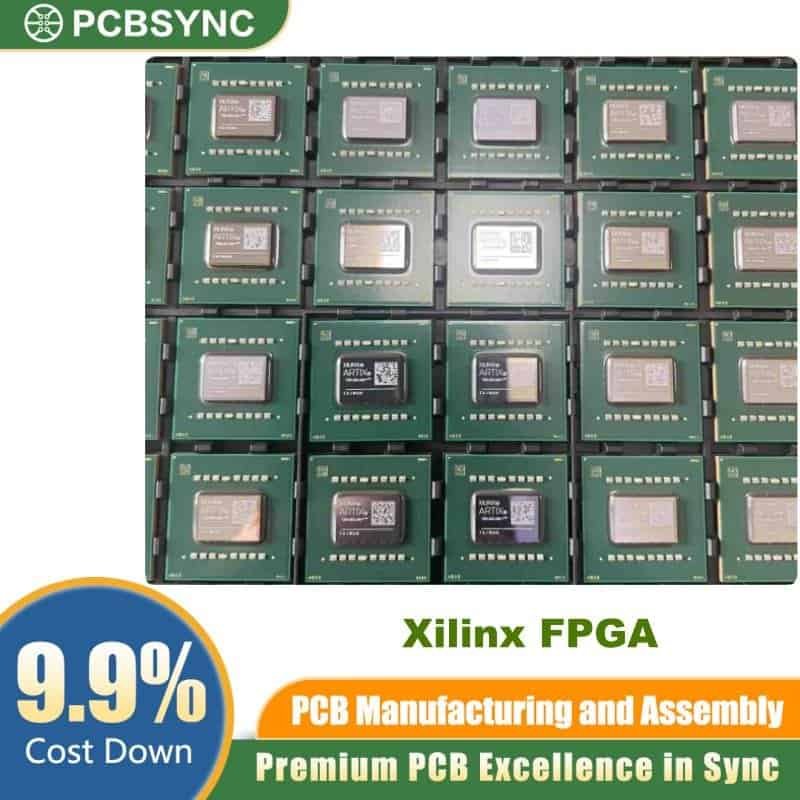
The XC3S400-4FG320I is a high-performance, cost-optimized Xilinx FPGA from the industry-proven Spartan-3 family. With 400,000 system gates, 8,064 logic cells, and a robust 320-pin Fine-pitch Ball Grid Array (FBGA) package, this device is engineered for demanding industrial and embedded applications that require reliable operation across an extended temperature range.
What Is the XC3S400-4FG320I?
The XC3S400-4FG320I is a Field Programmable Gate Array (FPGA) manufactured by AMD Xilinx, built on 90nm technology. The part number breaks down as follows:
| Part Number Segment |
Meaning |
| XC3S |
Xilinx Spartan-3 Family |
| 400 |
400,000 System Gates |
| -4 |
Speed Grade –4 (Standard Speed) |
| FG |
Fine-pitch Ball Grid Array (FBGA) Package |
| 320 |
320 Pins |
| I |
Industrial Temperature Range (–40°C to +100°C) |
This device is the industrial-grade variant of the XC3S400, making it the preferred choice for systems that must operate reliably under harsh environmental conditions.
XC3S400-4FG320I Key Specifications
Core Logic & Memory
| Parameter |
Value |
| System Gates |
400,000 |
| Logic Cells |
8,064 |
| Configurable Logic Blocks (CLBs) |
896 |
| CLB Array Size |
32 × 28 |
| CLB Flip-Flops |
7,168 |
| Maximum Distributed RAM |
56K bits |
| Block RAM (Total) |
288K bits (294,912 bits) |
| Number of Block RAMs |
16 |
| Maximum User I/O |
221 |
DSP & Clock Resources
| Parameter |
Value |
| Dedicated Multipliers (18×18) |
16 |
| Digital Clock Managers (DCMs) |
4 |
| Maximum System Clock Frequency |
630 MHz |
| DLL Frequency Range |
25 – 326 MHz |
Electrical & Physical Characteristics
| Parameter |
Value |
| Core Voltage (VCCINT) |
1.14V – 1.26V (nominal 1.2V) |
| I/O Voltage (VCCO) |
1.2V / 1.5V / 1.8V / 2.5V / 3.3V |
| Technology Node |
90nm |
| Package Type |
320-Pin FBGA (Fine-pitch BGA) |
| Package Dimensions |
19mm × 19mm |
| Ball Pitch |
1.0mm |
| Mounting Type |
Surface Mount |
| Operating Temperature |
–40°C to +100°C (Industrial) |
XC3S400-4FG320I Package & Ordering Information
| Attribute |
Detail |
| Manufacturer |
AMD (Xilinx) |
| Part Number |
XC3S400-4FG320I |
| Manufacturer Series |
Spartan-3 |
| Package / Case |
320-FBGA (19×19) |
| Supplier Device Package |
320-FBGA (19×19) |
| Base Part Number |
XC3S400 |
| RoHS Status |
Compliant |
| Moisture Sensitivity Level (MSL) |
3 (168-Hour Floor Life) |
Functional Overview: How the XC3S400-4FG320I Works
#### Configurable Logic Blocks (CLBs)
The XC3S400-4FG320I contains 896 CLBs arranged in a 32×28 matrix. Each CLB consists of four logic slices, and every slice includes two 4-input Look-Up Tables (LUTs), two storage elements (flip-flops or latches), and dedicated carry logic. This architecture enables efficient implementation of arithmetic functions, state machines, and complex combinational logic.
#### Block RAM
Sixteen dedicated 18Kb Block RAM tiles provide a total of 288Kb of on-chip synchronous memory. Each block can be configured as a true dual-port memory, supporting independent read and write operations. This is ideal for FIFO buffers, look-up tables, and local data storage in embedded processor designs.
#### Digital Clock Manager (DCM)
The device includes four DCMs, each capable of clock multiplication, division, phase shifting, and deskewing. The DCM supports system frequencies from 25MHz to 326MHz, making it straightforward to generate multiple derived clocks from a single input reference — a critical feature for synchronous design and interface timing.
#### Dedicated 18×18 Multipliers
Sixteen dedicated hardware multipliers deliver high-throughput integer multiplication without consuming CLB resources. These are essential for digital signal processing (DSP) tasks such as filtering, correlation, and Fourier transforms in applications like motor control and communications.
#### SelectIO Technology
The 221 user I/Os support a wide range of single-ended and differential I/O standards, including LVCMOS, LVTTL, HSTL, SSTL, LVDS, RSDS, and PPDS. This flexibility allows the XC3S400-4FG320I to interface directly with processors, ADCs, DACs, memory devices, and communication controllers without external level shifters.
XC3S400-4FG320I vs. Related Spartan-3 Devices
| Part Number |
Gates |
Logic Cells |
Block RAM |
I/Os (Max) |
Package |
Temp Grade |
| XC3S400-4FG320I |
400K |
8,064 |
288Kb |
221 |
320-FBGA |
Industrial |
| XC3S400-4FG320C |
400K |
8,064 |
288Kb |
221 |
320-FBGA |
Commercial |
| XC3S200-4FT256I |
200K |
4,320 |
216Kb |
173 |
256-FBGA |
Industrial |
| XC3S1000-4FG320I |
1,000K |
17,280 |
432Kb |
391 |
320-FBGA (456-pin alt) |
Industrial |
| XC3S1500-4FG320I |
1,500K |
29,952 |
576Kb |
487 |
Higher pin-count |
Industrial |
The XC3S400-4FG320I occupies the mid-range of the Spartan-3 family, offering a strong balance between logic density, memory, and I/O count at a competitive price point.
Target Applications
The XC3S400-4FG320I is well-suited for a broad range of embedded and industrial applications:
- Industrial Control & Automation — Motor control, PLC co-processing, industrial Ethernet interfaces
- Communications Equipment — Protocol bridging, UART/SPI/I2C controllers, line interfaces
- Embedded Vision — Image preprocessing pipelines, edge detection, frame buffering
- Test & Measurement — Data acquisition front ends, pattern generators, instrument control
- Consumer Electronics — Digital TV signal processing, broadband access equipment, set-top box logic
- Military & Defense — Sensor fusion, ruggedized control systems (industrial grade suits harsh environments)
- Automotive — In-vehicle network gateways, driver assistance logic (–40°C rating is a key enabler)
Design Tool Support
The XC3S400-4FG320I is supported by the following Xilinx/AMD design environments:
| Tool |
Version |
Notes |
| Xilinx ISE Design Suite |
14.7 (final) |
Primary legacy tool for Spartan-3 |
| Xilinx Vivado |
Not supported |
Vivado targets 7-series and newer |
| ModelSim / Questa |
All major versions |
RTL simulation |
| Synopsys Synplify |
Supported |
Third-party synthesis option |
| Mentor Precision |
Supported |
Third-party synthesis option |
| iMPACT |
Included in ISE |
Programming and boundary-scan |
HDL design flows using VHDL and Verilog are fully supported. The device can be configured via JTAG or from external serial/parallel configuration PROMs such as the XCF02S.
Configuration & Programming
The XC3S400-4FG320I supports multiple configuration modes:
| Mode |
Description |
| Master Serial |
From Xilinx Platform Flash PROM (e.g., XCF02S) |
| Slave Serial |
Driven by external microcontroller |
| Master SPI |
From standard SPI Flash memory |
| Master BPI |
From parallel NOR Flash |
| JTAG |
Boundary-scan and in-system programming |
The recommended companion configuration device is the XCF02S (1.7M-bit Platform Flash), which stores the approximately 1.7Mbit bitstream required to configure the XC3S400.
Frequently Asked Questions
Q: What is the XC3S400-4FG320I used for? It is primarily used as a programmable logic device in industrial control, communications, embedded vision, and signal processing applications where extended temperature operation (–40°C to +100°C) is required.
Q: What is the difference between XC3S400-4FG320I and XC3S400-4FG320C? The suffix “I” denotes the industrial temperature grade (–40°C to +100°C), while “C” denotes the commercial grade (0°C to +85°C). All other electrical characteristics are identical.
Q: Is the XC3S400-4FG320I RoHS compliant? Yes, the device is RoHS compliant.
Q: What programming software does the XC3S400-4FG320I require? The Xilinx ISE Design Suite 14.7 is the standard tool chain. The iMPACT programmer within ISE handles device configuration via JTAG.
Q: What is the core voltage of the XC3S400-4FG320I? The internal core voltage (VCCINT) is nominally 1.2V, with an acceptable range of 1.14V to 1.26V.
Summary
The XC3S400-4FG320I delivers a proven, cost-effective FPGA solution with 400,000 system gates, 8,064 logic cells, 16 block RAMs, 16 hardware multipliers, and 221 user I/Os — all in a compact 320-pin FBGA package rated for industrial temperature operation. Its combination of logic density, dedicated DSP resources, flexible I/O standards, and robust –40°C to +100°C temperature range makes it a dependable choice for engineers designing industrial, communications, and embedded systems that demand both performance and long-term reliability.