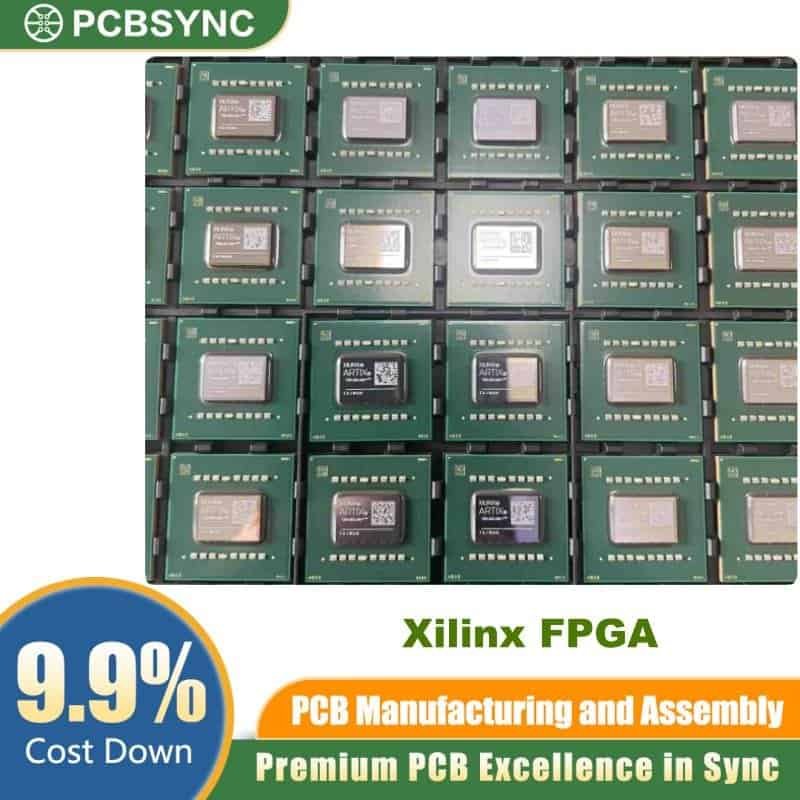
The XC3S400-5FG456C is a high-performance Xilinx FPGA from the Spartan-3 family, engineered by AMD (formerly Xilinx) to deliver exceptional programmable logic capability for cost-sensitive, high-volume embedded applications. With 400K system gates, 8,064 logic cells, and a 456-ball Fine-Pitch Ball Grid Array (FBGA) package, this device is a compelling alternative to mask-programmed ASICs — combining design flexibility with a reduced time-to-market.
What Is the XC3S400-5FG456C?
The XC3S400-5FG456C belongs to AMD’s Spartan-3 FPGA family, a generation built on 90nm process technology and designed to maximize logic density per dollar. It targets engineers and designers who require robust, reconfigurable digital logic without the non-recurring engineering (NRE) costs associated with custom silicon. The device supports in-field reprogramming, making it ideal for iterative product development and firmware upgrades after deployment.
Key Features of the XC3S400-5FG456C
- 400K System Gates for complex logic design
- 8,064 Equivalent Logic Cells organized in Configurable Logic Blocks (CLBs)
- Speed Grade -5 — the fastest speed grade in the XC3S400 lineup
- 725 MHz internal clock capability
- 90nm CMOS Process Technology for low power and high density
- 1.2V Core Voltage operation
- 456-Pin FBGA Package (Fine-Pitch Ball Grid Array) for compact PCB footprints
- Commercial Temperature Range (0°C to +85°C)
- Distributed RAM and Dedicated Block RAM for versatile memory configurations
- Digital Clock Managers (DCMs) for precise clock synthesis, deskewing, and phase shifting
- Dedicated 18×18 Hardware Multipliers for DSP-class arithmetic
- Numerous I/O standards supported, including LVCMOS, LVTTL, HSTL, SSTL, and LVDS
- In-system reprogrammability — no hardware replacement needed for design updates
XC3S400-5FG456C Full Technical Specifications
General Specifications
| Parameter |
Value |
| Manufacturer |
AMD (Xilinx) |
| Part Number |
XC3S400-5FG456C |
| FPGA Family |
Spartan-3 |
| Process Technology |
90nm |
| System Gates |
400,000 |
| Equivalent Logic Cells |
8,064 |
| Speed Grade |
-5 (Fastest) |
| Internal Clock Speed |
725 MHz |
| Core Supply Voltage (VCC_INT) |
1.2V |
| I/O Supply Voltage (VCC_O) |
1.2V – 3.3V |
| Operating Temperature |
0°C to +85°C (Commercial) |
| RoHS Compliance |
Yes (Non-Pb-free version) |
Package & Physical Specifications
| Parameter |
Value |
| Package Type |
FBGA (Fine-Pitch Ball Grid Array) |
| Package Code |
FG456 |
| Number of Pins |
456 |
| Mounting Type |
Surface Mount |
| Package Dimensions |
23mm x 23mm |
| Ball Pitch |
1.00mm |
Logic Resources
| Resource |
XC3S400 |
| Configurable Logic Blocks (CLBs) |
896 |
| CLB Slices |
3,584 |
| Equivalent Logic Cells |
8,064 |
| 4-Input LUTs |
7,168 |
| Flip-Flops |
7,168 |
| Maximum Distributed RAM (bits) |
55,296 |
Memory & DSP Resources
| Resource |
Value |
| Block RAM (18Kbit blocks) |
16 |
| Total Block RAM (Kbits) |
288 |
| Dedicated 18×18 Multipliers |
16 |
| Digital Clock Managers (DCMs) |
8 |
I/O Specifications
| Parameter |
Value |
| Maximum User I/Os (FG456) |
264 |
| Number of I/O Banks |
8 |
| Differential I/O Pairs |
Supported |
| Supported I/O Standards |
LVCMOS 1.2/1.5/1.8/2.5/3.3V, LVTTL, HSTL I/II, SSTL 2/18 I/II, LVDS, LVPECL, PCI, GTL, GTLP |
| Digitally Controlled Impedance (DCI) |
Supported |
XC3S400-5FG456C Ordering Information & Part Number Breakdown
Understanding the part number helps engineers quickly identify the correct variant for their design:
| Code Segment |
Meaning |
| XC |
Xilinx (now AMD) device identifier |
| 3S |
Spartan-3 product family |
| 400 |
Approximate gate count (400K gates) |
| -5 |
Speed grade (-5 = fastest available for this device) |
| FG |
Package type (Fine-Pitch Ball Grid Array) |
| 456 |
Number of package pins |
| C |
Temperature range (C = Commercial, 0°C to +85°C) |
XC3S400-5FG456C vs. Other XC3S400 Package Variants
| Part Number |
Package |
Pins |
Max User I/Os |
Speed Grade |
Temp Range |
| XC3S400-5FG456C |
FBGA |
456 |
264 |
-5 |
Commercial |
| XC3S400-5FG320C |
FBGA |
320 |
173 |
-5 |
Commercial |
| XC3S400-5TQ144C |
TQFP |
144 |
97 |
-5 |
Commercial |
| XC3S400-4FG456I |
FBGA |
456 |
264 |
-4 |
Industrial |
| XC3S400-4TQ144C |
TQFP |
144 |
97 |
-4 |
Commercial |
Note: The FG456 package provides the maximum I/O count for the XC3S400 device, making the XC3S400-5FG456C the top choice when pin density is a design priority.
Architecture Overview: Inside the XC3S400-5FG456C
Configurable Logic Blocks (CLBs)
The Spartan-3 CLB architecture is arranged in a regular matrix array. Each CLB contains four slices, and each slice includes two 4-input Look-Up Tables (LUTs) paired with two storage elements (D-type flip-flops or level-sensitive latches). The left-hand slice pairs in each CLB additionally support Distributed RAM and 16-bit shift register (SRL16) functions, enabling efficient memory-in-logic implementations.
Block RAM
The XC3S400 integrates 16 true dual-port 18Kbit block RAMs, totaling 288Kbits of on-chip synchronous memory. Each block RAM can be configured as single-port or dual-port and supports various aspect ratios, making it suitable for FIFOs, lookup tables, and data buffers.
Digital Clock Managers (DCMs)
Eight fully digital DCMs provide clock synthesis, phase shifting, deskewing, and frequency division/multiplication. DCMs eliminate clock distribution delay and enable systems to meet tight timing margins, which is especially valuable in high-speed data communication and synchronous designs.
Dedicated Multipliers
Sixteen dedicated 18×18-bit signed multipliers work alongside the block RAMs to accelerate DSP operations such as digital filtering, fast Fourier transforms (FFTs), and other arithmetic-intensive tasks — all without consuming general-purpose CLB logic resources.
I/O Blocks (IOBs)
Each IOB contains three signal paths: input, output, and 3-state control. All three paths include programmable storage elements for registered I/O. The Spartan-3 IOB supports Digitally Controlled Impedance (DCI), which provides on-chip termination for signal integrity in high-speed interfaces, reducing the need for external termination resistors.
Supported I/O Standards
The XC3S400-5FG456C supports a wide range of single-ended and differential I/O standards:
| Category |
Standards |
| Single-Ended |
LVCMOS 1.2V / 1.5V / 1.8V / 2.5V / 3.3V, LVTTL |
| High-Speed Single-Ended |
HSTL Class I & II, SSTL2 Class I & II, SSTL18 Class I & II |
| Differential |
LVDS, LVPECL, Bus LVDS, BLVDS |
| Bus Standards |
PCI (33MHz / 66MHz), GTL, GTLP |
Typical Applications for the XC3S400-5FG456C
The XC3S400-5FG456C is well-suited for a broad range of embedded system designs:
- Communications & Networking: Protocol bridging, line card control, SONET/SDH framing
- Industrial Automation: Motor control, sensor interface, machine vision preprocessing
- Consumer Electronics: Set-top boxes, digital displays, audio/video processing
- Test & Measurement: Data acquisition front-ends, signal generation
- Embedded Computing: Co-processor acceleration, glue logic replacement, bus interfaces
- Medical Devices: Real-time signal processing, imaging interface logic
- Automotive Electronics (Non-Safety Critical): Infotainment systems, diagnostic interfaces
Configuration & Programming
Spartan-3 FPGAs, including the XC3S400-5FG456C, are programmed via configuration data stored in external non-volatile memory. Five configuration modes are supported:
| Mode |
Description |
| Master Parallel |
FPGA reads configuration data from a parallel PROM |
| Slave Parallel |
External controller writes configuration in parallel |
| Master Serial |
FPGA reads configuration from a serial PROM (SPI or standard) |
| Slave Serial |
External controller streams configuration serially |
| JTAG |
Boundary-scan and direct configuration via JTAG port |
The Xilinx ISE Design Suite (and compatible tools) are used to generate bitstream files for programming this device. JTAG-based programming is also fully supported for in-system updates.
Development Tools & Software Support
| Tool |
Description |
| Xilinx ISE Design Suite |
Legacy design environment for Spartan-3 devices |
| VHDL / Verilog / SystemVerilog |
Supported HDL languages for RTL design |
| XST (Xilinx Synthesis Technology) |
Synthesis engine included with ISE |
| iMPACT |
Xilinx configuration and programming tool |
| ModelSim / Vivado Simulator |
Functional and timing simulation |
| ChipScope Pro |
In-system logic analysis and debug |
Frequently Asked Questions (FAQ)
What is the XC3S400-5FG456C?
The XC3S400-5FG456C is a Spartan-3 family FPGA manufactured by AMD (Xilinx), featuring 400K gates, 8,064 logic cells, a 456-ball FBGA package, speed grade -5, 90nm process technology, and commercial temperature rating.
What is the difference between XC3S400-5FG456C and XC3S400-5FGG456C?
The “G” in XC3S400-5FGG456C denotes a Pb-free (RoHS-compliant, lead-free) packaging option. Both devices have identical electrical characteristics and pin compatibility. The XC3S400-5FG456C uses standard (leaded) solder ball composition, while the FGG variant uses lead-free solder balls.
What speed grade does the XC3S400-5FG456C use?
Speed grade -5 is the highest (fastest) performance grade available for the XC3S400 device family, supporting internal clock frequencies up to 725 MHz.
Is the XC3S400-5FG456C still in production?
The Spartan-3 family is a mature product line. While AMD/Xilinx has introduced newer families (Spartan-6, Spartan-7, Artix-7), the XC3S400-5FG456C remains available through authorized distributors for legacy design support and new designs with cost-sensitive requirements.
What software is used to program the XC3S400-5FG456C?
The primary design and configuration tool is the Xilinx ISE Design Suite. The ChipScope Pro analyzer can be used for in-system debugging.
What is the maximum number of user I/Os on the XC3S400-5FG456C?
In the FG456 package, the XC3S400 provides up to 264 maximum user I/Os, the highest available I/O count for this device family.
Why Choose the XC3S400-5FG456C?
- Cost-Efficient Logic Integration: Replaces complex discrete logic, ASICs, and multiple standard logic ICs with a single programmable device.
- Fastest Speed Grade: The -5 speed grade delivers maximum performance for timing-critical designs within the XC3S400 family.
- Maximum Pin Count: The FG456 package offers the highest available I/O density for this device, ideal for I/O-intensive designs.
- Proven Architecture: Based on Xilinx’s Virtex-II platform technology, the Spartan-3 family has been deployed in millions of production systems worldwide.
- In-Field Reprogrammability: Design changes and firmware updates can be applied without hardware replacement, reducing field maintenance costs.
- Abundant Ecosystem: Extensive reference designs, IP cores, application notes, and community support are available through AMD/Xilinx.
Summary Specification Table
| Feature |
XC3S400-5FG456C |
| Family |
Spartan-3 |
| System Gates |
400,000 |
| Logic Cells |
8,064 |
| CLBs |
896 |
| Block RAM (Kbits) |
288 |
| Multipliers (18×18) |
16 |
| DCMs |
8 |
| Max User I/Os |
264 |
| Package |
456-ball FBGA |
| Speed Grade |
-5 |
| Process Node |
90nm |
| Core Voltage |
1.2V |
| Temperature |
0°C to +85°C |
| Manufacturer |
AMD (Xilinx) |
For design support, reference schematics, and volume pricing, consult your authorized AMD/Xilinx distributor. Always verify part specifications against the official AMD DS099 Spartan-3 FPGA Family datasheet prior to production use.