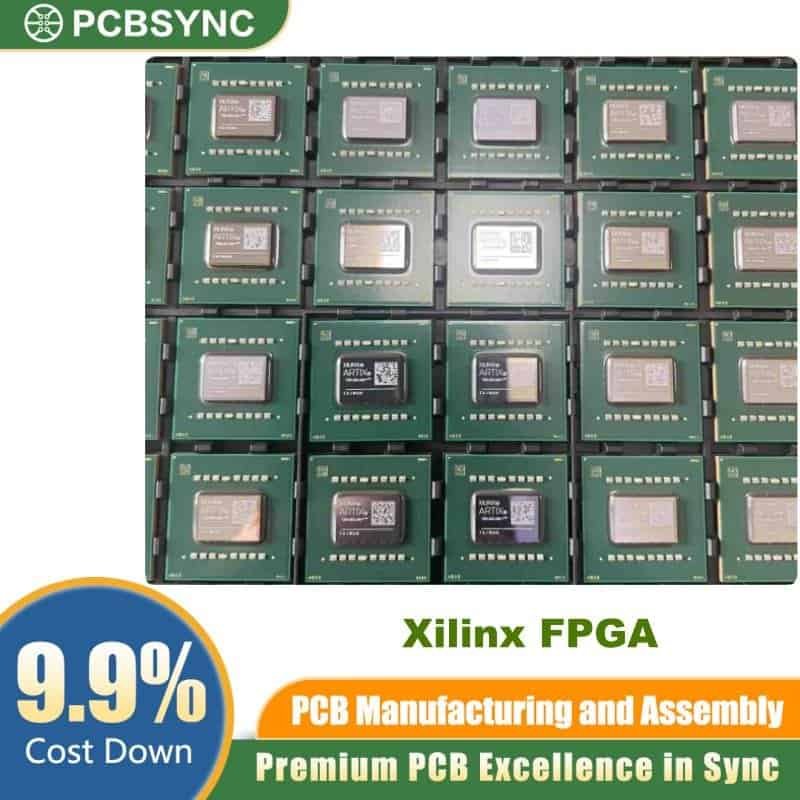
The XC3S400-5FTG256C is a high-performance, cost-optimized Field-Programmable Gate Array (FPGA) from Xilinx’s Spartan-3 family, now under AMD. Designed for high-volume, cost-sensitive applications, this device delivers 400K system gates, 8,064 logic cells, and operates at up to 725 MHz — all in a compact 256-ball Fine-Pitch Thin Ball Grid Array (FTBGA) package. Whether you are developing embedded systems, industrial controllers, or consumer electronics, the XC3S400-5FTG256C offers a powerful blend of logic density, memory, and I/O flexibility at an attractive price point.
If you’re building with programmable logic, this guide covers everything you need to know: from core specifications and pinout details to application use cases and ordering information. For a broader look at the product family, visit our Xilinx FPGA product page.
What Is the XC3S400-5FTG256C?
The XC3S400-5FTG256C belongs to the Xilinx Spartan-3 FPGA family, a series engineered to deliver the highest logic density per dollar in the programmable logic market. The “XC3S400” designation indicates the 400K-gate device within the Spartan-3 line. The “-5” speed grade signifies the fastest commercially available performance tier for this device. The “FTG256” identifies the 256-ball FTBGA (Fine-Pitch Thin Ball Grid Array) lead-free (RoHS-compliant) package. The “C” suffix denotes commercial temperature range (0°C to +85°C).
This FPGA is built on 90nm process technology and is powered by a 1.2V core supply voltage, making it well-suited for power-efficient embedded designs.
XC3S400-5FTG256C Key Specifications
General Overview
| Parameter |
Value |
| Manufacturer |
AMD (Xilinx) |
| Part Number |
XC3S400-5FTG256C |
| FPGA Family |
Spartan-3 |
| Product Category |
Embedded – Complex Logic (FPGA) |
| RoHS Compliance |
Yes (Lead-Free, “G” in part number) |
| Moisture Sensitivity Level (MSL) |
3 |
Logic Resources
| Resource |
Specification |
| System Gates |
400,000 |
| Logic Cells |
8,064 |
| Configurable Logic Blocks (CLBs) |
3,584 |
| CLB Array Size |
32 × 28 |
| Flip-Flops |
7,168 |
| Distributed RAM |
56 Kb |
| Maximum Equivalent Logic Cells |
8,064 |
Memory Resources
| Memory Type |
Capacity |
| Block RAM (Total) |
288 Kb |
| Number of Block RAM Modules |
16 × 18 Kb |
| Distributed RAM (LUT-Based) |
56 Kb |
DSP and Arithmetic
| Feature |
Value |
| Dedicated Multipliers |
16 |
| Multiplier Size |
18 × 18-bit |
Clock Management
| Feature |
Value |
| Digital Clock Managers (DCMs) |
4 |
| DCM Functions |
DFS, DLL, Phase Shift, Frequency Synthesis |
| Maximum Clock Frequency |
725 MHz (Speed Grade -5) |
I/O Capabilities
| Parameter |
Value |
| Package |
FTG256 (256-ball FTBGA) |
| Maximum User I/Os |
173 |
| I/O Standards Supported |
LVTTL, LVCMOS, SSTL, HSTL, LVDS, LVPECL, PCI, and more |
| Differential I/O Pairs |
Yes |
| DCI (Digitally Controlled Impedance) |
Yes |
Electrical & Thermal Characteristics
| Parameter |
Value |
| Core Supply Voltage (VCC_INT) |
1.2V |
| I/O Supply Voltage (VCCO) |
1.2V – 3.3V |
| Process Technology |
90nm CMOS |
| Operating Temperature Range |
0°C to +85°C (Commercial) |
| Package Body Size |
17 × 17 mm |
| Ball Pitch |
1.0 mm |
Package & Ordering Information
| Parameter |
Value |
| Package Type |
FTBGA (Fine-Pitch Thin Ball Grid Array) |
| Package Code |
FTG256 |
| Ball Count |
256 |
| Lead-Free |
Yes (“G” suffix) |
| Speed Grade |
-5 (Fastest commercial grade) |
| Temperature Grade |
C (Commercial: 0°C to +85°C) |
| Mounting Type |
Surface Mount |
XC3S400-5FTG256C Part Number Decoder
Understanding the Xilinx part numbering system helps you select the right variant for your design:
| Field |
Value |
Meaning |
| XC |
XC |
Xilinx Commercial Device |
| 3S |
3S |
Spartan-3 Family |
| 400 |
400 |
400K System Gates |
| Speed |
-5 |
Speed Grade (-4 = standard, -5 = fastest) |
| Package |
FT |
Fine-Pitch Thin BGA |
| G |
G |
Lead-Free (RoHS Pb-free) |
| 256 |
256 |
256 Balls / Pins |
| Temp |
C |
Commercial Temperature (0°C to +85°C) |
Spartan-3 Family Comparison: Where Does the XC3S400 Fit?
The XC3S400-5FTG256C is the mid-range entry in the Spartan-3 product line. The table below positions it relative to other family members:
| Device |
System Gates |
Logic Cells |
Block RAM |
Multipliers |
Max I/Os (All Packages) |
| XC3S50 |
50K |
1,728 |
72 Kb |
4 |
124 |
| XC3S200 |
200K |
4,320 |
216 Kb |
12 |
173 |
| XC3S400 |
400K |
8,064 |
288 Kb |
16 |
264 |
| XC3S1000 |
1,000K |
17,280 |
432 Kb |
24 |
391 |
| XC3S1500 |
1,500K |
29,952 |
576 Kb |
32 |
487 |
| XC3S2000 |
2,000K |
46,080 |
720 Kb |
40 |
565 |
| XC3S4000 |
4,000K |
62,208 |
1,728 Kb |
96 |
712 |
| XC3S5000 |
5,000K |
74,880 |
1,872 Kb |
104 |
784 |
XC3S400 Available Package Options
The XC3S400 is offered in multiple package styles. The table below shows all variants and their corresponding I/O counts:
| Package Code |
Package Type |
Ball/Pin Count |
Max User I/Os |
| TQ144 |
Thin Quad Flat Pack (TQFP) |
144 |
97 |
| FTG256 |
Fine-Pitch Thin BGA (FTBGA) |
256 |
173 |
| FGG320 |
Fine-Pitch BGA (FBGA) |
320 |
221 |
| FGG456 |
Fine-Pitch BGA (FBGA) |
456 |
264 |
The FTG256 package used in the XC3S400-5FTG256C provides a compact 17×17 mm footprint with 173 user I/Os — an ideal balance between pin count, board area, and routing density.
Five Functional Elements of the Spartan-3 Architecture
The XC3S400-5FTG256C is built around five programmable functional elements that work in concert to implement complex digital logic:
1. Configurable Logic Blocks (CLBs)
Each CLB contains four slices, and each slice includes two 4-input Look-Up Tables (LUTs), two storage elements (flip-flops or latches), and dedicated carry logic. With 3,584 CLBs and 8,064 logic cells, the XC3S400 can implement state machines, arithmetic functions, and complex combinatorial logic efficiently.
2. Input/Output Blocks (IOBs)
The IOBs support a wide range of single-ended and differential I/O standards including LVTTL, LVCMOS (1.2V–3.3V), SSTL18, HSTL, LVDS, LVPECL, RSDS, and PCI. Each IOB includes input and output registers, optional DDR (Double Data Rate) registers, and programmable slew rate control.
3. Block RAM (BRAM)
The XC3S400 includes 16 true dual-port 18 Kb BRAM modules totaling 288 Kb. These can be configured as single or dual-port memories in various aspect ratios, making them ideal for FIFOs, look-up tables, and local data caching.
4. Dedicated Multipliers
Sixteen 18×18-bit dedicated hardware multipliers deliver high-throughput arithmetic without consuming LUT resources. These are essential for digital signal processing (DSP), filtering, and communications applications.
5. Digital Clock Managers (DCMs)
Four DCMs provide precise clock control including frequency synthesis, phase shifting, and clock duty-cycle correction. The DCM eliminates clock skew across the device and allows the designer to derive multiple derived clocks from a single input, up to 725 MHz with the -5 speed grade.
Configuration Modes
The XC3S400-5FTG256C supports five standard FPGA configuration modes:
| Mode |
Description |
| Master Serial |
FPGA reads configuration data from an external serial PROM |
| Slave Serial |
Configuration data is clocked in from an external source |
| Master Parallel |
FPGA reads data from a parallel NOR Flash or PROM |
| Slave Parallel (SelectMAP) |
Parallel configuration by an external processor or CPLD |
| JTAG (IEEE 1149.1) |
Boundary scan and in-system configuration/debugging |
Supported I/O Standards
The XC3S400-5FTG256C supports an extensive set of I/O standards for interfacing to diverse system components:
| Category |
Standards Supported |
| Single-Ended |
LVTTL, LVCMOS33, LVCMOS25, LVCMOS18, LVCMOS15, LVCMOS12 |
| Stub Series Terminated |
SSTL3_I, SSTL3_II, SSTL2_I, SSTL2_II, SSTL18_I, SSTL18_II |
| High-Speed Terminated Logic |
HSTL_I, HSTL_II, HSTL_III, HSTL_IV |
| Differential |
LVDS, LVPECL, RSDS, BLVDS, ULVDS |
| Bus Standards |
PCI (3.3V/5V tolerant) |
| DCI Standards |
GTL, GTLP and DCI-terminated variants of SSTL/HSTL |
Typical Applications for XC3S400-5FTG256C
The XC3S400-5FTG256C is well-suited for a broad range of embedded and signal-processing applications:
- Industrial Control Systems – Motor drive controllers, PLC interfaces, sensor data acquisition
- Communications Equipment – Protocol bridging (UART, SPI, I²C, CAN), packet processing
- Consumer Electronics – Video processing pipelines, display controllers, audio DSP
- Embedded Processor Systems – MicroBlaze soft-core processor integration
- Test & Measurement – Logic analyzers, signal generators, data capture systems
- Automotive Electronics – Sensor fusion, ADAS interfaces (XA automotive variants available)
- Medical Devices – Real-time monitoring, waveform analysis
- Networking – Packet classification, line-rate interfaces
Development Tools
Designers working with the XC3S400-5FTG256C can use the following Xilinx/AMD design tools:
| Tool |
Description |
| ISE Design Suite |
Legacy design environment for all Spartan-3 devices (recommended) |
| Vivado Design Suite |
Supported for programming and hardware analysis (limited synthesis support) |
| ChipScope Pro |
In-system logic analysis and debugging |
| MicroBlaze Soft Processor |
Embedded 32-bit RISC processor core |
| PicoBlaze |
Lightweight 8-bit embedded processor |
| IP Core Catalog |
Pre-verified IP for interfaces, DSP, and memory controllers |
Note: The Spartan-3 family is best supported by Xilinx ISE 14.7, the final release of the ISE Design Suite. New users should download ISE 14.7 from the AMD/Xilinx support portal.
XC3S400-5FTG256C vs. XC3S400-4FTG256C: Speed Grade Comparison
A common sourcing decision involves choosing between the -4 and -5 speed grades. Here is a direct comparison:
| Parameter |
XC3S400-4FTG256C |
XC3S400-5FTG256C |
| Speed Grade |
-4 (Standard) |
-5 (Fastest) |
| Max Clock Frequency |
~630 MHz |
~725 MHz |
| Typical IOB Setup Time |
Slower |
Faster |
| Combinatorial Path Delay |
Higher |
Lower |
| Price |
Lower |
Higher |
| Best For |
Cost-sensitive designs |
Timing-critical applications |
Choose the -5 speed grade when your design has tight timing closure requirements, high-frequency state machines, or interfaces running at maximum I/O speeds.
Frequently Asked Questions (FAQ)
Q: What is the core voltage for the XC3S400-5FTG256C?
A: The core supply voltage (VCC_INT) is 1.2V. The I/O banks (VCCO) support 1.2V to 3.3V depending on the I/O standard in use.
Q: Is the XC3S400-5FTG256C RoHS compliant?
A: Yes. The “G” in the package code (FTG256) confirms this is a lead-free, RoHS-compliant device.
Q: What is the maximum number of user I/Os available in the FTG256 package?
A: The 256-ball FTBGA package provides a maximum of 173 user I/Os for the XC3S400 device.
Q: Can the XC3S400-5FTG256C be programmed using JTAG?
A: Yes. The device supports JTAG-based configuration (IEEE 1149.1) in addition to four other configuration modes.
Q: What configuration PROM is recommended for the XC3S400?
A: Xilinx recommends the XCF02S (1.7M-bit Platform Flash PROM) for storing the XC3S400 bitstream.
Q: Is the XC3S400-5FTG256C still in production?
A: The Spartan-3 family is in the mature/end-of-life product lifecycle stage. Availability depends on distributor stock. Check authorized distributors such as DigiKey, Mouser, Avnet, or Arrow for current inventory.
Q: What is the commercial temperature range for this device?
A: The “C” suffix denotes a commercial temperature range of 0°C to +85°C (ambient). For industrial range (-40°C to +85°C), look for the “I” suffix variant (XC3S400-5FTG256I).
Summary
The XC3S400-5FTG256C remains a capable and cost-effective FPGA for a wide range of digital design tasks. With 400K gates, 8,064 logic cells, 288 Kb of block RAM, 16 hardware multipliers, 4 DCMs, and 173 user I/Os in a compact lead-free BGA package, this Spartan-3 device provides a solid platform for embedded, industrial, and communications applications. Its -5 speed grade ensures maximum timing performance, making it the top choice for designs with demanding clock frequency requirements.
For engineers evaluating the broader Spartan-3 ecosystem or planning a migration to newer Xilinx/AMD FPGA families, explore the full selection on our Xilinx FPGA resource page.