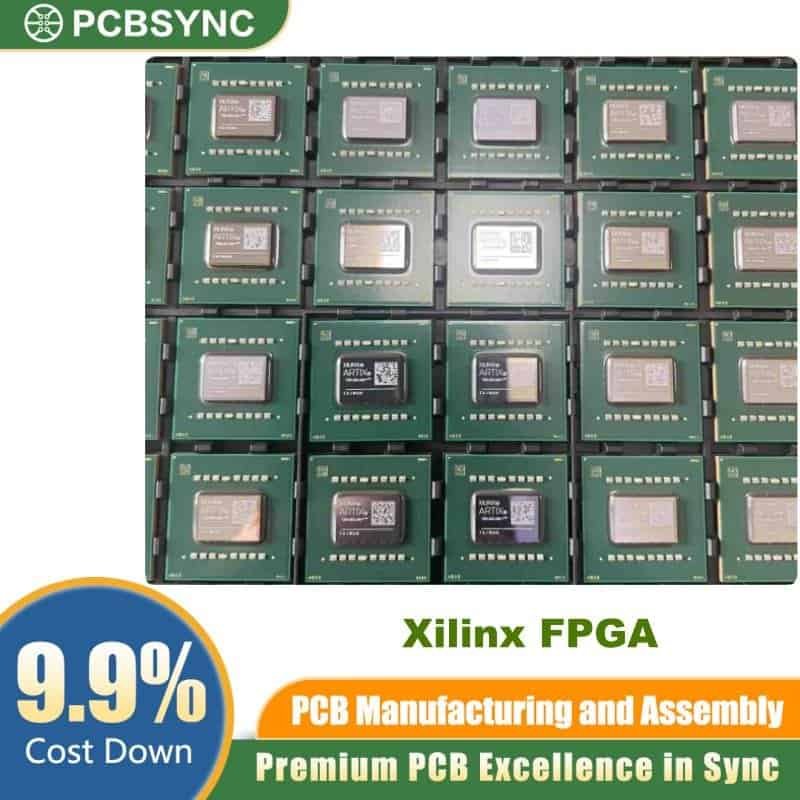
The XC2S200-6FGG1145C is a high-performance Field Programmable Gate Array (FPGA) from Xilinx’s Spartan-II family. Combining 200,000 system gates, 5,292 logic cells, and a large 1,145-ball Fine-Pitch BGA package, this device is engineered for engineers and system designers who need a cost-effective, flexible programmable logic solution. Whether you are prototyping complex digital systems, building industrial control hardware, or developing telecommunications equipment, the XC2S200-6FGG1145C delivers the capacity and speed your project demands.
For a complete range of compatible programmable devices, visit Xilinx FPGA.
What Is the XC2S200-6FGG1145C? – Overview of the Xilinx Spartan-II FPGA
The XC2S200-6FGG1145C belongs to Xilinx’s Spartan-II FPGA family, a product line originally developed as a high-volume, low-cost alternative to mask-programmed ASICs. The XC2S200 core device integrates 200,000 equivalent system gates into a 28×42 Configurable Logic Block (CLB) array, offering substantial programmable resources in a compact silicon footprint.
The -6 speed grade suffix indicates this is the fastest commercially rated variant in the Spartan-II lineup — the -6 speed grade is exclusively available in the Commercial temperature range (0°C to +85°C). The FGG1145 package descriptor denotes a 1,145-ball Fine-Pitch Ball Grid Array (FBGA) with lead-free (Pb-free) packaging (the double “G” indicates RoHS-compliant green packaging). The trailing C confirms Commercial temperature operation.
This combination makes the XC2S200-6FGG1145C the top-speed, maximum-I/O, Pb-free variant of the XC2S200 device — ideal for high-density PCB designs requiring abundant connectivity pins and maximum clock throughput.
XC2S200-6FGG1145C Key Specifications at a Glance
| Parameter |
Value |
| Manufacturer |
Xilinx (now AMD) |
| Product Family |
Spartan-II FPGA |
| Part Number |
XC2S200-6FGG1145C |
| System Gates |
200,000 |
| Logic Cells |
5,292 |
| CLB Array |
28 × 42 |
| Total CLBs |
1,176 |
| Max User I/O Pins |
284 |
| Distributed RAM |
75,264 bits |
| Block RAM |
56K bits (7 × 8K blocks) |
| Technology Node |
0.18 µm |
| Core Voltage |
2.5V |
| Package Type |
Fine-Pitch BGA (FBGA) |
| Package Code |
FGG1145 |
| Pin Count |
1,145 balls |
| Speed Grade |
-6 (fastest commercial grade) |
| Max System Clock |
263 MHz |
| Temperature Range |
Commercial (0°C to +85°C) |
| RoHS / Pb-Free |
Yes (FGG = Pb-free package) |
Detailed Technical Specifications of the XC2S200-6FGG1145C
## Programmable Logic Resources
The heart of the XC2S200-6FGG1145C is its 1,176 Configurable Logic Blocks (CLBs) arranged in a 28-column by 42-row matrix. Each CLB contains four logic cells (slices), and each slice includes two 4-input Look-Up Tables (LUTs) and two D-type flip-flops. This architecture provides exceptional flexibility for implementing combinational and sequential logic with minimal routing overhead.
| Logic Resource |
Specification |
| CLB Array Dimensions |
28 × 42 |
| Total CLBs |
1,176 |
| Logic Cells |
5,292 |
| Equivalent System Gates |
200,000 |
| LUTs (4-input) |
4,704 |
| Flip-Flops |
4,704 |
## Memory Architecture: Distributed RAM and Block RAM
The XC2S200-6FGG1145C provides two types of on-chip memory, making it suitable for data-intensive signal processing and buffering applications.
Distributed RAM is formed by repurposing CLB LUTs as small synchronous RAM elements. With 75,264 bits of total distributed RAM, designers can implement small lookup tables, shift registers, and FIFO buffers directly within the logic fabric without consuming dedicated block RAM resources.
Block RAM consists of seven dedicated 8K-bit synchronous dual-port RAM blocks, totaling 56K bits (7,168 bytes) of true dual-port memory. Each block RAM can be configured in various aspect ratios and supports independent read and write clocks, making them ideal for cross-clock-domain buffering and high-bandwidth data storage.
| Memory Type |
Capacity |
| Distributed RAM (LUT-based) |
75,264 bits |
| Block RAM (dedicated) |
56,000 bits (56K) |
| Block RAM Blocks |
7 × 8K |
| Total On-Chip RAM |
~131,264 bits |
## I/O Architecture and Pin Specification
The FGG1145 package provides the XC2S200 device with its maximum available I/O count. The 284 maximum user I/O pins (not including the four dedicated global clock/user input pins) give system designers unmatched connectivity for interfacing with external buses, memory, sensors, and communication peripherals.
Each Input/Output Block (IOB) supports multiple I/O standards, including LVTTL, LVCMOS (3.3V, 2.5V), GTL, SSTL, and HSTL. IOBs also include programmable input delays for setup time optimization and support for 3-state outputs with configurable pull-up/pull-down resistors.
| I/O Parameter |
Value |
| Maximum User I/O |
284 |
| Dedicated Global Clock Pins |
4 |
| Supported I/O Standards |
LVTTL, LVCMOS3.3, LVCMOS2.5, GTL, GTL+, SSTL2, SSTL3, HSTL |
| Input Termination |
Programmable pull-up / pull-down |
| Output Drive Strength |
Configurable (2 mA to 24 mA) |
| 3-State Output |
Yes |
## Clock Management and Delay-Locked Loops (DLLs)
The XC2S200-6FGG1145C integrates four Delay-Locked Loops (DLLs), one at each corner of the die. The DLLs eliminate clock skew across the device, provide clock edge alignment, and support frequency synthesis (multiplication and division). This is critical for high-speed synchronous designs where clock distribution delay can compromise setup and hold time margins.
| Clock Feature |
Specification |
| DLL Count |
4 (one per corner) |
| Global Clock Networks |
4 dedicated networks |
| Max System Clock |
263 MHz |
| DLL Functions |
Clock de-skew, phase shift, frequency synthesis |
Package Information: FGG1145 Fine-Pitch BGA
### Understanding the FGG1145 Package Designation
The FGG1145 package code breaks down as follows:
- FG – Fine-Pitch BGA (ball grid array with fine ball pitch for high-density PCB mounting)
- G – Lead-free (Pb-free) RoHS-compliant solder balls
- 1145 – Total number of solder balls on the package
With 1,145 solder balls, this is the largest package available for the XC2S200 device, enabling the full complement of 284 user I/O pins alongside power, ground, and configuration signals. The fine-pitch BGA format supports high-density PCB routing and is well-suited to compact, multi-layer board designs.
| Package Parameter |
Detail |
| Package Type |
Fine-Pitch BGA (FBGA) |
| Total Balls |
1,145 |
| Lead-Free (RoHS) |
Yes |
| Recommended PCB |
High-density multi-layer |
| Soldering Method |
SMT reflow |
XC2S200-6FGG1145C vs. Other XC2S200 Package Variants
The XC2S200 device is available in multiple packages. The table below compares the key variants to help engineers select the right option for their design constraints.
| Part Number |
Package |
Pin Count |
Max User I/O |
Pb-Free |
Speed Grade |
Temp Range |
| XC2S200-6FGG1145C |
FBGA |
1,145 |
284 |
Yes |
-6 |
Commercial |
| XC2S200-6FGG456C |
FBGA |
456 |
176 |
Yes |
-6 |
Commercial |
| XC2S200-6FGG256C |
FBGA |
256 |
140 |
Yes |
-6 |
Commercial |
| XC2S200-6FG456C |
FBGA |
456 |
176 |
No |
-6 |
Commercial |
| XC2S200-6FG256C |
FBGA |
256 |
140 |
No |
-6 |
Commercial |
| XC2S200-5FGG456I |
FBGA |
456 |
176 |
Yes |
-5 |
Industrial |
| XC2S200-6PQ208C |
PQFP |
208 |
140 |
No |
-6 |
Commercial |
The XC2S200-6FGG1145C is the clear choice when maximum I/O count (284 pins) and RoHS compliance are both required in a Commercial temperature application.
Spartan-II Family Comparison: Where Does the XC2S200 Fit?
The Spartan-II family spans six device densities. The XC2S200 is the largest and most capable member of the family.
| Device |
Logic Cells |
System Gates |
CLB Array |
Max User I/O |
Distributed RAM |
Block RAM |
| XC2S15 |
432 |
15,000 |
8 × 12 |
86 |
6,144 bits |
16K |
| XC2S30 |
972 |
30,000 |
12 × 18 |
92 |
13,824 bits |
24K |
| XC2S50 |
1,728 |
50,000 |
16 × 24 |
176 |
24,576 bits |
32K |
| XC2S100 |
2,700 |
100,000 |
20 × 30 |
176 |
38,400 bits |
40K |
| XC2S150 |
3,888 |
150,000 |
24 × 36 |
260 |
55,296 bits |
48K |
| XC2S200 |
5,292 |
200,000 |
28 × 42 |
284 |
75,264 bits |
56K |
The XC2S200-6FGG1145C represents the pinnacle of the Spartan-II lineup — delivering the greatest gate count, highest logic cell density, most I/O, and largest on-chip memory of any device in the family.
Key Features and Benefits of the XC2S200-6FGG1145C
### Superior ASIC Alternative with In-Field Reprogrammability
The Spartan-II FPGA was designed from the ground up as a direct substitute for mask-programmed ASICs. Unlike ASICs, the XC2S200-6FGG1145C eliminates non-recurring engineering (NRE) costs, removes lengthy silicon tape-out timelines, and enables in-field design updates without hardware replacement — a critical advantage during product iteration cycles.
### High-Speed -6 Commercial Grade Performance
The -6 speed grade is the fastest rating available in the Spartan-II Commercial range, supporting a maximum system clock of 263 MHz. With four on-chip DLLs providing zero-skew clock distribution, the device can reliably implement high-speed synchronous digital designs including pipelined DSP cores, high-bandwidth memory controllers, and fast serial communication logic.
### Extensive On-Chip Memory for Data-Intensive Applications
With 75,264 bits of distributed RAM and 56K bits of true dual-port block RAM, the XC2S200-6FGG1145C can store lookup tables, coefficient arrays, FIFOs, and data buffers entirely on-chip, reducing dependence on external memory devices and improving system latency.
### Maximum I/O Flexibility with 284 User Pins
The 1,145-ball FGG package unlocks the full 284-pin user I/O capability of the XC2S200. Multi-standard IOBs support a wide range of interface voltages and signaling standards — including LVTTL, LVCMOS, GTL+, SSTL, and HSTL — making it straightforward to interface with external processors, memory buses, ADCs/DACs, and communication PHYs.
### RoHS-Compliant Lead-Free Packaging
The double-G in FGG1145 confirms this part uses Pb-free solder balls, meeting RoHS and WEEE environmental compliance requirements. This makes the XC2S200-6FGG1145C suitable for consumer electronics, medical equipment, and any application subject to European or international environmental regulations.
Typical Applications for the XC2S200-6FGG1145C
The XC2S200-6FGG1145C is well-suited to a broad range of demanding digital system applications:
| Application Area |
Use Case Examples |
| Telecommunications |
Protocol bridging, framing logic, line-card control |
| Industrial Automation |
Motor control, PLCs, sensor fusion, fieldbus interfaces |
| Signal Processing |
FIR/IIR filters, FFT engines, video processing pipelines |
| Data Communications |
Ethernet MAC/PHY bridging, bus protocol converters |
| Embedded Computing |
Co-processor logic, custom instruction accelerators |
| Test & Measurement |
Logic analyzers, signal generators, protocol analyzers |
| Aerospace & Defense |
Radiation-tolerant logic emulation, embedded control |
| Consumer Electronics |
Image processing, display controllers, audio DSP |
Design and Development Tool Support
The XC2S200-6FGG1145C is supported by Xilinx (AMD) design tools. Designers typically use the following workflow:
- Design Entry: VHDL, Verilog, or schematic capture via Vivado Design Suite or legacy ISE Design Suite
- Synthesis: Xilinx XST or third-party synthesizers (Synplify, Design Compiler)
- Implementation: Place & Route within ISE (recommended for Spartan-II legacy devices)
- Configuration: JTAG (IEEE 1149.1 Boundary Scan), Master/Slave Serial, SelectMAP parallel configuration modes
- Simulation: ModelSim, Vivado Simulator, Aldec Active-HDL
Ordering Information and Part Number Decoder
Understanding the XC2S200-6FGG1145C part number fully:
| Code Segment |
Meaning |
| XC |
Xilinx product prefix |
| 2S |
Spartan-II family |
| 200 |
200,000 equivalent system gates |
| -6 |
Speed grade 6 (fastest commercial) |
| FGG |
Fine-Pitch BGA, Pb-free (lead-free) |
| 1145 |
1,145 solder ball count |
| C |
Commercial temperature range (0°C to +85°C) |
Frequently Asked Questions (FAQ)
Q: What is the maximum operating frequency of the XC2S200-6FGG1145C?
A: The -6 speed grade supports a maximum system clock of 263 MHz, making it the fastest Spartan-II variant available in the Commercial temperature range.
Q: Is the XC2S200-6FGG1145C RoHS compliant?
A: Yes. The double “G” in FGG1145 indicates Pb-free, lead-free solder balls, confirming full RoHS and environmental compliance.
Q: How many I/O pins does the XC2S200-6FGG1145C have?
A: The device supports up to 284 user I/O pins in the FGG1145 package, plus four dedicated global clock/user input pins.
Q: What is the difference between XC2S200-6FGG1145C and XC2S200-6FGG456C?
A: Both share the same XC2S200 silicon core and -6 speed grade, but the FGG1145 package (1,145 balls) exposes the full 284-pin I/O count, while the FGG456 package (456 balls) is limited to 176 user I/O pins. Choose FGG1145 when maximum connectivity is required.
Q: What design tools support the XC2S200-6FGG1145C?
A: The device is fully supported by Xilinx ISE Design Suite. While AMD’s newer Vivado tool primarily targets UltraScale and 7-series devices, ISE remains the recommended toolchain for Spartan-II legacy designs.
Q: Can the XC2S200-6FGG1145C replace an ASIC?
A: Yes. Xilinx designed the Spartan-II family specifically as a cost-effective, reconfigurable alternative to mask-programmed ASICs, eliminating NRE costs and enabling in-field design updates.
Summary: Why Choose the XC2S200-6FGG1145C?
The XC2S200-6FGG1145C is the definitive high-I/O, high-speed, RoHS-compliant variant of the Xilinx Spartan-II XC2S200 FPGA. With 200,000 system gates, 5,292 logic cells, 284 user I/O pins, 131K bits of combined on-chip memory, four DLLs, and a 263 MHz maximum clock frequency, it provides a complete and flexible programmable logic platform for engineers across telecommunications, industrial, consumer, and embedded computing applications. Its Pb-free FGG1145 package ensures regulatory compliance while delivering the maximum connectivity the XC2S200 silicon can offer.
For engineers sourcing Xilinx programmable devices for new designs or production replenishment, the XC2S200-6FGG1145C remains a proven, well-documented solution backed by decades of field deployment and comprehensive datasheet support.