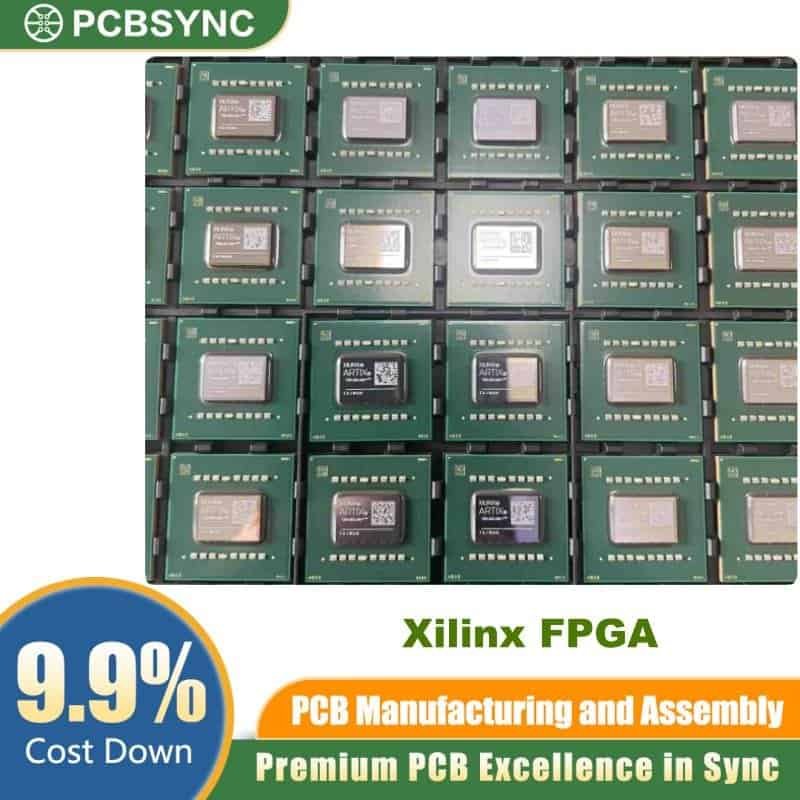
The XC3S400-FT256EGQ is a high-performance, cost-optimized Field-Programmable Gate Array (FPGA) from Xilinx’s (now AMD) Spartan-3 family. Designed for high-volume, cost-sensitive applications, this device delivers powerful programmable logic in a compact 256-ball Fine-Pitch Thin Ball Grid Array (FTBGA) package. Whether you are developing broadband access equipment, digital television systems, or industrial control solutions, the XC3S400-FT256EGQ provides an ideal balance of logic density, I/O flexibility, and cost efficiency.
As one of the most versatile Xilinx FPGA devices in the Spartan-3 lineup, the XC3S400-FT256EGQ builds on the proven Spartan-IIE architecture while integrating enhancements drawn directly from Virtex-II platform technology — delivering more functionality and bandwidth per dollar than ever before.
What Is the XC3S400-FT256EGQ?
The XC3S400-FT256EGQ is a member of the Xilinx Spartan-3 FPGA family, a series engineered specifically for high-volume, cost-sensitive electronic applications. The part number breaks down as follows:
| Field |
Meaning |
| XC3S |
Xilinx Spartan-3 Family |
| 400 |
400K equivalent system gates |
| FT |
Fine-Pitch Thin BGA package type |
| 256 |
256-ball package |
| E |
Extended temperature (or variant indicator) |
| G |
Pb-free (RoHS-compliant) package |
| Q |
Automotive / specific qualification grade |
This device is produced using a 90nm CMOS process technology, operates at a 1.2V core voltage, and is well-suited to replace mask-programmed ASICs without the associated high NRE costs or lengthy development cycles.
XC3S400-FT256EGQ Key Specifications
Core Logic Resources
| Parameter |
Value |
| Equivalent System Gates |
400,000 |
| Logic Cells (CLB Slices) |
8,064 |
| Configurable Logic Blocks (CLBs) |
896 |
| CLB Array Size |
32 x 28 |
| Flip-Flops |
7,168 |
| Max Distributed RAM |
56 Kbits |
Memory Resources
| Parameter |
Value |
| Block RAM Capacity |
288 Kbits |
| Number of Block RAM Blocks |
16 |
| Block RAM Size per Block |
18 Kbits |
DSP and Clock Resources
| Parameter |
Value |
| Dedicated Multipliers (18×18) |
16 |
| Digital Clock Managers (DCMs) |
4 |
| Max Clock Frequency |
630 MHz |
I/O and Package
| Parameter |
Value |
| Package Type |
FTBGA (Fine-Pitch Thin Ball Grid Array) |
| Total Balls |
256 |
| Max User I/O Pins |
173 |
| I/O Banks |
Multiple (supports diverse voltage standards) |
| Package Body Size |
17 × 17 mm |
| Ball Pitch |
1.0 mm |
Electrical Characteristics
| Parameter |
Value |
| Core Supply Voltage (VCCINT) |
1.2V |
| Auxiliary Supply Voltage (VCCAUX) |
2.5V |
| I/O Supply Voltage (VCCO) |
1.2V – 3.3V (bank configurable) |
| Process Technology |
90nm CMOS |
| Standby Current (Typical) |
Low (varies by configuration) |
XC3S400-FT256EGQ: Supported I/O Standards
The XC3S400-FT256EGQ supports a broad range of single-ended and differential I/O standards, giving designers maximum flexibility when interfacing with external components and buses.
| I/O Standard Category |
Supported Standards |
| Single-Ended |
LVTTL, LVCMOS 3.3V/2.5V/1.8V/1.5V, PCI |
| Differential |
LVDS, BLVDS, LVPECL, RSDS |
| Stub-Series Terminated Logic |
SSTL 2/18 Class I and II |
| High-Speed Transceiver Logic |
HSTL Class I, II, III, IV |
| Digitally Controlled Impedance (DCI) |
Supported on select banks |
XC3S400-FT256EGQ: Five Programmable Functional Elements
The Spartan-3 architecture, including the XC3S400-FT256EGQ, is built around five key programmable elements that work together to deliver flexible, high-performance logic:
1. Configurable Logic Blocks (CLBs)
CLBs form the core logic fabric. Each CLB contains four slices, and each slice contains two 4-input Look-Up Tables (LUTs), two storage elements (flip-flops or latches), and carry and arithmetic logic. The 896 CLBs in the XC3S400 provide 8,064 logic cells for implementing combinatorial and sequential digital functions.
2. Input/Output Blocks (IOBs)
Each IOB supports three signal paths: input, output, and 3-state (tri-state). All paths include dedicated storage elements that can function as registers or latches, enabling Double Data Rate (DDR) I/O. The 173 user I/Os in the FT256 package support a wide array of single-ended and differential standards.
3. Block RAM (BRAM)
The XC3S400-FT256EGQ includes 16 dedicated 18-Kbit block RAMs, totaling 288 Kbits of on-chip memory. These dual-port RAMs can be configured as single-port or dual-port memories and are ideal for FIFO buffers, lookup tables, and data storage in embedded applications.
4. Dedicated Multipliers
Sixteen dedicated 18×18 signed multipliers are embedded alongside the Block RAMs. These hardware multipliers enable high-throughput DSP operations — such as filtering, correlation, and convolution — without consuming CLB logic resources.
5. Digital Clock Managers (DCMs)
Four DCMs provide fully digital, fully programmable clock management. DCMs can perform clock frequency synthesis (multiply/divide), phase shifting, and skew elimination, enabling precise timing control across the entire device.
Configuration Options for XC3S400-FT256EGQ
The XC3S400-FT256EGQ supports five standard configuration modes, giving system designers flexibility in how and when the FPGA is programmed at power-up:
| Configuration Mode |
Description |
| Master Serial |
Reads configuration from a serial PROM |
| Slave Serial |
Receives bitstream from an external controller |
| Master Parallel (SelectMAP) |
High-speed parallel configuration from a PROM |
| Slave Parallel (SelectMAP) |
Parallel configuration from an external processor |
| JTAG Boundary Scan |
IEEE 1149.1 compliant, ideal for debugging and production test |
Configuration data is stored in Xilinx XCF-series Platform Flash PROMs or other non-volatile memories. The recommended PROM for the XC3S400 is the XCF02S (1.7 Mbit), which fits the device’s configuration bitstream requirements.
Typical Applications of the XC3S400-FT256EGQ
The XC3S400-FT256EGQ is designed for high-volume, cost-sensitive markets where programmable logic offers clear advantages over ASICs in terms of flexibility, time-to-market, and total cost.
Consumer Electronics
- Digital television (DTV) decoders and set-top boxes
- Display and projection equipment
- Home networking and broadband access devices
Industrial and Embedded Systems
- Motor control and industrial automation
- Embedded co-processing alongside microcontrollers or DSPs
- Protocol bridging (UART, SPI, I2C, custom buses)
Communications
- Packet processing and switching fabric
- Physical-layer interface logic
- Line card and backplane control
Automotive (with appropriate variant)
- Body electronics
- Infotainment systems
- Driver assistance logic
XC3S400-FT256EGQ vs. Other Spartan-3 Variants
| Part Number |
Gates |
Logic Cells |
Block RAM |
Max I/O |
Package |
| XC3S200-FT256 |
200K |
4,320 |
144 Kbits |
173 |
256-ball FTBGA |
| XC3S400-FT256EGQ |
400K |
8,064 |
288 Kbits |
173 |
256-ball FTBGA |
| XC3S1000-FT256 |
1,000K |
17,280 |
432 Kbits |
173 |
256-ball FTBGA |
| XC3S1500-FT256 |
1,500K |
29,952 |
576 Kbits |
173 |
256-ball FTBGA |
The XC3S400-FT256EGQ occupies the sweet spot for mid-density designs that need more logic than the XC3S200 but fit within the same compact 256-ball FTBGA footprint. This makes PCB re-use and migration between density grades exceptionally straightforward.
Ordering Information
| Parameter |
Value |
| Manufacturer |
Xilinx (AMD) |
| Part Number |
XC3S400-FT256EGQ |
| Manufacturer Series |
Spartan-3 |
| Package |
256-Ball FTBGA |
| Mounting Type |
Surface Mount |
| Operating Temperature |
Extended / Automotive (per suffix) |
| RoHS Compliance |
Pb-free (G suffix) |
| Configuration Bitstream Size |
~1.7 Mbit (XCF02S PROM recommended) |
Why Choose the XC3S400-FT256EGQ?
✔ Cost-Optimized for High Volume
The Spartan-3 family was designed from the ground up for high-volume cost-sensitive applications. The XC3S400-FT256EGQ provides competitive gate density and memory at a price point that makes it viable even in consumer products.
✔ ASIC Replacement Without NRE
Unlike mask-programmed ASICs, the XC3S400-FT256EGQ eliminates costly non-recurring engineering (NRE) fees and removes the risk of silicon respins. Designs can be updated in the field simply by loading a new configuration bitstream.
✔ Compact BGA Footprint
The 256-ball FTBGA (17×17mm, 1.0mm pitch) package allows integration into space-constrained PCB designs. Its footprint is compatible across multiple density grades in the Spartan-3 FT256 family, enabling simple density scaling.
✔ Proven 90nm Process Technology
Manufactured on a mature and stable 90nm CMOS process, the XC3S400-FT256EGQ benefits from a well-characterized supply chain and broad industry support, including ISE Design Suite from Xilinx.
✔ Rich Ecosystem and Tool Support
Xilinx ISE Design Suite provides complete synthesis, implementation, and simulation support for the Spartan-3 family. IP cores, reference designs, and application notes are widely available from Xilinx and the broader FPGA community.
Frequently Asked Questions (FAQ)
Q: What is the difference between XC3S400-FT256EGQ and XC3S400-4FT256C? Both devices are Spartan-3 400K-gate FPGAs in the 256-ball FTBGA package. The “-4” in XC3S400-4FT256C refers to the speed grade (commercial temperature, standard speed). The “EGQ” suffix in XC3S400-FT256EGQ indicates a Pb-free, extended or automotive-qualified variant. Always verify the exact suffix requirements with your distribution partner.
Q: What PROM should I use to configure the XC3S400-FT256EGQ? Xilinx recommends the XCF02S (1.7 Mbit) Platform Flash PROM for the XC3S400 configuration bitstream. Alternatively, SPI Flash devices and parallel NOR Flash chips can be used in slave mode.
Q: Is the XC3S400-FT256EGQ pin-compatible with other Spartan-3 FT256 devices? Yes. The Spartan-3 FT256 package is consistent across multiple density grades (XC3S200, XC3S400, XC3S1000, XC3S1500), allowing straightforward density migration on existing PCB designs.
Q: What design tools support the XC3S400-FT256EGQ? The device is fully supported by Xilinx ISE Design Suite. Third-party synthesis tools including Synopsys Synplify and Mentor ModelSim also support Spartan-3 devices.
Q: What is the core voltage for the XC3S400-FT256EGQ? The core voltage (VCCINT) is 1.2V. The auxiliary supply (VCCAUX) is 2.5V, and I/O bank voltages (VCCO) are configurable from 1.2V to 3.3V depending on the I/O standard in use.