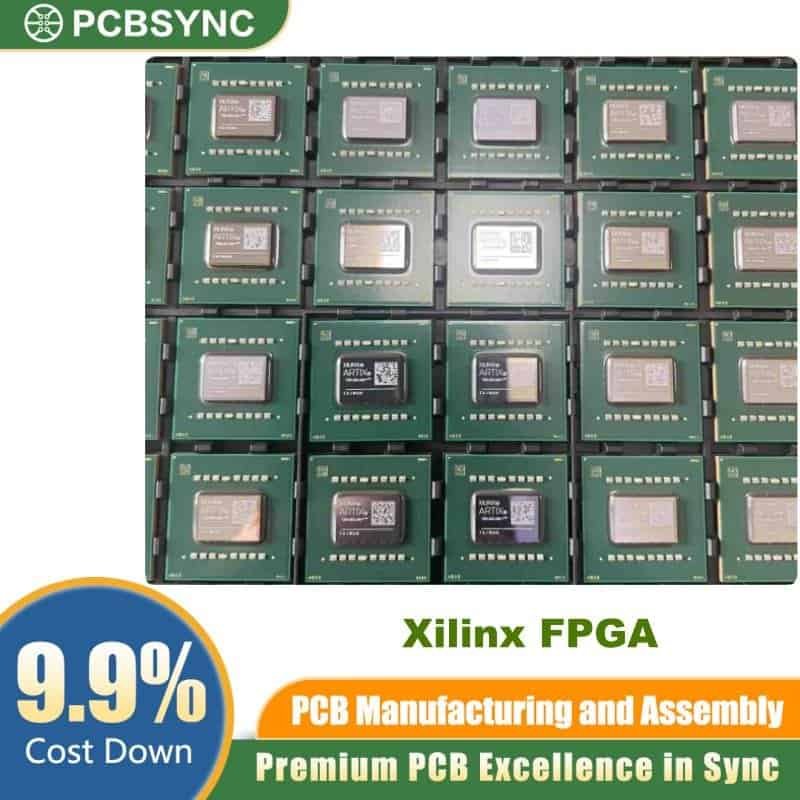
The XC3S5000-5FGG676C is a high-density, cost-effective Field-Programmable Gate Array (FPGA) from Xilinx’s Spartan-3 family. Built on 90nm process technology and housed in a compact 676-pin Fine-Pitch Ball Grid Array (FBGA) package, this device delivers up to 5 million system gates and 74,880 logic cells — making it one of the most capable members of the Spartan-3 lineup. Whether you’re designing for broadband access, home networking, digital television, or display/projection systems, the XC3S5000-5FGG676C offers the performance and flexibility modern applications demand.
For a broader selection of programmable logic solutions, explore our full catalog of Xilinx FPGA products.
What Is the XC3S5000-5FGG676C?
The XC3S5000-5FGG676C is a member of Xilinx’s Spartan-3 FPGA family — a product line specifically engineered to serve high-volume, cost-sensitive consumer electronics markets. The device code breaks down as follows:
- XC3S5000 – Spartan-3 series, 5 million gate density
- -5 – Speed grade 5 (725 MHz internal performance)
- FGG676 – Fine-Pitch BGA package, 676 pins, lead-free (RoHS compliant)
- C – Commercial temperature range (0°C to +85°C)
This FPGA is an ideal alternative to mask-programmed ASICs, eliminating the high upfront tooling cost and offering full in-field reconfigurability — something ASICs simply cannot provide.
XC3S5000-5FGG676C Key Specifications
General Electrical & Logic Parameters
| Parameter |
Value |
| Manufacturer |
AMD / Xilinx |
| Part Number |
XC3S5000-5FGG676C |
| FPGA Family |
Spartan-3 |
| System Gates |
5,000,000 (5M) |
| Logic Cells |
74,880 |
| Technology Node |
90nm |
| Core Supply Voltage (VCCINT) |
1.2V |
| I/O Supply Voltage (VCCO) |
1.2V to 3.3V |
| Auxiliary Supply (VCCAUX) |
2.5V |
| Operating Temperature |
0°C to +85°C (Commercial) |
| Internal Clock Speed |
Up to 725 MHz |
| System Clock Rate |
Up to 326 MHz |
Package & Mechanical Specifications
| Parameter |
Value |
| Package Type |
FBGA (Fine-Pitch Ball Grid Array) |
| Package Code |
FGG676 |
| Pin Count |
676 |
| Lead-Free (RoHS) |
Yes (G in package code) |
| Mounting Type |
Surface Mount |
| Package Dimensions |
Refer to DS099 datasheet |
XC3S5000-5FGG676C Logic & Memory Resources
Configurable Logic Block (CLB) Resources
The Spartan-3 architecture divides logic into Configurable Logic Blocks (CLBs), each containing slices with 4-input Look-Up Tables (LUTs) and D flip-flops. The XC3S5000 leverages the largest CLB array in the Spartan-3 standard family.
| Resource |
XC3S5000 |
| System Gates |
5,000,000 |
| Logic Cells |
74,880 |
| CLB Slices |
33,280 |
| Distributed RAM |
Up to 520 Kbits |
| Total Block RAM |
Up to 1,872 Kbits |
| Block RAM Blocks |
104 × 18Kbit |
| Dedicated Multipliers (18×18) |
104 |
| Digital Clock Managers (DCMs) |
4 |
I/O Capabilities
| Parameter |
Value |
| Maximum User I/O Pins |
489 (FGG676 package) |
| Maximum Data Rate per I/O |
622 Mb/s |
| Single-Ended Signal Standards |
17 |
| Differential Signal Standards |
7 (including LVDS) |
| Impedance Control |
Digitally Controlled Impedance (DCI) |
| Signal Voltage Swing |
1.14V to 3.45V |
| Double Data Rate (DDR) Support |
Yes |
XC3S5000-5FGG676C Architecture Deep Dive
H3: Five Fundamental Programmable Elements
The Spartan-3 family is built around five core architectural blocks that work together to deliver flexible, high-performance digital logic:
1. Configurable Logic Blocks (CLBs) CLBs are the primary logic resource. Each CLB contains four slices, and each slice houses two 4-input LUTs, two storage elements (flip-flops or latches), wide multiplexer logic, and fast carry logic. LUTs can also be used as 16-bit shift registers (SRL16), adding significant flexibility for DSP and control path designs.
2. Block RAM (BRAM) The XC3S5000 includes 104 dual-port 18Kbit Block RAM modules, totaling 1,872 Kbits. Each BRAM supports independent read and write widths on ports A and B, and is paired with a dedicated 18×18-bit multiplier — making this FPGA highly capable for DSP-heavy applications.
3. Dedicated 18×18-Bit Multipliers Each of the 104 multiplier blocks is hardwired adjacent to a block RAM. These multipliers operate at high clock frequencies and are essential for applications such as signal processing, filtering, and video pipeline acceleration.
4. Digital Clock Managers (DCMs) Four DCMs provide robust clock management capabilities including Delay-Locked Loop (DLL) functions, Digital Frequency Synthesis (DFS), and programmable phase shifting. DCMs enable the XC3S5000 to generate, multiply, divide, phase-shift, and distribute clock signals with minimal jitter.
5. SelectIO™ I/O Blocks Each I/O Bank supports a rich set of single-ended and differential standards. The Digitally Controlled Impedance (DCI) feature eliminates the need for external termination resistors, reducing BOM cost and board complexity.
H3: Clock and Interconnect Architecture
The XC3S5000-5FGG676C supports a hierarchical interconnect system comprising:
- Long Lines – Spanning the full width or height of the device for low-skew signal distribution
- Hex Lines – Connecting CLBs within a local region with minimal delay
- Double Lines – Short-distance connections for adjacent CLBs
- Direct Lines – Zero-delay connections between immediately neighboring CLBs
Eight global clock buffers (BUFGMUXes) feed clock signals throughout the device from the four DCMs. This ensures timing closure across large, high-frequency designs.
Supported I/O Standards
The XC3S5000-5FGG676C supports an extensive set of industry-standard I/O interfaces, enabling seamless integration with DDR memory, high-speed buses, and differential signal networks.
Single-Ended Standards
| Standard |
Drive Options |
| LVCMOS (1.2V, 1.5V, 1.8V, 2.5V, 3.3V) |
2, 4, 6, 8, 12, 16, 24 mA |
| LVTTL |
2, 4, 6, 8, 12, 16, 24 mA |
| HSTL Class I, II, III, IV |
DCI Supported |
| SSTL 2 Class I & II |
DCI Supported |
| SSTL 18 Class I & II |
DCI Supported |
| GTL, GTLP |
Supported |
Differential Standards
| Standard |
Description |
| LVDS |
Low-Voltage Differential Signaling |
| LVPECL |
Low-Voltage Positive Emitter-Coupled Logic |
| BLVDS |
Bus LVDS for multi-point applications |
| ULVDS |
Ultra Low-Voltage Differential Signaling |
| LDT |
Lightning Data Transport |
| HSTL Differential |
High-Speed Transceiver Logic |
| SSTL Differential |
Stub Series Terminated Logic |
Configuration Options for XC3S5000-5FGG676C
The XC3S5000-5FGG676C supports five standard configuration modes, providing maximum flexibility for system integration:
| Configuration Mode |
Description |
| Master Serial |
FPGA reads bitstream from serial PROM |
| Slave Serial |
External controller loads bitstream serially |
| Master Parallel (SelectMAP) |
FPGA reads bitstream from parallel PROM |
| Slave Parallel (SelectMAP) |
External controller loads bitstream in parallel |
| JTAG (Boundary Scan) |
IEEE 1149.1/1532 compliant in-system programming |
Configuration data is stored in reprogrammable static CMOS Configuration Latches (CCLs) — ensuring reliable retention without power while allowing fast, repeatable reconfiguration.
Typical Applications
The combination of 5M gates, abundant block RAM, dedicated multipliers, and rich I/O support makes the XC3S5000-5FGG676C well-suited for:
| Application Area |
Relevant Features Used |
| Broadband Access Equipment |
High I/O count, DDR, high-speed serial |
| Home Networking Gateways |
CLB logic density, LVDS interfaces |
| Digital Television / Set-Top Boxes |
DCMs, multipliers, large block RAM |
| Display & Projection Controllers |
SelectIO, distributed RAM, fast clocking |
| Industrial Control Systems |
Robust I/O standards, DCI, JTAG support |
| Embedded Processing |
Soft-core CPU (MicroBlaze), BRAM, multipliers |
| Digital Signal Processing |
104 hardware multipliers, distributed RAM |
| Prototype / ASIC Emulation |
Full logic density, in-circuit reconfigurability |
Ordering Information & Part Number Variants
XC3S5000 FGG676 Speed & Temperature Variants
| Part Number |
Speed Grade |
Temperature Range |
I/O Supply |
| XC3S5000-4FGG676C |
-4 (630 MHz) |
Commercial (0°C to +85°C) |
1.2V–3.3V |
| XC3S5000-4FGG676I |
-4 (630 MHz) |
Industrial (-40°C to +100°C) |
1.2V–3.3V |
| XC3S5000-5FGG676C |
-5 (725 MHz) |
Commercial (0°C to +85°C) |
1.2V–3.3V |
XC3S5000 in Other Package Options
| Part Number |
Package |
Pin Count |
Notes |
| XC3S5000-5FG900C |
FBGA |
900 |
Higher I/O count |
| XC3S5000-5FGG676C |
FBGA |
676 |
This product |
| XC3S5000-5FGG1156C |
FBGA |
1156 |
Maximum I/O (discontinued) |
Note: The FGG1156 package has been discontinued by AMD/Xilinx. The FGG676 package remains the recommended high-density option for new designs.
Design Tools & Development Support
Recommended Xilinx/AMD Tools
- Xilinx ISE Design Suite – The primary legacy toolchain for Spartan-3 devices (synthesis, implementation, bitstream generation)
- iMPACT – Configuration and JTAG programming tool included in ISE
- ChipScope Pro – In-system logic analysis and debugging
- System Generator for DSP – MATLAB/Simulink integration for DSP design
- PlanAhead – Floorplanning and physical design tool
The XC3S5000-5FGG676C is not supported in Vivado Design Suite, which targets newer 7-Series and UltraScale devices. Use Xilinx ISE 14.7 (the final ISE release) for Spartan-3 design flows.
FPGA Programming Hardware
Compatible JTAG programming cables include the Xilinx Platform Cable USB II and third-party equivalents. The XC3S5000 also supports JTAG-based boundary-scan testing per IEEE 1149.1.
Why Choose XC3S5000-5FGG676C Over an ASIC?
| Factor |
XC3S5000-5FGG676C FPGA |
Mask-Programmed ASIC |
| NRE Cost |
None |
$500K–$5M+ |
| Time to Market |
Days (reprogram existing board) |
6–18 months |
| Design Changes |
In-field reconfigurability |
Requires new silicon spin |
| Volume Scalability |
Flexible |
Optimized only at very high volume |
| Prototyping |
Ideal |
Not practical |
| Logic Density |
5M gates |
Comparable but fixed |
For mid-volume productions and applications that require iterative development or post-deployment updates, the XC3S5000-5FGG676C represents a compelling value proposition against ASIC alternatives.
Compliance & Environmental Information
| Attribute |
Detail |
| RoHS Compliance |
Yes (Pb-free, “G” in package code) |
| Halogen-Free |
Refer to product eco-declaration |
| ECCN |
EAR99 (check for current export classification) |
| REACH Compliance |
Compliant |
| MSL (Moisture Sensitivity Level) |
Refer to AMD/Xilinx packaging documentation |
Frequently Asked Questions (FAQ)
Q: What is the maximum operating frequency of the XC3S5000-5FGG676C? The internal logic can run up to 725 MHz for the -5 speed grade, while the system clock rate through the DCMs is typically up to 326 MHz in typical designs.
Q: How many user I/O pins does the FGG676 package provide? The FGG676 package provides up to 489 user I/O pins for the XC3S5000 device.
Q: Is the XC3S5000-5FGG676C recommended for new designs? Yes. As of the most recent Xilinx/AMD notices, this product IS recommended for new designs (confirmed in DS099 Rev 3.1). However, designers building brand-new systems may also evaluate newer Spartan-7 or Artix-7 devices for lower power and updated tool support.
Q: What FPGA development board works with this device? Common boards that have historically used Spartan-3 FPGAs include the Digilent Nexys series and Basys boards. Custom boards using the FGG676 package footprint are also straightforward to design given the well-documented BGA layout guidelines.
Q: Does the XC3S5000-5FGG676C support DDR memory interfaces? Yes. The device supports Double Data Rate (DDR) I/O at up to 622 Mb/s per pin, enabling direct interfacing with DDR SDRAM memory modules.
Summary
The XC3S5000-5FGG676C is a production-proven, high-density FPGA delivering 5 million system gates in a compact 676-pin BGA package. With 74,880 logic cells, 1,872 Kbits of block RAM, 104 dedicated hardware multipliers, four DCMs, and support for 17 single-ended and 7 differential I/O standards, it provides everything engineers need for complex digital designs in a cost-effective, reconfigurable platform. Built on Xilinx’s 90nm Spartan-3 architecture and supported by ISE Design Suite, this part continues to serve industrial, consumer, and communications applications worldwide.