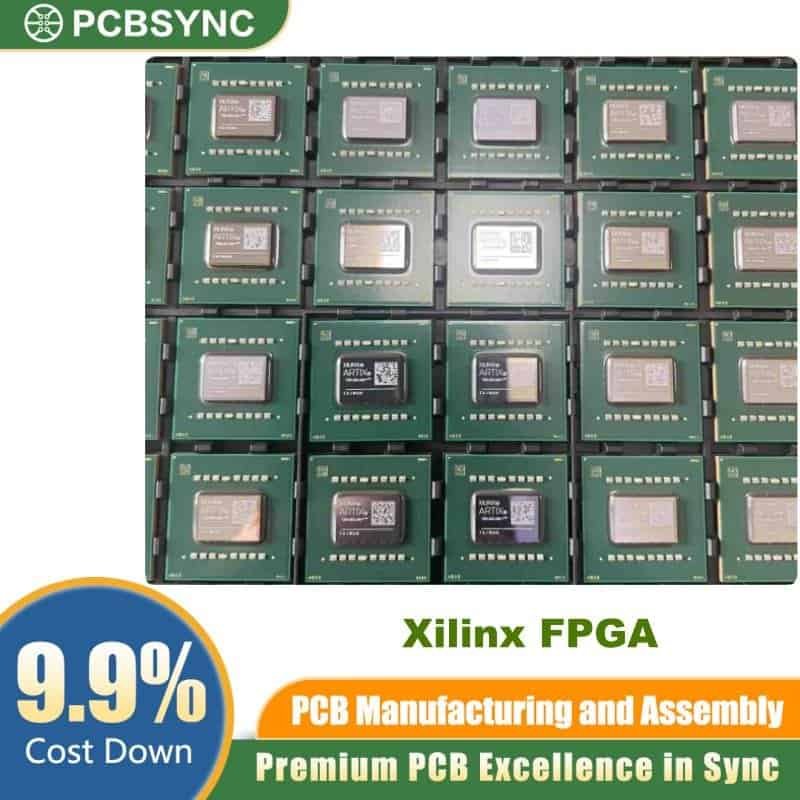
The XC3S50-4CP132I is a low-cost, high-performance field-programmable gate array (FPGA) from Xilinx’s Spartan-3 family. Designed for high-volume, cost-sensitive applications, this device delivers 50,000 system gates in a compact 132-pin CSBGA (chip-scale ball grid array) package. Whether you are building embedded systems, communications hardware, or consumer electronics, the XC3S50-4CP132I offers the programmable logic density, I/O flexibility, and industrial-grade reliability your design demands.
What Is the XC3S50-4CP132I?
The XC3S50-4CP132I belongs to the Xilinx Spartan-3 series, one of the most widely deployed FPGA families in the industry. The part number breaks down as follows:
- XC3S50 – Spartan-3 family, 50K system gate density
- -4 – Speed grade 4 (fastest commercial speed grade for this family)
- CP132 – 132-ball CSBGA (chip-scale BGA) package
- I – Industrial temperature range (–40°C to +85°C)
This combination makes the XC3S50-4CP132I a popular choice for engineers who need a compact, rugged, and cost-efficient programmable logic device for production-volume designs. For a broader selection of programmable logic solutions, explore the full range of Xilinx FPGA devices available from trusted distributors.
XC3S50-4CP132I Key Specifications
General Device Overview
| Parameter |
Value |
| Manufacturer |
AMD Xilinx |
| Part Number |
XC3S50-4CP132I |
| Product Family |
Spartan-3 |
| Series |
XC3S |
| System Gates |
50,000 |
| Package Type |
CSBGA (Chip-Scale BGA) |
| Pin Count |
132 |
| Temperature Grade |
Industrial (–40°C to +85°C) |
| Moisture Sensitivity Level (MSL) |
3 / 168 hours |
| RoHS Compliance |
Lead-Free / RoHS Compliant options available |
Logic Resources
| Resource |
Quantity |
| Logic Cells (LCs) |
1,728 |
| Configurable Logic Blocks (CLBs) |
384 |
| Slices |
768 |
| Flip-Flops |
1,536 |
| Maximum Distributed RAM |
24 Kb |
| Block RAM (BRAM) |
72 Kb (2 × 18 Kb blocks) |
| Multiplier Blocks (18×18) |
4 |
| Digital Clock Managers (DCMs) |
2 |
I/O and Connectivity
| Parameter |
Value |
| Maximum User I/O Pins |
97 |
| I/O Banks |
4 |
| Differential I/O Pairs |
Up to 48 |
| Supported I/O Standards |
LVCMOS, LVTTL, SSTL, GTL, PCI, HSTL, LVDS, RSDS |
| Maximum I/O Voltage (VCCO) |
3.3V |
Power Supply Requirements
| Supply Rail |
Voltage |
| Core Voltage (VCCINT) |
1.2V |
| I/O Voltage (VCCO) |
1.2V – 3.3V (bank-selectable) |
| Auxiliary Voltage (VCCAUX) |
2.5V |
Speed and Timing
| Parameter |
Value |
| Speed Grade |
–4 (Fastest) |
| Maximum System Clock |
Up to ~200 MHz (design-dependent) |
| DCM Input Frequency Range |
24 MHz – 280 MHz |
| DCM Output Frequency Range |
Up to 280 MHz |
Package Dimensions
| Parameter |
Value |
| Package |
CP132 – CSBGA |
| Ball Count |
132 |
| Ball Pitch |
0.5 mm |
| Body Size |
~8 mm × 8 mm |
| Height (max) |
~1.0 mm |
XC3S50-4CP132I Features and Benefits
High-Density Logic in a Compact Footprint
The 132-ball CSBGA package with a 0.5 mm pitch provides one of the smallest footprints in the Spartan-3 family. This is ideal for space-constrained PCB designs where board real estate is at a premium, such as wearable devices, compact industrial controllers, and handheld instruments.
Industrial Temperature Rating for Harsh Environments
The “I” temperature suffix means the XC3S50-4CP132I is fully specified and guaranteed to operate reliably from –40°C to +85°C. This makes it suitable for outdoor equipment, automotive accessories, industrial automation, and other applications where ambient temperature extremes are a concern.
Flexible I/O Standard Support
With support for over a dozen I/O standards including LVDS, LVCMOS, LVTTL, PCI, SSTL, and HSTL, the XC3S50-4CP132I interfaces easily with a wide range of external memory, processors, sensors, and communication peripherals. The four independently selectable I/O banks allow mixed-voltage designs on a single device.
Embedded Block RAM and Multipliers
The integrated 72 Kb of block RAM and four 18×18 hardware multipliers allow designers to implement DSP functions, FIFOs, dual-port memories, and state machines directly in dedicated silicon resources — freeing up logic fabric for other functions.
Digital Clock Management (DCM)
Two on-chip Digital Clock Managers support clock multiplication, division, phase shifting, and deskewing. The DCM eliminates the need for external PLLs in most designs and allows the designer to generate multiple clock domains from a single input reference.
Fast Configuration and Reprogrammability
The Spartan-3 supports multiple configuration modes, including Master Serial, Slave Serial, Master SelectMAP, Slave SelectMAP, JTAG, and SPI Flash. Configuration times are fast, enabling rapid startup in systems that require quick boot sequences.
XC3S50-4CP132I vs. Comparable Spartan-3 Devices
| Part Number |
Gates |
Package |
Pins |
User I/O |
Temp Grade |
BRAM |
| XC3S50-4CP132I |
50K |
CSBGA |
132 |
97 |
Industrial |
72 Kb |
| XC3S50-4VQ100I |
50K |
VQFP |
100 |
63 |
Industrial |
72 Kb |
| XC3S200-4CP132I |
200K |
CSBGA |
132 |
97 |
Industrial |
216 Kb |
| XC3S400-4CP132I |
400K |
CSBGA |
132 |
97 |
Industrial |
288 Kb |
| XC3S50-4PQ208I |
50K |
PQFP |
208 |
124 |
Industrial |
72 Kb |
Note: The CP132 package offers the smallest footprint of all Spartan-3 packages supporting the S50 die, making the XC3S50-4CP132I the preferred choice for size-critical designs that do not require maximum I/O count.
Typical Applications of the XC3S50-4CP132I
The XC3S50-4CP132I is well-suited for a broad range of applications across multiple industries:
Embedded Control Systems
- Industrial PLCs and motion controllers
- Robotics and actuator interface logic
- Smart sensor aggregators
Communications and Networking
- Protocol conversion bridges (UART, SPI, I2C, CAN)
- Line-side interface logic
- Wireless modem front-end glue logic
Consumer and Medical Electronics
- Wearable device control logic
- Medical diagnostic instrument interfaces
- Point-of-sale terminal logic
Automotive and Transportation
- Automotive gateway modules (operating within –40°C to +85°C)
- Sensor fusion interface controllers
- LIDAR and camera pre-processing logic
Test and Measurement
- Data acquisition systems
- Automated test equipment (ATE) support logic
- Instrument front-panel controllers
Configuration Modes Supported
| Mode |
Description |
| Master Serial |
FPGA drives configuration clock, data from serial flash |
| Slave Serial |
External controller drives clock and data |
| Master SelectMAP (Parallel) |
High-speed parallel configuration from flash or processor |
| Slave SelectMAP |
External processor directly programs device |
| JTAG |
IEEE 1149.1 boundary scan and in-system programming |
| SPI Flash |
Direct configuration from standard SPI flash memory |
Supported I/O Standards
| Standard |
Type |
Max Voltage |
| LVCMOS 3.3 / 2.5 / 1.8 / 1.5 |
Single-ended |
3.3V |
| LVTTL |
Single-ended |
3.3V |
| PCI / PCI-X |
Single-ended |
3.3V |
| SSTL 2 / SSTL 3 |
Single-ended |
3.3V |
| GTL / GTL+ |
Single-ended |
1.2V |
| HSTL Class I / II |
Single-ended |
1.5V |
| LVDS |
Differential |
2.5V |
| RSDS |
Differential |
2.5V |
| BLVDS |
Differential |
2.5V |
| Mini-LVDS |
Differential |
2.5V |
Ordering Information
| Attribute |
Detail |
| Manufacturer Part Number |
XC3S50-4CP132I |
| Alternate Part Numbers |
XC3S50-4CPG132I (tray packaging variant) |
| ECCN (Export Control) |
EAR99 |
| HTS Code |
8542.39.00.01 |
| Packaging |
Tray |
| Minimum Order Quantity |
1 (check distributor) |
| Lead Time |
Varies by distributor and market availability |
Design Resources and Tools
Xilinx (now AMD) provides comprehensive development tools for the Spartan-3 family:
- ISE Design Suite – Legacy RTL synthesis, simulation, and implementation tools for Spartan-3 (Note: ISE is no longer actively developed; it supports Windows 7 and Linux environments)
- ISim / ModelSim – HDL simulation environments
- ChipScope Pro – On-chip debug and logic analysis
- IMPACT / iMPACT – Configuration programming software
- XPower Analyzer – Power estimation tool
Spartan-3 is supported through Xilinx ISE 14.7, which remains available for legacy design maintenance.
Frequently Asked Questions (FAQ)
What does the “I” suffix mean in XC3S50-4CP132I?
The “I” designates the industrial temperature grade, meaning the device is tested and guaranteed to function correctly over the full range of –40°C to +85°C. Commercial-grade parts (suffix “C”) are typically rated 0°C to +85°C.
What is the difference between XC3S50-4CP132I and XC3S50-4CPG132I?
These part numbers refer to the same die and silicon. The “G” in CPG132 typically denotes a lead-free (RoHS-compliant, green) packaging variant. Both parts are electrically and pin-compatible. Always verify with your distributor for exact RoHS/lead-free status based on date codes.
Is the XC3S50-4CP132I still in production?
The Spartan-3 family has reached end-of-life (EOL) status for new designs, though Xilinx/AMD has committed to continued supply for existing production customers through its longevity program. For new designs, Xilinx recommends migrating to the Spartan-7 family. For immediate procurement needs, authorized distributors and component brokers continue to carry XC3S50-4CP132I stock.
Can I replace XC3S50-4CP132I with a Spartan-7 device?
While the Spartan-7 family offers superior performance, lower power consumption, and modern tool support, it is not pin-compatible with Spartan-3. A redesign of the PCB and HDL logic is typically required when migrating between generations.
What programming software does the XC3S50-4CP132I use?
The XC3S50-4CP132I is programmed using Xilinx ISE Design Suite (version 14.7 is the final release). For configuration/programming hardware, the Xilinx Platform Cable USB II or a JTAG-compatible programmer is recommended.
Summary
The XC3S50-4CP132I is a proven, cost-effective FPGA solution for engineers who need programmable logic in a compact, industrially-rated package. With 50,000 system gates, 97 user I/Os, 72 Kb of block RAM, hardware multipliers, and dual DCMs — all housed in a tiny 132-ball CSBGA package — it remains a capable choice for sustaining existing production designs and legacy system maintenance. Its industrial temperature rating ensures reliable operation in the most demanding thermal environments.
For new projects requiring similar capabilities with modern tool support, consider evaluating the Spartan-7 or Artix-7 families as forward-looking alternatives.