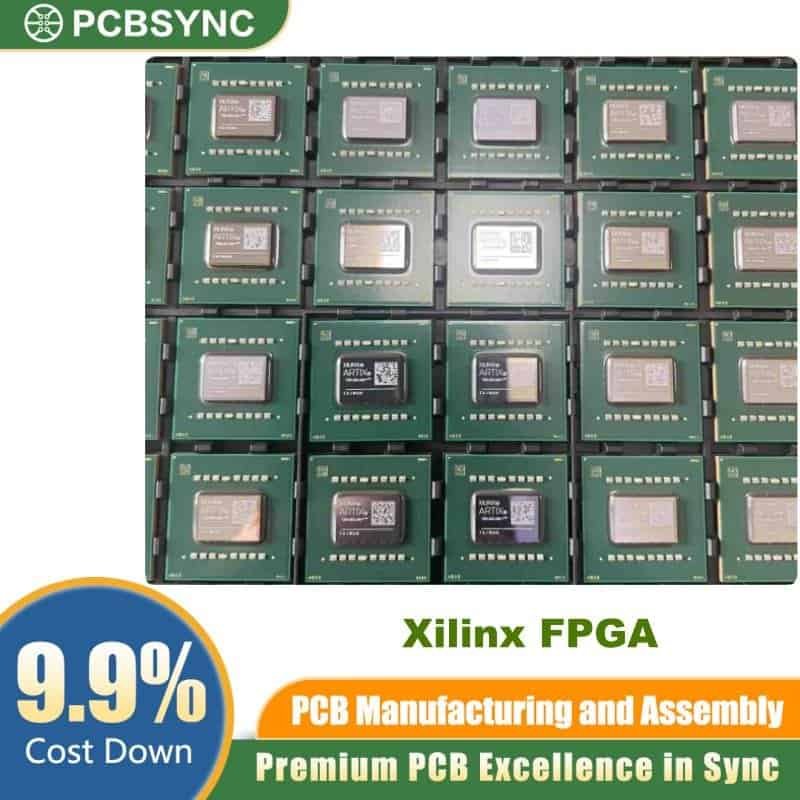
The XC3S1000-4FG456EGC is a high-performance, cost-optimized field-programmable gate array (FPGA) from Xilinx’s Spartan-3 family. Designed for high-volume embedded applications, this device delivers 1,000,000 system gates, a -4 speed grade, and a 456-pin Fine-Pitch Ball Grid Array (FBGA) package — making it one of the most versatile solutions in its class. If you are evaluating Xilinx FPGA devices for your next design, the XC3S1000-4FG456EGC deserves serious consideration.
What Is the XC3S1000-4FG456EGC?
The XC3S1000-4FG456EGC belongs to Xilinx’s Spartan-3 generation — a family engineered to bring FPGA programmability to cost-sensitive, high-volume markets. The part number breaks down as follows:
| Segment |
Meaning |
| XC3S |
Xilinx Spartan-3 family |
| 1000 |
~1,000,000 system gate count |
| -4 |
Speed grade (-4 = faster than -5) |
| FG456 |
Fine-Pitch BGA, 456 pins |
| E |
Extended or screened variant |
| GC |
Specific screening / marking code |
This makes the XC3S1000-4FG456EGC a speed-grade-optimized, extended-screened version of the standard XC3S1000-4FG456C, targeting applications that require tighter performance margins and enhanced quality assurance.
Key Technical Specifications
Core Logic Resources
| Parameter |
Value |
| System Gates |
1,000,000 |
| Logic Cells |
17,280 |
| CLB Array (Rows × Columns) |
32 × 48 |
| CLB Flip-Flops |
15,360 |
| Maximum Distributed RAM |
120 Kb |
| Block RAM |
432 Kb (24 × 18 Kb blocks) |
| Multiplier Blocks (18×18) |
24 |
| DCM (Digital Clock Manager) |
4 |
I/O and Package Details
| Parameter |
Value |
| Package |
FG456 (Fine-Pitch BGA) |
| Total Package Pins |
456 |
| Maximum User I/O |
391 |
| I/O Standards Supported |
LVCMOS, LVTTL, HSTL, SSTL, PCI, LVDS, BLVDS, RSDS |
| Differential I/O Pairs |
173 |
Electrical Characteristics
| Parameter |
Value |
| Core Supply Voltage (VCCINT) |
1.2 V |
| I/O Supply Voltage (VCCO) |
1.2 V – 3.3 V |
| Speed Grade |
-4 |
| Operating Temperature (Commercial) |
0°C to +85°C |
| Static Current (ICC) |
Typically < 50 mA |
Configuration
| Parameter |
Value |
| Configuration Modes |
Master Serial, Slave Serial, Master Parallel (SelectMAP), JTAG |
| Configuration Memory |
External (serial or parallel Flash/PROM) |
| JTAG Boundary Scan |
IEEE 1149.1 compliant |
XC3S1000-4FG456EGC vs. Standard XC3S1000-4FG456C
A common question is how the EGC marking differs from the standard C commercial version.
| Feature |
XC3S1000-4FG456C |
XC3S1000-4FG456EGC |
| Speed Grade |
-4 |
-4 |
| Package |
FG456 |
FG456 |
| Temperature Range |
0°C to +85°C |
0°C to +85°C |
| Screening Level |
Standard commercial |
Extended / enhanced screening |
| Lot Traceability |
Standard |
Enhanced |
| Typical Use |
General commercial designs |
High-reliability commercial designs |
The “E” and “GC” suffix indicates the part has undergone additional screening and traceability requirements, often mandated in applications where supply chain integrity is critical — such as industrial control systems, communications infrastructure, and defense-adjacent commercial equipment.
Functional Architecture Overview
Configurable Logic Blocks (CLBs)
Each CLB in the XC3S1000 contains four slices, and each slice includes:
- Two 4-input Look-Up Tables (LUTs) that can be used as logic or 16-bit shift registers
- Two storage elements (flip-flops or latches)
- Carry and arithmetic logic
- Wide-function multiplexers
This architecture enables highly efficient implementation of both combinatorial and sequential logic.
Block RAM (BRAM)
The 24 block RAM modules each offer 18 Kb of true dual-port synchronous memory. Key capabilities include:
| Feature |
Detail |
| Organization |
Configurable width × depth (e.g., 16K×1, 8K×2, 4K×4, 2K×9, 1K×18) |
| Port Mode |
True dual-port (independent read/write clocks) |
| Total Capacity |
432 Kb |
| Error Correction |
Optional parity bits |
Dedicated Multipliers
The 24 dedicated 18×18-bit hardware multipliers accelerate DSP operations dramatically compared to LUT-based implementations. They are frequently used for:
- FIR and IIR digital filters
- FFT butterfly operations
- Motor control algorithms
- Image processing pipelines
Digital Clock Manager (DCM)
The four DCMs enable advanced clock management:
| DCM Capability |
Details |
| Frequency Synthesis |
Multiply/divide input clock by integer ratios |
| Phase Shifting |
Fine or coarse phase adjustment |
| Deskew |
Eliminate clock distribution delay |
| Duty Cycle Correction |
Maintain 50% duty cycle |
| Input Frequency Range |
24 MHz – 350 MHz (typical) |
Supported I/O Standards
The XC3S1000-4FG456EGC supports a broad range of single-ended and differential I/O standards, making it compatible with virtually any modern interface.
Single-Ended Standards
| Standard |
VCCO |
| LVCMOS 3.3 V |
3.3 V |
| LVCMOS 2.5 V |
2.5 V |
| LVCMOS 1.8 V |
1.8 V |
| LVCMOS 1.5 V |
1.5 V |
| LVTTL |
3.3 V |
| PCI (33 MHz / 66 MHz) |
3.3 V |
| HSTL Class I / II |
1.5 V |
| SSTL 2 / SSTL 3 |
2.5 V / 3.3 V |
Differential Standards
| Standard |
Description |
| LVDS |
Low-Voltage Differential Signaling |
| BLVDS |
Bus LVDS for multi-drop buses |
| RSDS |
Reduced-Swing Differential Signaling |
| Mini-LVDS |
Reduced-power LVDS variant |
Typical Applications
The combination of logic density, embedded multipliers, block RAM, and flexible I/O makes the XC3S1000-4FG456EGC well-suited for a wide range of designs:
Communications and Networking
- Protocol bridging (PCIe, Ethernet, UART, SPI, I²C)
- Packet processing and traffic management
- Serializer/deserializer (SERDES) interfaces
Industrial Control
- Motor control (FOC, PWM generation)
- Industrial Ethernet (PROFINET, EtherCAT controller offload)
- Sensor fusion and real-time data acquisition
Signal Processing
- Software-defined radio (SDR) baseband processing
- Digital filters (FIR, IIR, CIC)
- FFT accelerators
Embedded Computing
- Custom processor implementations (MicroBlaze soft-core CPU)
- Memory controllers (SDRAM, SRAM)
- Peripheral expansion for microprocessors
Video and Imaging
- Video timing controllers
- Image preprocessing pipelines
- Display interface generation
Development and Design Tools
Xilinx (now AMD) provides a mature toolchain for the Spartan-3 family:
| Tool |
Purpose |
| ISE Design Suite (Legacy) |
Primary synthesis, place-and-route, and bitstream generation tool |
| XST (Xilinx Synthesis Technology) |
HDL synthesis engine included in ISE |
| PlanAhead |
Floor-planning and timing closure |
| ChipScope Pro |
In-system logic analysis (similar to on-chip oscilloscope) |
| iMPACT |
Configuration and JTAG programming utility |
Note: The Spartan-3 family is supported by ISE Design Suite 14.7, which remains available as a free download from AMD/Xilinx. Vivado does not support Spartan-3 devices.
Supported HDL Languages
- VHDL
- Verilog
- Mixed-language designs
IP Cores Available
- MicroBlaze soft-core processor
- AXI peripheral library
- FIR Compiler, CORDIC, FFT cores
- Memory interface generators
- Ethernet MAC, PCI cores
Ordering and Part Number Variants
The XC3S1000 in the FG456 package is available in several variants. Understanding the suffix helps ensure you order the correct part.
| Part Number |
Speed Grade |
Package |
Screening |
| XC3S1000-4FG456C |
-4 |
FG456 |
Commercial |
| XC3S1000-5FG456C |
-5 |
FG456 |
Commercial (slower) |
| XC3S1000-4FG456I |
-4 |
FG456 |
Industrial (−40°C to +100°C) |
| XC3S1000-4FG456EGC |
-4 |
FG456 |
Extended screened commercial |
For industrial temperature requirements (−40°C to +100°C), choose the -4FG456I variant. For standard commercial operation with enhanced screening, the XC3S1000-4FG456EGC is the appropriate choice.
Package Dimensions and PCB Design Guidelines
FG456 Package Overview
| Attribute |
Value |
| Package Type |
Fine-Pitch Ball Grid Array (FBGA) |
| Body Size |
23 mm × 23 mm |
| Ball Pitch |
1.00 mm |
| Ball Count |
456 |
| Ball Diameter (typical) |
0.60 mm |
| Package Height |
~1.60 mm |
PCB Design Recommendations
- Via-in-pad or dog-bone fan-out is recommended for the 1 mm pitch BGA
- Use controlled-impedance traces for high-speed differential pairs
- Place decoupling capacitors (100 nF ceramic) as close as possible to each VCCINT and VCCO ball
- Bulk capacitance (10 µF or greater) should be placed within 5 mm of the device
- Refer to Xilinx UG331 (Spartan-3 Generation FPGA User Guide) for detailed power distribution network guidance
Power Consumption
Power in FPGA designs is highly application-dependent. The XC3S1000 features separate core and I/O power domains for efficient power management.
| Power Domain |
Voltage |
Typical Current (idle) |
Notes |
| VCCINT (Core) |
1.2 V |
30–80 mA |
Depends on logic utilization |
| VCCO (I/O Banks) |
1.5–3.3 V |
10–100 mA |
Depends on I/O activity and standard |
| VCCAUX (Auxiliary) |
2.5 V |
~10 mA |
For DCMs, configuration logic |
Use the Xilinx XPower Analyzer tool within ISE to estimate power based on your specific design activity levels.
Frequently Asked Questions
Is the XC3S1000-4FG456EGC pin-compatible with the XC3S1000-4FG456C?
Yes. The EGC and C suffixes refer to screening level and lot traceability, not to physical or electrical differences. Both parts share the same FG456 package pinout and are interchangeable at the board level.
Can the XC3S1000-4FG456EGC operate at industrial temperatures?
No. The commercial-grade (C/EGC) devices are rated for 0°C to +85°C. For industrial temperature range (−40°C to +100°C), use the XC3S1000-4FG456I.
What is the configuration bitstream size for the XC3S1000?
The XC3S1000 requires approximately 2.98 Mb of configuration data. A standard 4 Mb serial configuration PROM (e.g., Xilinx XCF04S or compatible Flash) is sufficient.
Does the XC3S1000 support partial reconfiguration?
The Spartan-3 family does not support partial reconfiguration. Full device reconfiguration is required for any design changes.
Is Vivado compatible with the XC3S1000-4FG456EGC?
No. The Spartan-3 family is only supported in ISE Design Suite 14.7. Vivado supports only 7-series and newer devices.
Conclusion
The XC3S1000-4FG456EGC is a proven, flexible FPGA solution for engineers who need substantial logic capacity, embedded DSP resources, and rich I/O capabilities in a compact 23 × 23 mm BGA package. Its extended screening makes it particularly attractive for applications where supply chain traceability and quality consistency are important. With 1 million system gates, 432 Kb of block RAM, 24 hardware multipliers, and support for over 20 I/O standards, this device delivers the performance and versatility required for a broad spectrum of embedded and signal-processing applications.