Inquire: Call 0086-755-23203480, or reach out via the form below/your sales contact to discuss our design, manufacturing, and assembly capabilities.
Quote: Email your PCB files to Sales@pcbsync.com (Preferred for large files) or submit online. We will contact you promptly. Please ensure your email is correct.
Notes: For PCB fabrication, we require PCB design file in Gerber RS-274X format (most preferred), *.PCB/DDB (Protel, inform your program version) format or *.BRD (Eagle) format. For PCB assembly, we require PCB design file in above mentioned format, drilling file and BOM. Click to download BOM template To avoid file missing, please include all files into one folder and compress it into .zip or .rar format.
Samsung Capacitors: The Complete MLCC Engineer’s Guide to CL Series Selection
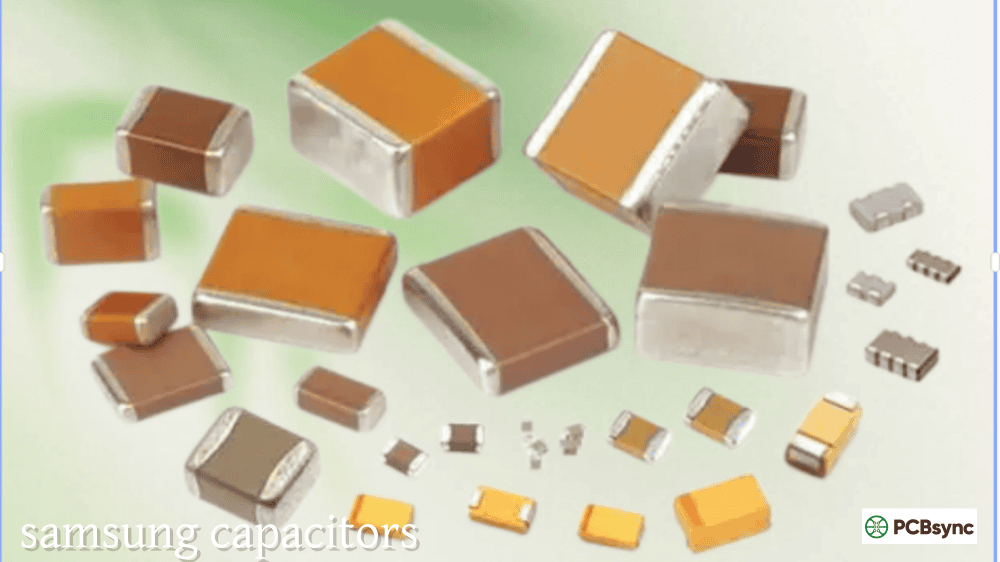
Samsung Electro-Mechanics — known in the industry as SEMCO — is one of the top three MLCC manufacturers globally alongside Murata and TDK. If you’ve been building PCBs for any length of time, you’ve already placed thousands of their parts. That CL10B104KB8NNNC 0.1µF 0603 in your bypass network? Very likely a SEMCO device. The company holds a particularly strong position in high-density consumer electronics, smartphones, and increasingly in the automotive and AI server markets it’s actively expanding into.
This guide covers the practical side of working with samsung capacitors on real designs — what the CL part number actually tells you, how the dielectric families differ in ways that matter under operating conditions, where the new automotive and AI server series fit, and the mistakes that cause field failures when engineers underestimate how much Class II MLCCs change under DC bias and temperature.
## What “Samsung Electro-Mechanics” Actually Makes and Why It Matters
SEMCO is an integrated components subsidiary of Samsung Group, not the same company as Samsung Electronics (phones, TVs). It operates manufacturing in Suwon and Busan in South Korea, with mass production facilities in Tianjin, China and the Philippines. All facilities are ISO-9001 certified; the AS9100 standard applies to aerospace-grade production.
SEMCO’s capability milestone worth knowing: they can stack up to 600 ceramic layers in a single MLCC body, which is directly what enables the 100µF values they’re achieving in 0603 and even 0402 packages. That layering density also drives the DC bias performance tradeoffs discussed later in this article.
For context on scale: a 5G smartphone contains roughly 1,000 MLCCs; a 5G base station around 16,000; a pure electric vehicle approximately 30,000. SEMCO’s product roadmap reflects these growth vectors directly — automotive and AI server MLCCs are the two highest-priority development areas as of 2024–2026.
## Decoding the Samsung CL Part Number System
Every Samsung MLCC carries a CL prefix followed by 13 more characters, each encoding a specific parameter. Getting comfortable with this system saves real time during BOM reviews, cross-referencing, and alternate sourcing.
Example: CL10A106MP8NNNC
Position
Characters
Meaning
1–2
CL
Series designator: Samsung MLCC
3–4
10
Size code — 10 = 0603 (1.6mm × 0.8mm metric)
5
A
Dielectric — A = X5R
6–8
106
Capacitance — 10 × 10⁶ pF = 10µF
9
M
Tolerance — M = ±20%
10
P
Rated voltage — P = 10V
11
8
Thickness — 8 = 0.8mm ±0.1mm
12–14
NNN
Electrode / termination / packaging codes
15
C
Internal code (customer / grade variant)
Size codes (positions 3–4) frequently used:
Code
EIA Size (inch)
Dimensions (mm)
03
0201
0.6 × 0.3
05
0402
1.0 × 0.5
10
0603
1.6 × 0.8
21
0805
2.0 × 1.25
31
1206
3.2 × 1.6
32
1210
3.2 × 2.5
Voltage codes (position 10) you’ll see most often:
Code
Voltage
Code
Voltage
Q
6.3V
B
50V
P
10V
T
75V
O
16V
C
100V
A
25V
H
630V
L
35V
I
1,000V
The dielectric code at position 5 is particularly important and links directly to the temperature characteristic and DC bias behavior — covered in the next section.
Samsung’s capacitor lineup spans Class I (stable, low permittivity) and Class II (high capacitance density, voltage/temperature dependent) dielectrics. Understanding these differences is not academic — they’re the reason a design passes qualification but fails in field conditions six months later.
### Class I: C0G (NP0) — Stable, Low Loss, Precision
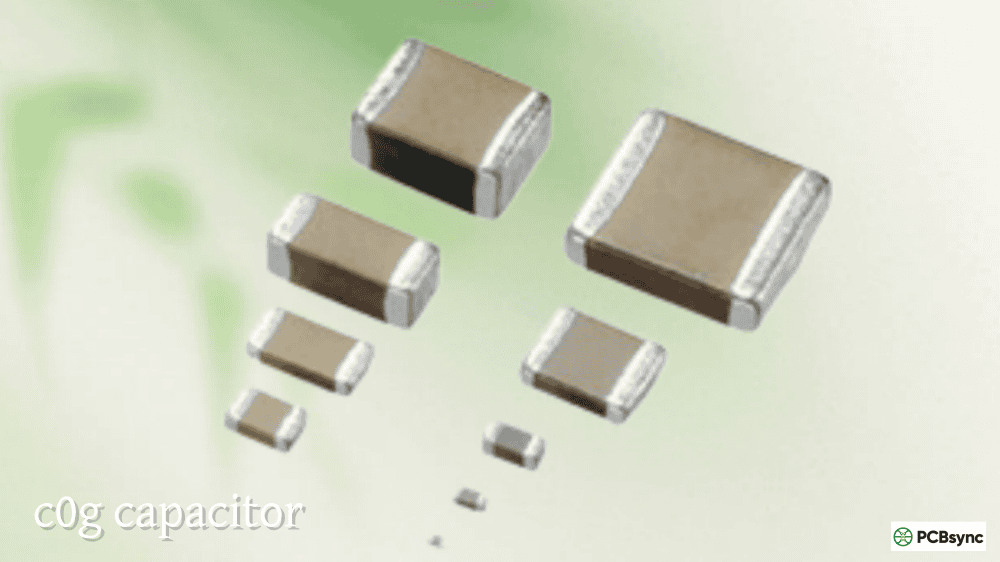
C0G has a temperature coefficient of ±30 ppm/°C from −55°C to +125°C. It shows essentially zero DC bias effect, zero aging, and very low dissipation factor. This is the correct choice for timing circuits, RF matching networks, precision analog filters, and anywhere capacitance stability over time and voltage matters more than package size.
The tradeoff is volumetric efficiency. A C0G 100nF in 0402 is achievable; 10µF in 0402 is not. C0G occupies its own lane in the catalog — high precision, moderate capacitance, indispensable for specific applications.
### Class II: X5R — Highest Capacitance per Package
X5R covers −55°C to +85°C with ±15% capacitance change over that temperature range. It delivers the highest capacitance density in Samsung’s portfolio, which is why it dominates in bulk decoupling on 1.8V and 3.3V rails in consumer electronics where cost and board area are primary constraints.
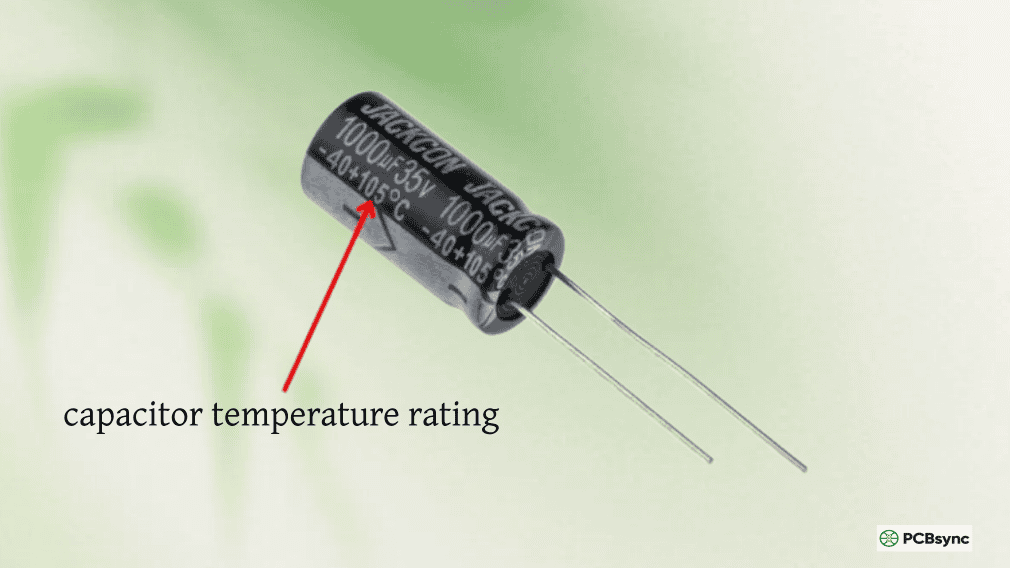
The temperature ceiling of +85°C is the limiting factor. Above that, X5R can violate its ±15% spec significantly. For anything seeing underhood automotive temperatures or high-temperature industrial environments, X5R is the wrong call.
### Class II: X7R — Industrial Workhorse
X7R extends the temperature range to +125°C with ±15% capacitance change. This wider operating range is what makes X7R the default choice for industrial and general automotive decoupling. The DC bias performance is better than X5R but still requires careful derating — more on this below.
### Class II: X7S, X7T — Higher Capacitance at Extended Temperature
X7S (±22% capacitance change to +125°C) and X7T (−33%/+22% to +125°C) represent SEMCO’s push to combine X5R-level capacitance density with X7R’s temperature range. This is why the 0402 1µF 25V part for AI server VRMs uses X7S — it delivers meaningful capacitance in a tiny package while surviving the thermal environment of a server power module.
Dielectric comparison at a glance:
Dielectric
Temp Range
Cap Change
DC Bias Effect
Best Use Case
C0G
−55 to +125°C
±30 ppm/°C
None
Precision, RF, timing
X5R
−55 to +85°C
±15%
Severe
Consumer bulk decoupling
X7R
−55 to +125°C
±15%
Moderate–severe
Industrial/auto general decoupling
X7S
−55 to +125°C
±22%
Moderate
AI server, high-density +temp
X7T
−55 to +125°C
−33/+22%
Moderate
High-cap automotive applications
## The DC Bias Problem Every Engineer Must Understand
This is the part most datasheets don’t make obvious enough, and it causes real field failures. Class II MLCCs — X5R, X7R, X7S, X7T — lose capacitance when a DC voltage is applied across them. Not a little. A lot.
A practical example: a 10µF X5R rated at 6.3V, operating at 5V DC (roughly 80% of rated voltage), may deliver only 2–3µF of actual capacitance in circuit. An X7R of the same rating operating at 50% of rated voltage typically retains 60–80% of nominal — which is why the 2× voltage rating rule exists as minimum practice. For critical decoupling positions, 3× or higher is safer.
Samsung’s parametric search tool allows you to check DC bias curves before ordering. Use it. The difference between a 10µF capacitor delivering 7µF versus 2µF at operating voltage can be the difference between a power supply that stabilizes a GPU load transient and one that doesn’t.
Practical derating rules for Samsung Class II MLCCs:
Operating Voltage / Rated Voltage
Approximate Capacitance Retention (X7R)
25% of rated
~90–95%
50% of rated
~70–85%
75% of rated
~40–60%
100% (rated)
~15–40%
Aging compounds this. X5R and X7R both lose approximately 2–2.5% of capacitance per decade-hour after manufacture due to dielectric domain relaxation. This is recoverable by heating above 125°C (which resets the aging clock), but that’s obviously impractical in fielded equipment. Design margins should account for aging over the expected product life.
Larger case sizes lose less capacitance to DC bias than smaller ones with identical ratings. A 10µF X5R in 0805 holds more effective capacitance at 50% rated voltage than the same 10µF X5R in 0603. When board space is available, upsizing the package is a legitimate and often cost-effective way to recover effective capacitance without changing to a more expensive part.
## Samsung MLCC General Consumer and IT Series
For standard consumer electronics, IT, and industrial decoupling, Samsung’s CL series covers 0201 through 2220 in sizes and capacitance from sub-pF C0G to 100µF and beyond in X5R/X7R/X7S. The catalog is genuinely massive — over 10,000 active part numbers across the general lineup.
Key points for PCB engineers working with these parts: storage life is guaranteed for six months from outgoing date of delivery. If your warehouse holds components longer than that before use, verify storage conditions and consider incoming inspection. Samsung specifies pre-treatment at 150°C for one hour followed by 24 hours at room temperature before measuring Class II capacitance — this resets aging and is how the datasheet value was measured.
For reflow, Samsung specifies a peak of 260°C for maximum 10 seconds. Board flex cracking is the primary mechanical failure mode for larger MLCCs — the 1206 and 1210 parts near board edges, mounting holes, or V-score lines are the high-risk positions. Samsung’s high bending strength variants in the automotive line are available for general industrial use as well when mechanical robustness is a concern.
## Samsung Automotive MLCC: AEC-Q200 and EV Powertrain Series
Samsung’s automotive MLCC development has been particularly aggressive. A hybrid EV requires roughly twice as many MLCCs as an ICE vehicle, and BEVs add higher-voltage, higher-reliability requirements on top of that. SEMCO’s automotive roadmap reflects this directly.
### AEC-Q200 Qualification and What It Requires
All automotive-grade MLCCs from Samsung must pass AEC-Q200 — the automotive quality standard for passive components — plus individual customer validation before entering production. The validation steps are extensive: high-temperature unpowered exposure at 150°C for 1,000 hours, temperature cycling, humidity testing, and mechanical tests including bending strength. Part numbers with P or N in position 9 (product code) typically indicate automotive grade in the Samsung system.
### ADAS and Body Electronics: High Voltage, Ultra-Small
In February 2025, Samsung announced the world’s first AEC-Q200-qualified MLCC in 0402 size at 2.2µF and 10V — specifically targeting LiDAR systems where the standard was previously 6.3V. The 10V rating in a 0402 X7S package is roughly 60% higher than the previous benchmark in that footprint. This part (CL05Y225KP66PN) is relevant for ADAS radar, LiDAR, and camera systems where board density around sensor processors is constrained.
For ADAS with higher voltage requirements, Samsung introduced 16V class parts with the world’s highest capacitance in their size category in 2024.
### EV Inverter and OBC: High Voltage C0G Series
For EV charging systems — specifically the CLLC resonant circuits in on-board chargers and DC-DC converters — Samsung introduced the CL32C333JIV1PN# in late 2025: a 33nF C0G MLCC in a 1210 package rated at 1,000V. C0G dielectric at 1,000V across −55°C to +125°C is technically demanding; SEMCO cited its proprietary ceramic material technology and ultra-precision stacking as what makes it achievable. The expanded lineup includes 1,250V/10nF and 1,000V/22nF in the same 1210 size, targeting the growing high-voltage resonant circuit requirements in EV charging infrastructure.
For hybrid and mild-hybrid inverter snubber applications, the CL21Z104KEY6PJ# (100µF, 250V, X7T, 0805) announced in August 2025 represents Samsung’s push into mid-voltage, high-capacitance positions previously dominated by film capacitors. Snubber duty in automotive inverters requires stable performance under continuous voltage stress and wide temperature cycling — the X7T dielectric and AEC-Q200 qualification address both requirements.
Samsung automotive MLCC portfolio overview:
Application
Typical Series
Key Spec
AEC-Q200
ADAS / LiDAR
CL05Y (0402 X7S)
2.2µF 10V
Yes
Body / infotainment
CL general auto
Various X7R/X7S
Yes
Inverter snubber (MHEV/HEV)
CL21Z (0805 X7T)
100µF 250V
Yes
OBC resonant circuit
CL32C (1210 C0G)
33nF 1,000V
Yes
EV high-voltage (EV bus)
High-V C0G series
Up to 2,000V
Yes
## Samsung MLCC for AI Servers: The 0402 High-Cap Push
AI servers represent a second high-priority market for SEMCO. The reasons are straightforward: an AI server consumes 5–10× more power than a conventional server, which means more MLCCs are required near GPUs — but GPU module PCBs are densely populated and thermally challenging, so the MLCCs must be smaller AND capable of operating at elevated temperatures.
SEMCO’s response in 2024–2025 was a series of high-capacitance, ultra-small MLCCs specifically engineered for the 12V and 2.5V rails in AI server VRM and GPU power stages.
The 0402 1µF 25V X7S part targets the 12V input stage of AI server power modules, where the 25V voltage rating provides adequate headroom above 12V with meaningful DC bias derating margin, the X7S temperature rating handles VRM thermal environments above 105°C, and the 0402 package saves over 50% board area compared to conventional 0603 equivalents — which matters when you’re placing hundreds of them near a GPU.
Samsung also developed compact 47µF and 100µF parts in X6S dielectric (−55°C to +105°C, ±22% cap change) for the 2.5V low-voltage GPU supply rails. X6S was specifically chosen because the AI server thermal environment requires stable capacitance up to 105°C — the X6S boundary — but the volumetric efficiency advantage over X7R or X7S justifies the trade at that temperature ceiling. Using three 0402 47µF parts in the same footprint as one 0805 100µF part also reduces system ESL compared to the single larger capacitor.
Samsung has also documented the broader shift in AI server power architecture from aluminum polymer capacitors to MLCCs, driven by MLCCs’ lower ESR/ESL, superior high-frequency impedance (maintaining low impedance at 1–2 MHz), faster transient response during GPU load steps, smaller size and height, and lower supply chain concentration risk.
## Low ESL Samsung MLCC: 3-Terminal and Reverse Geometry for PDN Design
For power distribution network (PDN) design in high-frequency applications — GPU decoupling, DDR5 memory power, processor VRM output filtering — Samsung offers 3-terminal and reverse geometry (also called reverse current or RC) MLCC variants under the Low ESL product family.
A standard 2-terminal MLCC has ESL in the range of 0.5–1.5 nH depending on package size. In PDN design at frequencies above 100 MHz, this ESL dominates the impedance profile and limits how far below target impedance you can get. A 3-terminal MLCC, where current enters one terminal, passes through the capacitor, and exits through a third terminal (shunt path), effectively cancels the electrode inductance — achieving ESL values an order of magnitude lower than conventional two-terminal parts in the same size.
Reverse geometry MLCCs orient the electrodes along the long axis of the package rather than the short axis, which reduces the distance current must travel through the electrode and similarly lowers ESL. Both approaches let you place fewer parts to achieve equivalent PDN impedance, or achieve better impedance with the same part count.
Official SEMCO Design Tools and Technical Resources
SEMCO MLCC Product Search — Full parametric search with DC bias curves, temperature characteristics, and dimensional data. This is the primary tool for finding and verifying parts.
SEMCO Component Library — SPICE model library and impedance simulation tools for Samsung MLCCs. Essential for PDN analysis.
MLCC General Catalog (PDF) — Complete catalog for consumer/IT/industrial CL series, January 2024. Interactive PDF with links to product pages.
MLCC Automotive Catalog (PDF) — Automotive-grade series including AEC-Q200 parts for powertrain, ADAS, body, and EV applications.
DigiKey CL Series Datasheet — General CL series datasheet covering mechanical specifications, reliability test conditions, soldering guidelines, and PCB land design recommendations.
## 5 FAQs on Samsung MLCC Capacitors
Q1: I spec’d a 10µF X7R on a 3.3V rail using a 6.3V-rated part. My power supply is unstable. What went wrong?
You’ve likely hit severe DC bias capacitance loss. At 3.3V on a 6.3V-rated X7R, you’re operating at approximately 52% of rated voltage. X7R at 50% rated voltage typically retains only 60–80% of nominal capacitance — so your 10µF part may be delivering 6–8µF at best. If the design was optimized assuming the full 10µF was available, stability margins shrink. Upgrade to a 10V or 16V-rated part at 10µF, and your operating point drops to 33% or 21% of rated voltage, restoring most of the nominal capacitance. Alternatively, use Samsung’s parametric search to pull the DC bias curve for the specific part and verify effective capacitance at 3.3V before committing to the design. This is one of the most common MLCC-related power supply issues and it’s entirely avoidable with upfront derating analysis.
Q2: What’s the difference between Samsung CL automotive parts and standard CL parts? Can I use standard CL on an automotive BOM?
Automotive CL parts go through AEC-Q200 qualification and then individual customer validation before production approval. The AEC-Q200 test suite is significantly more rigorous than standard reliability testing — high-temperature unpowered storage at 150°C for 1,000 hours, temperature cycling, humidity bias, and mechanical tests including bending resistance. Standard CL parts are not tested to these conditions and should not be substituted on automotive BOMs where AEC-Q200 is specified, even if the electrical parameters look identical on the datasheet. There is no shortcut: automotive qualification requires the process controls and lot traceability that SEMCO’s automotive manufacturing line specifically maintains. If you’re in a cost pressure situation, the correct path is to approach SEMCO or your distributor about minimum order quantities on the automotive-grade variant, not to substitute a general-purpose part.
Q3: When should I use Samsung’s 3-terminal MLCC versus a standard 2-terminal in a decoupling application?
The decision comes down to frequency. Standard 2-terminal MLCCs are adequate for most decoupling below approximately 100 MHz. Above 100 MHz — which is relevant for DDR5, PCIe Gen 5/6 power supply decoupling, and AI GPU power planes — the ESL of standard MLCCs starts to dominate the impedance profile and limits how effectively they suppress high-frequency noise. Samsung’s 3-terminal MLCCs provide ESL values that are roughly 5–10× lower than equivalent 2-terminal parts, which directly extends the frequency range where the capacitor provides useful impedance suppression. The mounting footprint is different from standard 2-terminal parts, so 3-terminal parts need to be designed in from the start — you can’t easily retrofit them onto an existing layout that assumed standard 0402 or 0603 two-terminal pads. For AI server GPU power design specifically, Samsung’s published application notes explicitly recommend 3-terminal or reverse geometry parts to achieve the PDN impedance targets around GPU and CPU power pins.
Q4: Samsung shows an X7S 0402 in 1µF 25V for AI server VRMs. How is this different from just using an X7R 0402 at 1µF 25V?
X7S has a slightly wider capacitance tolerance over temperature (±22% vs X7R’s ±15%) but the key advantage in this application is higher volumetric efficiency — X7S achieves higher capacitance per unit volume than X7R in the same package at similar voltage ratings. The 25V X7R 0402 1µF is a demanding specification that pushes process capability; the X7S dielectric reaches it more comfortably with better DC bias behavior at the 12V operating point (about 48% of rated voltage for this part). Samsung’s published data for this part shows it saves over 50% board area compared to a conventional 0603 equivalent, which directly translates to placing more decoupling capacitance in the constrained space around GPU VRMs. The X7S also maintains the −55°C to +125°C operating range, handling the thermal demands of server VRM environments above 105°C that would push X5R out of specification.
Q5: How do I find a Samsung MLCC substitute when my preferred part is out of stock?
Samsung’s own product search at product.samsungsem.com is the correct starting point. Their part numbering guide and search tool make it straightforward: identify the size code, dielectric, capacitance, and voltage from the original part number, then search for parts matching those parameters. Samsung lists the number of matching in-stock alternatives directly in the results. The key parameters to match in priority order are: package size, dielectric type (do not substitute C0G for X7R or X7R for X5R — they have fundamentally different electrical behavior), rated voltage (use same or higher, never lower), and capacitance value within the tolerance band your circuit requires. For automotive parts, you can only substitute with another AEC-Q200 qualified variant — check the product code character at position 9 in the part number (P = automotive in many Samsung automotive part numbers). For critical applications, also verify thickness: the thickness code at position 11 affects the land pattern and may cause fitment problems if it changes.
## Working with Samsung Capacitors in Production Design
A few practical notes from experience working with CDE components at scale. Samsung’s 6-month shelf life recommendation for tape-and-reel parts is real — it applies to solderability of the Sn terminations, not to the ceramic dielectric itself. If you’re pulling parts from a warehouse that’s been holding them 8–12 months in low humidity controlled storage, run a solderability check before committing to a production run. The fix is simple (baking at 150°C for an hour resets dielectric aging and also drives off any absorbed moisture in the termination area), but discovering solderability issues during production is expensive.
For high-volume BOM management, Samsung’s interactive PDF catalogs allow building a custom catalog of only the series you need — this simplifies approved vendor list management and keeps your team from speccing discontinued part numbers. The SEMCO Component Library also provides SPICE models organized by part number, which is useful when you want to verify impedance curves in simulation before hardware build.
Samsung’s market position in MLCCs means supply is generally robust for standard parts — their global manufacturing footprint across Korea, China, and Philippines provides supply chain diversity that single-source specialty suppliers can’t match. For automotive and AI server parts, lead times and minimum order quantities are more constrained; engaging SEMCO’s application engineering team early in the design cycle is worth the effort for high-volume programs.
Inquire: Call 0086-755-23203480, or reach out via the form below/your sales contact to discuss our design, manufacturing, and assembly capabilities.
Quote: Email your PCB files to Sales@pcbsync.com (Preferred for large files) or submit online. We will contact you promptly. Please ensure your email is correct.
Notes: For PCB fabrication, we require PCB design file in Gerber RS-274X format (most preferred), *.PCB/DDB (Protel, inform your program version) format or *.BRD (Eagle) format. For PCB assembly, we require PCB design file in above mentioned format, drilling file and BOM. Click to download BOM template To avoid file missing, please include all files into one folder and compress it into .zip or .rar format.