Inquire: Call 0086-755-23203480, or reach out via the form below/your sales contact to discuss our design, manufacturing, and assembly capabilities.
Quote: Email your PCB files to Sales@pcbsync.com (Preferred for large files) or submit online. We will contact you promptly. Please ensure your email is correct.
Notes: For PCB fabrication, we require PCB design file in Gerber RS-274X format (most preferred), *.PCB/DDB (Protel, inform your program version) format or *.BRD (Eagle) format. For PCB assembly, we require PCB design file in above mentioned format, drilling file and BOM. Click to download BOM template To avoid file missing, please include all files into one folder and compress it into .zip or .rar format.
Polyester Film Capacitors: Budget-Friendly Solutions
I’ll level with you – when someone asks me about the cheapest way to populate a bill of materials without sacrificing reliability, polyester capacitors come up in that conversation nine times out of ten. After designing hundreds of production boards where cost matters as much as performance, I’ve learned that the polyester capacitor isn’t just a budget option; it’s often the smart engineering choice when you understand its strengths and limitations.
Understanding the Polyester Capacitor
A polyester capacitor uses polyethylene terephthalate (PET) film as its dielectric material. You might also see these called Mylar capacitors, named after DuPont’s trade name for their PET film, or simply PET capacitors. Despite different names floating around, we’re talking about the same basic component – a Capacitor that’s dominated mass electronics production for decades because it delivers solid performance at rock-bottom prices.
The construction is straightforward: thin polyester film (as thin as 0.7µm in modern production) with aluminum metallization deposited directly onto the film, or alternating layers of foil and film, all rolled into a compact cylinder. The entire assembly gets dipped in epoxy resin for moisture protection, leads are attached, and you’ve got a capacitor that costs pennies but lasts years.
What makes polyester special isn’t exotic materials or cutting-edge technology – it’s the dielectric constant of 3.2 combined with manufacturing simplicity. That relatively high dielectric constant means you pack more capacitance into less volume compared to polypropylene (dielectric constant 2.2). When your PCB real estate costs money and your component budget is tight, that matters.
The dissipation factor deserves special attention. At 0.3-0.5%, polyester sits comfortably between polypropylene’s stellar 0.01-0.025% and aluminum electrolytics’ painful 5-20%. For DC blocking, coupling, and general filtering in non-critical circuits, this dissipation factor causes zero problems. Where it bites you is AC power applications and high-frequency work – we’ll get to that.
Temperature and Frequency Behavior
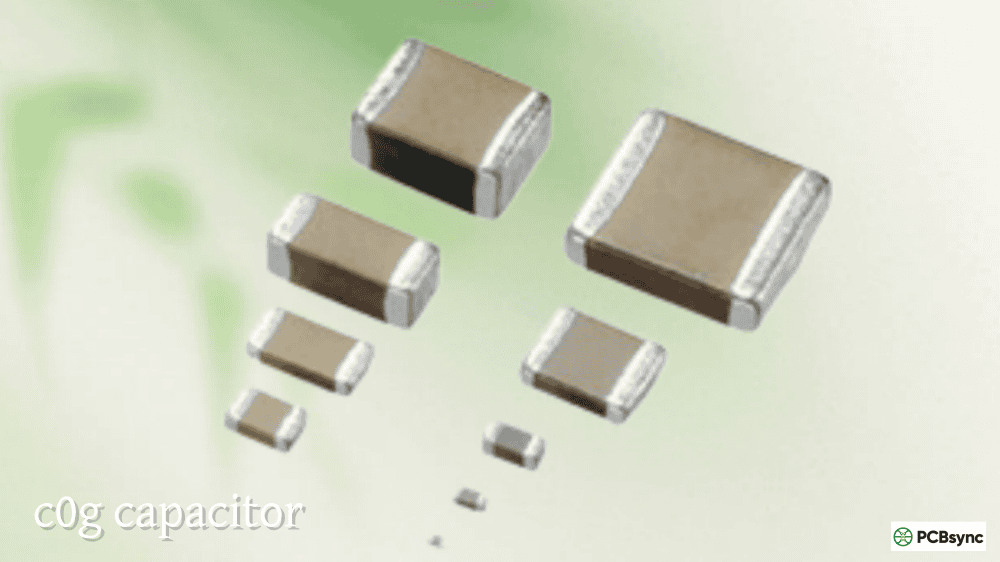
Polyester capacitors have what I’d call “acceptable but not stellar” temperature stability. You’ll see capacitance drift up to ±5% across the full temperature range. That’s ten times worse than C0G ceramics but perfectly fine for coupling capacitors, bypass applications, and timing circuits that don’t need laboratory precision.
The frequency dependency is similar – expect -3% capacitance change from 100Hz to 100kHz. In most digital circuits and audio applications, this drift is completely inaudible and unmeasurable in system performance. It’s only when you’re building precision filters or RF circuits that this becomes an issue, and frankly, you shouldn’t be using polyester there anyway.
Cost Analysis: Why Polyester Wins
Let me show you actual numbers from recent designs:
At production quantities (10,000+), these differentials become even more pronounced. A polyester capacitor that costs $0.04 might compete against a $0.15 polypropylene. When you’re placing 50 capacitors per board and building 100,000 units annually, you’re talking about $550,000 versus $137,500 – real money that shows up on quarterly reports.
The Volume Efficiency Advantage
Here’s where polyester really shines: volumetric efficiency. Because of the 3.2 dielectric constant and ability to manufacture ultra-thin films (down to 0.7µm), you get more capacitance in less space compared to polypropylene.
A 1µF/100V polyester capacitor might measure 13mm x 5mm x 8mm. The equivalent polypropylene? 18mm x 8mm x 11mm – roughly double the volume. When board space translates to manufacturing cost, smaller wins.
I designed a power supply board last year where switching from polypropylene to polyester for output filtering saved 22% on PCB area. The board went from 85mm x 65mm to 85mm x 52mm. With panel utilization, we got one additional board per panel. The capacitor cost savings were nice ($0.40 per board), but the real win was 8% more boards per manufacturing run.
When Polyester Makes Engineering Sense
Ideal Applications
DC Blocking and Coupling: This is polyester’s home turf. Need to block DC between amplifier stages while passing audio? Polyester handles this brilliantly. The high insulation resistance (>30,000 MΩ) means negligible DC leakage, and the dissipation factor at audio frequencies is completely inaudible.
I’ve A/B tested polyester versus polypropylene coupling caps in guitar amplifiers and audio preamps. In proper blind testing, nobody – including self-proclaimed golden ears – could distinguish them. The price difference, however, was readily apparent on the BOM.
Power Supply Filtering (Non-Critical): For secondary filtering after electrolytic bulk capacitors, polyester works perfectly. I’m not suggesting you replace your 1000µF electrolytics with polyester, but that 0.1µF – 1µF bypass cap across the regulator output? Polyester costs half what a ceramic X7R does and provides lower ESR than an electrolytic.
Timing Circuits (Relaxed Tolerance): Need a 10-second delay with ±10% tolerance? Polyester is fine. Building a precision timer where 1% drift matters? Use polypropylene or C0G ceramic. It’s about matching component to requirement.
Snubber Circuits: This surprised me initially, but polyester handles voltage transients beautifully. The film has excellent dielectric strength (580V/µm), and the self-healing property means small dielectric faults vaporize the metallization locally without catastrophic failure. I’ve used polyester snubbers on relay coils and motor drivers for years without issues.
EMI/RFI Suppression: Most X and Y safety capacitors use metallized polyester. They’re cheap, they handle transients, they fail gracefully (self-healing), and they meet flame-resistance requirements. You’ll find polyester in virtually every power supply with EMI filtering.
Applications to Avoid
High-Frequency Circuits: Above 1MHz, polyester’s dissipation factor climbs and becomes problematic. Use C0G ceramics or polypropylene for RF work, oscillators, or high-speed digital bypass.
AC Power Applications: The dissipation factor causes excessive heating under continuous AC load. For motor-run capacitors, power factor correction, or AC line filtering, use polypropylene. I learned this the hard way – a batch of polyester caps in a motor circuit overheated and failed after 200 hours. Polypropylene replacements ran for 50,000+ hours.
Precision Analog Circuits: If you’re building a ±0.1% accurate integrator or sample-and-hold circuit, the temperature and voltage coefficients of polyester will bite you. Use polypropylene, polystyrene, or C0G ceramic.
High-Current Pulse Applications: While polyester handles voltage spikes well, sustained high-current pulses (like camera flash or capacitor discharge welding) exceed its current-handling capability. Use film/foil polypropylene for these applications.
Metallized vs Film/Foil Construction
Polyester capacitors come in two construction styles, and understanding the difference helps you make smarter choices:
Metallized Film Polyester
Construction: Vacuum-deposited aluminum layer (typically 50nm thick) directly on polyester film. This creates an extremely thin, uniform electrode.
Advantages:
Self-healing after dielectric puncture
Higher volumetric efficiency (smaller size)
Lower cost
Lighter weight
Disadvantages:
Higher ESR than film/foil
Lower current-handling capability
Capacitance can drift slightly over time
Best for: General-purpose applications, EMI filtering, DC blocking, bypass capacitors
Most polyester capacitors you encounter are metallized. The self-healing property is genuinely valuable – when a defect in the dielectric causes a local short, the metallization vaporizes in that spot, clearing the fault. The capacitor loses a tiny bit of capacitance but continues functioning.
Film/Foil Polyester
Construction: Alternating layers of polyester film and aluminum foil (typically 6-7µm thick).
Advantages:
Lower ESR
Better pulse current handling
More stable over time
Higher capacitance precision
Disadvantages:
Larger physical size
Higher cost
No self-healing
Heavier
Best for: Applications requiring low ESR, high ripple current, or precision
Film/foil costs roughly 40-60% more than metallized for the same capacitance and voltage rating. I use them when ESR matters – like output filtering in switching supplies where ripple current is high. For most other applications, the extra cost doesn’t justify the marginal performance improvement.
Selecting the Right Polyester Capacitor
Capacitance Value Selection
The sweet spot for polyester is 10nF to 2.2µF. Below 10nF, ceramic capacitors cost less and take less space. Above 2.2µF, polyester gets physically large and electrolytics (for DC applications) or polypropylene (for AC) make more sense.
Here’s a practical guide:
Application
Typical Values
Alternative Consideration
AC coupling (audio)
0.1µF – 2.2µF
Polypropylene for critical paths
DC blocking
0.01µF – 0.47µF
Ceramic for <100nF
Bypass/decoupling
0.1µF – 1µF
Ceramic X7R for space-critical
EMI filtering
0.01µF – 0.1µF
X/Y rated polyester
Snubber
0.01µF – 0.22µF
Match to inductive load
Timing
0.01µF – 1µF
RC time constant dependent
Voltage Rating Strategy
Always apply the 2:1 derating rule: if your maximum circuit voltage is 50V, use at least a 100V capacitor. This isn’t just good practice – it’s survival. Capacitors degrade when operated near their maximum voltage, especially at elevated temperatures.
Polyester’s voltage ratings are DC specifications. For AC applications, the RMS voltage matters, but remember – polyester shouldn’t be your first choice for AC anyway.
Standard voltage ratings: 50V, 100V, 250V, 400V, 630V, 1000V, 1500V. The 100V and 250V ratings dominate consumer electronics. Go to 400V or 630V for offline power supplies (90-265VAC input requires >400V capacitor ratings after rectification).
Temperature Derating
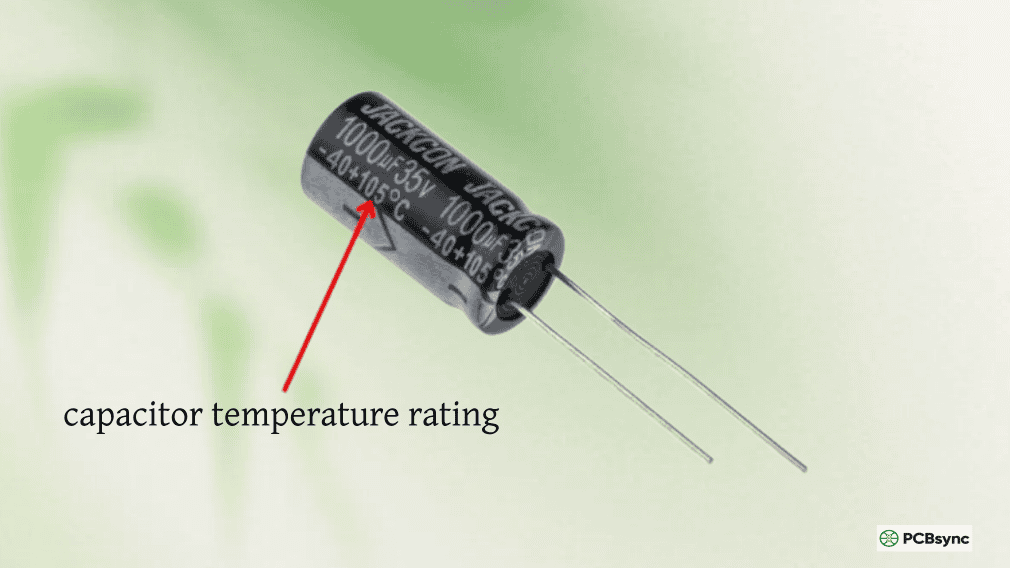
Polyester can operate to 125°C, but you’ll need to derate voltage above 85°C. Most manufacturers specify 50% voltage rating at maximum temperature. This means your 100V capacitor becomes a 50V capacitor at 125°C.
In practice, if your board runs hot (>85°C ambient), either:
Use higher voltage rating to maintain margin
Switch to polypropylene (if budget allows)
Improve thermal management
I’ve had failures where designers ignored this. A 100V polyester cap in a 75V circuit seemed fine on paper, but next to a 3W resistor (local temperature 115°C), it failed after 500 hours. Moving the cap 5mm away solved it.
Reading Polyester Capacitor Markings
Polyester capacitors typically use the three-digit code system:
Example: 104J250
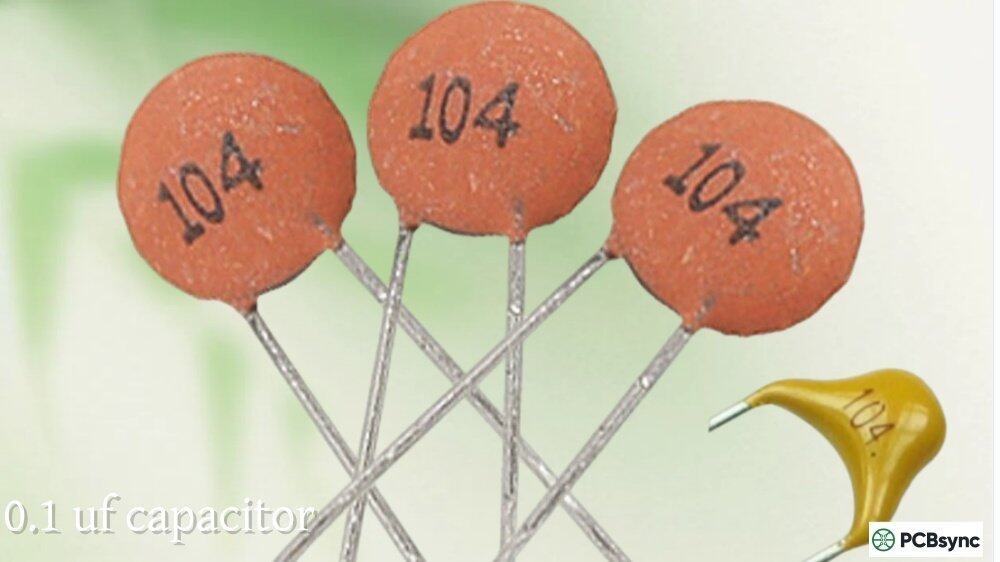
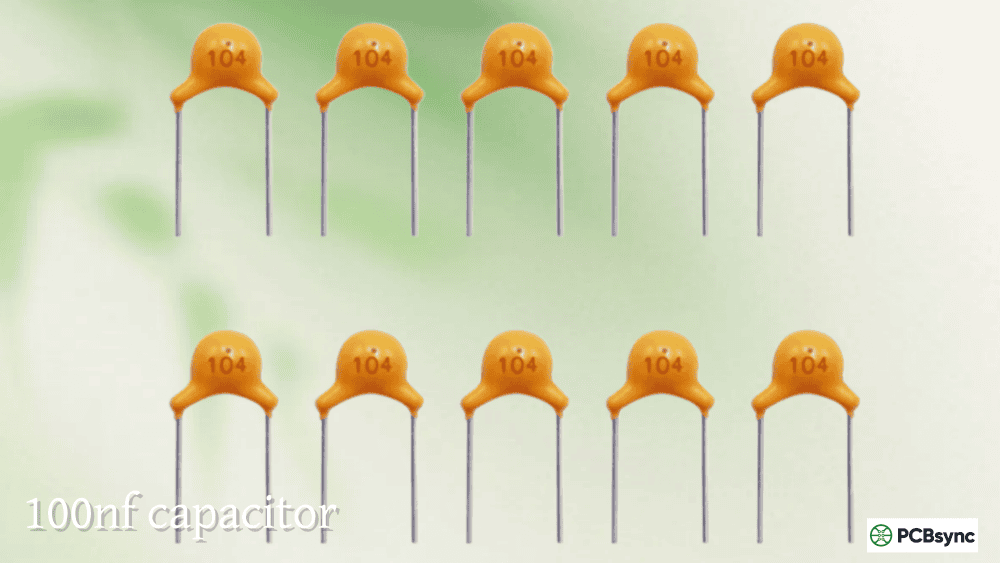
104 = Capacitance in picofarads. First two digits are significant figures, third is multiplier (number of zeros). 104 = 10 + 4 zeros = 100,000pF = 100nF = 0.1µF
J = Tolerance (J = ±5%, K = ±10%, M = ±20%)
250 = Voltage rating (250V DC)
Some manufacturers use different systems:
Example: 225M
225 = 22 + 5 zeros = 2,200,000pF = 2.2µF
M = ±20% tolerance
Physical markings on the capacitor body usually include voltage rating, temperature rating, and sometimes the dielectric type (MKT for metallized polyester, KT for film/foil polyester).
Polyester capacitors come in radial and axial lead configurations. Radial (leads on same side) dominates modern designs because they mount perpendicular to the PCB, saving space.
Standard lead spacing: 5mm, 7.5mm, 10mm, 15mm, 22.5mm. Match your footprint to the capacitor you’re actually buying. I’ve seen too many boards where the designer assumed 5mm spacing, ordered capacitors, and discovered they were 7.5mm spacing. Now you’re bending leads and introducing mechanical stress.
Axial capacitors (leads on opposite ends) work better for through-hole repairs and vintage equipment restoration. They’re becoming less common in new designs.
Soldering Considerations
Polyester can handle soldering temperatures, but excessive heat will damage them. Use these guidelines:
Temperature: 260°C maximum, preferably 240-245°C Time: <3 seconds per joint Distance: Keep iron tip 2mm from capacitor body
The epoxy coating can crack if you overheat it. I’ve seen this cause moisture ingress and eventual failure. Use a temperature-controlled iron and work quickly.
For wave soldering: polyester handles this fine. Preheating helps but isn’t mandatory. The brief exposure to molten solder won’t damage quality polyester caps.
For reflow soldering: You’ll need to check manufacturer specs. Standard polyester caps are NOT designed for reflow (they can’t survive 235°C peak temperature). Special high-temperature polyester caps exist, but they cost more. If you need surface-mount film caps for reflow, consider ceramic or special SMD film types.
Mechanical Stress Avoidance
Film capacitors don’t like vibration and mechanical flexing. The leads attach to the metallization, and repeated flexing can break this connection.
Good practices:
Leave 1-2mm of lead between the PCB and capacitor body (stress relief)
Don’t mount polyester caps where they’ll contact other components that might vibrate
In high-vibration environments (automotive, industrial), use conformal coating or additional mechanical support
Don’t exceed the manufacturer’s lead bend radius (typically 3mm minimum)
I designed a board for a vehicle application where polyester caps failed in field testing. The root cause? They were mounted directly adjacent to a relay that clicked 1000+ times per day. The vibration eventually fractured the internal connections. Moving them 10mm away eliminated failures.
Common Mistakes and How to Avoid Them
Mistake 1: Using Polyester for AC Line Applications
I see this constantly in amateur projects and even some commercial designs. Someone needs a 0.47µF cap for power factor correction or an AC motor and grabs a cheap polyester cap because it’s rated for 400V.
The problem: Polyester’s dissipation factor causes excessive heat generation under continuous AC load. That 0.5% dissipation factor means half a percent of the AC power becomes heat in the capacitor. At line voltage and significant current, this adds up fast.
The solution: Use polypropylene for AC applications. Yes, it costs more, but it won’t fail after 1000 hours of operation.
Mistake 2: Ignoring Temperature Rise
Polyester caps can self-heat in high-ripple applications. This is separate from ambient temperature – it’s heat generated by the ripple current flowing through the capacitor’s ESR.
The problem: That self-heating reduces the effective voltage rating and accelerates aging. I’ve measured 20°C temperature rise in polyester caps handling high ripple current in switching supplies.
The solution: Calculate actual ripple current and verify it’s within the manufacturer’s specification. If you’re pushing limits, either increase capacitor voltage rating, parallel multiple caps, or switch to a film/foil construction with lower ESR.
Mistake 3: Assuming All Polyester Caps Are Equal
Not all polyester capacitors come from the same manufacturing processes. Quality varies dramatically between manufacturers.
The problem: Cheap, no-name polyester caps might have loose tolerances, poor moisture resistance, and short lifetimes. I’ve tested batches where a “0.1µF ±10%” capacitor actually measured 0.087µF – outside specification.
The solution: Stick with reputable manufacturers: WIMA, KEMET, Vishay, Panasonic, Cornell Dubilier, TDK. Yes, they cost slightly more, but the difference between $0.08 and $0.12 is negligible compared to field failures.
Mistake 4: Mixing Up Voltage Ratings
This seems obvious, but I’ve seen it enough to mention: AC voltage ratings and DC voltage ratings aren’t interchangeable.
The problem: A capacitor rated 250V DC can NOT handle 250V AC. The peak AC voltage (250V × 1.414 = 353V) exceeds the DC rating.
The solution: For AC circuits, ensure your capacitor’s DC voltage rating exceeds the peak AC voltage with appropriate safety margin. For 230V AC, you need at least a 400V DC rated capacitor, preferably 630V.
Polyester Capacitor Longevity and Reliability
One question I get frequently: how long do polyester capacitors last?
In properly designed circuits with appropriate derating, polyester caps can last 20+ years. I’ve repaired equipment from the 1980s where original polyester caps still measured within spec.
The failure mechanisms:
Moisture Absorption: Polyester absorbs minimal moisture, but poor-quality epoxy coatings can crack and allow water ingress. This reduces insulation resistance and eventually causes leakage.
Voltage Stress: Operating near maximum voltage rating causes gradual dielectric degradation. Follow the 2:1 derating rule and this isn’t an issue.
Thermal Cycling: Repeated heating and cooling can stress the internal connections. Industrial and automotive applications see more thermal cycling and typically experience shorter capacitor lifetimes.
Mechanical Stress: Vibration and board flexing can break internal connections, especially on larger values with heavier bodies.
Expected lifetimes under various conditions:
Operating Conditions
Expected Lifetime
50% voltage, 25°C ambient
50,000+ hours
50% voltage, 85°C ambient
30,000+ hours
70% voltage, 25°C ambient
20,000+ hours
70% voltage, 85°C ambient
10,000+ hours
90% voltage, 85°C ambient
3,000-5,000 hours
These aren’t guarantees – they’re what I’ve observed across multiple manufacturers and applications. Your mileage will vary based on manufacturer quality and application specifics.
WIMA Application Guide: Search for “WIMA Selection Guide Film Capacitors” PDF – comprehensive guide covering when to use polyester versus other film types.
Kemet Film Capacitor Application Guide: Detailed information on selecting appropriate film capacitors for various applications.
Cornell Dubilier Capacitor Life Expectancy: Technical paper on predicting capacitor lifetime based on operating conditions.
Capacitor Ripple Current Calculator: Search for manufacturer-specific tools to calculate allowable ripple current based on capacitor ESR and thermal resistance.
Frequently Asked Questions
Can I replace a polypropylene capacitor with a polyester capacitor?
It depends on the application. For DC blocking, coupling, and general bypass applications, yes – polyester can replace polypropylene. You’ll sacrifice some performance (higher dissipation factor, less stable with temperature), but in non-critical circuits, this doesn’t matter. However, do NOT replace polypropylene with polyester in AC power circuits, motor-run applications, or precision analog circuits. The higher dissipation factor of polyester will cause problems. Always verify that the polyester cap’s specifications meet or exceed the circuit requirements, and maintain the same voltage rating and capacitance value (within tolerance).
Why are polyester capacitors so much cheaper than polypropylene?
The cost difference comes from manufacturing and materials. Polyester (PET) film can be produced thinner (down to 0.7µm) and faster on manufacturing equipment compared to polypropylene. The higher dielectric constant (3.2 vs 2.2) means less material for the same capacitance. Additionally, polyester has better mechanical strength, allowing faster winding speeds during production. These factors combine to reduce manufacturing cost significantly. Polypropylene offers better electrical performance (lower losses, better temperature stability), but for many applications, polyester’s performance is perfectly adequate at a fraction of the cost.
How do I identify if a capacitor is polyester or polypropylene?
Physical inspection rarely helps – both can use similar epoxy coatings and colors. Check these sources in order: (1) Manufacturer markings on the capacitor body – look for “MKT” (metallized polyester), “KT” (film/foil polyester), “MKP” (metallized polypropylene), or “KP” (film/foil polypropylene). (2) Part number lookup – search the part number on the manufacturer’s website or distributor parametric search. (3) If no markings exist, use an LCR meter to measure dissipation factor at 1kHz: polyester typically shows 0.3-0.5%, while polypropylene shows 0.01-0.025%. This difference is reliable for identification.
Can polyester capacitors handle the reflow soldering temperatures used in SMD assembly?
Standard polyester capacitors cannot handle reflow soldering temperatures. The typical peak reflow temperature (235-245°C) exceeds polyester’s maximum operating temperature of 125°C. The film can shrink, deform, or crack under reflow conditions. Some manufacturers produce special high-temperature polyester capacitors designed for SMD assembly, but these cost more and have limited availability. For standard reflow assembly, use ceramic capacitors, or switch to special SMD film capacitor types. If you must use through-hole polyester caps, design them for wave soldering or hand soldering after reflow.
What’s the maximum frequency I should use polyester capacitors at?
The practical frequency limit is 1-2MHz, though this varies by application. Above this frequency, the dissipation factor increases and ESR becomes problematic. For decoupling and bypass at frequencies above 1MHz, use ceramic capacitors (X7R or C0G). For audio applications (20Hz-20kHz), polyester performs excellently. For switching power supply input/output filtering (typically 100kHz-500kHz), polyester works fine for bulk filtering, but use ceramics for high-frequency bypass. If you’re designing RF circuits or high-speed digital systems operating above 10MHz, polyester is not appropriate – use C0G ceramic or polypropylene film capacitors instead.
Conclusion: Making Smart Budget Decisions
Polyester film capacitors don’t win awards for performance. They won’t set your design apart. They’re not exciting.
What they are is practical. They’re the workhorse capacitor that shows up in millions of designs because they deliver adequate performance at excellent prices. When you need DC blocking, general coupling, bypass filtering, or EMI suppression, and you don’t need laboratory-grade precision or premium AC performance, polyester is the obvious choice.
I’ve designed with polyester, polypropylene, ceramic, tantalum, and electrolytics. Each has its place. The mistake isn’t using polyester – it’s using polyester where it doesn’t belong, or avoiding it where it would work perfectly fine because of unfounded fears about “cheap capacitors.”
The engineering skill is knowing when good enough actually is good enough. For the vast majority of circuits I design, polyester delivers good enough performance at a price point that makes the accountants happy and the reliability engineers satisfied.
Your job as an engineer isn’t to use the most expensive components. It’s to meet specifications reliably at an acceptable cost. Polyester film capacitors, properly applied with appropriate derating and attention to application requirements, accomplish exactly that.
Budget-friendly doesn’t mean cheap engineering – it means smart engineering that delivers value. Polyester capacitors embody that principle perfectly.
Inquire: Call 0086-755-23203480, or reach out via the form below/your sales contact to discuss our design, manufacturing, and assembly capabilities.
Quote: Email your PCB files to Sales@pcbsync.com (Preferred for large files) or submit online. We will contact you promptly. Please ensure your email is correct.
Notes: For PCB fabrication, we require PCB design file in Gerber RS-274X format (most preferred), *.PCB/DDB (Protel, inform your program version) format or *.BRD (Eagle) format. For PCB assembly, we require PCB design file in above mentioned format, drilling file and BOM. Click to download BOM template To avoid file missing, please include all files into one folder and compress it into .zip or .rar format.