Inquire: Call 0086-755-23203480, or reach out via the form below/your sales contact to discuss our design, manufacturing, and assembly capabilities.
Quote: Email your PCB files to Sales@pcbsync.com (Preferred for large files) or submit online. We will contact you promptly. Please ensure your email is correct.
Notes: For PCB fabrication, we require PCB design file in Gerber RS-274X format (most preferred), *.PCB/DDB (Protel, inform your program version) format or *.BRD (Eagle) format. For PCB assembly, we require PCB design file in above mentioned format, drilling file and BOM. Click to download BOM template To avoid file missing, please include all files into one folder and compress it into .zip or .rar format.
There’s something quietly reassuring about specifying a Panasonic capacitor. You know the datasheet will be clear, the part will arrive within spec, and it’ll still be in production when you’re building revision 3 of the same board two years from now. That kind of consistency isn’t exciting to talk about, but it matters enormously when you’re responsible for a design that ships in volume.
Panasonic’s capacitor portfolio is genuinely one of the most comprehensive in the passive components industry — spanning standard aluminum electrolytics, their branded polymer families (OS-CON, SP-Cap, POSCAP), polymer hybrid aluminum electrolytics, and film capacitors covering everything from consumer AC-line EMI suppression to EV inverter DC bus filtering. With over 150,000 available part numbers, the catalog isn’t short on options. The challenge is knowing where each technology fits.
This guide covers the full Panasonic capacitor product line from a working engineer’s perspective — what to use where, how to read the series structure, and which tools make the selection process faster.
Why Panasonic Capacitors Belong in Your Design Toolkit
Panasonic’s edge comes from decades of polymer capacitor R&D. They launched the SP-Cap polymer aluminum series back in 1991 — among the first polymer electrolytic capacitors ever commercialized — and then added the OS-CON line after acquiring Sanyo’s capacitor business in 2010. That gives them a depth of polymer technology experience that few competitors can match.
On the automotive side, Panasonic has built out a strong AEC-Q200 qualified lineup across multiple families, earning supplier quality recognition from major OEMs. Their ECWFJ film capacitor series now extends to 1000V for automotive and industrial infrastructure applications, reflecting a serious commitment to EV powertrain design-in.
Everything in their standard commercial line is RoHS and REACH compliant, and their parametric search tools are among the better ones available from a Japanese passive component manufacturer.
Before getting into individual series, here’s how Panasonic’s capacitor portfolio maps across technologies:
Product Family
Brand Name
Technology
Typical ESR
Key Application
Aluminum Electrolytic
—
Wet aluminum, various series
20 mΩ–several Ω
General purpose, power supply filtering
Polymer Aluminum Solid
OS-CON™
Solid conductive polymer, Al foil
5–40 mΩ
SMPS, VRM, industrial
Polymer Aluminum SMD
SP-Cap™
Conductive polymer, layered Al
3–15 mΩ
CPU VRM, DC/DC, MLCC alternative
Polymer Tantalum Solid
POSCAP™
Conductive polymer, Ta anode
5–20 mΩ
Compact digital devices, laptop, mobile
Polymer Hybrid Al
EEH-ZL / ZA / ZC
Polymer + liquid hybrid, Al
10–50 mΩ
Automotive, 48V, high voltage
Film Capacitors
ECWFJ, ECQE, etc.
PP/PET/PPS film
Very low
AC mains, power electronics, EV
Panasonic Aluminum Electrolytic Capacitors: Series Guide
This is the backbone of Panasonic’s lineup for most PCB engineers. The radial lead series in particular are ubiquitous in power supplies, audio equipment, and industrial control circuits worldwide. The challenge is that Panasonic has many overlapping series, and the differences between them aren’t always obvious.
## Radial Lead Through-Hole Series: FC, FM, FR, FP and Beyond
The most frequently asked question in Panasonic electrolytic selection is “what’s the difference between FC, FM, and FR?” Here’s the direct answer:
Series
Temp
Life
Impedance vs FC
Ripple Current
AEC-Q200
Best For
FC
105°C
1,000–5,000 hrs
Baseline
Baseline
Yes
General purpose, versatile
FK
105°C
5,000 hrs
30% lower than FC
Higher
Yes
Low impedance, miniaturized body
FM
105°C
7,000 hrs
70% lower than FC
Higher
Yes
Low impedance priority
FP
105°C
5,000 hrs
—
High ripple focus
Yes
High ripple current, large cap values
FR
105°C
10,000 hrs
Similar to FM
Higher than FM
—
Long life, extended service
EB
105°C
—
Standard
Standard
—
General use, budget
ED
105°C
10,000 hrs
—
50% higher than EB
—
Long life, higher ripple than EB
EE
105°C
10,000 hrs
—
40% higher than ED
—
Long life, even higher voltage to 450V
TP
135°C / 125°C
2,000–5,000 hrs
—
—
—
High temperature industrial
The FC series is the Panasonic default for most general-purpose applications. AEC-Q200 compliant, wide voltage range up to 100V, available in an enormous range of values. For anything where you don’t have a specific low-impedance or long-life requirement, FC is the starting point.
The FM stands out when impedance and ripple current matter most. At up to 70% lower impedance than FC in the same case size, FM is the go-to for SMPS output filters, audio power supply bypass, and any circuit where the cap sees meaningful high-frequency ripple current. It’s often available at similar or lower cost than FC, which makes it an easy upgrade for most designs.
The FR is the long-life play. FM and FR are electrically similar, but FR is rated to 10,000 hours versus FM’s 7,000 hours. For industrial equipment with 10+ year service life targets, FR is worth the selection over FM. The 10°C rule applies here the same way it does with any aluminum electrolytic: operating 20°C below rated temperature quadruples the calculated service life.
The TP series for 135°C environments is worth knowing if you’re designing industrial equipment in thermally aggressive enclosures. Most 105°C series are stress-tested to their limit when ambient runs at 70–80°C inside a hot control panel. The TP series buys genuine headroom.
## SMD Surface Mount Aluminum Electrolytic Series
Panasonic covers the full SMD aluminum electrolytic market with three primary chip-type families that together span general purpose to low impedance to high reliability. The EEH-ZA, EEH-ZC, and EEH-ZL series are the current recommended lines for new designs.
One important note for engineers sourcing the classic EEE-FC SMD series: Panasonic has marked the EEE-FC, EEE-HA, EEE-HB, and EEE-S chip series as Not Recommended for New Design. If you’re speccing a new board, move to EEH-series SMD parts from the start to avoid longevity concerns in your BOM.
## Snap-In and Large Format Aluminum Electrolytic
For bulk energy storage in motor drives, UPS systems, and inverters, Panasonic’s large-format series include the ZA series (high withstand voltage, high ripple current) and FK series (low impedance, large capacitance). These cover the range from 25V to 450V and capacitance up to the low hundreds of thousands of microfarads.
When specifying snap-in electrolytics for VFD or inverter applications, always pull the ripple current frequency multiplier table from the Panasonic datasheet. High-frequency ripple from modern SiC/GaN switching stages at 50–200 kHz will push significantly more current through the cap than the 120 Hz baseline rating implies.
OS-CON is Panasonic’s through-hole and radial-lead polymer solid electrolytic line — the direct heir to the original Sanyo OS-CON that was famously used as the preferred decoupling capacitor for Pentium processor-based PCs in the mid-1990s. The technology has been substantially updated since then, now using a proper conductive polymer electrolyte rather than the original TCNQ salt formulation.
The distinguishing characteristic of OS-CON is stable, very low ESR across the full operating temperature range. Unlike wet aluminum electrolytics where ESR increases dramatically at low temperatures, OS-CON maintains consistent impedance from -55°C to +105°C. That’s genuinely useful in outdoor industrial equipment and automotive applications where cold-start performance matters.
OS-CON Series
Voltage Range
Life
Key Feature
SVPE
2–25V
2,000 hrs at 105°C
Low ESR, through-hole
SXE
4–25V
2,000 hrs at 105°C
High endurance, through-hole
SXV
4–25V
2,000 hrs at 105°C
Wide temp range
SVPG
20–25V
5,000 hrs at 105°C
Higher endurance, low ESR
SVPK
Up to 50V
—
High voltage polymer solid
For SMPS output filtering in industrial power supplies and server power conversion, OS-CON through-hole parts are a solid choice where board space allows for radial-lead components. The stable high-frequency ESR directly reduces output ripple compared to equivalent wet electrolytic values.
SP-Cap is Panasonic’s surface-mount polymer aluminum electrolytic in a flat chip package. It was introduced in 1991 and remains one of Panasonic’s most strategically important product lines — particularly as MLCC shortages have driven engineers to evaluate alternatives.
SP-Cap capacitors use a conductive polymer electrolyte in a layered aluminum foil construction, giving them some of the lowest ESR values in the SMD aluminum electrolytic category. ESR values as low as 3 mΩ are available in the SX series — genuinely competitive with many MLCC arrays at far higher capacitance per package.
## SP-Cap Series and Applications
SP-Cap Series
Voltage
Max Capacitance
ESR Range
Key Use Case
EEF-SX
2–4V
560 µF
Ultra-low, ~3 mΩ
CPU VRM, AI server power
EEF-CS/CT/CX
Up to 25V
560 µF
Low
DC/DC converter output, high voltage SP-Cap
EEF-SR/LR
2–4V
470 µF
Low
General SMPS, DC/DC
EEF-SS/ST
2–4V
470 µF
Low
Compact designs
EEF-GX
2.5–6.3V
470 µF
Low
Mid-range general purpose
The CS, CT, and CX series are notable for offering up to 25V rated voltage — higher than many SP-Cap competitors can achieve with polymer technology. They use a high-grade polymer electrolyte optimized for elevated voltage operation and are qualified for high-temperature reflow soldering, which matters when your board runs through a lead-free reflow profile at 260°C peak.
From a PCB space perspective, SP-Cap delivers a compelling argument in tight CPU VRM or DC/DC converter layouts. Panasonic’s application notes show that replacing 33 discrete 0402/0603 MLCCs with 6 SP-Cap GX parts achieves the same filtering performance — that’s a real reduction in BOM count and assembly complexity. For AI server and high-performance computing applications where power rail transient response is critical and board real estate is precious, this is worth running the numbers on.
POSCAP is Panasonic’s branded polymer tantalum technology — a sintered tantalum anode with a proprietary high-conductivity polymer cathode in a molded chip package. These are among the most compact high-capacitance, low-ESR options available in SMD form.
The combination of tantalum anode (very high surface area, enabling high capacitance in a tiny volume) and polymer cathode (low ESR, benign failure mode) makes POSCAP an excellent fit for applications where package size is critical and reliability must be high. ESR values as low as 5 mΩ are available in the larger case sizes.
## POSCAP Series Reference
POSCAP Series
Voltage Range
Capacitance Range
Life at 105°C
Notable Feature
TPE
2–35V
3.9–1,500 µF
2,000 hrs
Core POSCAP series, wide range
TQC
16–35V
Up to 1,000 µF
—
High voltage POSCAP
TPF
2–35V
—
—
Low-profile option
TPB
2–35V
—
—
Compact, general
TPG
2–16V
—
—
Lower voltage, general
For laptop motherboard decoupling, smartphone power management, and portable electronics where board height is constrained and capacitance density matters, POSCAP is Panasonic’s primary recommendation. Panasonic’s application notes document a specific case study where 17 MLCCs (42.5 mm² total board area) are replaced with a smaller number of POSCAP TQC parts in a CPU supply decoupling circuit — with better transient performance and a fraction of the footprint.
The TPE series also carries AEC-Q200 qualification, making it suitable for automotive ECU designs where both the compact package and the polymer’s benign failure mode are design advantages.
Polymer Hybrid Aluminum Electrolytic Capacitors: The EEH-ZL Series
The hybrid polymer aluminum line is where Panasonic addresses the gap between standard wet aluminum electrolytics and pure polymer parts. By combining a conductive polymer layer with a liquid electrolyte, the hybrid design gets lower ESR than a conventional wet cap while retaining the high voltage capability and higher maximum capacitance that pure polymer solids can’t achieve.
The EEH-ZL series is Panasonic’s industry-leading hybrid aluminum electrolytic, optimized specifically for under-hood automotive applications, DC/DC converters, and inverter power supply use. Operating voltage range spans 25–80V, with capacitance up to 1,000 µF. Life rating is 4,000 hours at 125°C — a strong spec for automotive thermal environments.
Hybrid Series
Voltage Range
Capacitance
Life
Application
EEH-ZL
25–80V
10–1,000 µF
4,000 hrs/125°C
Automotive, DC/DC, inverter
EEH-ZA
Up to —
—
—
High withstand voltage, high ripple
EEH-ZC
Up to —
—
—
Low ESR, high voltage
For 48V automotive mild-hybrid systems and automotive DC/DC converters, the EEH-ZL is Panasonic’s primary recommendation. Its combination of AEC-Q200 compliance, extended high-temperature life, and moderate ESR covers the requirements of the vast majority of under-hood power conversion stages.
Panasonic Film Capacitors: From EMI Filtering to EV Inverters
Film capacitors are the third pillar of Panasonic’s portfolio, and arguably the most specialized. Their film lineup covers metallized polyester (PET), metallized polypropylene (PP), and PPS film dielectrics in both radial lead and SMD packages.
The ECWFJ series is Panasonic’s automotive and industrial power film capacitor, now available in 600V, 630V, 700V, and 1000V ratings — a recent expansion reflecting the push toward higher-voltage EV powertrain platforms. For DC bus filtering in EV inverters, onboard chargers, and DC-DC converters running at 400V or 800V bus voltages, polypropylene film capacitors in this voltage range are essential. Panasonic’s failsafe metallization technology means that if the film self-heals after a local dielectric breakdown, the capacitor degrades gracefully rather than failing catastrophically.
For EMI/RFI suppression at AC mains, Panasonic’s safety-rated X and Y capacitors carry the required IEC and UL certifications. These are essential for any equipment that connects to the AC supply and needs to pass conducted emissions testing. X2/Y2 rated parts for line-to-line and line-to-ground positions respectively are available across Panasonic’s film lineup.
Panasonic Capacitor Part Number Decoding
Panasonic uses a consistent part number structure, though it differs between through-hole and SMD series. For the radial lead aluminum electrolytic series, the pattern for Type 1 series (FC, FM, FK, FR, FP, EB, ED, EE, TA, TP) follows this format:
Example: EEUFM1V471
Segment
Example
Meaning
Prefix
EEU
Radial lead aluminum electrolytic
Series Code
FM
Product series (low impedance, FM series)
Voltage Code
1V
35V (Panasonic voltage code table)
Capacitance
471
47 × 10¹ µF = 470 µF
Common Panasonic voltage codes: 0J = 6.3V, 1A = 10V, 1C = 16V, 1E = 25V, 1V = 35V, 1H = 50V, 2A = 100V, 2G = 400V. For the EEH hybrid and EEF SP-Cap series, part number formats vary — always verify with the parametric search tool or datasheet header.
Useful Resources for Panasonic Capacitor Selection
These are the tools and documentation links worth keeping bookmarked.
Panasonic Parametric Search Tool — Drop-down filtered search by voltage, capacitance, ESR, temp rating, package; fastest path from requirements to part number
Panasonic Capacitor Life Estimation Tool — Simulates expected capacitor lifespan based on operating temperature, hours, and voltage; essential for reliability calculations
5 Frequently Asked Questions About Panasonic Capacitors
Q1: What is the practical difference between Panasonic FC, FM, and FR series, and which should I use?
FC is the all-around standard series — AEC-Q200 compliant, wide voltage range, long manufacturing history, widely stocked. FM offers up to 70% lower impedance than FC in the same case size, making it the better choice wherever ripple current handling or transient response matters. Think SMPS output filtering, audio power supply bypassing, or any rail with meaningful high-frequency content. FR is electrically similar to FM but rated for 10,000 hours versus FM’s 7,000 hours — choose FR when long service life is a formal design requirement. For most consumer and commercial PCB work, FM hits the best balance of cost, availability, and performance. Start there, and bump to FR only when your operating life calculation specifically demands it.
Q2: When should I use SP-Cap instead of MLCCs for CPU decoupling?
The case for SP-Cap over MLCC becomes compelling when you’re working with high-capacitance bulk decoupling at low voltage (typically under 3.3V) where DC bias effects significantly reduce actual MLCC capacitance. A 100 µF X5R MLCC in an 0805 package may only deliver 30–50 µF under a 1.8V DC bias, while a 100 µF SP-Cap delivers close to its rated value at operating voltage. If you’re consolidating 10–20 high-CV MLCCs into 2–4 SP-Cap parts to free up board space, run the Panasonic parametric tool to verify ESR at your operating frequency, then validate the transient response in simulation with Panasonic’s SPICE models before committing.
Q3: What is the POSCAP failure mode, and is it safe?
POSCAP uses a conductive polymer cathode rather than MnO2 (as in traditional solid tantalum), which significantly changes the failure behavior. Standard MnO2 tantalum capacitors can fail as a short circuit with potential for thermal runaway. POSCAP fails in a more benign manner — the polymer cathode degrades when overstressed, typically resulting in increased leakage current and eventually an open circuit rather than a hard short. This doesn’t mean POSCAP is indestructible, but the failure mode is considerably safer in most system architectures. Still practice appropriate voltage derating — Panasonic recommends applying no more than 80% of rated voltage in steady-state DC operation for automotive applications.
Q4: Are Panasonic OS-CON capacitors better than standard electrolytics for industrial SMPS designs?
For industrial SMPS output filter positions, OS-CON offers two specific advantages over wet aluminum electrolytics: far lower ESR at high frequencies (5–40 mΩ versus 50–500 mΩ for equivalent-size wet parts), and stable ESR across the full operating temperature range. That second point is often overlooked — standard wet electrolytics show ESR that increases sharply at low temperatures, which can significantly affect converter stability in cold-start conditions or outdoor equipment. OS-CON’s solid polymer construction eliminates this temperature dependence. The trade-offs are maximum voltage (typically 25–50V), higher cost per unit, and less availability in very large capacitance values compared to wet aluminum electrolytics.
Q5: How do I properly calculate service life for a Panasonic electrolytic in a real application?
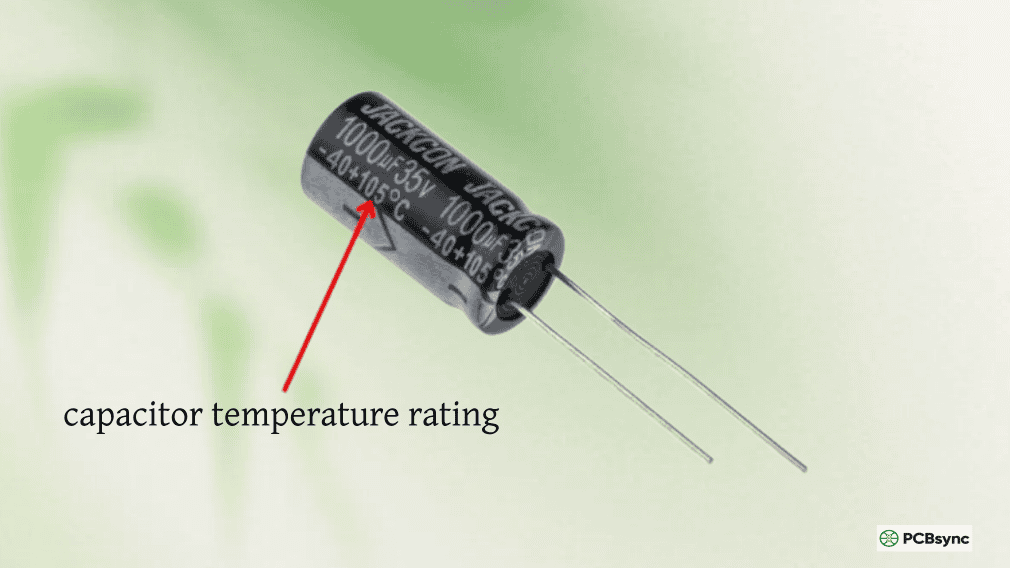
Panasonic provides both online life estimation tools and the standard formula-based approach. The key inputs are rated life (from datasheet, at rated temperature and full ripple current), actual operating temperature (measure at the cap body, not ambient), and actual ripple current versus rated. The standard 10°C rule applies: every 10°C below rated temperature approximately doubles calculated life. Every 50% reduction in applied ripple current roughly doubles life again. Use Panasonic’s online life calculation tool for a more accurate result — it accounts for operating voltage and wall surface temperature rather than just ambient. For conservative designs targeting 10+ year field life, aim for at least 20–30°C thermal margin below the cap’s rated temperature in your worst-case thermal analysis.
Final Thoughts: Building Better Designs with Panasonic Capacitors
The breadth of Panasonic’s capacitor portfolio means there’s almost always an optimized Panasonic part for whatever you’re designing. The challenge is navigating from the application requirement to the right family and then to the right series within that family.
A practical approach: start with Panasonic’s parametric search to filter by the non-negotiables (capacitance, voltage, package, temp rating), then evaluate within the resulting series list based on ESR and life requirements. For any polymer technology choice — whether OS-CON, SP-Cap, or POSCAP — download Panasonic’s SPICE model and run an impedance simulation before committing, especially if you’re replacing MLCCs or evaluating whether one part can replace multiple lower-density components.
Panasonic’s polymer capacitor lineup in particular is strong enough that their MLCC alternative recommendations — SP-Cap for aluminum-based applications, POSCAP for tantalum-based applications — are worth evaluating seriously on any new design where MLCC supply chain risk or board density is a concern. Those aren’t marketing claims; they’re backed by solid technical data in Panasonic’s application notes and third-party engineering analysis.
Inquire: Call 0086-755-23203480, or reach out via the form below/your sales contact to discuss our design, manufacturing, and assembly capabilities.
Quote: Email your PCB files to Sales@pcbsync.com (Preferred for large files) or submit online. We will contact you promptly. Please ensure your email is correct.
Notes: For PCB fabrication, we require PCB design file in Gerber RS-274X format (most preferred), *.PCB/DDB (Protel, inform your program version) format or *.BRD (Eagle) format. For PCB assembly, we require PCB design file in above mentioned format, drilling file and BOM. Click to download BOM template To avoid file missing, please include all files into one folder and compress it into .zip or .rar format.