Inquire: Call 0086-755-23203480, or reach out via the form below/your sales contact to discuss our design, manufacturing, and assembly capabilities.
Quote: Email your PCB files to Sales@pcbsync.com (Preferred for large files) or submit online. We will contact you promptly. Please ensure your email is correct.
Notes: For PCB fabrication, we require PCB design file in Gerber RS-274X format (most preferred), *.PCB/DDB (Protel, inform your program version) format or *.BRD (Eagle) format. For PCB assembly, we require PCB design file in above mentioned format, drilling file and BOM. Click to download BOM template To avoid file missing, please include all files into one folder and compress it into .zip or .rar format.
Ask any hardware engineer which MLCC brand ends up on the most critical nodes of their PCB and Murata comes up first, consistently. That’s not brand loyalty — it’s the result of decades of Murata pushing the technical limits of what a multilayer ceramic capacitor can do. When Murata announces a world-first in miniaturization or a new automotive qualification, the rest of the industry adjusts their roadmaps.
In September 2024, Murata introduced the world’s first 006003-inch (0.16 mm × 0.08 mm) MLCC — a volume approximately 75% smaller than the previously smallest commercially available device. That kind of innovation isn’t an anomaly. It’s a pattern. Murata has been at the front of MLCC technology for decades, and understanding their product line properly means you’re working with the best the passive component industry has to offer.
This guide covers the full Murata capacitor product portfolio — from their mainstream GRM series through automotive GCM/GCJ, RF-optimized GJM/GQM, and beyond — with the practical series comparisons, DC bias context, and tool references that PCB engineers actually need when specifying parts.
Murata’s competitive advantage is built on materials science. Their ability to control the size, shape, and distribution of ceramic powder grains at high accuracy and density allows them to produce thinner dielectric layers than most competitors, which translates directly into higher capacitance in a smaller volume. This manufacturing precision is how they consistently achieve world-firsts in miniaturization, from the now-commonplace 0201 case size to the new 006003 format announced in late 2024.
Beyond miniaturization, Murata’s proprietary dielectric formulations deliver tighter capacitance stability, lower loss, and better DC bias characteristics than generic MLCC alternatives at the same case size and nominal value. For engineers doing serious power supply design or RF work, those differences show up in your circuit performance — not just on a spec sheet.
Their portfolio also covers a deliberately wide range of application spaces: consumer electronics (GRM), automotive to AEC-Q200 (GCM, GCJ, GRT), RF and microwave (GJM, GQM), high-voltage (GRM high-voltage variants), and specialty formats like low-inductance reverse-geometry parts. Murata also offers a set of design tools — particularly SimSurfing — that are industry-leading for characterizing how their parts actually behave in circuit conditions.
Murata MLCC Dielectric Types: The Foundation of Everything
Before diving into individual series, dielectric type is the first decision in any Murata MLCC selection. Getting this wrong is one of the most common and quietly expensive mistakes in PCB design.
Dielectric
Class
Temp Coefficient
Capacitance Range
Key Property
Use Case
C0G (NP0)
Class 1
±30 ppm/°C
0.1 pF – 100 nF
Linear, no aging, no DC bias effect
RF, timing, precision analog
U2J
Class 1
–750 ppm/°C
Up to tens of nF
Stable, low loss
RF coupling, DC blocking
X7R
Class 2
±15% (−55 to +125°C)
100 pF – 100 µF
Moderate stability, widely available
General decoupling, bypass
X5R
Class 2
±15% (−55 to +85°C)
1 µF – 100 µF
High cap per volume, lower temp range
Low-voltage rails, consumer
X6S
Class 2
±22% (−55 to +105°C)
1 µF+
Between X5R and X7R
Mid-temp high-cap applications
X7S
Class 2
±22% (−55 to +125°C)
1 µF+
High-cap with wider temp than X5R
High-cap automotive/industrial
X8G
Class 2
±15% (−55 to +150°C)
—
Extended high-temp
Automotive high-temp environments
Y5V
Class 3
+22/−82% (−30 to +85°C)
Very high
Unstable, high max cap
Non-critical filtering only
The two things engineers underestimate most with Class 2 dielectrics like X7R and X5R are the DC bias effect and aging. A 10 µF X5R MLCC in a 0805 package rated at 6.3V can lose 60–70% of its capacitance when biased at just 3.3V DC. That means your “10 µF” cap may be providing only 3–4 µF at operating voltage. Murata’s SimSurfing tool shows this curve for every part in their catalog — use it before finalizing any high-K MLCC selection.
Aging is the other silent issue: Class 2 ceramics lose capacitance over time at a rate defined in the datasheet (typically 2–5% per decade-hour from the time of last firing). This is not a defect — it’s an inherent property of ferroelectric dielectrics. It matters most in timing and filter circuits where you’re relying on a specific capacitance value.
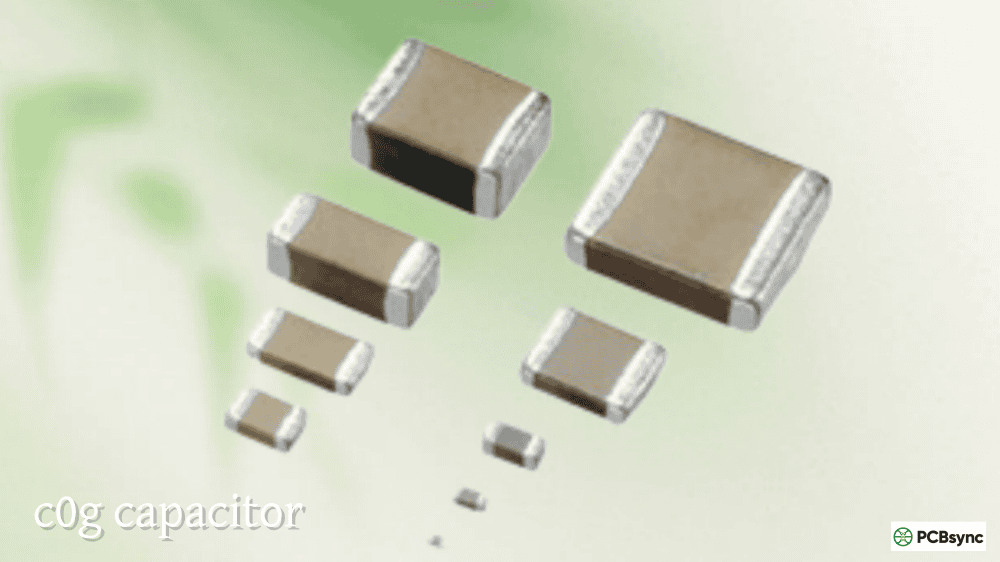
C0G has neither of these problems. It has a linear, predictable temperature coefficient, zero voltage dependency, and zero aging. The trade-off is that C0G cannot achieve the high capacitance values that Class 2 dielectrics can in the same package. You won’t find a 10 µF C0G in a 0402 package. But for RF matching networks, oscillator load capacitors, loop filter components, and precision signal path applications — C0G is the only correct answer.
The GRM series is where most engineers spend most of their time. It’s Murata’s mainstream commercial MLCC family, covering an enormous range of capacitance values, voltages, case sizes, and dielectric types for general-purpose and industrial applications.
## GRM Series Key Parameters
Dimension Code
EIA Size
Physical Size (L×W)
Common Dielectrics Available
GRM01
008004
0.25 × 0.125 mm
C0G, X7R
GRM03
0201
0.6 × 0.3 mm
C0G, X7R, X5R
GRM15
0402
1.0 × 0.5 mm
C0G, X7R, X5R
GRM18
0603
1.6 × 0.8 mm
C0G, X7R, X5R, X6S
GRM21
0805
2.0 × 1.25 mm
C0G, X7R, X5R, X7S
GRM31
1206
3.2 × 1.6 mm
C0G, X7R, X5R, X7S
GRM32
1210
3.2 × 2.5 mm
C0G, X7R
GRM43
1812
4.5 × 3.2 mm
X7R, C0G high-voltage
The GRM series supports capacitance from 0.1 pF up to 150 µF depending on case size and dielectric, and rated voltages from 4V to several kilovolts in high-voltage variants. For anything that isn’t explicitly automotive-grade or RF-specific, GRM is the right starting point.
When selecting GRM parts for SMPS decoupling, three things to verify before finalizing: actual capacitance under DC bias at your operating voltage (SimSurfing), thermal derating for your operating temperature range, and the case size’s susceptibility to flex cracking given your board’s mechanical environment. If that last point is a concern, GCJ soft-termination parts are the straightforward upgrade path.
GCM Series: Automotive-Grade MLCC
The GCM series is Murata’s primary AEC-Q200 qualified automotive MLCC line. Structurally, GCM parts use the same advanced ceramic and electrode materials as GRM, but they are qualified through the full AEC-Q200 stress test suite — including high-temperature/humidity bias testing, thermal shock, vibration, and mechanical shock — which adds cost but provides the documented qualification trail that automotive programs require.
GCM parts are available in X7R and C0G dielectrics across standard EIA case sizes from 0201 to 2220. Voltage ratings range from 6.3V to 630V. For ECU decoupling, sensor conditioning, powertrain control, ADAS processing hardware, and EV battery management systems, GCM is the appropriate default over GRM regardless of whether the electrical spec difference matters to your specific circuit.
## GCM vs GRM: When the Difference Actually Matters
Aspect
GRM (General Purpose)
GCM (Automotive)
AEC-Q200
No
Yes
Qualification testing
Commercial
Full AEC-Q200 stress suite
Operating temp range
−55 to +125°C (X7R)
−55 to +125°C (X7R)
Availability traceability
Standard
Extended lot traceability
Cost
Lower
Higher (~20–40%)
Use case
Consumer, general industrial
Automotive, hi-rel industrial
One practical note: more and more non-automotive industrial designs are specifying AEC-Q200 parts by default, treating the qualification as a quality indicator rather than just an automotive requirement. For industrial control systems, medical equipment, and infrastructure applications where the cost of field failure is high, GCM’s additional qualification discipline is worth the premium even when the design isn’t going into a vehicle.
GCJ Series: Soft-Termination MLCCs for Flex Crack Prevention
This series is one of the more practically important entries in the Murata lineup, and one that engineers often discover only after experiencing field failures from PCB flex cracking.
MLCC flex cracking is a real and underappreciated failure mode. When a PCB bends — during board depaneling, in-circuit testing, connector insertion, or field vibration — the ceramic body of a standard MLCC can crack along the termination-to-ceramic interface. The crack may not show up in immediate electrical testing, but it manifests later as intermittent opens, leakage current, or complete failure in the field. Larger case sizes (1206, 1210, 1812) on longer or thinner boards are most vulnerable.
Murata’s GCJ series addresses this by inserting a conductive polymer layer between the copper inner electrode and the nickel/tin outer termination. The polymer’s elasticity absorbs PCB bending stress before it reaches the ceramic body. In Murata’s own testing with a 1.6 mm thick PCB soldered with 200 µm thick solder, standard MLCC terminations cracked well before 5 mm of board flex. GCJ soft-termination parts did not suffer stress damage at the same deflection.
The ESR and current rating of GCJ parts are equivalent to their GRM counterparts — the soft termination doesn’t compromise electrical performance. The GCJ series is available in both commercial and AEC-Q200 qualified grades, making it applicable across consumer, industrial, and automotive designs.
If you’ve seen cracked MLCCs in reliability testing or field returns, and the application involves any board flex whatsoever, converting those positions to GCJ is the straightforward fix. If you’re in a vibration-heavy environment (motor controllers, automotive near suspension or engine mounts, industrial machinery), design GCJ in from the start at every 0805 and larger position.
GRT Series: Automotive Grade for Infotainment and Body Electronics
The GRT series sits between GRM (commercial) and GCM (full automotive powertrain) in Murata’s automotive portfolio. It’s AEC-Q200 qualified but targets automotive infotainment, body electronics, and interior modules where the thermal and mechanical stress levels are less extreme than under-hood powertrain environments.
The typical design strategy in automotive programs is GCM for powertrain and ADAS computing hardware, GCJ where flex crack risk is elevated, and GRT for infotainment head units, climate control electronics, and body control modules where operating conditions are milder. This tiered approach optimizes cost without over-specifying components in every position.
For RF work, standard GRM parts are often inadequate. The high-Q, low-loss requirements of impedance matching networks, RF filter circuits, antenna tuning, and power amplifier decoupling demand a different construction optimized for high-frequency performance.
Murata’s GJM and GQM series are specifically engineered for RF and microwave applications from 500 MHz to 10 GHz. The key difference from standard GRM parts is their construction: GJM and GQM use precious metal electrode (PME) terminations rather than the nickel (base metal electrode, BME) terminations in standard GRM parts, which delivers lower ESR and higher Q-factor at high frequencies.
## GJM vs GQM: Understanding the Difference
Series
Voltage Range
Q Factor
Capacitance Range
Primary Application
GJM
Up to 100V
Very high
0.1 pF – 47 pF
RF matching, DC blocking, PA decoupling
GQM
Up to 50V (lower V)
Very high
0.1 pF – 100 pF
RF matching, microwave
GRM (C0G)
Up to several kV
High
0.1 pF – 100 nF
General RF, not optimized for >1 GHz
The GJM022/100V series introduced in early 2024 is worth calling out specifically. It’s designed for impedance matching and DC cutting applications in RF modules for 5G base stations, where the high-Q value and low ESR directly improve power amplifier efficiency and lower system power consumption. The 100V rating is meaningful in base station front-end applications where signal levels are higher than in handset designs.
For any design involving transmit paths, low-noise amplifiers, or resonant circuits at frequencies above ~500 MHz, GJM or GQM is the correct series to evaluate before defaulting to a general-purpose GRM C0G.
Murata Capacitor Part Number Decoder: Reading a GRM Part Number
Murata’s part number system is consistent once you learn the structure. Take GRM188R71H104KA57D as an example:
Segment
Value
Meaning
Product ID
GRM
Chip Monolithic Ceramic Capacitor (MLCC)
Series
18
Case size (0603: 1.6 × 0.8 mm)
Chip Height
8
Height code (0.8 mm max)
Temperature Char.
R7
X7R dielectric
Rated Voltage
1H
50 VDC
Capacitance
104
10 × 10⁴ pF = 100 nF (0.1 µF)
Tolerance
K
±10%
Individual Spec
A57
Internal specification code
Packaging
D
180mm paper taping reel
The voltage code system is one of the more confusing parts of Murata’s numbering: 0J = 6.3V, 1A = 10V, 1C = 16V, 1E = 25V, 1V = 35V, 1H = 50V, 2A = 100V, 2E = 250V, 2J = 630V. Memorize these and the catalog becomes much more navigable.
For GCM automotive parts, the prefix changes to GCM and there’s an additional qualification code embedded in the individual specification segment. GCJ soft-termination parts follow the same structure as GRM but with the GCJ prefix.
Murata Capacitor Series Quick Reference Table
Series
Application Grade
AEC-Q200
Soft Term
Key Dielectrics
Best For
GRM
Commercial / Industrial
No
No
C0G, X7R, X5R, X7S
General purpose, most designs
GCM
Automotive
Yes
No
C0G, X7R, X5R, X7S
Under-hood ECU, ADAS, EV
GCJ
Automotive / Commercial
Both grades
Yes
C0G, X7R, X5R
High-flex boards, vibration environments
GRT
Automotive (infotainment/body)
Yes
No
C0G, X7R, X5R
In-cabin automotive, body electronics
GJM
RF (100–600V capable)
No
No
C0G, high-Q
RF matching, PA decoupling, 5G
GQM
RF (lower voltage)
No
No
C0G, high-Q
RF matching, microwave, resonant circuits
LLL/LLA
Low inductance reverse geom.
—
No
X7R, C0G
PDN decoupling where ESL is limiting factor
Murata SimSurfing and Design Tools: Why You Should Use Them
SimSurfing is the tool that separates Murata from most MLCC competitors on the engineering support front. It’s a free web-based simulation platform that shows you real characterization data — not idealized datasheet curves — for every part in Murata’s catalog.
The capabilities that matter most in daily design work are the capacitance vs. DC bias plot, capacitance vs. temperature curve, impedance vs. frequency, ESR vs. frequency, and S-parameter export for RF simulation. Using SimSurfing for DC bias evaluation should be mandatory before finalizing any high-K Class 2 MLCC selection in a power supply output filter or DC rail decoupling position. The difference between nominal capacitance and actual in-circuit capacitance at operating voltage is frequently large enough to require a different part or a parallel combination.
SimSurfing also allows SPICE netlist export for any part, which integrates directly into LTspice and other circuit simulators. Murata’s 3D CAD models (in .stp and .idf formats) are available through the same portal, useful for mechanical clearance verification during PCB layout.
Useful Resources for Murata Capacitor Selection
Official Murata Tools and Databases
Murata SimSurfing Design Tool — Free web-based tool for capacitance vs. DC bias, impedance, ESR, S-parameters, and SPICE netlist export. Essential for any serious MLCC design work.
Murata Design Tools Portal — Hub for all Murata simulation tools including SPICE models, S-parameters, 3D CAD data, C-format EDA library data
Murata MLCC Product Lineup — Product series navigation by application, dielectric type, and special features
DigiKey Murata MLCC Search — Filter by series, dielectric, voltage, capacitance, temperature rating; direct datasheet and SimSurfing links on product pages
5 Frequently Asked Questions About Murata Capacitors
Q1: Why does my Murata X7R MLCC have much less capacitance than rated when installed in my circuit?
This is the DC bias effect, and it’s one of the most common and impactful surprises in MLCC design. Class 2 dielectrics like X7R and X5R use ferroelectric ceramics that change their permittivity — and therefore capacitance — as DC voltage is applied. A Murata GRM MLCC rated at 10 µF in 0805 case at 10V might deliver only 3–4 µF when biased at 5V DC. The effect is strongest in smaller case sizes and at higher applied voltage ratios. To find the actual capacitance at your operating voltage, use Murata’s SimSurfing tool: search for your part number, select the “Capacitance vs. DC Bias” plot, and read the value at your operating voltage. If the derated value doesn’t meet your filtering requirement, you’ll need a part with a higher voltage rating, larger case size, or a parallel combination.
Q2: When should I use GCM instead of GRM for an industrial (non-automotive) design?
AEC-Q200 qualification is increasingly being specified in industrial designs as a quality benchmark, not just an automotive requirement. If your industrial application involves extended temperature exposure (above +85°C ambient), vibration, long product life requirements (10+ years), or high failure costs, GCM is a sensible choice even without an automotive program driver. The qualification testing GCM parts undergo — thermal shock, moisture resistance bias, mechanical shock, vibration — stress-screens failure modes that raw electrical specs don’t reveal. The 20–40% cost premium is often justified in industrial designs where field service is expensive or the product is safety-related.
Q3: What is the difference between GJM and GQM for RF applications?
Both GJM and GQM are precious metal electrode (PME) construction capacitors optimized for high-Q performance in RF and microwave circuits from 500 MHz to 10 GHz. The primary distinction is rated voltage: GJM is available at higher voltages (up to 100V and higher in recent releases) while GQM typically covers lower voltage ranges. For most small-signal RF applications at handset or module power levels, either series provides sufficient voltage headroom and the selection comes down to availability of your specific capacitance and frequency requirements. For base station PA applications where signal voltages are higher, GJM’s higher voltage ratings are a meaningful differentiator.
Q4: What causes MLCC flex cracking and how does Murata’s GCJ soft termination help?
MLCC flex cracking happens when a PCB bends — during board depaneling, ICT bed-of-nails testing, connector insertion, or in-field vibration. The ceramic body of an MLCC is mechanically brittle, and when the PCB bends, the stress concentrates at the termination-to-ceramic interface. Standard tin-nickel-copper terminations transmit this stress directly into the ceramic. In Murata’s GCJ series, a conductive polymer layer is applied between the copper electrode and the nickel overplate. The polymer’s elastic compliance absorbs bending stress before it reaches the ceramic body. In Murata’s own testing, GCJ parts on a standard 1.6 mm PCB showed no cracking at 5 mm of board deflection — the same deflection that cracks standard MLCC terminations. The fix is straightforward: identify positions in your design where large MLCCs (0805 and above) are on boards that flex during manufacturing or field use, and replace those positions with GCJ parts. ESR and current ratings are unchanged from the equivalent GRM parts.
Q5: How should I read a Murata SimSurfing impedance plot for power supply decoupling design?
When you open a part in SimSurfing and select impedance vs. frequency, you’re looking at the combined effect of capacitive reactance (falling slope), ESR (the flat minimum at self-resonant frequency), and inductive reactance (rising slope above SRF). For a decoupling capacitor on a power rail, the most useful thing to read is the impedance at your target frequency — typically your switching frequency and its harmonics. The minimum of the impedance curve is your best-case performance. Anything you need to filter above that minimum starts seeing increasing inductive reactance as the capacitor enters its inductive region. For SMPS output filtering at frequencies above the SRF, a smaller case size capacitor will have lower ESL and push the SRF higher. SimSurfing lets you overlay multiple parts on the same plot — select your intended part and its alternatives, then compare impedance at the frequency that matters to your design. This is far more useful than comparing nominal capacitance values in a datasheet table.
The DC Bias Effect: The Most Important Thing to Know About Murata MLCCs
It’s worth giving this a dedicated section because it’s the source of more unexplained design problems with Murata capacitors than anything else. When a design fails filtering, when an output has higher-than-expected ripple, when a DC/DC converter behaves differently than simulated — DC bias derating of Class 2 MLCCs is often the culprit.
The practical rule of thumb: for X5R and X7R MLCCs in power supply applications, start your selection with a voltage rating 2–3× higher than your operating voltage. A 3.3V rail should be decoupled with 10V or 16V rated MLCCs, not 4V or 6.3V parts. The derating curve is steep in the low voltage ratio region — moving from a 6.3V to a 10V rated part on a 3.3V rail can recover 40–50% of the capacitance you thought you had. Then validate the specific part with SimSurfing before finalizing.
For C0G/NP0 dielectric parts, none of this applies. C0G capacitance is independent of applied DC voltage. That’s one of the main reasons C0G is specified for critical filter poles and timing networks even when the nominal capacitance value could be achieved with a smaller X7R part.
Final Thoughts: Getting the Most from Murata’s Catalog
The Murata capacitor product line is deep enough that you can get to the right part for almost any application — but shallow enough in documentation clarity that engineers often default to GRM X7R for everything without thinking hard about whether C0G, GCM, GCJ, or GJM is the better fit.
The habit worth building is using SimSurfing from the beginning of every critical capacitor selection, not as an afterthought. Checking actual DC-biased capacitance for every Class 2 MLCC in a power supply design adds maybe ten minutes to the design process. Discovering the same problem during bringup, when the BOM is locked, costs far more.
Murata’s technical FAQ and application note library is also genuinely worth reading. They’ve done a thorough job of documenting the tricky behavior of their own products — from the subtleties of temperature coefficient interaction with DC bias to the specific mechanical conditions that trigger soft-termination benefits. That documentation exists to help you design it right the first time.
Inquire: Call 0086-755-23203480, or reach out via the form below/your sales contact to discuss our design, manufacturing, and assembly capabilities.
Quote: Email your PCB files to Sales@pcbsync.com (Preferred for large files) or submit online. We will contact you promptly. Please ensure your email is correct.
Notes: For PCB fabrication, we require PCB design file in Gerber RS-274X format (most preferred), *.PCB/DDB (Protel, inform your program version) format or *.BRD (Eagle) format. For PCB assembly, we require PCB design file in above mentioned format, drilling file and BOM. Click to download BOM template To avoid file missing, please include all files into one folder and compress it into .zip or .rar format.