Inquire: Call 0086-755-23203480, or reach out via the form below/your sales contact to discuss our design, manufacturing, and assembly capabilities.
Quote: Email your PCB files to Sales@pcbsync.com (Preferred for large files) or submit online. We will contact you promptly. Please ensure your email is correct.
Notes: For PCB fabrication, we require PCB design file in Gerber RS-274X format (most preferred), *.PCB/DDB (Protel, inform your program version) format or *.BRD (Eagle) format. For PCB assembly, we require PCB design file in above mentioned format, drilling file and BOM. Click to download BOM template To avoid file missing, please include all files into one folder and compress it into .zip or .rar format.
Motor Capacitors: Start, Run & Dual Capacitor Complete Guide
After working on motor control circuits for over a decade, I’ve come to appreciate how often the humble motor capacitor gets overlooked until something goes wrong. That humming sound from your HVAC unit, the pool pump that won’t start, the workshop compressor refusing to spin up—these problems frequently trace back to a small cylindrical component that most people never think about.
This guide breaks down everything you need to understand about motor capacitors. Whether you’re troubleshooting a failed appliance, selecting a replacement part, or simply want to understand how single-phase motors actually work, I’ve compiled the practical knowledge that makes the difference between a quick fix and hours of frustration.
A motor capacitor is an electrical component that modifies the current flow to the windings of a single-phase AC induction motor. Its primary job involves creating a phase shift between the motor’s main and auxiliary windings, which generates the rotating magnetic field necessary to start and run the motor efficiently.
Single-phase power, unlike three-phase industrial power, doesn’t naturally create a rotating magnetic field. Without help, a single-phase motor would simply sit there humming, with its rotor stuck between opposing magnetic poles. The Capacitor solves this problem by shifting the phase of current in the auxiliary winding, creating a second magnetic pole that’s offset in time from the main winding. This offset gets the rotor spinning in a definite direction.
Think of it like pushing someone on a swing. You need to push at the right moment in the swing’s arc to keep it moving. The motor capacitor provides that perfectly timed “push” to the motor’s magnetic field, keeping the rotor spinning smoothly in the desired direction.
How Motor Capacitors Work in Single-Phase Motors
Understanding the electrical principles behind motor capacitors helps you diagnose problems and select correct replacements. Here’s the engineering explanation in practical terms.
The Phase Shift Principle
In an AC circuit, current and voltage constantly change direction, completing 60 cycles per second (60 Hz) in North America. A capacitor introduces a leading phase shift, meaning the current through a capacitor-connected winding reaches its peak slightly before the current in the main winding.
This timing difference creates two magnetic fields that peak at different moments. As they alternate, the combined effect is a rotating magnetic field that sweeps around the motor, dragging the rotor along with it through electromagnetic induction.
Main and Auxiliary Windings
Single-phase capacitor motors have two sets of windings physically offset by 90 degrees around the stator. The main winding carries most of the current during normal operation. The auxiliary (or start) winding, connected through the capacitor, provides the phase-shifted current needed for starting and, in some designs, improved running efficiency.
The capacitor’s value directly affects how much phase shift occurs. This is why matching the correct microfarad rating matters so much—too little capacitance means insufficient phase shift and weak starting torque, while too much creates excessive current that can damage windings.
Types of Motor Capacitors Explained
Motor capacitors come in three main types, each designed for specific functions within the motor circuit.
Start Capacitors
Start capacitors provide the high-torque boost needed to get a motor spinning from a dead stop. They’re built for intermittent duty, staying in the circuit only during the startup phase—typically a few seconds until the motor reaches about 75% of operating speed.
Key characteristics of start capacitors include high capacitance values (typically 70-1200 µF), lower voltage ratings (125V, 165V, 250V, or 330V), black plastic (phenolic or Bakelite) housings, electrolytic construction, and round case shapes.
A centrifugal switch or electronic relay disconnects the start capacitor once the motor reaches operating speed. If this switch fails in the closed position, the start capacitor stays energized continuously and will fail catastrophically, often literally blowing its top off due to internal pressure buildup.
Run Capacitors
Run capacitors remain energized throughout motor operation, continuously optimizing the phase relationship between windings for maximum efficiency. Because they operate constantly, they’re built from more durable materials than start capacitors.
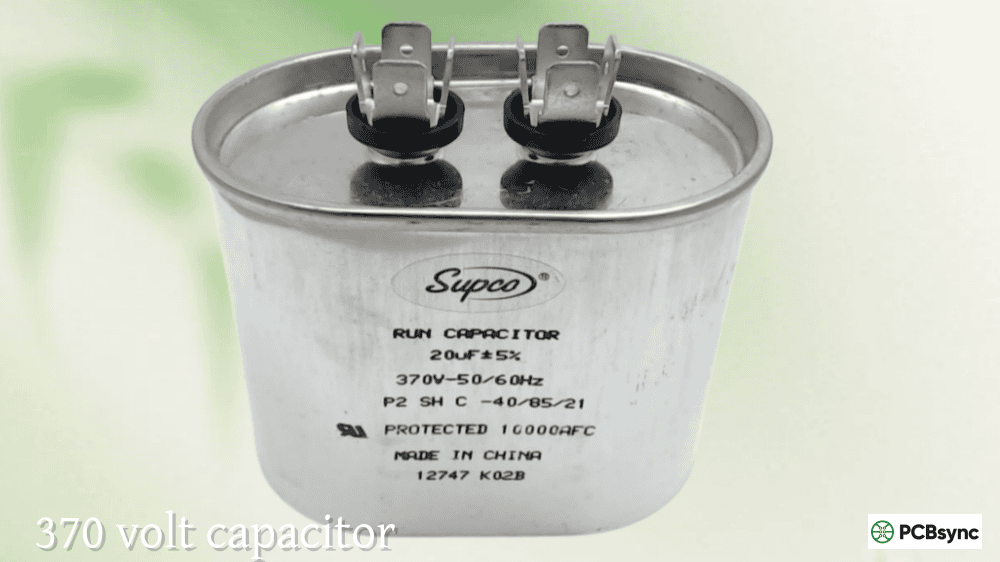
Run capacitors feature lower capacitance values (typically 2.5-70 µF), higher voltage ratings (370V or 440V AC), metal (aluminum or steel) housings, oil-filled or dry film construction, and round or oval case shapes.
The continuous duty design means run capacitors use oil-filled polypropylene or polyester film construction rather than electrolytic technology. This provides longer life and lower energy losses but limits the capacitance values achievable in a practical package size.
Dual Run Capacitors
Dual run capacitors combine two run capacitors into a single package, saving space in equipment like air conditioners where both the compressor motor and fan motor need their own capacitors.
Dual capacitors have three terminals labeled C (Common), HERM (Hermetic compressor), and FAN. The label shows two capacitance values, such as “45/5 µF,” where the larger value serves the compressor and the smaller value serves the fan motor.
Electrically, a dual capacitor is simply two separate capacitors sharing a common terminal and a single housing. You can replace a failed dual capacitor with two individual run capacitors if you have mounting space, connecting their negative terminals together to create the common connection.
Motor Capacitor Specifications Comparison
The following table summarizes key differences between the three motor capacitor types:
Specification
Start Capacitor
Run Capacitor
Dual Run Capacitor
Duty Cycle
Intermittent (seconds)
Continuous
Continuous
Capacitance Range
70-1200 µF
2.5-70 µF
Various (e.g., 45/5 µF)
Voltage Ratings
125V, 165V, 250V, 330V
370V, 440V AC
370V, 440V AC
Construction
Electrolytic
Oil-filled film
Oil-filled film
Housing Material
Black plastic
Aluminum/steel
Aluminum/steel
Shape
Round
Round or oval
Round or oval
Terminals
2 per post
3-4 per post
3 (C, HERM, FAN)
Tolerance
±10%
±5% to ±6%
±5% to ±6%
Common Motor Capacitor Applications
Motor capacitors appear throughout residential, commercial, and industrial equipment wherever single-phase motors need to start under load or run efficiently.
HVAC Systems
Air conditioners and heat pumps typically use dual run capacitors to power both the compressor motor and condenser fan motor. Furnace blower motors often have their own run capacitors. These applications account for the majority of motor capacitor replacements.
Pumps and Compressors
Pool pumps, well pumps, sump pumps, and air compressors commonly use capacitor-start motors because they need to start under load (with water or air already in the system). These applications often use both a start capacitor and a run capacitor.
Household Appliances
Washing machines, dryers, dishwashers, refrigerators, and garbage disposals use various motor capacitor configurations depending on their starting torque requirements and efficiency targets.
Power Tools and Workshop Equipment
Drill presses, lathes, table saws, and other workshop machinery with single-phase motors frequently use start capacitors to develop adequate starting torque, especially when loaded.
The following table shows typical capacitor configurations by application:
Selecting a replacement motor capacitor requires matching several specifications precisely. Getting these wrong can damage your motor or create safety hazards.
Match the Capacitance Value
The microfarad (µF or MFD) rating must match the original capacitor exactly for run capacitors. Motor manufacturers determine this value through extensive testing to optimize efficiency and prevent overheating. Using a different capacitance creates an uneven magnetic field that causes the motor to run hot, vibrate, consume excess energy, and fail prematurely.
Start capacitors allow slightly more flexibility. You can go up to 10% higher than the original rating if an exact match isn’t available, but never go lower.
Select Appropriate Voltage
The voltage rating must equal or exceed the original capacitor. Using a 440V capacitor in place of a 370V capacitor is acceptable and may actually extend capacitor life. Using a 370V capacitor in a 440V application will cause premature failure.
Important: Start capacitor voltage ratings (125V, 250V, 330V) refer to the induced voltage in the start winding, not the supply voltage. A 220V motor typically needs a 250V or 330V start capacitor.
Verify Frequency Rating
Motor capacitors should be rated for 50/60 Hz operation, matching standard power grid frequencies. Most capacitors are dual-rated and work with either frequency.
Check Physical Fit
While round and oval capacitors are electrically equivalent, they must physically fit in the available mounting space. Measure the original capacitor and verify clearances before purchasing a replacement.
Motor Capacitor Troubleshooting Guide
Recognizing capacitor failure symptoms helps you diagnose motor problems quickly and avoid unnecessary parts replacement.
Symptoms of a Failed Start Capacitor
When a start capacitor fails, the motor typically hums but doesn’t start, requires a manual push or spin to begin rotating, makes clicking sounds as the contactor engages repeatedly, and trips the circuit breaker after several start attempts.
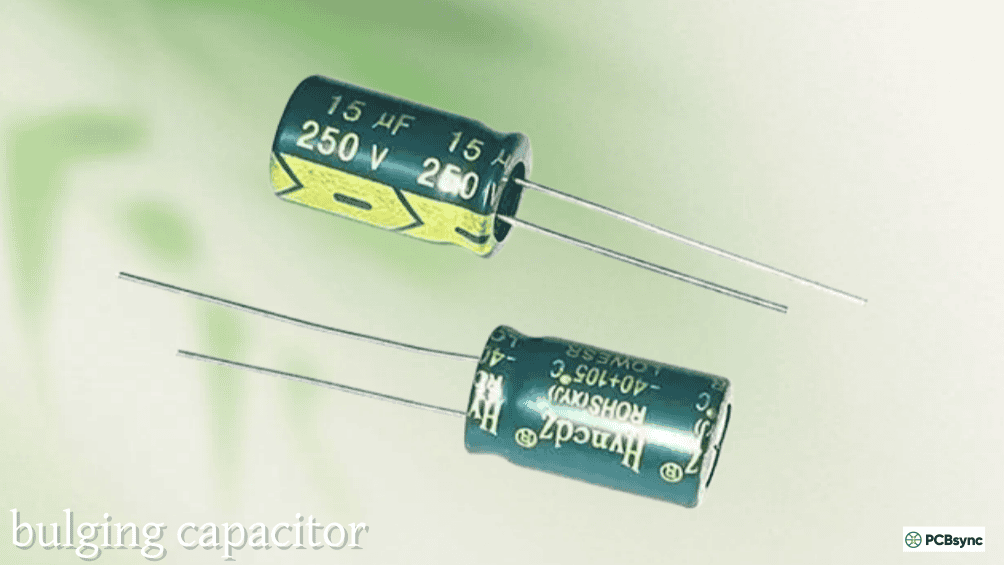
Failed start capacitors often show obvious physical damage. Look for a bulging or ruptured case, blown-off top with internal components ejected, burn marks or melted plastic, and leaking electrolyte (oily substance).
Symptoms of a Failed Run Capacitor
Run capacitor failure produces different symptoms. The motor may start but run slowly or weakly, overheat during operation, draw higher than normal current, produce a loud humming during operation, or cause the system to short-cycle (turn on and off rapidly).
Run capacitors fail more gradually than start capacitors. Physical signs include bulging case (particularly the top), leaking oil, corrosion around terminals, and swollen or cracked housing.
Testing Motor Capacitors
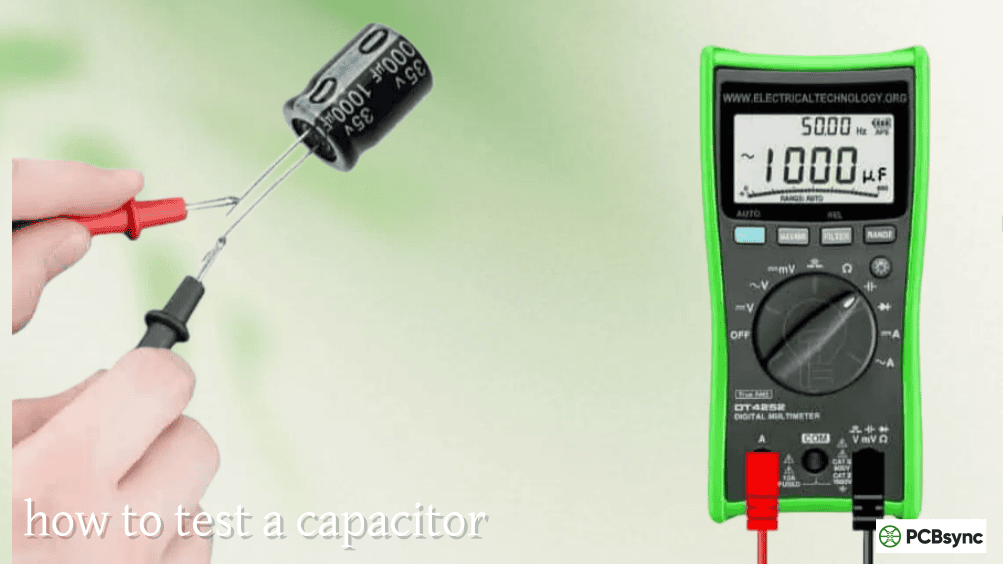
Testing a motor capacitor requires a multimeter with capacitance measurement capability. Always disconnect power and discharge the capacitor before testing by carefully shorting across the terminals with an insulated screwdriver.
Set your multimeter to capacitance mode (µF or MFD). Connect the probes to the capacitor terminals and compare the reading to the rated value on the capacitor label.
Test Result
Diagnosis
Action
Within ±5% of rated value
Capacitor is good
No replacement needed
5-10% below rated value
Capacitor is marginal
Replace soon
More than 10% below rated
Capacitor is failing
Replace immediately
Zero or very low reading
Capacitor is shorted
Replace immediately
OL (overload/infinite) reading
Capacitor is open
Replace immediately
Motor Capacitor Replacement Procedure
Replacing a motor capacitor is straightforward if you follow proper safety procedures.
Step 1: Disconnect all power to the equipment. Verify power is off using a non-contact voltage tester.
Step 2: Locate and access the capacitor. In HVAC systems, this typically means removing an access panel from the outdoor condensing unit.
Step 3: Discharge the capacitor by carefully placing an insulated screwdriver across the terminals. You may see a small spark.
Step 4: Document all wire connections with a photo or labels before disconnecting anything. Note which wires connect to C, HERM, and FAN terminals.
Step 5: Disconnect wires using needle-nose pliers, pulling on the connector rather than the wire.
Step 6: Remove the mounting hardware and extract the old capacitor.
Step 7: Install the new capacitor, ensuring specifications match the original or exceed voltage ratings.
Step 8: Reconnect all wires to their correct terminals according to your documentation.
Step 9: Replace mounting hardware and access panels.
Step 10: Restore power and test operation.
Frequently Asked Questions About Motor Capacitors
Can I use a higher microfarad capacitor than specified?
No, you should not use a higher microfarad (µF) capacitor for run capacitors. The motor manufacturer specifies the exact capacitance needed for proper phase shift and efficiency. A higher value creates excessive current in the auxiliary winding, causing overheating and premature motor failure. Start capacitors allow up to 10% higher ratings, but exact matching is always preferred.
What happens if I use a lower voltage capacitor?
Using a capacitor with a voltage rating below the system requirements causes rapid failure. The capacitor’s dielectric material breaks down under the excess voltage stress, leading to internal shorts and potential safety hazards. Always use capacitors rated at or above the original voltage specification. Higher voltage ratings are acceptable and may extend capacitor life.
Can a start capacitor be used as a run capacitor?
No. Start capacitors use electrolytic construction designed only for brief duty cycles (a few seconds). Running an electrolytic start capacitor continuously would cause it to overheat and fail, potentially explosively. Run capacitors use oil-filled film construction specifically designed for continuous operation.
How long do motor capacitors typically last?
Run capacitors typically last 10-20 years under normal operating conditions, with quality units rated for 30,000-60,000 operating hours. Start capacitors often last longer because they operate only briefly during each motor start. However, heat exposure, voltage fluctuations, and frequent cycling can significantly reduce lifespan. Capacitors in hot environments or poorly ventilated equipment may need replacement every 5-10 years.
Why does my new capacitor keep failing?
Repeated capacitor failure indicates an underlying problem that needs diagnosis. Common causes include motor winding problems drawing excessive current, voltage supply issues, poor ventilation causing heat buildup, incorrect capacitor specifications, a failed centrifugal switch keeping the start capacitor energized, and oversized replacement capacitors. Have the motor tested if capacitors fail repeatedly—the capacitor may be a symptom, not the cause.
Useful Resources for Motor Capacitor Selection
Technical Guides and References:
TEMCO Industrial Capacitor Guides (temcoindustrial.com) — Detailed selection guides for start and run capacitors
InspectAPedia (inspectapedia.com) — Comprehensive motor capacitor identification and troubleshooting
Capacitor Guide at EE Power (eepower.com) — Technical explanations of capacitor motor theory
Parts Suppliers:
Grainger (grainger.com) — Industrial-grade motor capacitors with specifications
RepairClinic (repairclinic.com) — Search by appliance model number
TEMCO Industrial (temcoindustrial.com) — Specialized motor capacitor supplier
Amazon — Wide selection with customer reviews
Manufacturer Resources:
AO Smith Motors (aosmithmotors.com) — Motor manuals including capacitor specifications
Emerson Climate Technologies — Compressor motor documentation
Regal Beloit — Motor specification sheets
Final Thoughts on Motor Capacitor Selection and Maintenance
The motor capacitor might seem like a minor component, but its proper function determines whether your equipment starts reliably and runs efficiently. Understanding the differences between start, run, and dual capacitors—and knowing how to select correct replacements—saves both money and frustration when problems arise.
Remember the key principles: match capacitance exactly for run capacitors, never use lower voltage ratings than specified, and always discharge capacitors before handling them. When symptoms suggest capacitor failure, test before replacing—but also investigate why the capacitor failed to prevent repeat problems.
Regular maintenance helps extend capacitor life. Keep equipment clean and well-ventilated, address voltage supply issues promptly, and replace capacitors proactively during scheduled maintenance rather than waiting for complete failure. A $20 capacitor replaced during a routine service call costs far less than an emergency repair or damaged motor.
With the information in this guide, you’re equipped to diagnose motor capacitor problems, select proper replacements, and maintain your single-phase motor equipment for reliable long-term operation.
Inquire: Call 0086-755-23203480, or reach out via the form below/your sales contact to discuss our design, manufacturing, and assembly capabilities.
Quote: Email your PCB files to Sales@pcbsync.com (Preferred for large files) or submit online. We will contact you promptly. Please ensure your email is correct.
Notes: For PCB fabrication, we require PCB design file in Gerber RS-274X format (most preferred), *.PCB/DDB (Protel, inform your program version) format or *.BRD (Eagle) format. For PCB assembly, we require PCB design file in above mentioned format, drilling file and BOM. Click to download BOM template To avoid file missing, please include all files into one folder and compress it into .zip or .rar format.