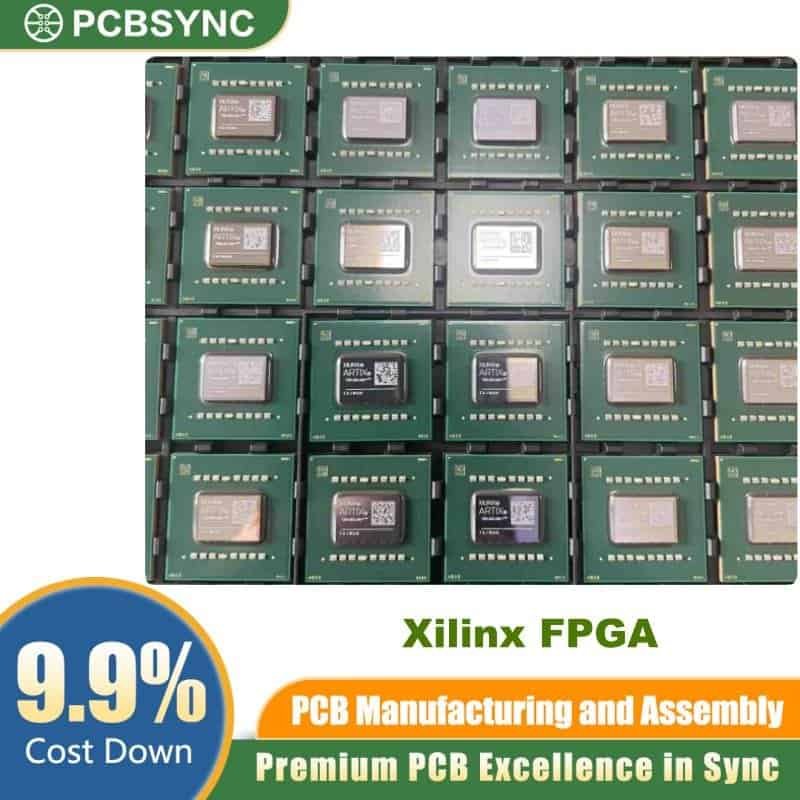
The XC3S1000-5FG676C is a high-performance, cost-optimized Field-Programmable Gate Array (FPGA) from Xilinx’s Spartan-3 family, now under AMD. Designed for high-volume, cost-sensitive applications, this device delivers 1 million system gates, 17,280 logic cells, and 676 I/O pins in a Fine-Pitch Ball Grid Array (FBGA) package. Built on 90nm CMOS technology and operating at a core voltage of 1.2V, the XC3S1000-5FG676C is a versatile solution for embedded control, digital signal processing, communications, and consumer electronics applications.
Whether you are an engineer sourcing components or a designer evaluating FPGA options, this guide covers everything you need to know about the XC3S1000-5FG676C — from detailed technical specifications and pin configurations to ordering information and application use cases.
What Is the XC3S1000-5FG676C?
The XC3S1000-5FG676C is part of Xilinx’s eight-member Spartan-3 FPGA family, which ranges from 50,000 to 5,000,000 system gates. The “XC3S1000” designates the device’s 1-million gate density, “-5” indicates the speed grade (the fastest commercial grade), “FG676” specifies the 676-ball Fine-Pitch BGA package, and “C” denotes the commercial temperature range (0°C to +85°C).
As a fully reprogrammable logic device, the XC3S1000-5FG676C is a superior, flexible alternative to mask-programmed ASICs — eliminating high NRE (Non-Recurring Engineering) costs, long development cycles, and field-inflexibility. Designers can update and reprogram the device in the field without hardware replacement, making it ideal for applications that require firmware updates or design iterations.
If you are evaluating Xilinx FPGA solutions for your next project, the XC3S1000-5FG676C offers an exceptional balance of gate density, I/O flexibility, and cost efficiency.
XC3S1000-5FG676C Key Specifications at a Glance
| Parameter |
Value |
| Manufacturer |
Xilinx (AMD) |
| Part Number |
XC3S1000-5FG676C |
| FPGA Family |
Spartan-3 |
| System Gates |
1,000,000 |
| Logic Cells |
17,280 |
| CLBs (Configurable Logic Blocks) |
1,920 |
| Slices |
7,680 |
| Flip-Flops |
15,360 |
| Distributed RAM |
120 Kbits |
| Block RAM |
432 Kbits (24 blocks × 18 Kbits) |
| Dedicated Multipliers (18×18) |
24 |
| DCMs (Digital Clock Managers) |
4 |
| Maximum User I/Os |
391 |
| Speed Grade |
-5 (fastest commercial) |
| Technology Node |
90nm CMOS |
| Core Supply Voltage (VCCINT) |
1.2V |
| I/O Supply Voltage (VCCO) |
1.2V – 3.3V |
| Operating Temperature |
0°C to +85°C (Commercial) |
| Package |
676-ball FBGA (Fine-Pitch BGA) |
| Package Dimensions |
27mm × 27mm |
| Ball Pitch |
1.0mm |
| RoHS Compliance |
Pb-free (G suffix variant) |
| Configuration Modes |
Master/Slave Parallel, Master/Slave Serial, JTAG |
XC3S1000-5FG676C Part Number Decoder
Understanding the Xilinx ordering code helps engineers quickly identify the exact variant they need.
| Field |
Code |
Meaning |
| Family |
XC3S |
Spartan-3 FPGA Family |
| Density |
1000 |
1,000,000 System Gates |
| Speed Grade |
-5 |
Fastest Commercial Speed Grade |
| Package Type |
FG |
Fine-Pitch Ball Grid Array (FBGA) |
| Pin Count |
676 |
676 Solder Balls |
| Temperature Range |
C |
Commercial (0°C to +85°C) |
Note: The “G” infix (e.g., FGG676) indicates a Pb-free (RoHS-compliant) package. The XC3S1000-5FG676C uses standard (non-Pb-free) solder finish.
XC3S1000-5FG676C Logic Resources
The XC3S1000-5FG676C features a rich array of programmable logic resources organized around a regular array of Configurable Logic Blocks (CLBs) surrounded by a ring of Input/Output Blocks (IOBs).
Configurable Logic Blocks (CLBs)
| Resource |
Count |
| Total CLBs |
1,920 (48 columns × 40 rows) |
| Slices per CLB |
4 |
| Total Slices |
7,680 |
| LUTs (4-input) |
15,360 |
| Flip-Flops / Registers |
15,360 |
| Distributed RAM |
120 Kbits |
| 16-bit Shift Registers (SRL16) |
Supported |
Each CLB contains four slices, and each slice includes two 4-input Look-Up Tables (LUTs), two storage elements (flip-flops or latches), and dedicated carry logic. The left-hand slices additionally support Distributed RAM and SRL16 shift register functions.
Block RAM
| Resource |
Count |
| Block RAM Modules |
24 |
| Capacity per Block |
18 Kbits |
| Total Block RAM |
432 Kbits |
| Configuration Options |
True dual-port, simple dual-port, single-port |
| Width × Depth Options |
Various (×1, ×2, ×4, ×9, ×18) |
Block RAM modules are true dual-port, allowing simultaneous read and write on independent ports with independent clocks — making them ideal for FIFOs, data buffers, and lookup tables.
Dedicated Multipliers and DSP Resources
| Resource |
Count |
| 18×18 Dedicated Multipliers |
24 |
| Multiplier Output Width |
36 bits |
The 24 dedicated hardware 18×18 multipliers support high-throughput DSP applications such as FIR filters, FFTs, and arithmetic-intensive datapaths without consuming CLB resources.
XC3S1000-5FG676C I/O and Package Information
I/O Capabilities
| Parameter |
Value |
| Maximum User I/Os (FG676) |
391 |
| I/O Banks |
8 |
| Supported Single-Ended Standards |
18 (LVCMOS, LVTTL, SSTL, HSTL, GTL, etc.) |
| Supported Differential Standards |
8 (LVDS, LVPECL, BLVDS, ULVDS, LDT, RSDS, HSTL Diff, SSTL Diff) |
| Digitally Controlled Impedance (DCI) |
Yes |
| Double Data Rate (DDR) Registers |
Yes |
| VCCO Range |
1.2V – 3.3V (bank-configurable) |
The SelectIO technology supports 26 different signal standards across all banks, including eight high-performance differential standards for memory interfaces, high-speed serial links, and board-to-board communication.
FG676 Package Details
| Parameter |
Value |
| Package Type |
FBGA (Fine-Pitch Ball Grid Array) |
| Total Balls |
676 |
| User I/Os Available |
391 |
| Body Size |
27mm × 27mm |
| Ball Pitch |
1.0mm |
| Mounting |
Surface-mount (SMT) |
Clock Management: Digital Clock Managers (DCMs)
The XC3S1000-5FG676C integrates 4 Digital Clock Managers (DCMs), providing powerful on-chip clock synthesis and conditioning capabilities.
| DCM Feature |
Details |
| Number of DCMs |
4 |
| Clock Multiplication/Division |
Integer and non-integer ratios |
| Phase Shifting |
Fixed or variable (fine-grained) |
| Deskewing |
Internal and external |
| Clock Frequency Synthesis |
Wide range using M/D ratios |
| Duty Cycle Correction |
50% output duty cycle |
| Maximum Input Frequency |
Up to 326 MHz |
DCMs eliminate clock skew, multiply or divide clock frequencies, and shift clock phases — simplifying high-speed, multi-clock domain designs.
Configuration and Programming
The XC3S1000-5FG676C is configured by loading data into reprogrammable static CMOS Configuration Latches (CCLs). Configuration data is stored externally and loaded at power-up.
| Configuration Mode |
Interface |
Width |
| Master Serial |
SPI/Platform Flash PROM |
1-bit |
| Slave Serial |
External controller |
1-bit |
| Master Parallel (SelectMAP) |
PROM/microprocessor |
8-bit |
| Slave Parallel (SelectMAP) |
External controller |
8-bit |
| Boundary Scan (JTAG) |
IEEE 1149.1 |
Serial |
Recommended configuration PROMs: Xilinx XCF04S (Platform Flash, serial) supporting up to 3.2 Mbit. The JTAG interface supports in-system programming (ISP) and boundary-scan testing without external hardware changes.
XC3S1000-5FG676C Electrical Characteristics
| Parameter |
Min |
Typical |
Max |
Unit |
| Core Supply Voltage (VCCINT) |
1.14V |
1.20V |
1.26V |
V |
| I/O Supply Voltage (VCCO) |
1.14V |
— |
3.465V |
V |
| Auxiliary Supply (VCCAUX) |
2.375V |
2.5V |
2.625V |
V |
| Operating Temperature (Commercial) |
0 |
— |
+85 |
°C |
| Maximum I/O Current per Pin |
— |
— |
24 |
mA |
Speed Grade –5: Performance Characteristics
The -5 speed grade is the highest (fastest) commercial speed grade for the Spartan-3 family, offering the lowest propagation delays and the highest achievable clock frequencies.
| Timing Parameter |
-5 Grade |
| System Clock Frequency |
Up to 725 MHz (internal) |
| Maximum DCM Input Frequency |
326 MHz |
| CLB-to-CLB Routing Delay |
Optimized for -5 grade |
| Setup/Hold Times |
Best-in-class for Spartan-3 |
The -5C speed/temperature combination can also be dual-marked as -4I (Industrial), meaning devices marked “5C/4I” meet both commercial and industrial timing specifications — providing supply chain flexibility.
XC3S1000-5FG676C vs. Other Spartan-3 Variants
The table below compares the XC3S1000-5FG676C against related members of the Spartan-3 family and common package variants to help engineers select the right device.
| Part Number |
Gates |
Logic Cells |
Block RAM |
Multipliers |
Package |
Max I/O |
Speed |
Temp |
| XC3S1000-5FG320C |
1M |
17,280 |
432 Kb |
24 |
FG320 |
221 |
-5 |
Commercial |
| XC3S1000-5FG456C |
1M |
17,280 |
432 Kb |
24 |
FG456 |
333 |
-5 |
Commercial |
| XC3S1000-5FG676C |
1M |
17,280 |
432 Kb |
24 |
FG676 |
391 |
-5 |
Commercial |
| XC3S1000-5FG676I |
1M |
17,280 |
432 Kb |
24 |
FG676 |
391 |
-5 |
Industrial |
| XC3S1500-5FG676C |
1.5M |
29,952 |
576 Kb |
32 |
FG676 |
487 |
-5 |
Commercial |
| XC3S2000-5FG676C |
2M |
46,080 |
720 Kb |
40 |
FG676 |
565 |
-5 |
Commercial |
The FG676 package offers the highest I/O count for the XC3S1000 device, making the XC3S1000-5FG676C the best choice when maximum connectivity is required alongside 1M-gate logic density.
Typical Applications for XC3S1000-5FG676C
The XC3S1000-5FG676C’s combination of logic density, embedded multipliers, block RAM, and extensive I/O makes it well-suited for a wide variety of applications:
| Application Area |
Use Case Examples |
| Communications |
Protocol bridging, line cards, packet processing, DSL modems |
| Industrial Control |
Motor control, PLC replacement, sensor fusion |
| Consumer Electronics |
Set-top boxes, digital cameras, home networking |
| Embedded Processing |
Soft-core processors (MicroBlaze, PicoBlaze), custom CPUs |
| Video & Imaging |
Real-time image processing, video scaling, frame grabbers |
| Test & Measurement |
Signal generation, pattern matching, data acquisition |
| Networking |
Ethernet interfaces, switching fabric, protocol converters |
| Military / Aerospace |
Signal processing (use XA Automotive/Industrial grade variants) |
Why Choose the XC3S1000-5FG676C Over an ASIC?
The XC3S1000-5FG676C offers several compelling advantages over traditional mask-programmed ASICs:
- No NRE Costs — Eliminate multi-million-dollar mask set expenses for prototype and low-to-mid-volume production.
- Fast Time-to-Market — Prototype and iterate in days instead of months; no foundry tape-out cycles.
- Field Programmability — Update firmware and functionality in-system via JTAG or serial configuration, even after deployment.
- Risk Reduction — Test complete designs in real hardware before committing to silicon.
- Flexibility — Implement different designs on the same hardware platform; support multiple product SKUs with one PCB.
Ordering Information
| Attribute |
Details |
| Manufacturer Part Number |
XC3S1000-5FG676C |
| Manufacturer |
AMD (Xilinx) |
| DigiKey Part Number |
122-1369-ND |
| Series |
Spartan-3 |
| Package / Case |
676-FBGA |
| Supplier Device Package |
676-FG |
| Mounting Type |
Surface Mount |
| RoHS Status |
Non-RoHS (standard; Pb-free variant: XC3S1000-5FGG676C) |
Pb-Free Alternative: For RoHS-compliant applications, order the XC3S1000-5FGG676C (note the extra “G” in the package code denoting lead-free solder balls).
XC3S1000-5FG676C Related Products and Accessories
| Product |
Part Number |
Description |
| Platform Flash PROM |
XCF04S-VOG20C |
4 Mbit serial configuration PROM |
| Platform Flash PROM |
XCF08PVOG20C |
8 Mbit parallel/serial configuration PROM |
| ISE Design Suite |
SW-SPAR3-ISE-L |
Xilinx ISE WebPACK (free download) |
| Development Board |
SP3 Starter Kit |
Spartan-3 Starter Kit for evaluation |
| Pb-Free Variant |
XC3S1000-5FGG676C |
RoHS-compliant version, same specs |
Frequently Asked Questions (FAQ)
Q: What is the difference between XC3S1000-5FG676C and XC3S1000-5FGG676C? A: The only difference is the package solder finish. The “FG676” variant uses standard (leaded) solder balls, while “FGG676” (with an extra “G”) uses Pb-free, RoHS-compliant solder balls. Both devices have identical electrical specifications and pinouts.
Q: What software is used to program the XC3S1000-5FG676C? A: Xilinx ISE Design Suite (ISE WebPACK is available free of charge) supports the Spartan-3 family. Vivado does NOT support Spartan-3 devices — use ISE 14.7, the final ISE release, for all Spartan-3 development.
Q: Can the XC3S1000-5FG676C be used in industrial temperature applications? A: The “C” suffix denotes commercial temperature range (0°C to +85°C). For industrial use (-40°C to +100°C), use the XC3S1000-5FG676I (I-suffix) or the -4I grade variant.
Q: How many I/O pins are available on the XC3S1000-5FG676C? A: The FG676 package provides a maximum of 391 user I/Os when using the XC3S1000 device. Of the 676 total balls, the remainder are used for power, ground, and configuration.
Q: What configuration PROM should I use with the XC3S1000-5FG676C? A: Xilinx recommends the XCF04S Platform Flash PROM for serial configuration. It holds up to 4 Mbit and supports Master Serial mode. For parallel configuration, use the XCF08P family.
Q: Is the XC3S1000-5FG676C still in production? A: The Spartan-3 family has reached end-of-life for new designs per Xilinx/AMD recommendations, though the part may still be available through distributors. For new designs, consider migrating to the Spartan-6, Artix-7, or newer AMD Spartan-7 families for better performance, lower power, and continued support.
Summary
The XC3S1000-5FG676C is a proven, cost-effective FPGA solution from Xilinx’s Spartan-3 family. With 1 million system gates, 17,280 logic cells, 391 user I/Os in the 676-ball FBGA package, 24 dedicated hardware multipliers, 432 Kbits of block RAM, and 4 Digital Clock Managers, it remains a powerful choice for legacy designs, replacements, and cost-sensitive embedded applications. The -5 speed grade ensures the best timing performance within the Spartan-3 commercial range, while the FG676 package maximizes I/O flexibility for complex board designs.
For procurement, technical support, and design resources, consult your authorized Xilinx/AMD distributor or refer to the official AMD documentation portal.