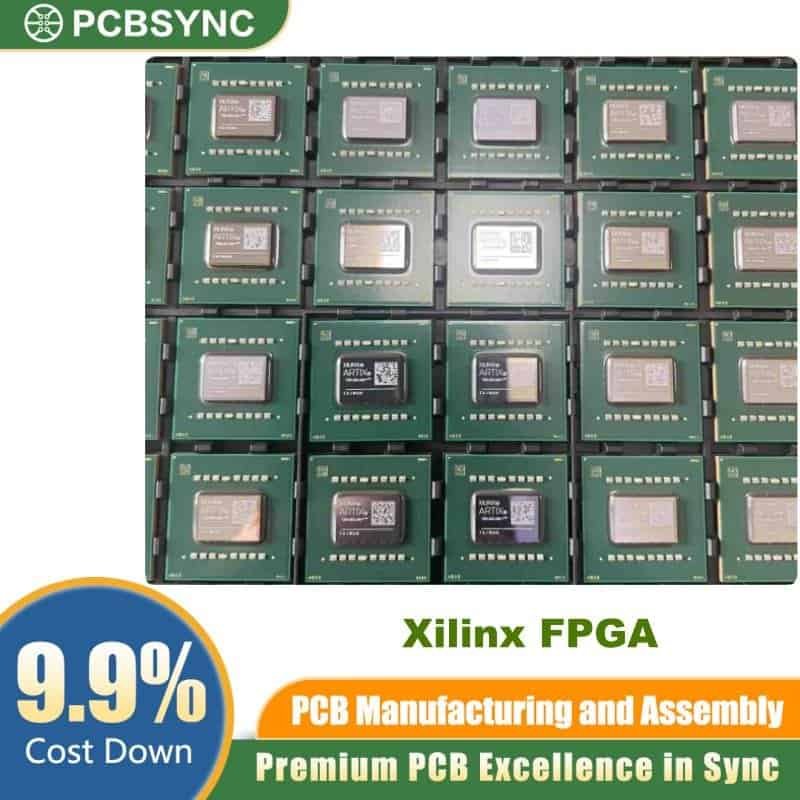
The XC2S200-6FGG1131C is a high-performance, cost-effective Field Programmable Gate Array (FPGA) from Xilinx’s Spartan-II family. Featuring 200,000 system gates, a 1,131-ball Fine Pitch BGA (FBGA) lead-free package, and the fastest -6 commercial speed grade, this device delivers exceptional logic density and I/O flexibility for a wide range of embedded, industrial, and consumer applications. If you are sourcing or evaluating Xilinx FPGA solutions, the XC2S200-6FGG1131C is a strong candidate worth understanding in depth.
What Is the XC2S200-6FGG1131C? Overview of the Spartan-II FPGA Family
The XC2S200-6FGG1131C belongs to Xilinx’s Spartan-II 2.5V FPGA family, a product line designed to offer the programmability and flexibility of FPGAs at a price point competitive with mask-programmed ASICs. The Spartan-II family was positioned as a superior alternative to conventional ASICs by eliminating upfront NRE (Non-Recurring Engineering) costs, reducing development time, and enabling in-field design updates — none of which are possible with hard-wired ASICs.
Breaking Down the Part Number: XC2S200-6FGG1131C
Understanding the part number is critical for procurement and design verification:
| Part Number Segment |
Meaning |
| XC2S200 |
Xilinx Spartan-II, 200K system gate device |
| -6 |
Speed Grade 6 (fastest available for commercial range) |
| FGG |
Fine Pitch Ball Grid Array, Pb-Free (G = RoHS-compliant) |
| 1131 |
1,131-ball package pin count |
| C |
Commercial temperature range (0°C to +85°C) |
XC2S200-6FGG1131C Key Specifications at a Glance
Core Logic Resources
| Parameter |
XC2S200 Value |
| System Gates |
200,000 |
| Logic Cells |
5,292 |
| CLB Array (Rows × Columns) |
28 × 42 |
| Total CLBs |
1,176 |
| Maximum User I/O |
284 |
| Distributed RAM (bits) |
75,264 |
| Block RAM (bits) |
56K |
Package & Electrical Specifications
| Parameter |
Value |
| Package Type |
Fine Pitch BGA (FBGA), Pb-Free |
| Pin Count |
1,131 |
| Core Supply Voltage |
2.5V |
| I/O Voltage |
2.5V (multi-standard IOBs supported) |
| Process Technology |
0.18µm |
| Speed Grade |
-6 (Commercial Only) |
| Operating Temperature |
0°C to +85°C (Commercial) |
| RoHS Compliance |
Yes (G suffix = Pb-Free) |
XC2S200-6FGG1131C Architecture: A Deep Dive
Configurable Logic Blocks (CLBs)
The XC2S200 contains 1,176 CLBs arranged in a 28 × 42 matrix. Each CLB consists of two slices, and each slice contains two Look-Up Tables (LUTs) and two flip-flops. This architecture allows flexible implementation of combinational logic, registered logic, and small distributed memory structures. The total of 5,292 logic cells provides ample capacity for mid-complexity digital designs.
Block RAM: On-Chip High-Speed Memory
The XC2S200 integrates 56 Kbits of dedicated block RAM, organized in two columns of symmetrical dual-port RAM blocks positioned on opposite sides of the die. Block RAM operates independently from the routing fabric, delivering high-speed, deterministic memory access that is ideal for FIFOs, data buffers, and look-up table acceleration. The 56 Kbits of block RAM complement the 75,264 bits of distributed RAM embedded within the CLB array.
Delay-Locked Loops (DLLs)
The XC2S200-6FGG1131C includes four on-chip Delay-Locked Loops (DLLs), one placed at each corner of the die. The DLLs provide:
- Zero-delay clock distribution
- Clock edge alignment and deskewing
- Frequency synthesis (multiply and divide)
- Phase shifting for source-synchronous interfaces
These DLL resources are critical for high-speed synchronous design and reduce the burden of external clock conditioning circuitry.
Input/Output Blocks (IOBs) and Multi-Standard Support
The device provides up to 284 user I/O pins through its programmable Input/Output Blocks. Each IOB supports:
- Selectable input delay (with or without DLL compensation)
- Programmable slew rate control (fast/slow)
- Programmable drive strength
- Optional pull-up, pull-down, and keeper feedback
- Support for multiple I/O standards (LVCMOS2.5, LVCMOS3.3, LVTTL, PCI, GTL, SSTL, and more)
The large 1,131-ball FGG package makes the XC2S200-6FGG1131C ideal for designs that require maximum pin accessibility and routing flexibility on the PCB.
Speed Grade -6: Why It Matters for the XC2S200-6FGG1131C
The -6 speed grade is the fastest available for the Spartan-II family and is exclusively offered in the Commercial temperature range. This means the XC2S200-6FGG1131C is optimized for:
- Maximum operating frequency in commercial environments
- Reduced propagation delays across CLB-to-CLB and CLB-to-IOB paths
- High-throughput data processing applications
Spartan-II Speed Grade Comparison
| Speed Grade |
Available Temperature Ranges |
Relative Performance |
| -5 |
Commercial, Industrial |
Standard |
| -6 |
Commercial Only |
Fastest |
For applications where raw clock speed and logic performance are paramount — such as high-speed communication interfaces or real-time signal processing — the -6 speed grade provides the maximum headroom within the Spartan-II lineup.
XC2S200 Spartan-II Family Comparison Table
Understanding where the XC2S200 sits within the Spartan-II family helps engineers select the right device for their design:
| Device |
Logic Cells |
System Gates |
CLB Array |
Total CLBs |
Max User I/O |
Dist. RAM (bits) |
Block RAM (bits) |
| XC2S15 |
432 |
15,000 |
8 × 12 |
96 |
86 |
6,144 |
16K |
| XC2S30 |
972 |
30,000 |
12 × 18 |
216 |
92 |
13,824 |
24K |
| XC2S50 |
1,728 |
50,000 |
16 × 24 |
384 |
176 |
24,576 |
32K |
| XC2S100 |
2,700 |
100,000 |
20 × 30 |
600 |
176 |
38,400 |
40K |
| XC2S150 |
3,888 |
150,000 |
24 × 36 |
864 |
260 |
55,296 |
48K |
| XC2S200 |
5,292 |
200,000 |
28 × 42 |
1,176 |
284 |
75,264 |
56K |
The XC2S200 is the top-of-range device in the Spartan-II family, offering the highest logic cell count, the most CLBs, the largest distributed and block RAM, and the greatest I/O count.
Typical Applications for the XC2S200-6FGG1131C
The XC2S200-6FGG1131C is well-suited for a broad range of high-volume and performance-sensitive application segments:
Digital Communications & Networking
- Protocol bridging and conversion (UART, SPI, I²C, Ethernet MAC)
- High-speed data serialization/deserialization
- Forward error correction (FEC) logic
Industrial Automation & Control
- Real-time motor control and servo drive logic
- Programmable machine vision preprocessing
- Industrial fieldbus interface controllers (CAN, Profibus)
Consumer Electronics & Multimedia
- Display controller interfaces
- Audio DSP and codec integration
- Set-top box logic glue
Embedded Computing & SoC Prototyping
- Co-processor acceleration for embedded microcontrollers
- ASIC prototyping and emulation
- Custom bus arbitration and DMA logic
Configuration and Programming: How to Program the XC2S200-6FGG1131C
Supported Configuration Modes
The Spartan-II devices, including the XC2S200-6FGG1131C, support multiple configuration modes to suit different system architectures:
| Configuration Mode |
Description |
| Master Serial |
FPGA loads bitstream from serial PROM |
| Slave Serial |
External host controls serial configuration |
| Master Parallel (SelectMAP) |
Parallel byte-wide configuration from host |
| Slave Parallel (SelectMAP) |
Byte-wide parallel from processor/controller |
| JTAG (Boundary Scan) |
IEEE 1149.1 JTAG interface for in-system programming |
Recommended Design Tools
Xilinx Spartan-II devices are supported by ISE Design Suite (the legacy toolchain) for synthesis, implementation, and bitstream generation. While the newer Vivado Design Suite does not support Spartan-II, ISE remains fully capable for this device family and is freely available for download.
Ordering Information & Part Marking Guide
How to Read the XC2S200-6FGG1131C Order Code
XC2S200  -  6  -  FGG  -  1131  -  C
  |           |     |        |       |
Device     Speed  Package  Pins   Temp
 Type      Grade   Type    Count  Range
Available Packages for XC2S200
| Package Code |
Package Description |
Pin Count |
| PQ(G)208 |
Plastic Quad Flat Pack, Pb-Free option |
208 |
| FG(G)256 |
Fine Pitch BGA, Pb-Free option |
256 |
| FG(G)456 |
Fine Pitch BGA, Pb-Free option |
456 |
| FGG1131 |
Fine Pitch BGA, Pb-Free |
1,131 |
Note: The “G” in FGG denotes a Pb-free (RoHS-compliant) package. The XC2S200-6FGG1131C is the lead-free variant of this configuration.
XC2S200-6FGG1131C vs Competing FPGA Devices
How Does It Compare to Other Xilinx FPGAs?
| Feature |
XC2S200-6FGG1131C (Spartan-II) |
XC3S200 (Spartan-3) |
XC6SLX9 (Spartan-6) |
| System Gates |
200K |
200K |
~9K LUTs equiv. |
| Technology Node |
0.18µm |
90nm |
45nm |
| Core Voltage |
2.5V |
1.2V |
1.2V |
| Block RAM |
56K bits |
216K bits |
576K bits |
| Max User I/O |
284 |
173 |
102 |
| DSP Slices |
None |
12 |
16 |
| Status |
Legacy / End-of-Life |
Legacy |
Active |
While the XC2S200-6FGG1131C is a legacy device, it remains widely used in maintenance, repair, and replacement applications for existing deployed systems, and continues to be sourced through authorized distributors and component brokers.
Why Choose the XC2S200-6FGG1131C for Your Design
Key Advantages
- Highest gate density in the Spartan-II family — 200,000 system gates and 5,292 logic cells
- Maximum I/O count — 284 user I/Os support complex multi-bus system integration
- Fastest commercial speed grade — -6 speed grade enables maximum operating frequency
- Pb-Free, RoHS-compliant packaging — FGG suffix ensures compliance with environmental directives
- Large 1,131-ball BGA package — ideal for high pin-count PCB designs requiring dense I/O connectivity
- Proven 0.18µm technology — mature, well-characterized process node with predictable behavior
- Four on-chip DLLs — simplify clocking architecture and reduce external clock conditioning
Limitations to Consider
- Legacy device — not recommended for new designs (NRND status)
- No dedicated DSP slices or hard-core processor blocks
- Limited block RAM compared to later Spartan generations
- Only commercial temperature range available for -6 speed grade
Frequently Asked Questions (FAQ)
What does the -6 speed grade mean for the XC2S200-6FGG1131C?
The -6 speed grade is the fastest speed grade in the Spartan-II family. It indicates lower propagation delays compared to the -5 grade, enabling the device to operate at higher clock frequencies. This grade is available only in the commercial temperature range (0°C to +85°C).
Is the XC2S200-6FGG1131C RoHS compliant?
Yes. The “G” in the FGG package designation confirms this is a Pb-free, RoHS-compliant package variant.
What configuration tools are compatible with the XC2S200-6FGG1131C?
The Xilinx ISE Design Suite is the recommended toolchain. It supports synthesis via XST or third-party tools (Synopsys, Mentor), place-and-route, and bitstream generation for all Spartan-II devices. JTAG-based programming is supported via Xilinx’s iMPACT programmer or third-party JTAG tools.
Can the XC2S200-6FGG1131C replace other Spartan-II devices?
The XC2S200 is the largest device in the Spartan-II family and can serve as a pin-compatible replacement for smaller Spartan-II devices when used within the same package type. Cross-package replacement requires PCB redesign due to different ball-out patterns.
Where can I buy the XC2S200-6FGG1131C?
The XC2S200-6FGG1131C can be sourced through authorized electronics distributors, independent component distributors, and specialist FPGA brokers. Always verify authenticity and request traceability documentation when sourcing legacy components.
Conclusion: Is the XC2S200-6FGG1131C Right for Your Application?
The XC2S200-6FGG1131C remains a capable and highly specified device within the Xilinx Spartan-II FPGA family. Its combination of 200,000 system gates, 284 user I/Os, four DLLs, and the fastest -6 commercial speed grade in a large 1,131-ball Pb-free BGA package makes it the premier choice within its product family. While it carries a legacy designation and is not recommended for new designs, it continues to serve critical roles in system maintenance, field replacement, and legacy product support.
For engineers working on new designs requiring programmable logic solutions, exploring the broader portfolio of available Xilinx FPGA devices — including modern Spartan-6, Spartan-7, and UltraScale families — may offer superior performance, lower power consumption, and extended product lifecycles.