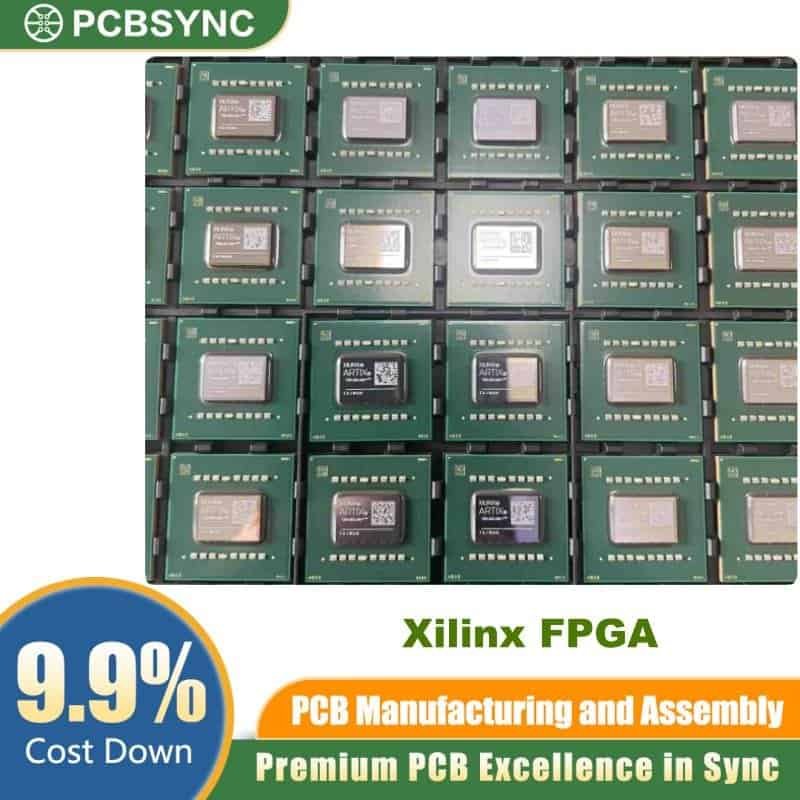
The XC2S200-6FGG1129C is a high-performance Field Programmable Gate Array (FPGA) from Xilinx’s Spartan-II family. Designed for cost-sensitive applications that demand reliable logic density and flexible programmability, this device delivers 200,000 system gates, 5,292 logic cells, and a 2.5V operating voltage — all housed in a robust 1129-ball Fine-pitch Ball Grid Array (FBGA) package. Whether you are designing communications equipment, industrial control systems, or embedded applications, the XC2S200-6FGG1129C offers an excellent balance of performance, flexibility, and cost efficiency.
For engineers and procurement specialists sourcing Xilinx programmable devices, explore the full range at Xilinx FPGA.
What Is the XC2S200-6FGG1129C? – Product Overview
The XC2S200-6FGG1129C belongs to Xilinx’s Spartan-II FPGA family, a product line built on 0.18-micron CMOS process technology. The part number breaks down as follows:
- XC2S200 – Spartan-II series, 200K gate density
- -6 – Speed grade 6 (commercial speed rating)
- FGG – Fine-pitch Ball Grid Array package type
- 1129 – 1,129 total ball count
- C – Commercial temperature grade (0°C to +85°C)
This device is a reprogrammable alternative to mask-programmed ASICs, eliminating upfront non-recurring engineering (NRE) costs and long development cycles. Because the XC2S200-6FGG1129C can be reconfigured in the field, it is especially valuable in applications where design updates are expected over the product lifecycle.
XC2S200-6FGG1129C Key Specifications
Core Electrical & Logic Specifications
| Parameter |
Value |
| Family |
Spartan-II |
| Manufacturer |
Xilinx (AMD) |
| System Gates |
200,000 |
| Logic Cells (CLBs) |
5,292 |
| CLB Array |
28 × 42 |
| Max Distributed RAM (bits) |
75,264 |
| Block RAM (bits) |
56K |
| Max User I/O Pins |
284 |
| Maximum Frequency |
263 MHz |
| Operating Voltage (VCC) |
2.5V |
| Process Technology |
0.18 µm CMOS |
| Configuration Bits |
1,335,840 |
Package & Physical Specifications
| Parameter |
Value |
| Package Type |
FBGA (Fine Pitch Ball Grid Array) |
| Package Code |
FGG |
| Total Ball Count |
1,129 |
| Package Designation |
FGG1129 |
| Temperature Grade |
Commercial (0°C to +85°C) |
| RoHS Compliance |
Not Compliant (legacy device) |
I/O & Interface Characteristics
| Feature |
Detail |
| I/O Standards Supported |
LVTTL, LVCMOS2, PCI, GTL, GTLP, HSTL, SSTL2, SSTL3 |
| Multivolt I/O Interface |
Yes |
| Global Clock Inputs |
4 dedicated clock pins |
| Slew Rate Control |
Yes (Fast/Slow) |
| Pull-up / Pull-down |
Programmable per I/O |
| Open-Drain Output |
Supported |
| 3-State Control |
Per I/O or globally via GTS pin |
XC2S200-6FGG1129C Architecture – Inside the Spartan-II
Configurable Logic Blocks (CLBs)
The heart of the XC2S200-6FGG1129C is its array of 5,292 Configurable Logic Blocks. Each CLB contains two slices, and each slice contains two 4-input Look-Up Tables (LUTs) and two flip-flops. This architecture allows the device to implement both combinational and registered logic with high efficiency. The CLBs can also be configured as distributed RAM, enabling fast on-chip data storage without consuming external memory resources.
Block RAM
The XC2S200-6FGG1129C integrates 56 kilobits of dedicated block RAM, organized as dual-port synchronous SRAM. This built-in memory is ideal for FIFOs, lookup tables, and local data buffers in signal processing and communications pipelines. Block RAM operates independently from the CLB logic fabric, ensuring no performance penalty on logic resources.
Clock Management
Four dedicated global clock buffers (GCLKs) provide low-skew, high-fanout clock distribution across the entire device. This architecture is critical for timing closure in designs running at or near the 263 MHz maximum frequency. The Spartan-II clock network minimizes clock insertion delay, making it suitable for synchronous designs with tight timing budgets.
Input/Output Blocks (IOBs)
Each I/O block in the XC2S200-6FGG1129C features:
- Programmable input delay for hold-time elimination
- Double Data Rate (DDR) support via dedicated registers
- Multivolt interface compatibility
- Selectable drive strength and slew rate
The 1,129-ball package provides access to up to 284 user I/O pins, making it one of the highest pin-count options in the Spartan-II lineup — ideal for applications requiring extensive external connectivity.
Configuration Modes
The XC2S200-6FGG1129C supports four standard configuration modes. The active mode is selected by the M0, M1, and M2 mode pins during power-up.
| Configuration Mode |
M[2:0] |
CCLK Direction |
Data Width |
Serial DOUT |
| Master Serial |
000 |
Output |
1-bit |
Yes |
| Slave Serial |
110 |
Input |
1-bit |
Yes |
| Slave Parallel |
010 |
Input |
8-bit |
No |
| Boundary-Scan (JTAG) |
101 |
N/A |
1-bit |
No |
Note: During power-on and throughout the configuration sequence, all I/O drivers are held in a high-impedance state. After successful configuration, unused I/Os remain tri-stated unless otherwise assigned.
Applications of the XC2S200-6FGG1129C
Communications & Networking
The high I/O count of the 1129-ball package and the 263 MHz clock capability make the XC2S200-6FGG1129C well-suited for line-rate protocol processing, packet switching, and framing logic in routers, switches, and DSL equipment.
Industrial Control Systems
Reprogrammable logic enables rapid adaptation of control algorithms for PLC interfaces, motor controllers, and automation gateways without hardware changes. The commercial temperature grade (0°C to +85°C) is appropriate for most factory floor environments.
Wireless & Telecom Infrastructure
The device supports high-speed I/O standards such as HSTL and SSTL, making it suitable for use in base station logic, frame synchronization, and channel aggregation in wireless infrastructure.
Embedded System Acceleration
Engineers implementing custom DSP pipelines, co-processors, or hardware accelerators benefit from the 75,264-bit distributed RAM and dedicated block RAM, which remove the bottleneck of off-chip memory access.
Prototyping & ASIC Replacement
Because the XC2S200-6FGG1129C is fully reprogrammable, it is widely used to prototype ASIC designs prior to tape-out, reducing risk and enabling functional verification in real hardware conditions.
XC2S200-6FGG1129C vs. Related Spartan-II Variants
| Part Number |
Gates |
Cells |
Package |
Pins |
Speed Grade |
| XC2S100-6FG256C |
100K |
2,700 |
FBGA |
256 |
6 |
| XC2S150-6FG256C |
150K |
3,888 |
FBGA |
256 |
6 |
| XC2S200-6FGG1129C |
200K |
5,292 |
FBGA |
1,129 |
6 |
| XC2S200-6FGG456C |
200K |
5,292 |
FBGA |
456 |
6 |
| XC2S200-5FGG456C |
200K |
5,292 |
FBGA |
456 |
5 |
The FGG1129 package is the largest ball-count option in the XC2S200 series and is chosen when maximum I/O pin access is required. Lower pin-count variants (FG256, FGG456) offer the same core logic but with fewer accessible I/O connections.
Design Tools & Software Support
The XC2S200-6FGG1129C is supported by Xilinx (AMD) legacy development tools:
- ISE Design Suite – Primary synthesis, implementation, and bitstream generation tool for Spartan-II devices
- JTAG Programmer / iMPACT – Configuration and boundary-scan testing via Boundary-Scan (JTAG) interface
- ChipScope Pro – In-system logic analysis for debugging live designs
- ModelSim / Questa – Simulation of HDL designs (VHDL and Verilog)
As a legacy product, the XC2S200-6FGG1129C is not supported by the Vivado Design Suite. Designers should use ISE Design Suite version 14.7 for full device support.
Ordering Information & Part Number Decoder
Understanding the full part number structure helps ensure you order the correct variant for your design requirements.
| Field |
Code |
Meaning |
| Family |
XC2S |
Spartan-II |
| Density |
200 |
200,000 system gates |
| Speed Grade |
-6 |
Speed grade 6 (slowest/most cost-effective commercial grade) |
| Package Type |
FGG |
Fine-pitch Ball Grid Array |
| Pin Count |
1129 |
1,129 total solder balls |
| Temperature |
C |
Commercial (0°C to +85°C) |
Full Part Number: XC2S200-6FGG1129C
Frequently Asked Questions (FAQ)
What is the XC2S200-6FGG1129C used for?
The XC2S200-6FGG1129C is a programmable logic device used in communications equipment, industrial automation, wireless infrastructure, embedded processing, and ASIC prototyping. Its 200K gate capacity and high I/O count make it suitable for complex logic designs.
What package does the XC2S200-6FGG1129C use?
It uses the FGG1129 Fine-pitch Ball Grid Array (FBGA) package with 1,129 solder balls, providing access to up to 284 user I/O pins.
Is the XC2S200-6FGG1129C RoHS compliant?
No. As a legacy Spartan-II device, the XC2S200-6FGG1129C is not RoHS compliant. Engineers designing for RoHS-regulated markets should evaluate RoHS-compliant alternatives from the Spartan-3 or later families.
What voltage does the XC2S200-6FGG1129C operate at?
The core logic operates at 2.5V. The I/O banks support a multivolt interface, allowing compatibility with 3.3V, 2.5V, 1.8V, and other I/O standards depending on the VCCO voltage applied.
What is the maximum clock frequency of the XC2S200-6FGG1129C?
The XC2S200 Spartan-II family supports a maximum internal clock frequency of 263 MHz at the commercial speed grade.
Can the XC2S200-6FGG1129C be used in new designs?
The XC2S200 family is a legacy product line that is not recommended for new designs (NRND). For new projects, Xilinx (AMD) recommends evaluating current-generation devices such as the Artix-7 or Spartan-7 families, which offer better performance, lower power, and active support.