Inquire: Call 0086-755-23203480, or reach out via the form below/your sales contact to discuss our design, manufacturing, and assembly capabilities.
Quote: Email your PCB files to Sales@pcbsync.com (Preferred for large files) or submit online. We will contact you promptly. Please ensure your email is correct.
Notes: For PCB fabrication, we require PCB design file in Gerber RS-274X format (most preferred), *.PCB/DDB (Protel, inform your program version) format or *.BRD (Eagle) format. For PCB assembly, we require PCB design file in above mentioned format, drilling file and BOM. Click to download BOM template To avoid file missing, please include all files into one folder and compress it into .zip or .rar format.
After spending thousands of hours designing and troubleshooting PCBs, I’ve come to appreciate ceramic capacitors as the unsung workhorses of modern electronics. These tiny components—some no bigger than a grain of sand—appear on virtually every circuit board you’ll encounter. Understanding ceramic capacitor types, their quirks, and proper selection criteria separates functional designs from problematic ones that waste engineering time and budget.
In my experience, most design issues with ceramic capacitors stem from not understanding the fundamental differences between Class 1 and Class 2 types, or failing to account for DC bias and temperature effects. Let’s dive into everything you need to know about these essential components from a practical engineering perspective.
A ceramic capacitor uses ceramic material as its dielectric—the insulating layer between conductive plates that stores electrical charge. The composition of this ceramic material directly determines the capacitor’s electrical characteristics, stability, and suitability for different applications.
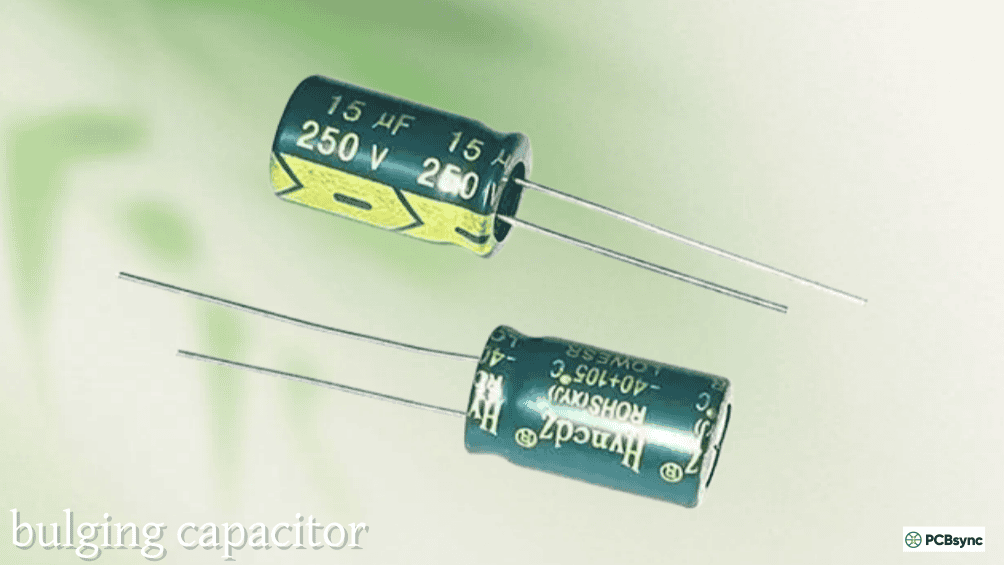
Unlike electrolytic capacitors, ceramic capacitors are non-polarized, meaning they can be installed in either orientation. This makes them more versatile and easier to work with during PCB assembly. They also offer excellent frequency response with low equivalent series resistance (ESR) and equivalent series inductance (ESL), making them ideal for high-frequency applications.
The ceramic capacitor family encompasses everything from ultra-stable precision components used in oscillators to high-capacitance parts that handle power supply decoupling. With approximately one trillion ceramic capacitors manufactured annually, they represent the most produced capacitor type in electronics.
Main Types of Ceramic Capacitors
Disc Ceramic Capacitors
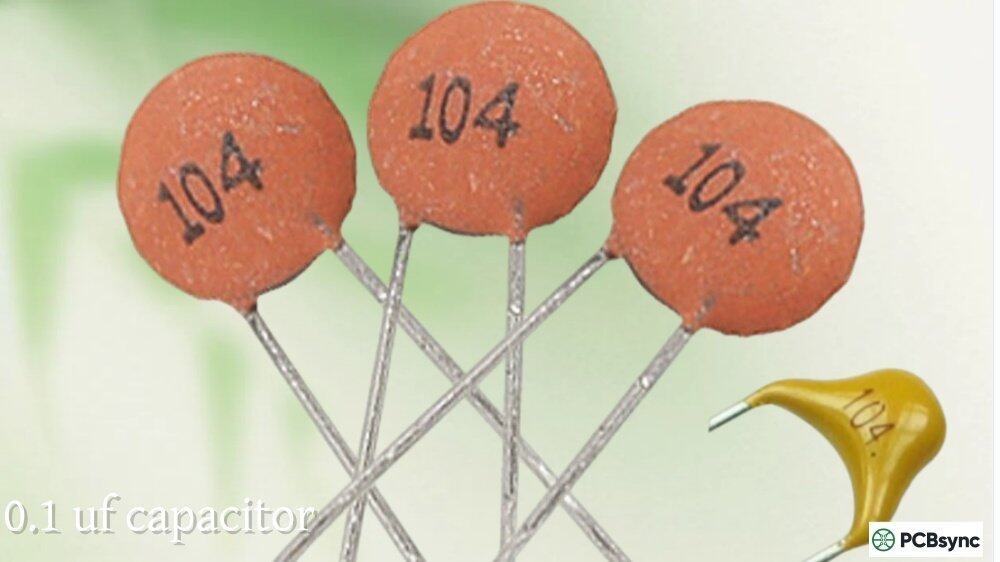
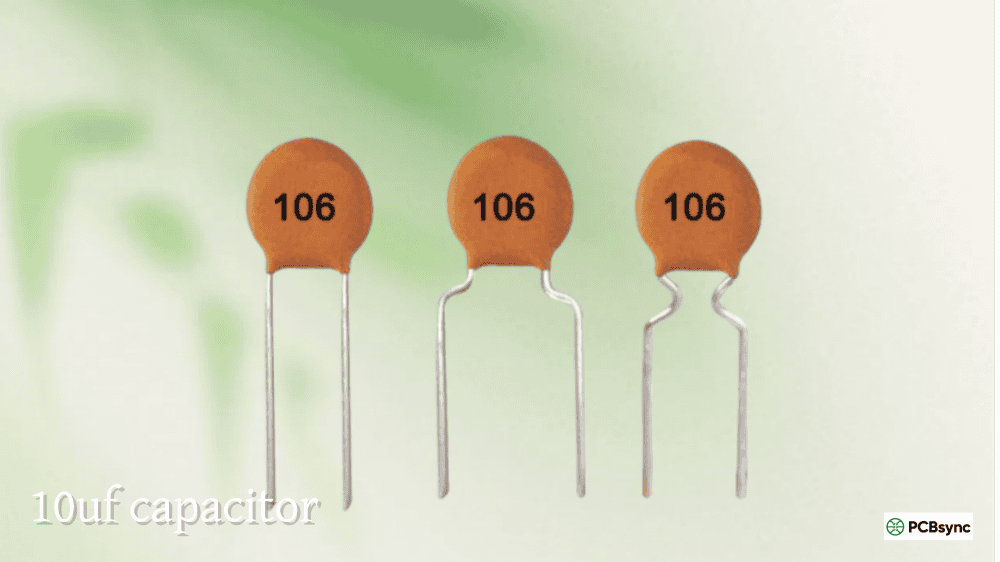
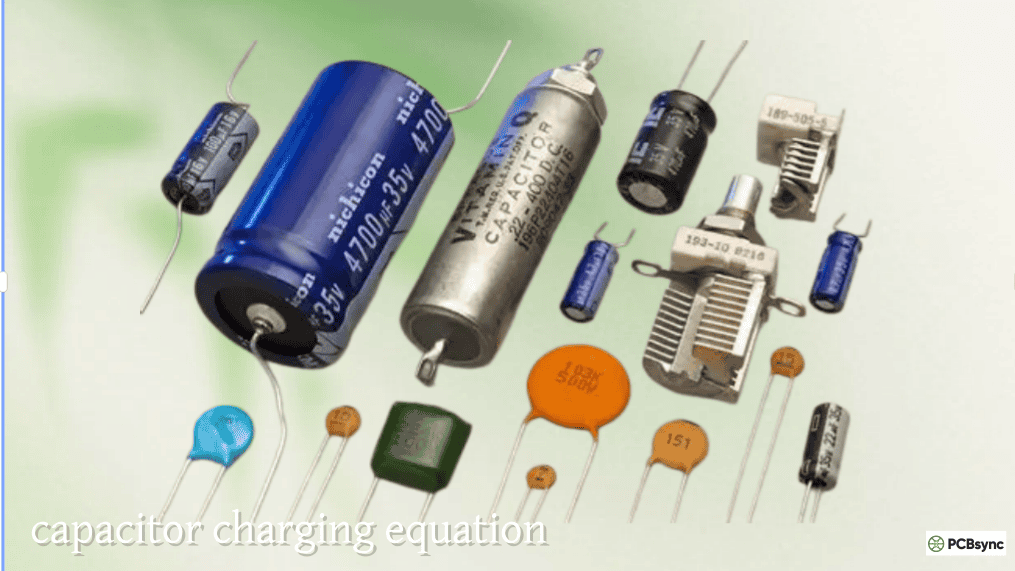
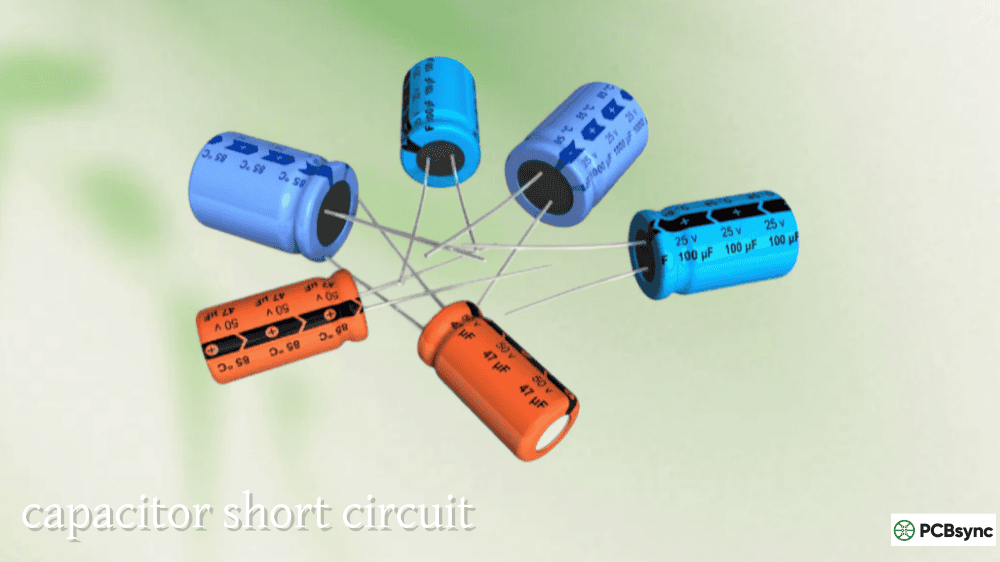
Traditional disc ceramic capacitors feature a simple construction: a ceramic disc with metal electrodes on both sides and radial leads for through-hole mounting. While still available, these have largely been replaced by surface-mount types in modern production.
I occasionally use disc ceramics in prototypes or repair work where through-hole mounting offers advantages, but for production designs, SMD alternatives provide better performance and space efficiency.
Multilayer Ceramic Capacitors (MLCCs)
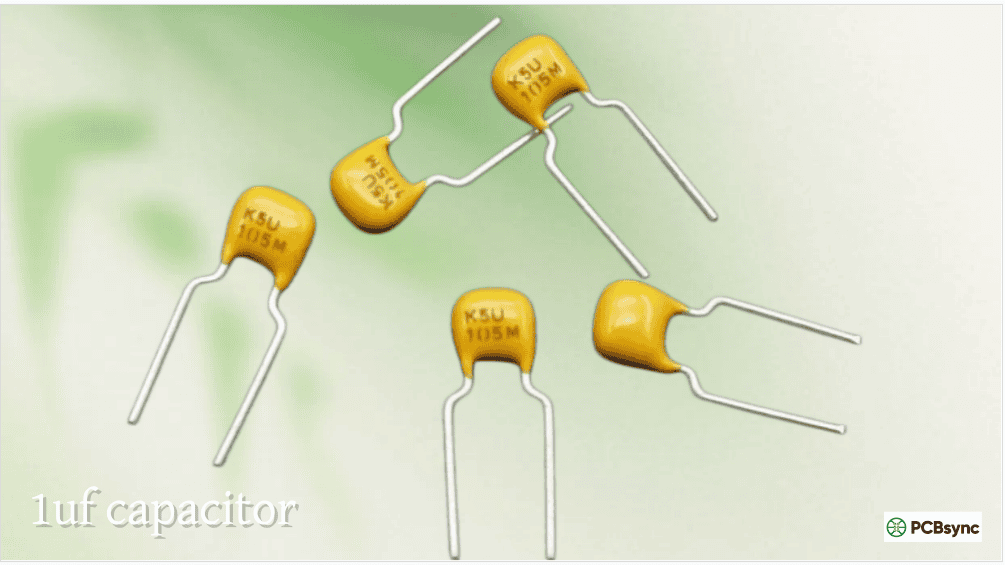
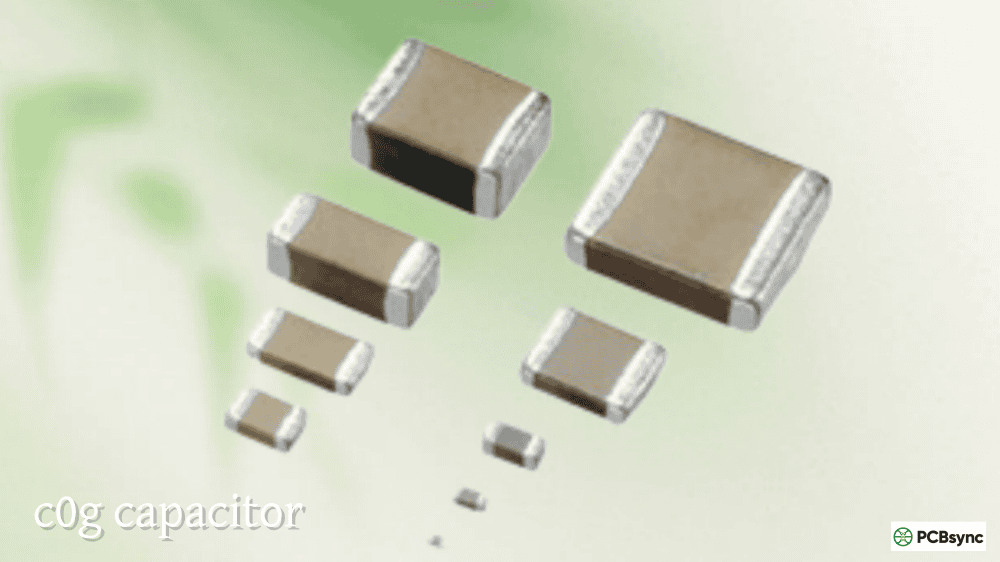
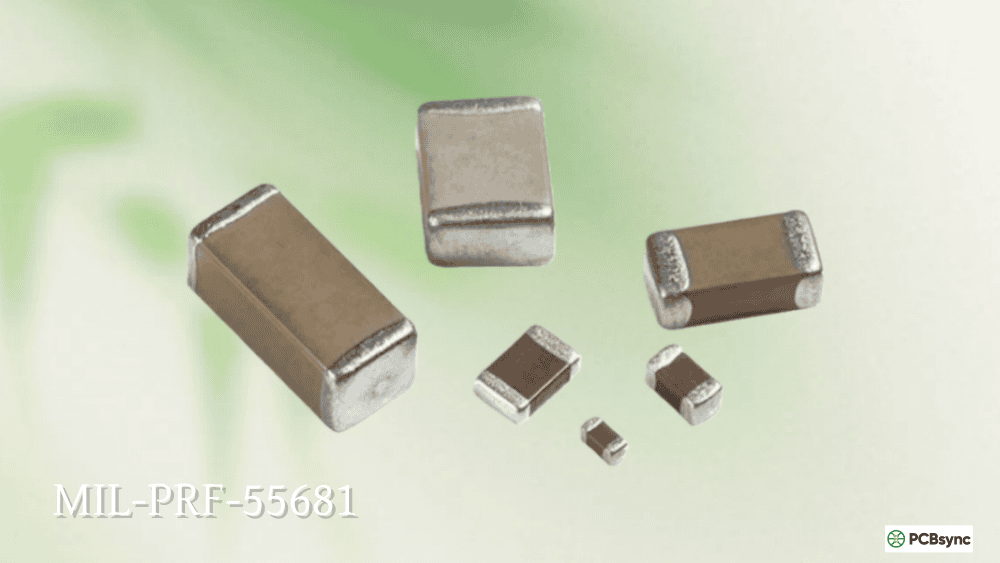
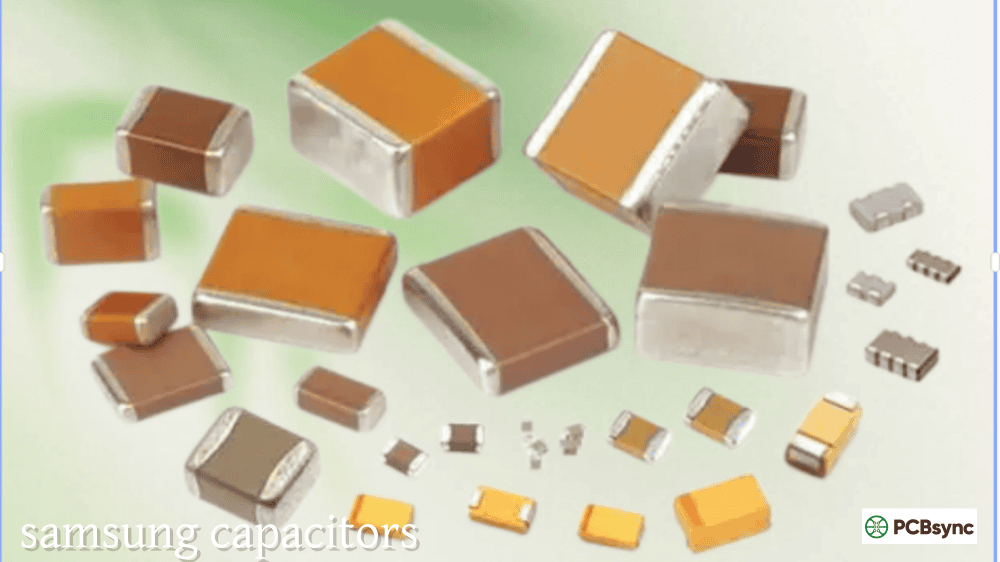
MLCCs dominate modern electronics because they pack impressive capacitance into tiny packages. The construction involves stacking hundreds or even thousands of thin ceramic layers interleaved with metal electrodes, then sintering everything into a solid block. This multilayer approach acts like many small capacitors in parallel, dramatically increasing total capacitance.
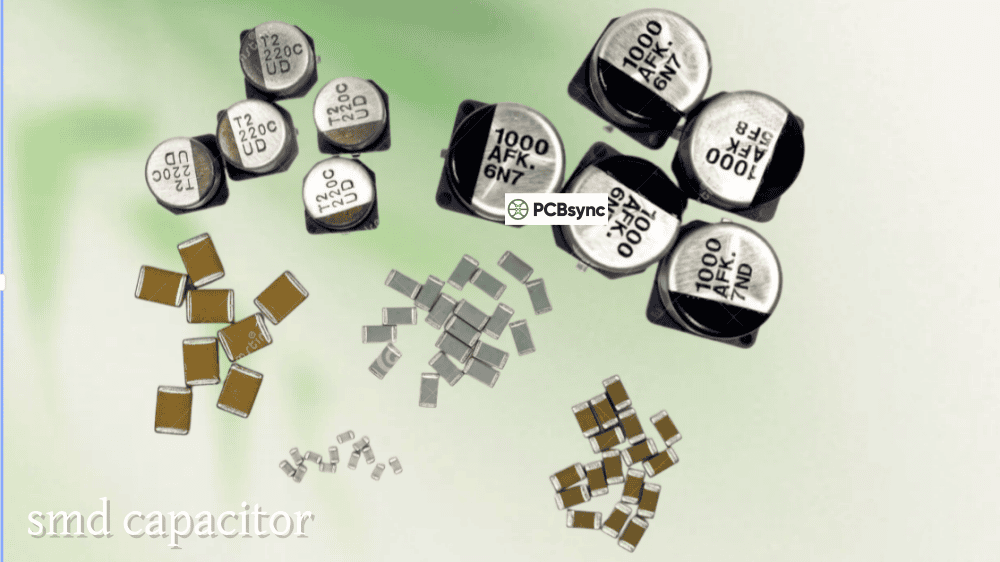
MLCCs are available in standard SMD package sizes from 0201 (0.6mm × 0.3mm) up to 3225 (3.2mm × 2.5mm), with larger sizes for high-voltage applications. The most common sizes I use are 0402, 0603, 0805, and 1206—balancing between component cost, assembly reliability, and electrical performance.
Ceramic Capacitor Classification System
Understanding the classification system is crucial for proper component selection. The Electronic Industries Alliance (EIA) defines classes based on dielectric characteristics, temperature stability, and intended applications.
Class 1 Ceramic Capacitors: Precision and Stability
Class 1 ceramic capacitors use dielectrics with low permittivity—typically titanium dioxide with various oxide additives (Zn, Zr, Nb, Mg, Ta, Co, Sr). These materials provide exceptional stability with predictable, linear behavior.
Key Characteristics:
Temperature coefficient specified in parts per million per degree Celsius (ppm/°C)
Minimal capacitance change with applied voltage
No aging effects (capacitance remains stable over time)
Low losses and high Q factor
Physically larger for given capacitance compared to Class 2
Common Class 1 Dielectrics:
Dielectric Type
Temperature Coefficient
Temperature Range
Capacitance Change
C0G / NP0
±30 ppm/°C
-55°C to +125°C
±0.54%
U2J
-750 ppm/°C ±120 ppm/°C
-55°C to +125°C
Linear variation
P100
+100 ppm/°C ±30 ppm/°C
-55°C to +125°C
Linear variation
The C0G/NP0 designation requires explanation. C0G is the EIA specification, while NP0 (Negative-Positive-Zero) is the military standard designation. They’re functionally identical—manufacturers often use the terms interchangeably. I prefer specifying “C0G/NP0” on BOMs to avoid any confusion with suppliers.
When to Use Class 1:
Precision oscillators and timing circuits
RF tuned circuits and filters
Sample-and-hold circuits
Analog-to-digital converter coupling
Any application where capacitance accuracy affects performance
From a practical standpoint, I reach for C0G/NP0 capacitors whenever timing, frequency, or precision matters. Yes, they’re physically larger and cost more than Class 2 alternatives, but the performance benefits justify the trade-offs in critical circuits.
Class 2 Ceramic Capacitors: High Capacitance Density
Class 2 capacitors use ferroelectric ceramics—primarily barium titanate formulations—that offer much higher dielectric constants (600 to 18,000+). This enables dramatically higher capacitance values in smaller packages.
The trade-off? These materials exhibit nonlinear behavior. Capacitance varies significantly with temperature, applied voltage, frequency, and even time (aging). For many applications, particularly decoupling and bypassing, these variations are acceptable.
Common Class 2 Dielectrics:
Dielectric
Temperature Range
Capacitance Change
Typical Applications
X7R
-55°C to +125°C
±15%
General purpose, decoupling, DC-DC converters
X5R
-55°C to +85°C
±15%
Consumer electronics, cost-sensitive designs
X8R
-55°C to +150°C
±15%
Automotive, high-temperature environments
Y5V
-30°C to +85°C
+22% / -82%
Non-critical coupling, space-constrained designs
Z5U
+10°C to +85°C
+22% / -56%
Limited temperature range applications
Understanding the EIA Code:
The three-character code format (e.g., X7R) breaks down as follows:
First character (letter): Lower temperature limit
X = -55°C
Y = -30°C
Z = +10°C
Second character (number): Upper temperature limit
5 = +85°C
6 = +105°C
7 = +125°C
8 = +150°C
Third character (letter): Capacitance change over temperature range
R = ±15%
S = ±22%
U = +22% / -56%
V = +22% / -82%
X7R vs. X5R: Which to Choose?
This decision comes up constantly in my designs. X7R offers wider temperature range (-55°C to +125°C) making it suitable for industrial and automotive applications. X5R operates from -55°C to +85°C, which covers most consumer electronics adequately while typically costing slightly less.
For general-purpose decoupling in consumer products operating indoors, X5R usually suffices. For anything automotive, industrial, or exposed to extreme temperatures, X7R is the safer choice. I default to X7R unless cost pressure forces reconsideration—the extended operating range provides design margin.
The Y5V and Z5U Problem:
Y5V and Z5U capacitors offer the highest capacitance density but with severe limitations. A Y5V capacitor can lose up to 82% of its rated capacitance over its temperature range. That 1µF capacitor might only provide 0.18µF at temperature extremes.
I avoid Y5V and Z5U unless absolutely desperate for board space and the application truly doesn’t care about capacitance accuracy—perhaps rough bulk decoupling where multiple capacitors are used anyway. Even then, I question whether the space savings justify the unpredictable behavior.
Class 3 Ceramic Capacitors
Class 3 capacitors feature barrier-layer designs with extremely high dielectric constants (up to 50,000). However, they suffer from poor stability, high losses, and severe voltage and temperature sensitivity. They cannot be manufactured in multilayer format, eliminating SMD options.
These have fallen out of favor—I haven’t specified one in years. Modern high-capacitance MLCCs in Class 2 dielectrics provide better overall performance.
Critical Performance Factors for Ceramic Capacitors
DC Bias Effect: The Hidden Capacitance Loss
Here’s something that catches many engineers by surprise: Class 2 ceramic capacitors lose significant capacitance when DC voltage is applied. This DC bias effect can reduce effective capacitance by 50% or more at rated voltage.
For example, a 10µF X7R capacitor rated at 25V might only provide 5µF when you apply 20V DC. The higher the applied voltage as a percentage of rated voltage, the worse the loss.
DC Bias Considerations:
Most severe in high-K dielectrics (X7R, X5R, Y5V)
Class 1 capacitors (C0G/NP0) show minimal DC bias effects
Smaller case sizes exhibit more severe bias effects
Always check manufacturer DC bias curves
I’ve learned to derate ceramic capacitors significantly for DC applications. For critical power supply decoupling, I’ll specify a capacitor with 2× the required capacitance and 2× the expected voltage rating. This ensures adequate effective capacitance under operating conditions.
Temperature Coefficient and Stability
We’ve discussed temperature ranges, but practical implications matter more. In a switching power supply operating at 85°C junction temperature, that X7R bypass capacitor could vary ±15% from its nominal value. For precision circuits, this variation is unacceptable—hence the need for C0G/NP0 types.
Temperature coefficient also matters for compensation. Some oscillator circuits deliberately use capacitors with specific temperature coefficients to offset drift in other components, creating a temperature-stable overall design.
Aging: The Time-Dependent Capacitance Drift
Class 2 ceramic capacitors age—their capacitance decreases logarithmically over time. This results from gradual realignment of the ferroelectric ceramic’s crystalline structure.
Typical Aging Rates:
X7R: ~2-2.5% per decade (10× time increase)
Y5V/Z5U: ~5-7% per decade
A decade represents 10× time increase, so aging occurs most rapidly initially:
After 10 hours: -2%
After 100 hours: -4%
After 1,000 hours: -6%
After 10,000 hours (~1 year): -8%
Manufacturers typically specify capacitance after 1,000 hours of aging. The good news? Heating the capacitor above its Curie point reverses aging. In practice, this happens during reflow soldering, effectively “resetting” the capacitor.
Class 1 capacitors don’t age because they use non-ferroelectric dielectrics. Yet another reason to prefer C0G/NP0 for critical applications.
Equivalent Series Resistance (ESR) and ESL
Ceramic capacitors excel in ESR and ESL compared to electrolytics. Low ESR reduces power dissipation and heat generation. Low ESL extends useful frequency range—critical for high-frequency decoupling.
MLCCs typically offer ESR in the milliohm range and ESL below 1nH for small packages. This makes them effective decoupling capacitors well into the hundreds of megahertz.
However, very low ESR can cause problems in certain applications. Switching regulators sometimes require minimum ESR for stability. Linear regulator datasheets often specify ESR ranges for output capacitors. Always check these requirements.
Mechanical Stress and Flex Cracking
Here’s a failure mode I’ve seen repeatedly: ceramic capacitors cracking due to PCB flexure. MLCCs are inherently brittle. When the PCB bends—during assembly, testing, or in the field—mechanical stress transfers to the capacitor, potentially causing internal cracks.
Cracks create paths for moisture ingress and can eventually cause complete failure or short circuits. Larger capacitors in smaller packages are particularly vulnerable.
Minimizing Flex Cracking:
Use smaller case sizes when possible (0603 instead of 1206)
Avoid placing large capacitors near board edges or mounting holes
Orient capacitors with long axis perpendicular to expected flex direction
Specify capacitors with flexible terminations when available
Route out stress relief slots near large capacitors in flex-prone areas
Use soft-termination or resin-coated MLCCs for mechanically demanding applications
Acoustic Noise (Piezoelectric Effect)
Class 2 ceramic capacitors are piezoelectric—mechanical stress creates voltage, and voltage creates mechanical stress. In power supply applications with AC ripple, this causes the capacitor to vibrate at the switching frequency, generating audible noise (typically a high-pitched whine).
I’ve spent frustrating hours tracking down mysterious whining sounds in power supplies, only to discover it’s a ceramic bypass capacitor singing away. The fix? Replace with a non-piezoelectric capacitor (film or aluminum electrolytic) or use Class 1 ceramics.
Conversely, the microphone effect means vibrations generate voltage noise. In precision analog circuits subjected to vibration, ceramic capacitors can introduce noise. Another reason to prefer film capacitors in high-end audio applications.
Common Applications and Selection Guidelines
Power Supply Decoupling and Bypassing
This is where you’ll use the most ceramic capacitors. Every IC needs local decoupling to suppress high-frequency noise and provide instantaneous current during switching.
Decoupling Strategy:
Bulk capacitance (10-100µF): Aluminum electrolytic or large MLCC
Mid-frequency (1-10µF): X7R or X5R MLCC, 0805 or 1206 package
High-frequency (0.1µF): X7R MLCC, 0402 or 0603 package, placed close to each power pin
Very high-frequency (0.01µF or less): C0G/NP0 for ultra-clean supplies or RF applications
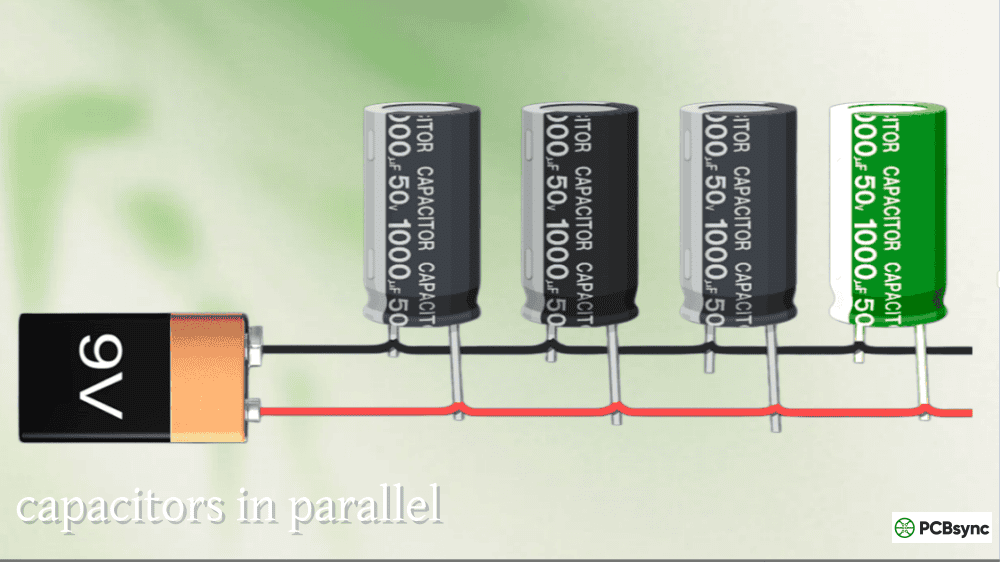
The parallel combination covers a wide frequency range, with each capacitor being most effective near its self-resonant frequency.
Filtering Applications
Ceramic capacitors work excellently in RC and LC filters due to their stable characteristics and wide frequency response. For audio applications, I prefer Class 1 types to avoid distortion from voltage-dependent capacitance.
Low-pass filters benefit from C0G/NP0 capacitors because their stable capacitance maintains precise cutoff frequency. Class 2 types work for less critical applications where ±15% frequency variation is acceptable.
Coupling and DC Blocking
AC coupling applications use capacitors to pass AC signals while blocking DC components. Class 2 ceramics work fine here since precise capacitance rarely matters—you just need “big enough” to pass the lowest frequency of interest.
For coupling in RF circuits or precision analog paths, C0G/NP0 types ensure minimal signal distortion.
Timing Circuits and Oscillators
Never compromise here—always use Class 1 ceramic capacitors (C0G/NP0) for timing applications. The stable, predictable capacitance ensures accurate timing and frequency generation.
Crystal oscillator load capacitors absolutely must be C0G/NP0. Using X7R will cause frequency drift and potentially prevent oscillation entirely. I specify tight tolerance (±5% or ±2%) C0G/NP0 capacitors for crystal circuits.
EMI/RFI Suppression
Feed-through ceramic capacitors provide excellent high-frequency noise suppression where wires pass through shielded enclosures. These specialized ceramic capacitors mount directly in panel cutouts, maintaining shield integrity while filtering conducted noise.
For general EMI suppression, small value (0.01-0.1µF) X7R or C0G capacitors placed strategically near noise sources help reduce radiated emissions.
High-Power Applications
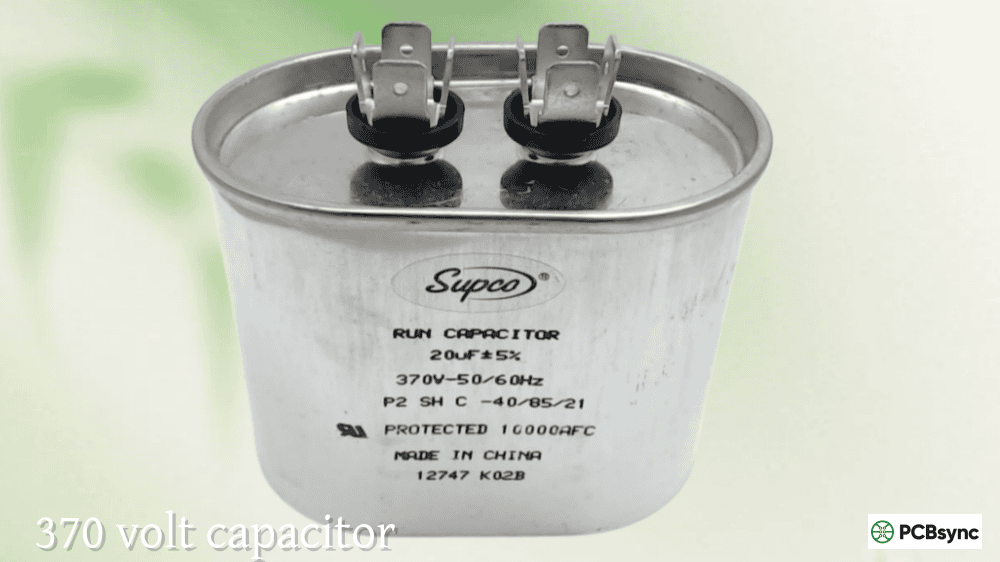
Power ceramic capacitors, physically much larger than PCB-mounted types, handle voltages from 2kV to 100kV in applications like RF transmitters, laser power supplies, and industrial power electronics.
I rarely work with these in typical product designs, but they’re critical in specialized high-power, high-frequency applications where other capacitor types can’t handle the combination of voltage, current, and frequency.
Practical Selection Guide
Step 1: Define Requirements
Before diving into part selection, clearly define:
Required capacitance value
Operating voltage (don’t forget DC bias derating)
Temperature range
Frequency range
Precision requirements
Physical constraints
Step 2: Choose Class and Dielectric
Requirement
Recommended Type
Precision timing, oscillators, filters
Class 1 (C0G/NP0)
General decoupling, bypassing
Class 2 (X7R or X5R)
High temperature (>85°C)
X7R or X8R
Automotive, industrial
X7R or X8R
Consumer electronics, cost-sensitive
X5R
Ultra-compact, non-critical
Y5V or Z5U (with caution)
Step 3: Select Voltage Rating
Always derate voltage ratings. My rule of thumb:
Class 2 ceramics: Use 50% derating minimum (if operating voltage is 12V, specify ≥24V rating)
Class 1 ceramics: Use 30% derating
High-reliability applications: Derate to 30% or less
This accounts for DC bias effects, voltage transients, and extends operating life.
Step 4: Choose Package Size
Larger packages generally offer:
Higher maximum voltage ratings
Better power handling
Lower cost per unit capacitance
Reduced bending stress susceptibility
Smaller packages provide:
Space savings
Lower ESL (better high-frequency performance)
Reduced board real estate cost
For bypass capacitors, I typically use 0402 or 0603. For bulk decoupling, 0805 or 1206. The specific choice depends on voltage rating needs and assembly capabilities.
Step 5: Verify Specifications
Always check manufacturer datasheets for:
DC bias curves
Temperature characteristics
ESR at operating frequency
Self-resonant frequency
Case size and pad layout requirements
Reading Ceramic Capacitor Codes
Three-Digit Code System
Most ceramic capacitors use a three-digit code indicating capacitance in picofarads:
Format: XYZ
X = First significant digit
Y = Second significant digit
Z = Number of zeros (multiplier)
Examples:
Code
Calculation
Value
104
10 × 10⁴
100,000pF = 100nF = 0.1µF
223
22 × 10³
22,000pF = 22nF = 0.022µF
475
47 × 10⁵
4,700,000pF = 4.7µF
101
10 × 10¹
100pF
The “R” character indicates a decimal point:
4R7 = 4.7pF
R10 = 0.10pF
Tolerance Codes
A letter following the capacitance code indicates tolerance:
I’ve seen this countless times—someone uses an X7R capacitor in an RC timing circuit, then wonders why the timing varies by 20%. Always use C0G/NP0 for timing applications.
Ignoring DC Bias Effects
Designing a power supply with 22µF output capacitance, specifying three 10µF X5R capacitors at 25V rating for a 20V rail. Under operating voltage, effective capacitance might be only 15µF total. The power supply becomes marginally stable or oscillates. Solution: Derate voltage significantly or use more capacitance.
Inadequate Mechanical Design
Placing large 1210 or 1812 MLCCs near board edges or mounting holes, then experiencing field failures from flex cracking. Design boards with adequate mechanical support and use appropriately sized capacitors.
Mixing Up µF, nF, and pF
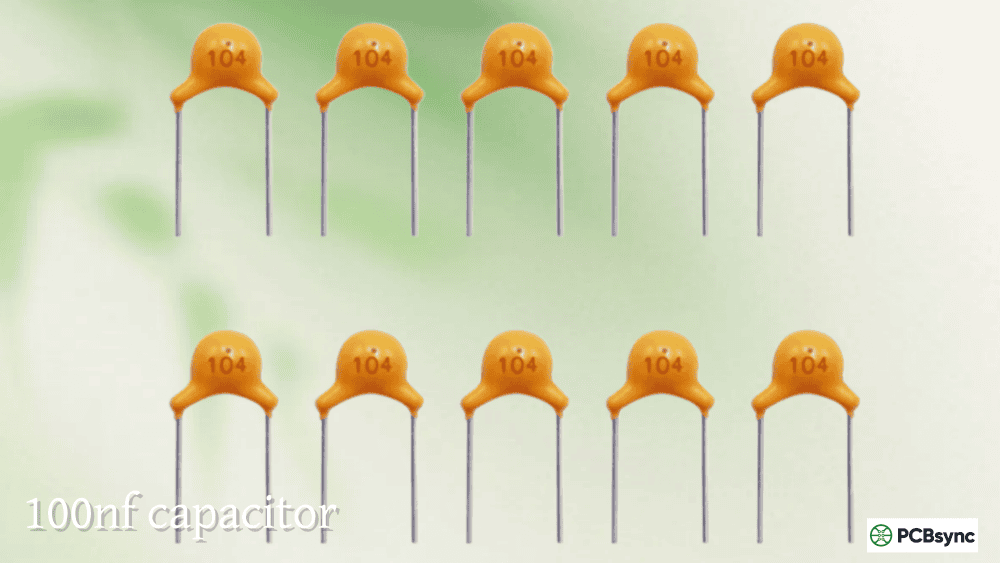
With values spanning from picofarads to hundreds of microfarads, unit confusion causes errors. A “104” capacitor is 0.1µF (100nF), not 104µF. Always double-check unit conversions.
Not Accounting for Aging
Specifying exactly the minimum required capacitance without margin, then finding the circuit marginally meets specs initially but fails after a year when capacitors age down. Build in margin for aging, especially with Class 2 types.
Component Library (iOS) – reference for all passive components
Downloadable Resources:
Manufacturer DC bias curves (PDF format from component datasheets)
Ceramic capacitor quick reference charts
Standard capacitance value tables (E6, E12, E24 series)
Component Databases:
Octopart – cross-supplier search and comparison
FindChips – availability and pricing across distributors
DigiKey, Mouser, Newark – parametric search with full specifications
LCSC – economical sourcing for prototypes and small production runs
Frequently Asked Questions
Q: Can I replace a C0G/NP0 capacitor with an X7R capacitor of the same value?
Generally no, don’t do this unless you fully understand the implications. C0G/NP0 capacitors are specified for precision applications where the stable characteristics matter. X7R capacitors will drift ±15% with temperature, exhibit DC bias effects, and age over time. For a crystal oscillator or precision timing circuit, this substitution will cause functional problems. For non-critical decoupling where the capacitor was perhaps over-specified as C0G, you might get away with it—but verify the circuit still meets specifications.
Q: Why does my 10µF ceramic capacitor only measure 6µF on my multimeter?
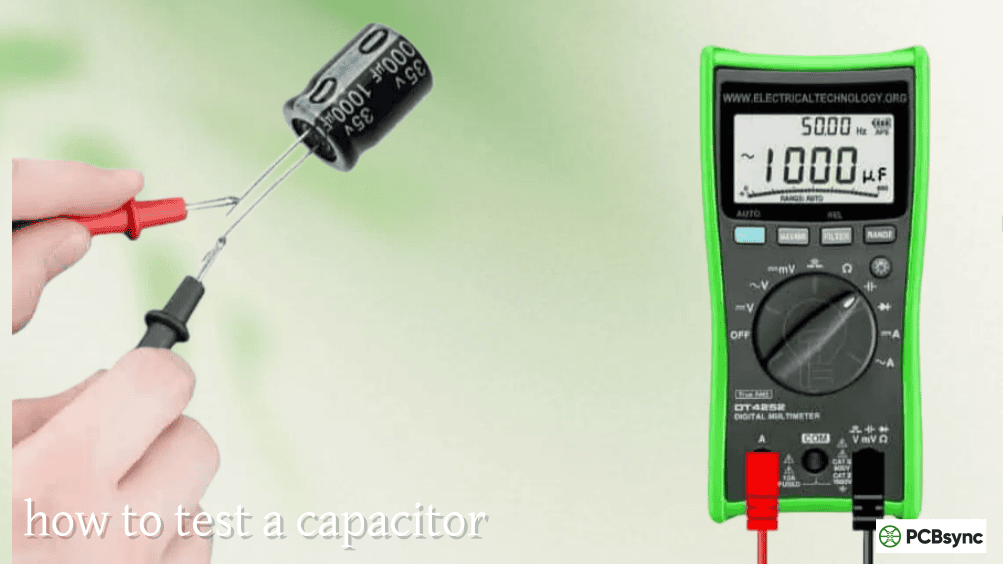
Most likely DC bias effect. Your multimeter applies some test voltage (typically 1-3V) which reduces the effective capacitance of Class 2 ceramic capacitors. Additionally, if the capacitor has been sitting at room temperature, aging effects have reduced capacitance. For accurate measurement, use an LCR meter at the specific frequency and voltage conditions of your application. The capacitor might also be degraded from mechanical stress or exposure to excessive voltage/temperature.
Q: What’s the difference between MLCC and regular ceramic capacitors?
MLCC (Multilayer Ceramic Capacitor) is a construction method where many thin ceramic layers are stacked to achieve higher capacitance in smaller packages. “Regular” disc ceramic capacitors use a single ceramic layer. The dielectric materials and classifications (Class 1, Class 2) apply to both, but MLCCs dominate modern designs because of their superior space efficiency and surface-mount compatibility. When someone says “ceramic capacitor” today, they usually mean MLCC.
Q: How do I choose between multiple capacitors in parallel versus one larger capacitor for decoupling?
Use multiple capacitors to cover a wider frequency range. Each capacitor is most effective near its self-resonant frequency, which depends on package inductance. A typical strategy: one large capacitor (10-100µF) for low-frequency bulk decoupling, several medium capacitors (0.1-1µF) for mid-frequency, and small capacitors (0.01µF) close to each IC power pin for high-frequency transients. This parallel combination provides effective impedance across a broad spectrum. Don’t just use one giant capacitor—its higher ESL makes it less effective at high frequencies.
Q: Do ceramic capacitors have polarity? Can I install them backwards?
Ceramic capacitors are non-polarized—they have no positive or negative terminal and can be installed in either direction. This contrasts with electrolytic and tantalum capacitors which are polarized and must be installed correctly. This makes ceramics simpler to work with and reduces assembly errors. However, some specialized high-voltage ceramic capacitors may have polarity markings for optimal performance, so always check manufacturer guidelines for specific parts.
Conclusion: Mastering Ceramic Capacitor Selection
Ceramic capacitors might seem like commodity components, but proper selection requires understanding their complex behavior. The difference between a stable, reliable design and one that exhibits temperature drift, noise issues, or field failures often comes down to choosing the right dielectric type and accounting for real-world effects like DC bias and aging.
Remember these key takeaways from my years on the bench:
Class 1 (C0G/NP0) for precision: When timing, frequency, or accuracy matters, the extra cost of Class 1 ceramics pays dividends. Don’t compromise on oscillators, precision filters, or sample-and-hold circuits.
X7R for general decoupling: The standard workhorse for most bypass and decoupling applications. Offers good balance of capacitance density, temperature range, and cost.
Derate significantly: Use 50% voltage derating for Class 2, 30% for Class 1. Account for DC bias loss when selecting capacitance values.
Watch for mechanical stress: Proper PCB layout and appropriate package sizes prevent flex cracking failures. Don’t place large MLCCs near board edges or mounting holes.
Use multiple capacitors in parallel: Don’t rely on a single capacitor value for power supply decoupling. Combine bulk, mid-frequency, and high-frequency capacitors for effective wide-spectrum performance.
Always verify with datasheets: Manufacturer specifications, DC bias curves, and temperature characteristics should guide final selection. Don’t assume all “X7R” capacitors perform identically.
The next time you place a ceramic capacitor in your schematic, take a moment to verify you’ve selected the right type for the application. That small investment in proper component selection prevents costly redesigns and field failures down the line. With ceramic capacitor volumes exceeding one trillion pieces per year, getting this right matters more than you might think.
Inquire: Call 0086-755-23203480, or reach out via the form below/your sales contact to discuss our design, manufacturing, and assembly capabilities.
Quote: Email your PCB files to Sales@pcbsync.com (Preferred for large files) or submit online. We will contact you promptly. Please ensure your email is correct.
Notes: For PCB fabrication, we require PCB design file in Gerber RS-274X format (most preferred), *.PCB/DDB (Protel, inform your program version) format or *.BRD (Eagle) format. For PCB assembly, we require PCB design file in above mentioned format, drilling file and BOM. Click to download BOM template To avoid file missing, please include all files into one folder and compress it into .zip or .rar format.