Inquire: Call 0086-755-23203480, or reach out via the form below/your sales contact to discuss our design, manufacturing, and assembly capabilities.
Quote: Email your PCB files to Sales@pcbsync.com (Preferred for large files) or submit online. We will contact you promptly. Please ensure your email is correct.
Notes: For PCB fabrication, we require PCB design file in Gerber RS-274X format (most preferred), *.PCB/DDB (Protel, inform your program version) format or *.BRD (Eagle) format. For PCB assembly, we require PCB design file in above mentioned format, drilling file and BOM. Click to download BOM template To avoid file missing, please include all files into one folder and compress it into .zip or .rar format.
CBB61 Capacitor: Fan Motor Applications & Specifications
Every ceiling fan, exhaust fan, and table fan you’ve ever taken apart has one thing in common — somewhere inside, there’s a small rectangular plastic box with a couple of wires coming out of it. That’s your CBB61 capacitor, and it’s the single component most responsible for whether that fan starts, runs smoothly, and gives you the speed control you expect.
I’ve replaced dozens of these over the years — in my own home, in friends’ fans, and while diagnosing product returns on appliance designs. The CBB61 capacitor is one of those parts that nobody thinks about until it fails. And when it does, the symptoms are unmistakable: the fan hums but won’t spin, it only runs on high speed, or it barely turns at a fraction of its normal RPM.
This guide covers everything a technician, repair enthusiast, or product engineer needs to know about the CBB61 capacitor — what it actually does inside the motor circuit, how to read its specifications, how to diagnose a bad one, and how to pick the right replacement.
A CBB61 capacitor is a metallized polypropylene film capacitor designed specifically for starting and running single-phase AC motors. The designation breaks down as follows: “C” stands for capacitor, “BB” identifies the dielectric material as polypropylene, and “61” designates its rectangular plastic-cased form factor intended for fan and small motor applications.
Unlike electrolytic capacitors that you’d find on a PCB power supply, the CBB61 is a non-polarized AC-rated capacitor. It can handle alternating current directly, which is exactly what it needs to do when it’s wired into a motor’s auxiliary winding circuit. The polypropylene film dielectric gives it low loss characteristics, good self-healing properties, and a long service life — typically 10 to 20 years under normal operating conditions.
The CBB61 capacitor’s job in a fan motor is straightforward but essential. Single-phase AC motors can’t generate a rotating magnetic field on their own. The capacitor creates a phase shift — typically around 90 degrees — between the main winding and the auxiliary (start) winding. This phase difference is what produces the rotating field that gets the motor spinning and keeps it running efficiently.
CBB61 Capacitor Specifications and Ratings
Getting the specifications right is critical when selecting or replacing a CBB61 capacitor. Here are the key parameters you’ll encounter on any datasheet or product label.
AC motor capacitors — General requirements, performance, testing, and rating
UL 810
Capacitors for use in AC motor applications (US market)
GB/T 3667.1
Chinese national standard for AC motor capacitors
EN 60252-1
European harmonized version of IEC 60252-1
Any CBB61 capacitor you buy for a real product should reference at least one of these standards. If a part doesn’t list any compliance, that’s a red flag.
How the CBB61 Capacitor Works in Fan Motor Circuits
Understanding the electrical role of the CBB61 capacitor helps explain why getting the capacitance value right matters so much — and why the symptoms of failure are what they are.
Single-Phase Motor Phase Shift
A ceiling fan motor is a permanent split capacitor (PSC) motor — one of the simplest single-phase AC motor types. It has two windings: the main (run) winding and the auxiliary winding. The CBB61 capacitor sits in series with the auxiliary winding.
When AC voltage is applied, current flows through both windings, but the capacitor causes the current in the auxiliary winding to lead the voltage. This creates a phase difference between the magnetic fields of the two windings, producing a rotating magnetic field that turns the rotor. Without the capacitor, you get no phase shift, no rotating field, and no torque — the motor just sits there humming.
Speed Control in Multi-Speed Fans
In ceiling fans with multiple speed settings, the CBB61 capacitor plays a direct role in speed regulation. This is where the multi-wire configurations come in.
Wire Configuration
How It Works
2-wire CBB61
Single capacitance value; used in single-speed fans or as individual replacement caps
4-wire CBB61
Contains two internal capacitor sections; provides two different capacitance values for speed switching
A typical 5-wire CBB61 capacitor for a three-speed ceiling fan might be rated at 4 µF + 4 µF + 2.5 µF. The speed switch selects different combinations of these capacitor sections to change the effective capacitance in the auxiliary winding circuit, which alters the motor’s torque and speed.
For example, on a common 5-wire CBB61 configuration, the two same-colored wires (often yellow) connect to the motor’s common terminal, while the three remaining wires (each a different color) connect to the speed switch positions. Each speed tap routes a different combination of the internal capacitor sections into the circuit.
CBB61 Capacitor Applications Beyond Ceiling Fans
While ceiling fans are the most common application, CBB61 capacitors show up in a wide range of equipment.
Application
Typical Capacitance
Voltage Rating
Notes
Ceiling fans
1.5 µF to 10 µF
250 VAC
Multi-speed with 4 or 5 wire caps
Exhaust fans
1 µF to 4 µF
250 VAC
Usually single-speed, 2-wire
Range hoods
2 µF to 5 µF
250 VAC
Motor run for fan and light
Portable generators
8 µF to 25 µF
250–450 VAC
Excitation capacitor for alternator
Bread machines
2 µF to 4 µF
250 VAC
Motor run for kneading mechanism
Air conditioning fan motors
1.5 µF to 6 µF
370–450 VAC
Indoor and outdoor unit fan motors
Water cooler fans
1 µF to 3 µF
250 VAC
Evaporative cooler motor
One application that catches people off guard is portable generators. Many small brushless generators use a CBB61 capacitor to excite the alternator windings and produce output voltage. When this capacitor fails, the generator runs fine mechanically but produces no electricity — a symptom that looks like a major alternator failure but is actually a $5 capacitor fix.
CBB61 vs. CBB60 vs. CBB65: Which Motor Capacitor Do You Need?
These three part numbers come from the same polypropylene film capacitor family, and the confusion between them is extremely common. Here’s the actual breakdown.
Feature
CBB61
CBB60
CBB65
Shape
Rectangular (box)
Cylindrical
Cylindrical (metal case)
Housing material
ABS plastic
PVC plastic
Aluminum shell
Filling
Epoxy resin
Epoxy resin
Castor oil + wax or epoxy
Typical capacitance
1–25 µF
5–120 µF
5–120 µF
Typical applications
Fans, small motors
Pumps, washing machines, compressors
HVAC compressors, refrigeration
Power handling
Lower power
Higher power
Highest power
Environmental resistance
Standard
Standard
Superior (metal case, oil-filled)
Cost
Lowest
Medium
Highest
The CBB61 and CBB60 are functionally identical in terms of dielectric material and electrical process. The difference is form factor: CBB61 is rectangular, CBB60 is cylindrical. In theory, if the rated voltage, capacitance, climate category, and safety class all match, they are interchangeable — the physical mounting is really the only issue.
CBB65 is a step up. The aluminum case and oil impregnation provide better heat dissipation, higher insulation strength, and longer life under demanding conditions. That’s why you see CBB65 in HVAC compressors and industrial pumps where the capacitor runs continuously at higher power levels.
For a ceiling fan or exhaust fan, CBB61 is the right choice. Don’t over-spec with a CBB65 unless you have a specific environmental or reliability reason to do so — the extra cost and size aren’t justified for typical fan applications.
CBB61 capacitors don’t fail suddenly in most cases. They degrade, and the symptoms show up gradually. Here’s what to look for and how to test.
Common Failure Symptoms
Fan won’t start but hums: This is the classic dead capacitor symptom. The motor gets power (you can hear it humming), but without the phase shift from the capacitor, it can’t generate starting torque. If you give the blade a push by hand, it may start spinning — that’s a strong indicator of capacitor failure.
Fan runs only on high speed: In multi-speed fans with a 4-wire or 5-wire CBB61, one or more internal capacitor sections may have failed while others still work. This results in some speeds working but not others.
Slow fan speed on all settings: A degraded capacitor that hasn’t fully failed will provide a reduced phase shift, resulting in lower torque and slower speeds across the board.
Motor runs hot: When the capacitor’s value drifts low, the motor works harder to maintain speed, which generates more heat. If the motor housing feels unusually hot, the capacitor should be checked.
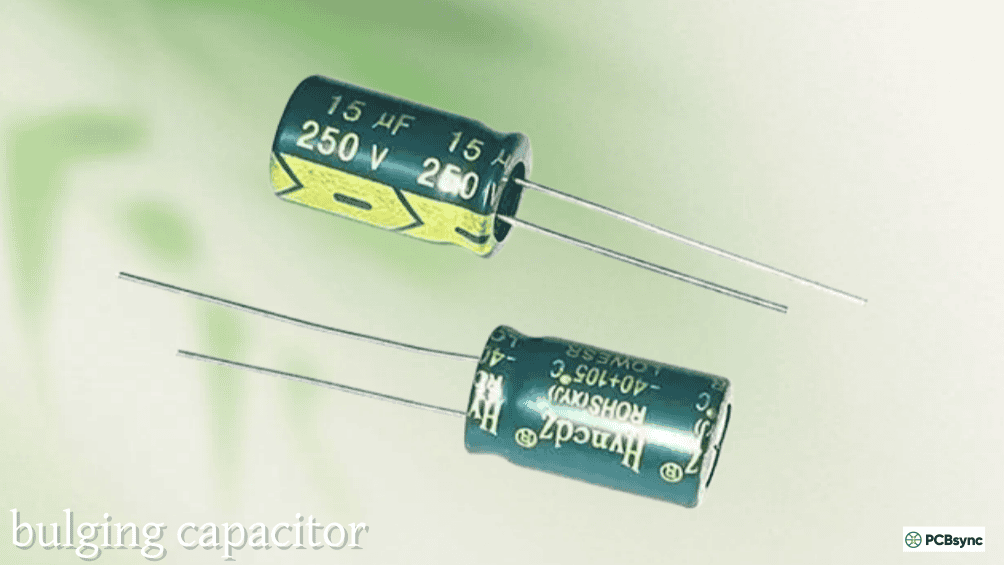
Visible damage: Bulging, cracking, discoloration, or leaked resin on the capacitor housing means the part needs to be replaced immediately.
Testing a CBB61 Capacitor with a Multimeter
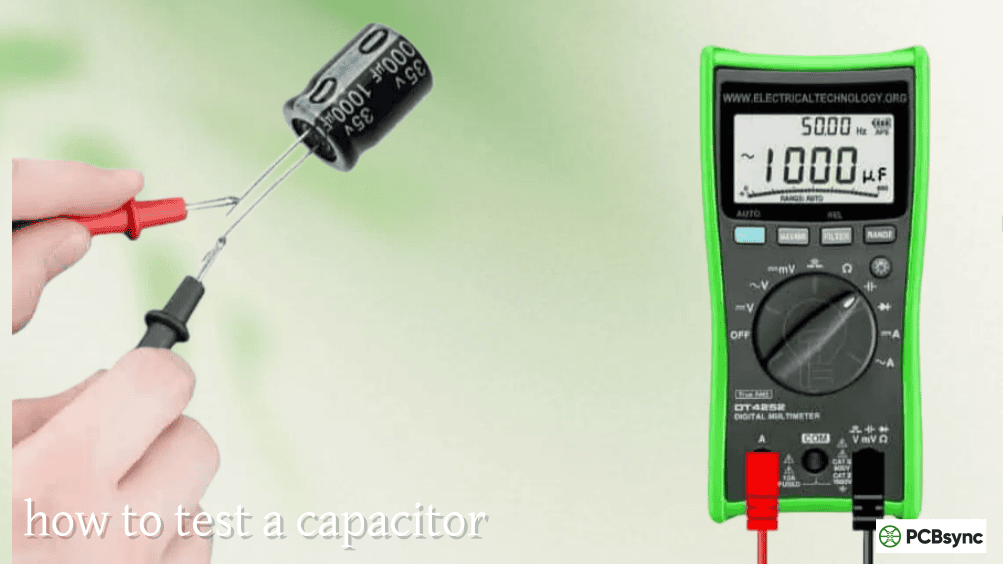
Before testing, always disconnect power and discharge the capacitor through a 100-ohm resistor. CBB61 capacitors can hold a charge that’s unpleasant at best and dangerous at worst.
Step
Action
What to Look For
1
Set multimeter to capacitance mode (µF)
Ensure meter can read the expected range
2
Connect probes to capacitor terminals
Observe the reading
3
Compare reading to rated value
Should be within ±5% of labeled value
4
Check for shorts (ohm mode)
Should read open circuit (very high resistance)
5
Look for rapid capacitance drift
Unstable readings suggest internal degradation
If your multimeter doesn’t have a capacitance mode, you can use the resistance mode as a rough check. Touch the probes to the terminals — you should see the resistance climb rapidly toward infinity as the capacitor charges. If it stays at zero (short) or starts at infinity and doesn’t move (open), the capacitor is bad.
How to Replace a CBB61 Capacitor
Replacing a CBB61 capacitor is one of the most common home appliance repairs, but getting the replacement right matters.
Matching Specifications
The replacement CBB61 capacitor must match these parameters from the original:
Capacitance value (µF): Must be exactly the same. Using a higher or lower value changes the motor’s torque characteristics, speed calibration, and current draw. A mismatched value can cause poor performance, overheating, or motor damage over time.
Voltage rating (VAC): Must be equal to or higher than the original. Going higher is safe — a 450V capacitor will work fine in a 250V circuit. Going lower is dangerous and will likely result in premature failure or dielectric breakdown.
Number of wires/terminals: Must match the original configuration (2, 4, or 5 wire). Each wire corresponds to a specific internal capacitor section and connects to a specific point in the speed control circuit.
Physical size: The replacement needs to fit in the available mounting space. Measure the original before ordering.
Wiring Tips for Multi-Wire CBB61 Capacitors
For 5-wire CBB61 replacements in ceiling fans, the wiring can be confusing because replacement capacitors rarely have the same wire colors as the original.
Here’s the general approach: identify the two common wires (usually the same color, often yellow), which connect to the motor’s common terminal. The remaining three wires each correspond to a capacitance section (e.g., 4 µF, 5.5 µF, 6 µF) and connect to the speed switch terminals for low, medium, and high speed.
If the original wiring isn’t documented, a multimeter in capacitance mode can identify which wire pair produces which capacitance value, allowing you to map the new capacitor to the circuit correctly.
Community troubleshooting threads for CBB61 wiring
Generator Guru
generatorguru.com
CBB61 capacitor selection for portable generators
Frequently Asked Questions About CBB61 Capacitors
What happens if I use a higher capacitance CBB61 capacitor in my fan?
Using a higher capacitance value increases the current through the auxiliary winding, which raises the motor’s torque and can increase speed. However, it also increases the winding current beyond the motor designer’s intent. Short-term, the fan may spin faster. Long-term, the excess current generates additional heat in the windings, which degrades insulation and shortens motor life. Always match the original capacitance value within the ±5% tolerance range.
Can I replace a CBB61 capacitor with a CBB60?
Yes, if the rated voltage, capacitance, climate category, and safety protection class (S0 or S3) are all the same. The key difference between CBB61 and CBB60 is form factor — CBB61 is rectangular and CBB60 is cylindrical. Electrically, they use the same metallized polypropylene film dielectric and are governed by the same standards (IEC 60252-1, GB/T 3667.1). The only practical concern is whether the cylindrical CBB60 physically fits in the space where the rectangular CBB61 was mounted.
How long does a CBB61 capacitor last?
Under normal operating conditions — proper voltage, moderate ambient temperatures, reasonable duty cycles — a quality CBB61 capacitor can last 10 to 20 years. The rated minimum is typically 10,000 hours under continuous full-load operation, but real-world ceiling fan usage (intermittent, moderate loads) is much gentler than worst-case testing conditions. Capacitor degradation accelerates with heat, voltage stress, and humidity. Cheap, no-name capacitors from uncertified manufacturers may fail much sooner.
Why does my ceiling fan hum but not spin?
In nearly all cases, this means the CBB61 capacitor has failed or lost most of its capacitance. The motor receives power (that’s the hum you hear), but without the phase shift from the capacitor, it can’t generate the rotating magnetic field needed to produce starting torque. If you give the blade a gentle push and it starts spinning, that confirms the capacitor is the problem. Disconnect power, test the capacitor with a multimeter, and replace it with one that matches the original specifications.
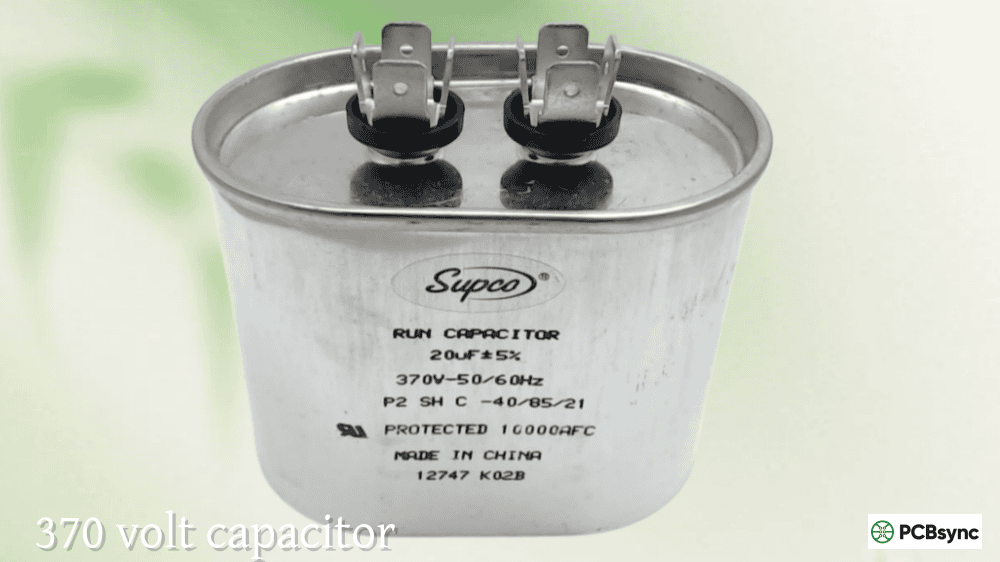
What does the “40/85/21” climate category on a CBB61 capacitor mean?
This is the IEC climate classification code. The first number (40) is the minimum operating temperature in °C (here, −40°C). The second number (85) is the maximum operating temperature in °C. The third number (21) is the number of days for the damp heat test at 93% relative humidity and the upper temperature limit. So 40/85/21 means the capacitor is rated for −40°C to +85°C and has passed a 21-day humidity endurance test. For most indoor fan applications, this is more than adequate. For outdoor or high-humidity environments, pay attention to this rating when selecting a replacement.
Inquire: Call 0086-755-23203480, or reach out via the form below/your sales contact to discuss our design, manufacturing, and assembly capabilities.
Quote: Email your PCB files to Sales@pcbsync.com (Preferred for large files) or submit online. We will contact you promptly. Please ensure your email is correct.
Notes: For PCB fabrication, we require PCB design file in Gerber RS-274X format (most preferred), *.PCB/DDB (Protel, inform your program version) format or *.BRD (Eagle) format. For PCB assembly, we require PCB design file in above mentioned format, drilling file and BOM. Click to download BOM template To avoid file missing, please include all files into one folder and compress it into .zip or .rar format.