Inquire: Call 0086-755-23203480, or reach out via the form below/your sales contact to discuss our design, manufacturing, and assembly capabilities.
Quote: Email your PCB files to Sales@pcbsync.com (Preferred for large files) or submit online. We will contact you promptly. Please ensure your email is correct.
Notes: For PCB fabrication, we require PCB design file in Gerber RS-274X format (most preferred), *.PCB/DDB (Protel, inform your program version) format or *.BRD (Eagle) format. For PCB assembly, we require PCB design file in above mentioned format, drilling file and BOM. Click to download BOM template To avoid file missing, please include all files into one folder and compress it into .zip or .rar format.
CBB60 Capacitor: Motor Run Applications Complete Guide
If you’ve ever pulled apart a water pump, washing machine, or air compressor and found a cylindrical plastic component with two or four terminals sitting near the motor, that’s almost certainly a CBB60 capacitor. It’s the workhorse of single-phase AC motor run circuits, and it’s one of the most commonly replaced components in household and light industrial equipment.
I deal with CBB60 capacitors regularly — sometimes in product designs, more often when diagnosing why a pump won’t start or a washing machine drum won’t spin. The part itself is cheap and simple, but picking the wrong replacement or misunderstanding how it functions in the circuit can turn a $5 repair into a burned-out motor. This guide covers everything you need to know about the CBB60 capacitor: what it is, how it works, where it’s used, how to size one, and how to replace a failed unit correctly.
The CBB60 capacitor is a metallized polypropylene film capacitor designed for continuous-duty motor run applications in single-phase AC circuits. The model designation breaks down like this: “C” means capacitor, “BB” identifies the dielectric as polypropylene (a non-polar organic film), and “60” denotes the cylindrical plastic-cased form factor intended for motor run and start use.
What sets the CBB60 apart from other capacitor types is its construction for sustained AC operation. Unlike electrolytic starting capacitors (CD60 types) that are only meant to be in-circuit for a few seconds during motor startup, the CBB60 stays connected to the motor’s auxiliary winding the entire time the motor is running. That means it needs to handle continuous AC current without overheating, degrading, or failing — and the polypropylene film dielectric is what makes that possible.
The construction is straightforward but well-engineered for the job. Thickened zinc-aluminum metallized polypropylene film serves as both the dielectric and electrode. The wound capacitor element sits inside a cylindrical ABS or PBT plastic housing, potted with flame-retardant epoxy resin to keep moisture out and provide mechanical stability. Terminals come in several configurations — 2-pin, 4-pin, wire leads, or quick-connect spades — depending on the specific application and manufacturer.
What “SH” Means on a CBB60 Capacitor
You’ll often see “SH” printed on CBB60 capacitors alongside the main specifications. This stands for “Self-Healing,” which is one of the key advantages of metallized film construction. If a localized dielectric breakdown occurs — say from a voltage spike or a minor manufacturing defect — the thin metallized layer around the fault point vaporizes and clears the short, allowing the capacitor to continue functioning. This self-healing behavior is what gives CBB60 capacitors their long service life of 10,000+ hours under rated conditions.
CBB60 Capacitor Specifications and Ratings
Knowing how to read the label on a CBB60 capacitor is essential for correct selection and replacement. Here are the key parameters.
S0 (no individual protection) or S3 (self-healing + pressure disconnect)
Applicable Industry Standards
Standard
Description
IEC 60252-1
AC motor capacitors — General requirements, performance, testing
UL 810
Capacitors for AC motor applications (North American market)
GB/T 3667.1
Chinese national standard for AC motor capacitors
EN 60252-1
European harmonized version of IEC 60252-1
VDE 0565
German safety standard for capacitors in power electronics
TUV / CE / CQC
Common certifications seen on CBB60 products
If you’re designing a product or approving a BOM, make sure the CBB60 capacitor you’re specifying carries at least one relevant safety certification. For products destined for the US market, UL 810 recognition is particularly important. For European markets, look for VDE or CE marks.
How the CBB60 Capacitor Works in Motor Circuits
The CBB60 capacitor’s role is fundamental to single-phase AC motor operation. Understanding this helps explain why capacitor failure has the symptoms it does and why getting the right value matters.
The Phase-Shift Problem in Single-Phase Motors
Three-phase motors generate a naturally rotating magnetic field from the three offset power phases. Single-phase motors don’t have that luxury — they only get one AC waveform. A single AC phase creates an oscillating magnetic field, not a rotating one, which means the rotor has no preferred direction of rotation and zero net starting torque.
The CBB60 capacitor solves this by creating an artificial second phase. Wired in series with the motor’s auxiliary (start/run) winding, the capacitor shifts the current in that winding ahead of the voltage by roughly 90 degrees. The combination of the main winding’s current (in phase with voltage) and the auxiliary winding’s current (shifted by the capacitor) produces a rotating magnetic field — and the motor spins.
Run Capacitor vs. Start Capacitor: A Critical Distinction
This is where a lot of confusion and mistakes happen, so it’s worth being clear about it.
Feature
Run Capacitor (CBB60)
Start Capacitor (CD60)
Dielectric
Metallized polypropylene film
Aluminum electrolytic
Duty cycle
Continuous (stays in circuit)
Momentary (disconnected after startup)
Typical capacitance
5–60 µF
50–400 µF
Typical voltage
250–450 VAC
125–330 VAC
Self-healing
Yes
No
Lifespan
10,000+ hours continuous
Short duty cycles only
Failure mode if left in circuit
Gradual degradation
Catastrophic (bulging, leaking, explosion)
Some motor designs use both: a CD60 electrolytic start capacitor for the initial high-torque startup, and a CBB60 film run capacitor that remains connected during operation. The start capacitor is disconnected by a centrifugal switch or relay once the motor reaches about 75% of rated speed. If your motor has both and you’re troubleshooting, test each separately — the symptoms of a failed start cap versus a failed run cap are quite different.
CBB60 Capacitor Applications by Equipment Type
The CBB60 capacitor shows up everywhere single-phase AC motors need a run capacitor. Here are the most common applications with typical specifications.
Equipment
Typical Capacitance
Voltage Rating
Notes
Water pumps (submersible)
20–60 µF
450 VAC
Continuous duty, harsh environment
Water pumps (jet/centrifugal)
15–40 µF
450 VAC
High starting torque required
Washing machines (drum motor)
10–25 µF
450 VAC
Reversal cycles stress the capacitor
Washing machines (drain pump)
3–8 µF
250 VAC
Lower power motor
Air compressors
25–60 µF
250–450 VAC
High inrush, continuous operation
Refrigerator compressors
10–30 µF
370–450 VAC
Continuous duty in sealed systems
Pressure washers
20–50 µF
450 VAC
High-power motor applications
Air conditioning (fan motor)
5–15 µF
370–450 VAC
Indoor and outdoor unit fans
Paper shredders
5–15 µF
250 VAC
Intermittent heavy loads
Food processing equipment
10–30 µF
250–450 VAC
Motors in mixers, kneaders
Water pumps are probably the single largest application category for CBB60 capacitors. A failed CBB60 is one of the most common reasons a well pump or pool pump stops working, and it’s often misdiagnosed as a motor failure. Before replacing a $300 pump motor, always test the $5 capacitor first.
How to Size a CBB60 Capacitor for Your Motor
If the original CBB60 capacitor label is still readable, matching it exactly is always the safest approach. But labels fade, and sometimes you’re working with an unlabeled motor or building a new system. Here’s how to approach sizing.
General Sizing Guidelines for Run Capacitors
Motor Power
Approximate Run Capacitance
Voltage Rating
Up to 250 W (1/3 HP)
5–15 µF
250–450 VAC
250–750 W (1/3–1 HP)
15–30 µF
450 VAC
750–1500 W (1–2 HP)
25–50 µF
450 VAC
1500–2200 W (2–3 HP)
40–60 µF
450 VAC
A widely used rule of thumb in the industry is 4 to 5 µF per 100 watts of motor power for run capacitors. This gives you a reasonable starting point, but the actual value depends on the motor’s winding design, which varies by manufacturer.
Sizing Rules You Should Follow
Always match the original value when possible. The motor designer chose that capacitance for a reason — it optimizes the phase angle for maximum efficiency at the motor’s rated load and speed.
Never exceed 20% above the original capacitance. While slightly increasing the run capacitor value can improve starting torque marginally, going too high pushes excess current through the auxiliary winding. The result is overheating, insulation breakdown, and eventual motor failure.
Voltage rating must meet or exceed the original. A 450V capacitor in a 250V circuit is perfectly fine and adds safety margin. A 250V capacitor in a 450V circuit will fail, potentially violently.
For a 220V motor, choose a 400V or 450V rated capacitor. The peak voltage on a 220V RMS supply is about 311V, so you need a capacitor rated well above that. The 450V rating gives you comfortable headroom.
CBB60 vs. CBB61 vs. CBB65: Choosing the Right Motor Capacitor
All three are polypropylene film motor capacitors from the same family, but they serve different application niches.
Feature
CBB60
CBB61
CBB65
Shape
Cylindrical
Rectangular (box)
Cylindrical (metal case)
Housing
ABS/PBT plastic
ABS plastic
Aluminum shell
Filling
Epoxy resin
Epoxy resin
Castor oil + wax or epoxy
Capacitance range
1–120 µF
1–25 µF
1–120 µF
Primary applications
Pumps, washers, compressors
Fans, exhaust fans
HVAC compressors, refrigeration
Power handling
Medium to high
Low to medium
High
Heat dissipation
Good
Moderate
Best (metal case + oil)
Cost
Low to medium
Lowest
Highest
The CBB60 and CBB61 are electrically identical in terms of dielectric and process — the difference is form factor and power class. CBB60 is cylindrical and typically handles higher capacitance values for higher-power motors. CBB61 is rectangular and optimized for the compact, lower-power world of fans and small appliances.
CBB65 is the premium option. The aluminum case provides better heat dissipation than plastic, and the oil impregnation improves insulation strength and extends life under harsh operating conditions. If you’re designing for HVAC, industrial refrigeration, or any application where the motor runs continuously in elevated ambient temperatures, CBB65 is worth the extra cost.
For most general-purpose pump, washer, and compressor applications, CBB60 is the correct and cost-effective choice.
Troubleshooting and Replacing a Failed CBB60 Capacitor
CBB60 capacitors fail more often than most people realize, and the symptoms are frequently misattributed to the motor itself.
Symptoms of CBB60 Capacitor Failure
Motor hums but won’t start: The most common symptom. The motor gets power and tries to run (you hear the 50/60 Hz hum), but without the capacitor’s phase shift, there’s no starting torque. Some technicians spin the shaft by hand to confirm — if the motor runs after a manual push, the capacitor is almost certainly dead.
Motor starts slowly or struggles under load: A degraded capacitor that still has some capacitance but has drifted significantly below its rated value produces a weak rotating field, resulting in poor torque and sluggish operation.
Motor runs hot: When the capacitor value drops, the current balance between main and auxiliary windings is disrupted. The motor draws more current than designed, generating excess heat that can damage windings over time.
Tripped breaker or blown fuse at startup: A shorted capacitor can draw excessive current during motor startup, triggering overcurrent protection.
Visible physical damage: Bulging, cracking, leaking resin, burn marks, or a strong chemical smell from the capacitor housing all indicate the part needs immediate replacement.
Testing a CBB60 Capacitor
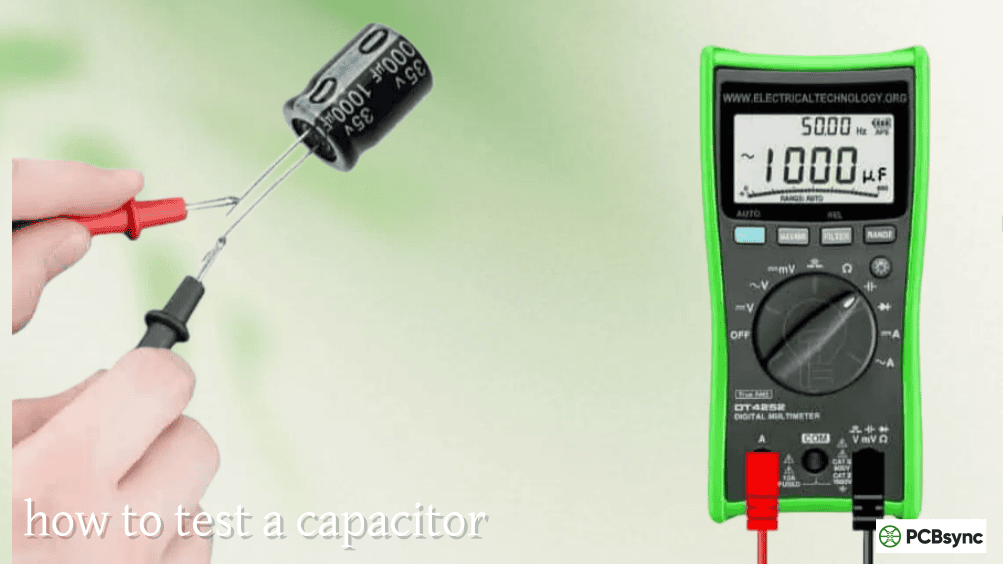
Before testing, disconnect power and discharge the capacitor through a resistor (100 ohm for small values, 10k ohm for larger ones). CBB60 capacitors can hold a charge.
Step
Action
Expected Result
1
Set multimeter to capacitance (µF) mode
Meter ready for measurement
2
Connect probes to capacitor terminals
Stable reading displayed
3
Compare reading to labeled value
Should be within ±5% (or ±10% for K tolerance)
4
Switch to resistance (MΩ) mode
Should show very high resistance (open circuit)
5
Check for visible damage
No bulging, cracks, leaks, or discoloration
If the measured capacitance is more than 10% below the rated value, replace the capacitor even if the motor still runs. A low capacitor means the motor is working harder than it should, and continued operation will shorten the motor’s life.
Replacement Procedure
Replacing a CBB60 capacitor is straightforward, but attention to detail matters.
Match the capacitance exactly. A 25 µF motor demands a 25 µF capacitor. Using 30 µF because “close enough” pushes 20% more current through the auxiliary winding than the designer intended.
Match or exceed the voltage rating. Never go lower. Higher is always safe.
Match the terminal configuration. If the original had 4-pin quick-connect terminals, the easiest replacement is the same type. You can adapt with wire leads and crimp connectors, but pin-compatible replacements are cleaner and more reliable.
Secure the mounting. CBB60 capacitors in pump and compressor applications experience vibration. Use the screw stud mount, U-bracket, or cable ties to ensure the capacitor doesn’t rattle loose.
Note the wiring. CBB60 capacitors are non-polarized — there’s no positive or negative terminal. Either wire can go to either terminal. On 4-pin models, the two pins on each side are internally connected (verify with a multimeter), so you’re effectively still connecting two wires.
Useful Resources for CBB60 Capacitor Selection and Sourcing
The designation breaks down as: “C” = capacitor, “BB” = non-polar organic film dielectric (specifically polypropylene), and “60” = cylindrical plastic-cased motor run capacitor. This naming convention comes from the Chinese component industry classification system and is now universally recognized in global capacitor sourcing. The CBB60 is part of a broader family that includes CBB61 (rectangular plastic case for fans) and CBB65 (aluminum case for HVAC/refrigeration).
Can I use a CBB60 capacitor with a higher voltage rating than the original?
Yes, always safely. A 450V-rated CBB60 capacitor will work perfectly in a circuit that originally used a 250V-rated capacitor, as long as the capacitance value is the same. The voltage rating is the maximum the capacitor can withstand — operating below that maximum just adds safety margin. Going the other direction (using a lower voltage rating than the original) is dangerous and will likely cause premature failure or dielectric breakdown.
How do I know if my CBB60 capacitor is bad?
The most telltale sign is a motor that hums but refuses to start. Other indicators include slow motor speed across all settings, the motor running hotter than normal, and tripped breakers during startup. Visually inspect the capacitor for bulging, cracks, or leaking resin. To confirm, disconnect power, discharge the capacitor, and measure its capacitance with a multimeter. If the reading is more than 10% below the labeled value, the capacitor needs replacing.
Can a CBB60 and CBB61 capacitor be used interchangeably?
Electrically, yes — they use the same metallized polypropylene film dielectric and are governed by the same standards (IEC 60252-1). The difference is purely physical: CBB60 is cylindrical, CBB61 is rectangular. If the capacitance, voltage rating, safety class, and climate category all match, they are interchangeable. The practical issue is whether the different form factor fits in the available mounting space. CBB60 typically handles higher capacitance values (up to 120 µF) while CBB61 tops out around 25 µF, so for high-power motor applications, CBB60 is usually the only option.
How long does a CBB60 capacitor last, and what shortens its life?
A quality CBB60 capacitor from a certified manufacturer typically lasts 10,000 to 30,000 hours under rated conditions — which translates to many years of normal household use. The three biggest life-shorteners are heat (operating near or above the rated temperature limit), voltage stress (running near maximum rated voltage continuously), and humidity (moisture ingress through casing seals). Cheap, uncertified capacitors may use thinner film or inferior epoxy sealing and fail much sooner. For long-life applications, look for S3 safety class (self-healing with pressure disconnect) and a climate category of 40/85/21 or better.
Inquire: Call 0086-755-23203480, or reach out via the form below/your sales contact to discuss our design, manufacturing, and assembly capabilities.
Quote: Email your PCB files to Sales@pcbsync.com (Preferred for large files) or submit online. We will contact you promptly. Please ensure your email is correct.
Notes: For PCB fabrication, we require PCB design file in Gerber RS-274X format (most preferred), *.PCB/DDB (Protel, inform your program version) format or *.BRD (Eagle) format. For PCB assembly, we require PCB design file in above mentioned format, drilling file and BOM. Click to download BOM template To avoid file missing, please include all files into one folder and compress it into .zip or .rar format.