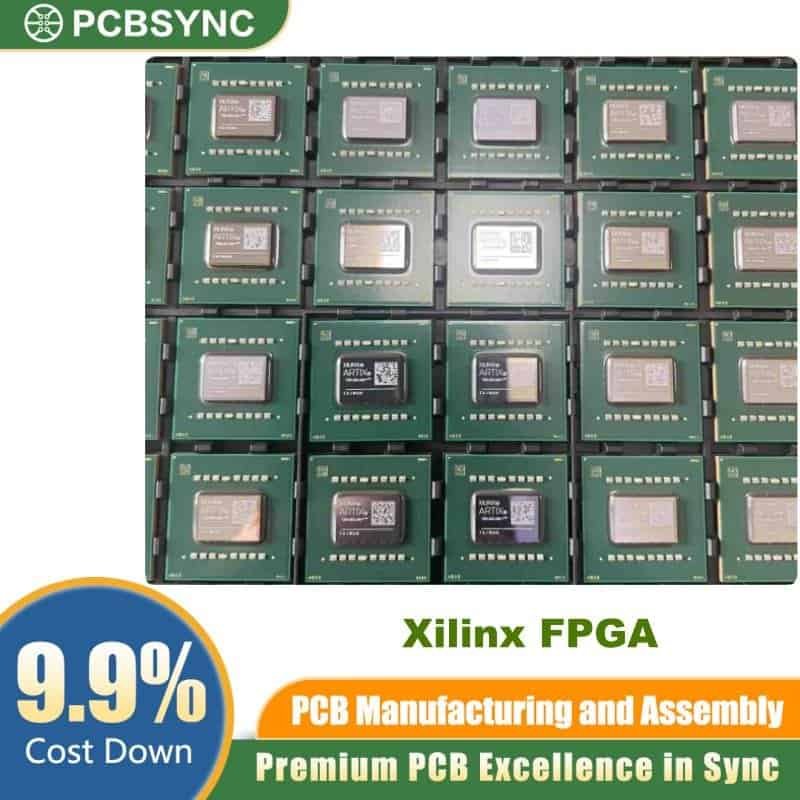
The XC3S1500-5FG456C is a high-performance, cost-optimized field-programmable gate array from the Xilinx Spartan-3 family (now under AMD). Designed for high-volume, price-sensitive applications, this FPGA delivers 1.5 million system gates, 26,624 logic cells, and a 456-pin Fine-pitch Ball Grid Array (FBGA) package — making it an ideal choice for embedded systems, digital signal processing, and telecommunications design. Whether you are prototyping or moving to production, the XC3S1500-5FG456C offers exceptional logic density, flexible I/O, and reliable performance at an accessible price point.
For engineers sourcing programmable logic devices, explore our full range of Xilinx FPGA solutions to find the right fit for your project.
XC3S1500-5FG456C Key Specifications at a Glance
| Parameter |
Value |
| Part Number |
XC3S1500-5FG456C |
| Manufacturer |
AMD (formerly Xilinx) |
| Series |
Spartan-3 |
| Logic Cells |
26,624 |
| System Gates |
1,500,000 (1.5M) |
| CLB Slices |
13,312 |
| Flip-Flops |
26,624 |
| Maximum Distributed RAM |
208 Kb |
| Block RAM |
576 Kb |
| DSP / Multiplier Blocks |
32 |
| Maximum User I/O Pins |
333 |
| Package Type |
FBGA (Fine-pitch BGA) |
| Package / Case |
456-FBGA |
| Ball Pitch |
1.00 mm |
| Supply Voltage (VCC INT) |
1.2 V |
| Supply Voltage (VCC IO) |
1.2 V – 3.3 V |
| Speed Grade |
-5 |
| Operating Temperature |
0°C to +85°C (Commercial) |
| RoHS Compliance |
Yes |
What Is the XC3S1500-5FG456C? Understanding the Spartan-3 Family
The XC3S1500-5FG456C belongs to Xilinx’s Spartan-3 FPGA family, a generation of devices specifically engineered to bring reconfigurable logic to cost-sensitive, high-volume markets. The Spartan-3 architecture introduced a 90 nm process technology with a host of improvements over earlier Spartan generations, including dedicated multiplier blocks, larger block RAMs, and improved digital clock management (DCM).
The “XC3S1500” portion of the part number designates the Spartan-3 device with 1.5 million equivalent system gates. The “-5” suffix indicates the speed grade (with -5 being the fastest in the Spartan-3 commercial range), and “FG456” refers to the 456-ball Fine-pitch BGA package. The trailing “C” denotes commercial temperature grade (0°C to +85°C).
Why Choose the Spartan-3 FPGA for Your Design?
The Spartan-3 family was groundbreaking for delivering ASIC-like density at FPGA flexibility. The XC3S1500-5FG456C is particularly compelling because it provides:
- A large logic fabric suitable for complex state machines, bus interfaces, and control logic
- Dedicated 18×18 multiplier blocks that accelerate DSP tasks without consuming CLB resources
- Flexible, multi-standard I/O supporting LVTTL, LVCMOS, HSTL, SSTL, and more
- Four Digital Clock Managers (DCMs) for clock synthesis, phase shifting, and deskewing
- Abundant block RAM for buffering, FIFOs, and look-up tables
Detailed Technical Specifications
Logic Resources
| Resource |
XC3S1500 |
| System Gates |
1,500,000 |
| Logic Cells |
26,624 |
| CLB Array |
104 × 64 |
| CLB Slices |
13,312 |
| Flip-Flops (total) |
26,624 |
| 4-input LUTs |
26,624 |
| Max. Distributed RAM |
208 Kb |
Memory Resources
| Resource |
Details |
| Block RAM (18 Kb each) |
32 blocks |
| Total Block RAM |
576 Kb |
| Max. Distributed RAM |
208 Kb |
Clock and DSP Resources
| Resource |
Count |
| Digital Clock Managers (DCMs) |
4 |
| Dedicated 18×18 Multipliers |
32 |
I/O and Package Details
| Parameter |
Details |
| Package |
456-FBGA (Fine-pitch BGA) |
| Ball Pitch |
1.00 mm |
| Package Dimensions |
23 mm × 23 mm |
| Maximum User I/O |
333 |
| I/O Standards Supported |
LVTTL, LVCMOS 1.2/1.5/1.8/2.5/3.3V, HSTL, SSTL, PCI, GTL+ |
| Max. Differential I/O Pairs |
140 |
| I/O Banks |
8 |
Power Supply Requirements
| Supply |
Voltage |
| Core Voltage (VCCINT) |
1.2 V |
| I/O Voltage (VCCIO) |
1.2 V – 3.3 V |
| Auxiliary Voltage (VCCAUX) |
3.3 V |
XC3S1500-5FG456C Speed Grade and Timing
The -5 speed grade is the highest (fastest) commercial speed grade available in the Spartan-3 family, making the XC3S1500-5FG456C the best choice when timing margins are tight. Representative performance figures for the -5 grade include:
| Timing Parameter |
Typical Value |
| Maximum System Clock (register-to-register) |
~200 MHz |
| DCM Clock Output Frequency Range |
25 MHz – 280 MHz |
| Logic Propagation Delay (typical LUT + route) |
~5 ns |
| Setup Time (flip-flop) |
Approx. 0.5 ns |
Note: Actual timing depends on design complexity, place-and-route results, and operating conditions. Always verify against the Xilinx XC3S1500 data sheet and generated timing reports.
Package Information: 456-FBGA (FG456)
The FG456 package uses a Fine-pitch Ball Grid Array with 456 solder balls arranged on a 1.00 mm pitch grid. This package style is favored in space-constrained PCB designs where a smaller footprint is essential, and it supports high-density routing with modern PCB fabrication techniques.
| Package Attribute |
Details |
| Package Code |
FG456 |
| Ball Count |
456 |
| Ball Pitch |
1.00 mm |
| Body Size |
23 mm × 23 mm |
| Mounting Type |
Surface Mount |
| Height |
~2.47 mm |
| PCB Land Pattern |
BGA (requires controlled-depth drilling or micro-via capable PCB) |
PCB Design Tips for the FG456 Package:
- Use a minimum of 4-layer PCB to properly route power, ground, and signal planes.
- Follow Xilinx package application notes for recommended via styles (dog-bone or in-pad via).
- Pay attention to the 1.00 mm ball pitch when selecting solder paste stencil thickness (typically 0.12–0.15 mm).
- Decouple VCCINT and VCCIO pins with 100 nF ceramic capacitors placed as close as possible to each power pin.
XC3S1500-5FG456C vs. Other Spartan-3 Devices
Understanding how the XC3S1500 compares to adjacent devices in the family helps designers select the right density for their application.
| Device |
System Gates |
Logic Cells |
Block RAM |
Multipliers |
Max I/O |
Packages |
| XC3S400 |
400K |
8,064 |
288 Kb |
16 |
264 |
FT256, PQ208 |
| XC3S700A |
700K |
13,824 |
360 Kb |
20 |
372 |
FG484, FT256 |
| XC3S1500 |
1.5M |
26,624 |
576 Kb |
32 |
333 |
FG456, FG676 |
| XC3S2000 |
2.0M |
46,080 |
720 Kb |
40 |
565 |
FG456, FG676 |
| XC3S4000 |
4.0M |
62,208 |
1,728 Kb |
96 |
633 |
FG676, FG900 |
The XC3S1500-5FG456C occupies a sweet spot: larger than mid-range Spartan-3 devices but contained within the popular 456-ball package also shared with the XC3S2000, allowing pin-compatible design migration to higher density if needed.
Supported I/O Standards
The Spartan-3 I/O banks support a wide range of single-ended and differential signaling standards, enabling the XC3S1500-5FG456C to interface with virtually any modern digital peripheral or processor.
| Standard |
Type |
VCCIO Required |
| LVTTL |
Single-ended |
3.3 V |
| LVCMOS 3.3 |
Single-ended |
3.3 V |
| LVCMOS 2.5 |
Single-ended |
2.5 V |
| LVCMOS 1.8 |
Single-ended |
1.8 V |
| LVCMOS 1.5 |
Single-ended |
1.5 V |
| LVCMOS 1.2 |
Single-ended |
1.2 V |
| HSTL Class I |
Single-ended |
1.5 V |
| SSTL 2 |
Single-ended |
2.5 V |
| SSTL 18 |
Single-ended |
1.8 V |
| LVDS |
Differential |
2.5 V |
| LVPECL |
Differential |
3.3 V |
| PCI |
Single-ended |
3.3 V |
Digital Clock Management (DCM) in the XC3S1500-5FG456C
What Is a DCM?
The four Digital Clock Managers (DCMs) in the XC3S1500 provide fully digital clock control with no analog components. Each DCM can:
- Eliminate clock skew across the chip by deskewing the feedback path
- Multiply or divide the input clock frequency using a programmable ratio
- Phase-shift the output clock in fine steps (as small as 1/256th of the clock period)
- Generate quadrature clocks (0°, 90°, 180°, 270°) from a single source
- Detect clock failure and optionally switch to a backup clock source
DCMs make the XC3S1500-5FG456C well-suited for designs that need precise, phase-aligned, or synthesized clocks — including DDR memory interfaces, high-speed serial communications, and multi-clock-domain SoC designs.
Typical Applications for the XC3S1500-5FG456C
The XC3S1500-5FG456C is deployed across a broad set of markets and applications due to its combination of logic density, dedicated DSP resources, flexible I/O, and competitive cost:
Embedded Systems and SoC Prototyping
- Soft processor cores (MicroBlaze, PicoBlaze) for custom SoC development
- Peripheral expansion for microprocessor-based boards (SPI, I2C, UART, custom buses)
- Glue logic replacement for legacy board designs
Digital Signal Processing (DSP)
- FIR and IIR digital filters using the 32 dedicated multiplier blocks
- FFT accelerators for audio and baseband processing
- Motor control algorithms (FOC, PWM generation)
Communications and Networking
- Physical layer interface control (LVDS, HSTL-based buses)
- Protocol bridging (PCIe legacy bridging, multi-protocol interfaces)
- Packet processing and routing logic
Industrial and Medical
- Real-time control planes for industrial automation
- Data acquisition front ends
- Image processing pipelines
Consumer Electronics
- Display controller logic
- Set-top box and multimedia processing
- Interface standardization between mixed-voltage subsystems
Development Tools and Design Flow
Xilinx ISE Design Suite
The XC3S1500-5FG456C is fully supported by Xilinx ISE Design Suite (specifically ISE 14.7, the final ISE release). The design flow includes:
- Design Entry: VHDL, Verilog, or schematic capture in ISE Project Navigator
- Synthesis: XST (Xilinx Synthesis Technology) or third-party synthesizers (Synplify, Precision)
- Implementation: Map, Place & Route (PAR), and timing analysis (TRCE)
- Bitstream Generation:
.bit file for direct JTAG programming or .mcs for flash configuration
- Simulation: ISim or ModelSim for functional and timing simulation
Configuration Modes
The XC3S1500-5FG456C supports multiple configuration modes:
| Mode |
Description |
| Master Serial |
Boot from serial flash (SPI-compatible) |
| Slave Serial |
Configured by an external controller (e.g., microcontroller) |
| Master Parallel (SelectMAP) |
High-speed parallel byte-wide configuration |
| Slave Parallel (SelectMAP) |
Parallel configuration driven externally |
| JTAG (Boundary Scan) |
IEEE 1149.1 JTAG for debug and in-circuit configuration |
Ordering Information and Part Number Breakdown
Understanding the Xilinx part numbering convention helps confirm you are ordering exactly the right device.
| Field |
Value |
Meaning |
| XC |
XC |
Xilinx Commercial product |
| Family |
3S |
Spartan-3 |
| Density |
1500 |
1.5 million system gates |
| Speed Grade |
-5 |
Fastest commercial speed grade |
| Package |
FG |
Fine-pitch Ball Grid Array |
| Pin Count |
456 |
456 solder balls |
| Temperature |
C |
Commercial (0°C to +85°C) |
Full Part Number: XC3S1500-5FG456C
Related Part Numbers
| Part Number |
Difference |
| XC3S1500-4FG456C |
Same device, slower -4 speed grade |
| XC3S1500-5FG676C |
Same density, larger 676-ball package (more I/O) |
| XC3S1500-5FG456I |
Industrial temperature grade (-40°C to +100°C) |
| XC3S2000-5FG456C |
Pin-compatible upgrade to 2.0M gates |
Absolute Maximum Ratings
⚠️ Warning: Exceeding absolute maximum ratings may permanently damage the device. These are stress ratings only, not operating conditions.
| Parameter |
Min |
Max |
| Storage Temperature |
-65°C |
+150°C |
| Voltage on any pin to GND |
-0.5 V |
+4.0 V |
| VCCINT |
-0.5 V |
+1.5 V |
| VCCAUX |
-0.5 V |
+4.0 V |
| VCCIO |
-0.5 V |
+4.0 V |
| Junction Temperature (TJ) |
— |
+125°C |
Frequently Asked Questions (FAQ)
Q: Is the XC3S1500-5FG456C still in production? A: The Spartan-3 family has reached end-of-life (EOL) for new production orders from AMD/Xilinx. However, the XC3S1500-5FG456C remains widely available through authorized distributors and component brokers for maintenance, repair, and last-time-buy purposes.
Q: Can I replace an XC3S1500-4FG456C with an XC3S1500-5FG456C? A: Yes. The -5 speed grade is pin-compatible and functionally identical to the -4. The -5 part meets all timing requirements of the -4 and is a drop-in replacement.
Q: What software do I need to program the XC3S1500-5FG456C? A: Xilinx ISE Design Suite 14.7 (free WebPACK edition supports the Spartan-3 family). For programming, use iMPACT (included in ISE) with a Xilinx Platform Cable USB or compatible JTAG programmer.
Q: Can the XC3S1500-5FG456C be used in an industrial temperature application? A: The “C” suffix denotes commercial grade (0°C to +85°C). For industrial temperatures (-40°C to +100°C), specify the XC3S1500-5FG456I instead.
Q: What is the difference between the FG456 and FG676 packages for the XC3S1500? A: Both contain the same silicon. The FG676 (676-ball BGA) exposes more I/O pins (up to 487 vs. 333) and is used when the design requires a large number of user I/O. The FG456 is preferred for smaller PCB footprints.
Summary
The XC3S1500-5FG456C is a mature, proven FPGA that delivers 1.5 million system gates, 26,624 logic cells, 576 Kb of block RAM, 32 dedicated multipliers, and 333 user I/O pins in a compact 456-ball FBGA package. Operating at the fastest commercial speed grade (-5) on a 1.2 V core supply, it is well-suited for embedded control, DSP, communications bridging, and industrial applications. Its pin compatibility with the XC3S2000-5FG456C also provides a straightforward path to higher density when design requirements grow.
For a broader selection of programmable logic devices and expert sourcing support, visit Xilinx FPGA.