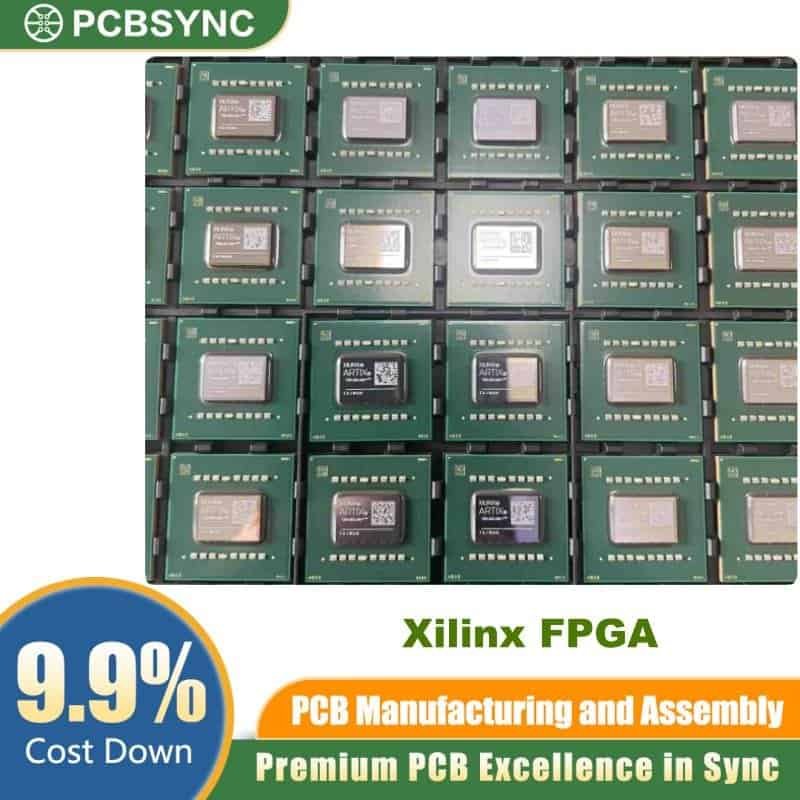
The XC3S1500-5FGG456C is a high-performance, commercially-graded field-programmable gate array (FPGA) from AMD (formerly Xilinx), part of the widely-adopted Spartan-3 family. With 1.5 million system gates, 456-pin Fine-pitch Ball Grid Array (FBGA) packaging, and a –5 speed grade, this device delivers exceptional logic density and processing capability for cost-sensitive, high-volume applications. Whether you are designing embedded systems, digital signal processing circuits, or communications hardware, the XC3S1500-5FGG456C provides a proven, flexible platform trusted by engineers worldwide.
For a full overview of Xilinx programmable logic solutions, visit Xilinx FPGA.
XC3S1500-5FGG456C Key Specifications at a Glance
| Parameter |
Value |
| Manufacturer |
AMD (Xilinx) |
| Part Number |
XC3S1500-5FGG456C |
| Family |
Spartan-3 |
| System Gates |
1,500,000 |
| Logic Cells |
29,952 |
| CLB Slices |
13,312 |
| Distributed RAM (bits) |
221,184 |
| Block RAM (bits) |
720,000 |
| Dedicated Multipliers |
32 |
| DCM (Digital Clock Manager) |
8 |
| Maximum I/O Pins |
333 |
| Package |
FGG456 (Fine-pitch BGA) |
| Package Pin Count |
456 |
| Speed Grade |
–5 |
| Operating Voltage (VCCINT) |
1.2 V |
| Operating Temperature |
0°C to +85°C (Commercial) |
| RoHS Status |
Compliant |
What Is the XC3S1500-5FGG456C?
The XC3S1500-5FGG456C belongs to the Spartan-3 FPGA series, one of Xilinx’s most successful and widely deployed programmable logic families. The “XC3S1500” portion of the part number indicates membership in the Spartan-3 subfamily with approximately 1.5 million equivalent system gates. The “5” denotes the –5 speed grade, reflecting a faster timing performance than the slower –4 variant. “FGG456” identifies the 456-pin Fine-pitch Ball Grid Array package, and “C” designates the commercial temperature range (0°C to +85°C).
Built on a 90 nm process node, the Spartan-3 architecture was designed specifically to deliver the lowest cost per logic cell in the industry at its time, making it ideal for high-volume consumer, industrial, and communications designs.
Detailed Technical Specifications
Logic Resources
| Resource |
Specification |
| System Gates |
1,500,000 |
| Logic Cells |
29,952 |
| CLB Array |
104 × 80 (8,320 CLBs) |
| Slices per CLB |
4 (13,312 total slices) |
| LUTs (4-input) |
26,624 |
| Flip-Flops |
26,624 |
| Maximum Distributed RAM |
221,184 bits |
Memory Resources
| Memory Type |
Specification |
| Block RAM (18 Kb each) |
40 blocks |
| Total Block RAM |
720,000 bits (≈ 88 KB) |
| Distributed RAM |
221,184 bits |
Arithmetic & DSP Resources
| Resource |
Specification |
| 18×18 Dedicated Multipliers |
32 |
| Carry Logic |
Full carry chain per column |
Clock Management
| Resource |
Specification |
| Digital Clock Managers (DCMs) |
8 |
| DCM Functions |
Clock multiplication, division, phase shifting, deskew |
| Global Clock Buffers |
24 |
I/O Interface
| Parameter |
Specification |
| Maximum User I/O |
333 |
| I/O Banks |
8 |
| Supported I/O Standards |
LVCMOS, LVTTL, SSTL, HSTL, LVDS, RSDS, PCI, GTL+ and more |
| Differential Pairs (max) |
162 |
Power & Electrical
| Parameter |
Specification |
| Core Supply Voltage (VCCINT) |
1.2 V |
| I/O Supply Voltage (VCCO) |
1.2 V – 3.3 V (bank selectable) |
| Auxiliary Supply (VCCAUX) |
2.5 V |
Package Information: FGG456
The FGG456 (Fine-pitch Ball Grid Array) package is a compact, area-efficient surface-mount package designed for PCB designs requiring high pin density in a small footprint.
| Package Attribute |
Detail |
| Package Type |
Fine-pitch BGA (FBGA) |
| Total Pins |
456 |
| Ball Pitch |
1.0 mm |
| Package Dimensions (approx.) |
23 mm × 23 mm |
| Height (max) |
1.76 mm |
| Lead Finish |
Lead-Free (RoHS Compliant) |
| PCB Assembly |
Standard BGA reflow soldering |
The fine-pitch BGA package enables a compact board layout while still providing 333 usable I/O pins, making the XC3S1500-5FGG456C an excellent choice for space-constrained designs.
Speed Grade –5: Performance Overview
The –5 speed grade is the fastest commercial speed grade available in the XC3S1500 product line, offering the best timing margins for high-speed logic paths.
| Timing Parameter |
–5 Speed Grade (typical) |
| Maximum System Clock (internal) |
Up to ~200+ MHz (design-dependent) |
| DCM Output Frequency (max) |
280 MHz |
| tCO (CLB flip-flop clock-to-out) |
~1.0 ns |
| Setup Time (tSU) |
~0.2 ns |
| Logic Propagation Delay |
~0.3 ns (4-LUT) |
Note: Actual performance depends on design implementation, routing, and operating conditions. Always verify timing with Xilinx ISE or Vivado timing analysis.
Spartan-3 Architecture Overview
Configurable Logic Blocks (CLBs)
Each CLB in the Spartan-3 architecture contains four slices, and each slice contains two 4-input Look-Up Tables (LUTs), two storage elements (flip-flops or latches), carry logic, and multiplexers. This structure provides maximum flexibility for both combinational and sequential logic implementations.
Block RAM (BRAM)
The XC3S1500-5FGG456C includes 40 block RAM tiles, each 18 Kb in size (dual-port, configurable as 16K×1 to 512×36). Block RAMs can be combined to create larger memories for buffering, FIFOs, lookup tables, and embedded processor memory.
Digital Clock Managers (DCMs)
The 8 DCMs provide powerful clock management capabilities including:
- Frequency synthesis (multiplication and division)
- Phase shifting (fine and coarse)
- Clock deskewing
- Duty-cycle correction
Dedicated Multipliers
Thirty-two 18×18-bit dedicated multipliers allow efficient implementation of DSP functions, filters, and arithmetic pipelines without consuming CLB resources.
Supported I/O Standards
The XC3S1500-5FGG456C supports a wide range of I/O signaling standards, enabling direct interfacing with many common system buses and external devices.
| Standard Category |
Standards Supported |
| Single-Ended |
LVCMOS 3.3V / 2.5V / 1.8V / 1.5V, LVTTL, PCI 3.3V |
| Terminated Single-Ended |
SSTL2, SSTL3, HSTL Class I/II |
| Low-Voltage Differential |
LVDS, LVDS_25, RSDS, Mini-LVDS |
| Open-Drain |
GTL, GTL+ |
Configuration Options
The XC3S1500-5FGG456C supports multiple configuration modes, providing design flexibility for different system architectures.
| Configuration Mode |
Description |
| Master Serial |
FPGA reads bitstream from serial PROM |
| Slave Serial |
External controller provides bitstream serially |
| Master SPI |
Boot from standard SPI Flash memory |
| Master BPI |
Boot from parallel NOR Flash |
| JTAG |
In-circuit configuration via IEEE 1149.1 boundary scan |
| Slave SelectMAP |
Parallel configuration (8-bit or 16-bit bus) |
Bitstream size for the XC3S1500 is approximately 5.4 Mb, which determines the required storage capacity for the configuration device.
Typical Applications
The XC3S1500-5FGG456C is well-suited for a broad range of applications across multiple industries:
| Industry |
Application Examples |
| Industrial Automation |
Motor control, machine vision, PLCs, sensor interfaces |
| Communications |
Protocol bridging, line cards, wireless baseband processing |
| Consumer Electronics |
Video processing, image scaling, display controllers |
| Embedded Systems |
MicroBlaze soft-core processor, co-processing, glue logic |
| Test & Measurement |
Data acquisition, signal generation, instrument control |
| Automotive |
ADAS subsystems, CAN/LIN interfaces, sensor fusion |
| Medical Devices |
Imaging, signal conditioning, patient monitoring |
| Defense & Aerospace |
Signal processing, avionics interfaces (non-military grade) |
XC3S1500-5FGG456C vs. Other Spartan-3 Variants
| Part Number |
Gates |
Slices |
Block RAM |
Multipliers |
I/O |
Package |
| XC3S200-5FT256C |
200K |
1,920 |
216 Kb |
12 |
141 |
FT256 |
| XC3S400-5FT256C |
400K |
3,584 |
288 Kb |
16 |
141 |
FT256 |
| XC3S1500-5FGG456C |
1.5M |
13,312 |
720 Kb |
32 |
333 |
FGG456 |
| XC3S2000-5FGG456C |
2M |
17,280 |
1,008 Kb |
40 |
333 |
FGG456 |
| XC3S4000-5FGG676C |
4M |
27,648 |
1,728 Kb |
96 |
489 |
FGG676 |
The XC3S1500-5FGG456C sits at a strong midrange position, offering substantial logic density and memory resources while maintaining cost-effectiveness — making it the preferred choice for designs that have outgrown smaller Spartan-3 devices.
Design Tools & Support
Xilinx (AMD) provides comprehensive EDA toolchain support for the XC3S1500-5FGG456C:
| Tool |
Purpose |
| Xilinx ISE Design Suite |
Primary synthesis, implementation, and bitstream generation tool for Spartan-3 |
| ModelSim / ISIM |
HDL simulation (VHDL, Verilog, SystemVerilog) |
| ChipScope Pro |
In-system logic analysis and debug |
| CORE Generator |
IP core generation (FIFOs, memory controllers, DSP blocks) |
| XPower Analyzer |
Power estimation and analysis |
| iMPACT |
FPGA programming and configuration |
| MicroBlaze BSP |
Soft processor support for embedded applications |
Note: Xilinx ISE Design Suite is the recommended toolchain for Spartan-3 series devices. Vivado does not support Spartan-3.
Ordering Information
| Attribute |
Detail |
| Full Part Number |
XC3S1500-5FGG456C |
| Manufacturer |
AMD (Xilinx) |
| Manufacturer Part Number |
XC3S1500-5FGG456C |
| DigiKey Part Number |
122-1251-ND |
| Package |
456-FBGA |
| Operating Temperature |
0°C ~ 85°C |
| Speed Grade |
–5 |
| Moisture Sensitivity Level |
MSL 3 |
| Series |
Spartan-3 |
| RoHS Compliance |
Yes |
Why Choose the XC3S1500-5FGG456C?
The XC3S1500-5FGG456C delivers a compelling combination of features that continue to make it a popular choice for new and legacy designs:
High Logic Density — Nearly 30,000 logic cells provide ample capacity for complex state machines, data paths, and interface logic without moving to larger, more expensive devices.
Abundant Memory Resources — 720 Kb of block RAM plus 221 Kb of distributed RAM satisfies most embedded memory requirements for buffers, FIFOs, and lookup tables.
Flexible Clock Management — Eight DCMs give designers full control over clock domains, enabling multi-clock designs with precise phase relationships.
Broad I/O Standard Support — Compatible with virtually all common single-ended and differential signaling standards, simplifying board-level integration.
Proven, Mature Platform — The Spartan-3 family has a decade-plus track record in production environments, with extensive community resources, reference designs, and supply chain stability.
Cost-Effective Scalability — Pin-compatible options within the FGG456 package allow design reuse across multiple product variants.
Frequently Asked Questions (FAQ)
What is the difference between XC3S1500-5FGG456C and XC3S1500-4FGG456C?
The only difference is the speed grade. The –5 variant offers faster timing performance than the –4 variant, making it suitable for higher-frequency clock domains. Both are pin-compatible and functionally identical.
Is the XC3S1500-5FGG456C RoHS compliant?
Yes. The C suffix in the part number confirms commercial temperature range, and this device ships in a lead-free, RoHS-compliant package.
What programming tool do I need for the XC3S1500-5FGG456C?
Xilinx ISE Design Suite (version 14.x or earlier) is the official design tool. The FPGA is programmed using Xilinx iMPACT via a JTAG cable or through a configuration device (SPI/BPI Flash).
Can I replace an XC3S1500-4FGG456C with an XC3S1500-5FGG456C?
Yes. The –5 speed grade is a drop-in pin-compatible replacement for the –4 speed grade in the same FGG456 package. No PCB changes are required.
What soft-core processors can I run on this FPGA?
The XC3S1500-5FGG456C supports the MicroBlaze 32-bit RISC soft processor and the PicoBlaze 8-bit soft processor, both available as free IP from Xilinx.
Summary
The XC3S1500-5FGG456C is a reliable, high-density Spartan-3 FPGA offering 1.5 million system gates, 720 Kb of block RAM, 32 dedicated multipliers, and 8 digital clock managers in a compact 456-pin BGA package. Its –5 speed grade delivers best-in-class timing performance within the Spartan-3 family, making it an excellent choice for engineers requiring maximum performance headroom in commercial-temperature applications. With mature tool support, broad I/O standard compatibility, and a well-established supply chain, the XC3S1500-5FGG456C remains a go-to solution for cost-sensitive FPGA designs across industrial, communications, consumer, and embedded markets.