Inquire: Call 0086-755-23203480, or reach out via the form below/your sales contact to discuss our design, manufacturing, and assembly capabilities.
Quote: Email your PCB files to Sales@pcbsync.com (Preferred for large files) or submit online. We will contact you promptly. Please ensure your email is correct.
Notes: For PCB fabrication, we require PCB design file in Gerber RS-274X format (most preferred), *.PCB/DDB (Protel, inform your program version) format or *.BRD (Eagle) format. For PCB assembly, we require PCB design file in above mentioned format, drilling file and BOM. Click to download BOM template To avoid file missing, please include all files into one folder and compress it into .zip or .rar format.
Capacitors in Parallel: Formula, Uses, and Examples for PCB Engineers
Walk into any design review where someone is questioning the power delivery network, and within five minutes someone will draw capacitors in parallel on a whiteboard. It’s one of the most common configurations in electronics — and also one of the most misunderstood. The formula is dead simple, but the real-world behavior has nuances that catch engineers out, particularly when mixing capacitor values across a wide frequency range.
This guide covers everything you need: the formula and its physical basis, worked calculation examples, the ESR/ESL benefits that make parallel configurations so useful for decoupling, and the anti-resonance trap that nobody’s textbook warned you about. If you’ve ever slapped a 100nF ceramic next to a 100µF electrolytic and assumed the problem was solved, read the sections on anti-resonance carefully.
## What Physically Happens When Capacitors Are Connected in Parallel
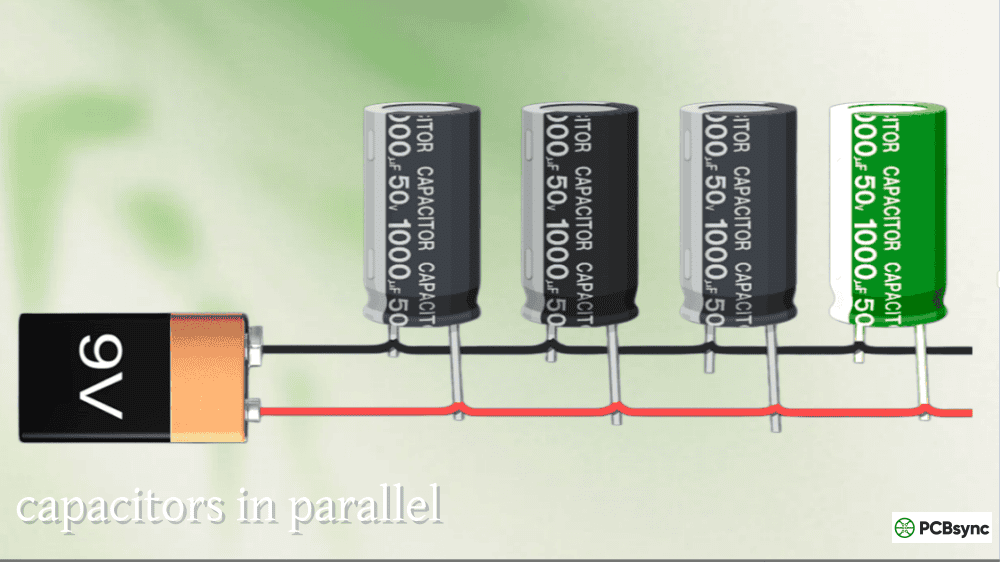
Two capacitors in parallel share the same two nodes — both terminals of every capacitor connect to the same voltage rails. This means every capacitor in a parallel combination sees exactly the same voltage across its plates at all times. There’s no voltage division, no sharing problem, no isolation issue. Each capacitor simply does its job independently, as if the others weren’t there.
The consequence of this shared voltage is that each capacitor stores charge proportional to its own capacitance: Q = C × V. Since voltage is the same for all, the total charge stored is the sum of all individual charges. That’s where the formula comes from. And since capacitance physically represents plate area (C = ε₀εᵣA/d), connecting capacitors in parallel is equivalent to increasing the total plate area — you’re effectively building one bigger capacitor.
This is the opposite of capacitors in series. Where series connections divide voltage and reduce total capacitance, parallel connections share voltage equally and increase total capacitance. It’s also the mathematical mirror image of resistors: capacitors in parallel add like resistors in series (simple addition), and capacitors in series combine like resistors in parallel (reciprocal sum).
## The Capacitors in Parallel Formula: Simple Addition
### General Formula for Total Capacitance
For any number of capacitors connected in parallel:
C_total = C₁ + C₂ + C₃ + … + Cₙ
The total capacitance is always greater than the largest individual capacitor in the group. If your calculated result is smaller than any single capacitor value, something went wrong in the arithmetic.
Unlike the series formula, there’s no reciprocal involved and no two-capacitor shortcut needed — it’s always just addition. This simplicity is one reason parallel capacitor banks are common: they’re easy to scale. Add another capacitor, add its value to the total.
### ESR and ESL in Parallel: They Combine Favourably
Beyond capacitance, there are two other key electrical parameters that change when you put capacitors in parallel, and both change for the better.
ESR (Equivalent Series Resistance) combines like resistors in parallel: the total ESR decreases as you add more capacitors. For N identical capacitors:
ESR_total = ESR_single / N
Two 22µF capacitors each with 50mΩ ESR in parallel give 100µF total with only 25mΩ total ESR.
ESL (Equivalent Series Inductance) also decreases in parallel by the same rule, which directly raises the effective Self-Resonant Frequency (SRF) of the combination. This is a critical benefit for high-frequency decoupling — lower ESL means the capacitor network remains capacitive (rather than becoming inductive) to higher frequencies.
Capacitors in Parallel — Electrical Parameter Summary:
Parameter
Effect When Adding Capacitors in Parallel
Formula
Total Capacitance
Increases (sum of all values)
C_t = C₁ + C₂ + … + Cₙ
Voltage Rating
Limited by lowest-rated capacitor
V_max = min(V₁, V₂, …, Vₙ)
Total ESR
Decreases
ESR_t = ESR / N (equal values)
Total ESL
Decreases
ESL_t = ESL / N (equal values)
Charge on Each Cap
Different (Q = C × V, V same)
Qₙ = Cₙ × V
Self-Resonant Frequency
Increases (effective)
Higher due to reduced ESL
### One Important Voltage Rating Rule
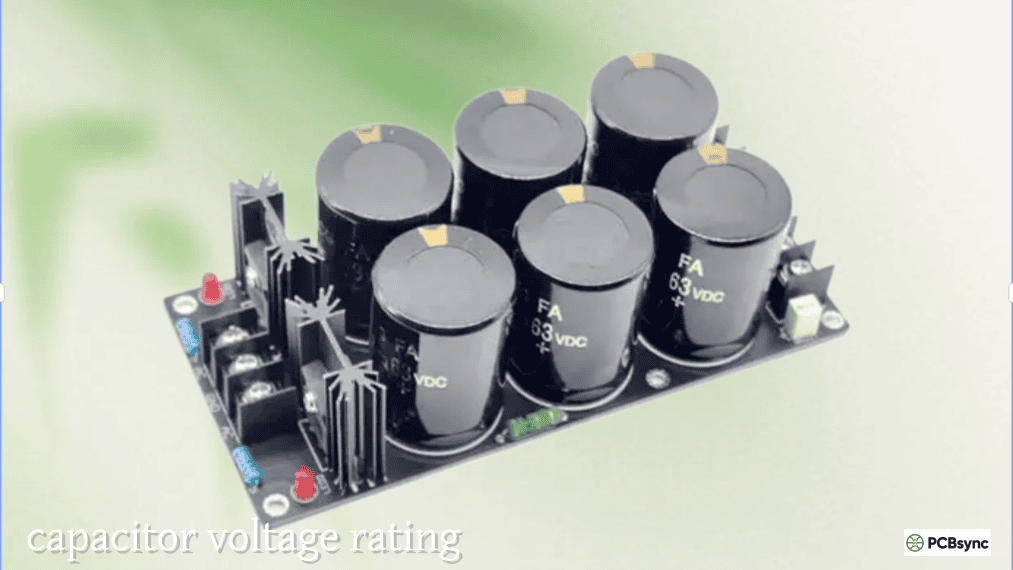
While total capacitance is the sum of all values, the voltage rating of a parallel combination is only as high as the lowest-rated capacitor in the group. If you combine a 10µF 50V capacitor with a 100µF 16V capacitor, the combination has 110µF of capacitance — but is only rated to 16V. This catches people out when mixing legacy parts and new designs, or substituting a lower-voltage bulk cap during a component shortage.
## Worked Calculation Examples
### Example 1: Three Capacitors in Parallel
Find the total capacitance of 10µF, 47µF, and 100µF capacitors connected in parallel.
C_total = 10 + 47 + 100 = 157µF
The result (157µF) is greater than the largest individual value (100µF). Calculation confirmed correct.
### Example 2: Matching a Specific Capacitance Value
Your design needs 3,300µF of bulk capacitance on a 12V rail. Available parts are 1,000µF 16V electrolytic capacitors. How many do you need?
Number of capacitors = 3,300µF / 1,000µF = 3.3 → use 4 capacitors in parallel for 4,000µF
Additional benefit: four 1,000µF capacitors, each with 200mΩ ESR, combine to give just 50mΩ total ESR — a 4× improvement in ESR performance vs. a single 4,000µF capacitor if such a part had the same per-unit ESR.
### Example 3: ESR Calculation for a Power Supply Output Filter
A 5V power supply requires a maximum output ESR of 20mΩ to meet ripple voltage specifications. Available 470µF capacitors each have 80mΩ ESR. How many in parallel are needed?
Total capacitance: 4 × 470µF = 1,880µF. Total ESR: 80/4 = 20mΩ. Both the capacitance and the ESR target are met simultaneously.
Parallel Capacitor Worked Examples Summary:
Scenario
Capacitors
Total C
Total ESR
Three different values
10µF + 47µF + 100µF
157µF
Varies
Meeting bulk C target
4 × 1,000µF
4,000µF
ESR/4
Meeting ESR target
4 × 470µF, 80mΩ each
1,880µF
20mΩ
Equal MLCC decoupling
5 × 100nF, 200mΩ each
500nF
40mΩ
## Key Applications of Capacitors in Parallel
### Power Supply Decoupling and Bypass: The Core PCB Application
The most pervasive use of capacitors in parallel on any PCB is power supply decoupling — placing one or more capacitors across the supply pins of ICs to provide local charge storage and filter noise from the power distribution network (PDN). Every time a logic gate switches, it demands a rapid surge of current. If the supply rail can’t respond instantly (due to inductance in traces and planes), the voltage droops, which causes glitches in nearby circuits sharing the same rail.
A decoupling capacitor placed right at the power pin acts as a local energy reservoir. It supplies the transient current demand in the few nanoseconds before the bulk supply can respond. The capacitor then slowly recharges between switching events.
For effective broadband decoupling, engineers typically use capacitors in parallel across different value ranges, covering different frequency bands:
Large electrolytic or tantalum capacitors (10µF to 100µF) handle low-frequency bulk energy storage and smooth out slow transients from load steps
Mid-range ceramic capacitors (1µF to 10µF) bridge the middle frequency range
Small ceramic MLCCs (10nF to 100nF) handle high-frequency switching noise above a few MHz
Very small ceramics (1nF and below) on high-speed ICs push decoupling effectiveness into the hundreds of MHz range
This hierarchical parallel combination is seen everywhere in digital PCB design — from microcontroller boards to server FPGAs.
Decoupling Capacitor Hierarchy for PCB Power Rails:
Sometimes the capacitance value you need simply doesn’t exist as a standard part — or the standard part at that value has impractical size, cost, or lead time. Paralleling two or more smaller parts gives design flexibility: more standard values to choose from, better component availability, and the ability to use what’s already in the approved components list.
This is also the practical reason large-value capacitor banks in industrial power electronics — motor drives, inverters, UPS systems — use arrays of multiple parallel capacitors rather than single enormous units. Individual parts are more available, easier to source as direct replacements, and the parallel array gives redundancy: losing one capacitor in a parallel bank reduces capacitance but doesn’t immediately fail the system.
### Ripple Current Rating: Distributing the Thermal Load
Each capacitor has a maximum ripple current rating — the RMS AC current it can sustain without exceeding its thermal limits. In high-ripple environments like switching regulator output stages, this rating can be a design constraint even when the capacitance value itself is easily achievable with a single part.
Parallel capacitors split the ripple current between them. If three identical capacitors are in parallel, each carries approximately one third of the total ripple current. This allows a design to meet the ripple current requirement using standard, readily available capacitors that would each be inadequate if used alone.
### Increasing Capacitance Near a BGA or Dense Placement Constraint
On a high-density PCB with a BGA processor, there may be seven or eight small 0402 MLCC decoupling positions available under the package or in the escaping ring, but each 0402 in X7R only goes up to 10µF at 1V rating. Filling all eight positions with 10µF parts in parallel gives 80µF of well-placed, low-inductance decoupling exactly where it’s needed — achievable because the positions exist, not because 80µF 0402 parts do.
## The Anti-Resonance Problem: When Parallel Capacitors Make Things Worse
This is the part of capacitors in parallel that doesn’t make it into most introductory tutorials — and the reason why mixing very different capacitor values across a wide frequency range can backfire badly.
Every real capacitor has a Self-Resonant Frequency (SRF), where its capacitive reactance equals its inductive reactance (from ESL) and the impedance reaches a minimum. Above the SRF, the capacitor behaves inductively — its impedance increases with frequency rather than decreasing.
When two capacitors with different SRFs are connected in parallel, a problem emerges at the frequency between their two SRFs: one capacitor is now inductive, the other is still capacitive. An inductor in parallel with a capacitor forms a tank circuit — a parallel LC resonator — and at its resonant frequency, the impedance shoots upward rather than down. This impedance spike is called anti-resonance, and it means the combined parallel network is actually worse at filtering noise at that frequency than either capacitor alone.
This effect was measured in a widely circulated experiment where a large electrolytic and a small ceramic capacitor were placed in parallel. At the anti-resonant frequency, the combined impedance was significantly higher than a single capacitor of either type. One EDN article describes a real-world case where a parallel resonant frequency of paralleled bypass capacitors happened to coincide exactly with a gate array’s 16MHz clock frequency — with catastrophic results for the design.
### How to Minimize Anti-Resonance in Parallel Capacitor Networks
Understanding the problem points to the mitigation strategies:
Keep the ratio between parallel capacitor values within about one decade (10:1 or less). A 100nF and a 1µF in parallel is relatively safe. A 100nF and a 100µF is a much wider spread — the SRFs are further apart, and the anti-resonant peak between them is sharper and harder to avoid.
Use same-value, same-package capacitors when possible. Multiple identical capacitors in parallel don’t create anti-resonance between themselves — they all have the same SRF, so their impedance curves overlap without creating a gap. Multiple 100nF 0402 X7R capacitors in parallel is a much cleaner decoupling solution than one 100nF plus one 10µF if your target frequency is in the hundreds of MHz range.
ESR is actually your friend here. Higher ESR capacitors dampen the anti-resonance peak because the resonant Q is lower. The sharpest, most destructive anti-resonance peaks occur with the lowest-ESR capacitors — another reason that blindly chasing minimum ESR isn’t always the right design decision.
Add a series ferrite bead or small resistor between the large and small capacitor sections to introduce damping. This detuples the two resonant sections and prevents the high-Q anti-resonant peak from forming.
## Capacitors in Parallel vs. in Series: Side-by-Side Comparison
Property
Capacitors in Parallel
Capacitors in Series
Total Capacitance
Increases (sum)
Decreases (reciprocal sum)
Voltage Across Each
Same for all
Divided (smaller cap = higher V)
Charge on Each
Different (Q = C × V)
Same for all
Total ESR
Decreases
Increases
Total ESL
Decreases
Increases
Voltage Rating
Limited by weakest cap
Effectively adds (with balancing Rs)
Main Use Case
More capacitance, better decoupling
Higher voltage rating, AC coupling
Formula Type
Simple addition (like resistors in series)
Reciprocal sum (like resistors in parallel)
## Common Design Mistakes with Parallel Capacitors
Ignoring the voltage rating of the weakest capacitor. Every capacitor in a parallel combination must be rated for the full supply voltage. The combination doesn’t split voltage; every single unit sees the full rail. Using a 16V-rated cap in a 24V parallel bank, even accidentally, is a waiting failure.
Assuming more capacitors always means better decoupling. Past a certain number of parallel capacitors, the diminishing returns in total capacitance and ESR are outweighed by the increased board space, assembly cost, and — at high frequencies — the risk of anti-resonance. Simulate the impedance profile of the network before committing to a large parallel array in a high-frequency design.
Placing parallel decoupling capacitors far from the IC. The whole benefit of parallel placement is reduced ESL and lower impedance at the point of current demand. If the capacitors are 20mm away connected through a thin trace, the trace inductance dominates and the parallel combination of capacitors at the other end is largely irrelevant for high-frequency transients. Placement and layout matter as much as the capacitor values themselves.
Mixing electrolytic and ceramic capacitors without considering anti-resonance. This is the most common version of the anti-resonance trap in practice. A 100µF electrolytic and a 100nF ceramic in parallel is a textbook anti-resonance scenario. Know the SRF of each capacitor type you’re paralleling, and either simulate the combined impedance or keep values within a decade of each other.
Q1: Why does the total capacitance of capacitors in parallel always exceed the largest individual value?
Because physically you’re increasing effective plate area, not splitting it. Each capacitor contributes its full plate area to the combined structure. The total charge the network can store at a given voltage is Q_total = (C₁ + C₂ + … + Cₙ) × V — every capacitor contributes independently. There’s no competition or sharing for voltage (unlike series circuits where voltage is divided). This is also why the formula is just simple addition: there’s no reciprocal sum, no product-over-sum shortcut needed. As long as your answer is larger than the largest individual capacitor, the calculation is correct.
Q2: I have a 100µF electrolytic and a 100nF ceramic both on the same supply rail. Is that good decoupling or am I creating a problem?
Both, depending on the frequency range. At low frequencies (DC to a few MHz), the 100µF electrolytic does the heavy lifting — bulk energy storage and slow transient response. At high frequencies where the electrolytic becomes inductive, the 100nF ceramic takes over. So the intent is correct. The problem is anti-resonance: at the frequency between the two self-resonant frequencies (somewhere in the 1–50MHz range depending on package and layout), the network impedance can spike upward — worse than either capacitor alone. For most digital designs running below 100MHz this is manageable, but for high-speed FPGAs, RF, and GHz-rate data interfaces it’s a real issue. Simulate the combined impedance using Murata SimSurfing or K-SIM before committing to mixed-value parallel combinations on critical rails.
Q3: Does it matter which way round polarized electrolytic capacitors are connected in a parallel bank?
Yes, absolutely. Every polarized capacitor (electrolytic, tantalum MnO₂) in a parallel bank must have the same polarity orientation — all positive terminals to the rail, all negative terminals to ground. Reversed polarity on even one capacitor in a parallel bank will cause that capacitor to fail (potentially violently, in the case of electrolytic or MnO₂ tantalum), and the resulting short can damage other capacitors and surrounding circuitry. Non-polarized capacitors (ceramic, film, polymer) have no polarity restriction and can be installed in either orientation.
Q4: My power supply filter capacitors run hot even though the capacitance is well within spec. What’s going on?
Almost certainly a ripple current issue. Each capacitor has a maximum rated ripple current (AC RMS current), and exceeding it causes heating proportional to I²×ESR. If your capacitance calculation was correct but you didn’t check the ripple current rating, you may be running the capacitors at or over their thermal limit. The fix is to add more capacitors in parallel: this both reduces the ESR of the combination (less I²R heating) and divides the total ripple current between more units so each individual capacitor carries a smaller fraction. Always check both the capacitance and the ripple current rating for any power supply filter application — they’re independent constraints that can both bite you.
Q5: Can I mix capacitors from different manufacturers and dielectrics in a parallel decoupling network?
Yes, and it’s done routinely in production designs. A typical decoupling scheme for a high-speed processor might use Murata GRM series ceramics for the 100nF high-frequency bypass and Panasonic or Nichicon electrolytics for the 100µF bulk caps — all in parallel on the same power rail. The key considerations are: voltage rating (every cap must be rated for the full rail voltage), polarity for polarized types, and the anti-resonance risk when mixing values more than one decade apart. For the high-frequency bypass capacitors specifically, mixing dielectrics and manufacturers within the same value range (say, multiple 100nF 0402 X7R ceramics from two different vendors) is unproblematic — same value means same SRF range, so no anti-resonance between them. Wherever possible, match package sizes and dielectric types for the units that share the same frequency role.
## Putting It Together: When to Reach for a Parallel Configuration
Capacitors in parallel are the right tool when you need more capacitance than a single part provides, lower effective ESR to handle ripple current or reduce heating, better decoupling across a wider frequency range, improved reliability through redundancy, or flexibility to build a required value from standard available parts.
The formula is the easy part — C_total = C₁ + C₂ + … + Cₙ. The real engineering work is in choosing capacitor types thoughtfully, sizing for ripple current and not just capacitance, placing components close to the load to minimize parasitic inductance, and staying aware of anti-resonance when paralleling capacitors with very different self-resonant frequencies.
Inquire: Call 0086-755-23203480, or reach out via the form below/your sales contact to discuss our design, manufacturing, and assembly capabilities.
Quote: Email your PCB files to Sales@pcbsync.com (Preferred for large files) or submit online. We will contact you promptly. Please ensure your email is correct.
Notes: For PCB fabrication, we require PCB design file in Gerber RS-274X format (most preferred), *.PCB/DDB (Protel, inform your program version) format or *.BRD (Eagle) format. For PCB assembly, we require PCB design file in above mentioned format, drilling file and BOM. Click to download BOM template To avoid file missing, please include all files into one folder and compress it into .zip or .rar format.