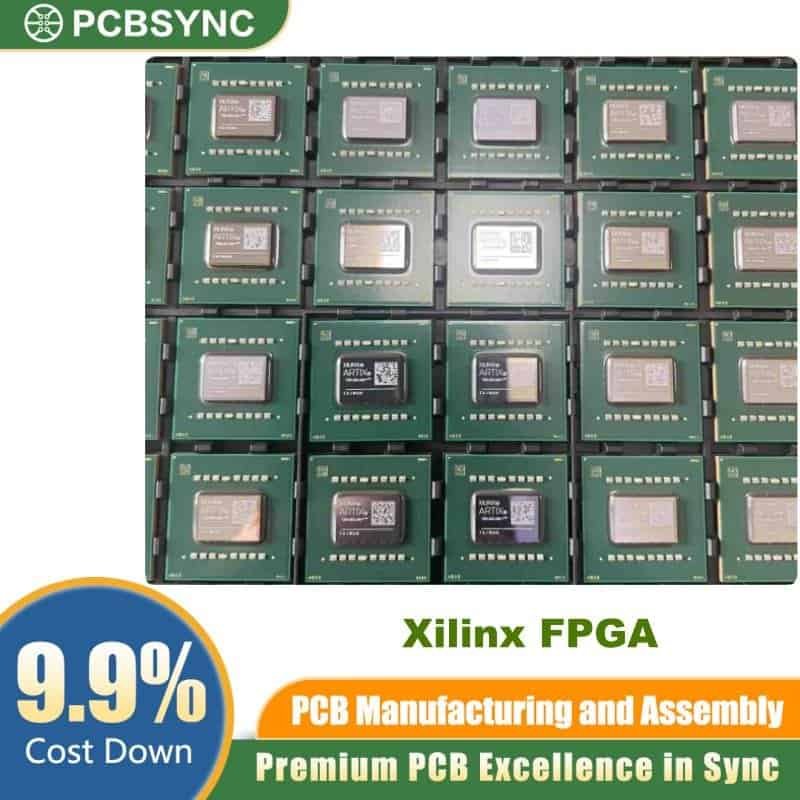
The XC3S1500-5FGG676C is a high-performance, mid-range field-programmable gate array (FPGA) from the AMD Xilinx Spartan-3 family. Designed for cost-sensitive, high-volume applications, this device delivers powerful logic density, dedicated digital signal processing (DSP) resources, and flexible I/O in a compact BGA package. Engineers and designers working on embedded systems, communications, and consumer electronics rely on this FPGA for its proven performance and broad ecosystem support.
Whether you are evaluating it for a new PCB design or sourcing it for production, this guide covers everything you need to know — from core specifications and pin configurations to power requirements and typical applications.
What Is the XC3S1500-5FGG676C?
The XC3S1500-5FGG676C is part of Xilinx’s (now AMD) Spartan-3 FPGA series, which was introduced to provide an optimal balance of logic capacity, performance, and cost. The “1500” in the part number refers to the device’s 1.5 million system gate count, making it one of the larger members of the Spartan-3 family. The “-5” denotes the speed grade, indicating a mid-tier performance level, and “FGG676C” specifies the Fine-pitch Ball Grid Array (FBGA) package with 676 balls, in commercial temperature range.
As a Xilinx FPGA, the XC3S1500 is built on a mature 90nm process technology, offering a compelling feature set for embedded logic, protocol bridging, signal processing, and custom computing tasks.
Key Specifications at a Glance
| Parameter |
Value |
| Manufacturer |
AMD (Xilinx) |
| Part Number |
XC3S1500-5FGG676C |
| Series |
Spartan-3 |
| Logic Cells |
29,952 |
| System Gates (Equivalent) |
~1,500,000 |
| CLB (Configurable Logic Blocks) |
3,456 |
| CLB Flip-Flops |
27,648 |
| Maximum Distributed RAM (Kb) |
216 Kb |
| Block RAM (Kb) |
432 Kb |
| Dedicated Multipliers (18×18) |
32 |
| DCM (Digital Clock Manager) |
4 |
| Maximum User I/O Pins |
487 |
| Package |
FBGA-676 (FGG676) |
| Speed Grade |
-5 |
| Core Voltage (VCCINT) |
1.2V |
| Temperature Range |
0°C to +85°C (Commercial) |
| Process Technology |
90nm |
| Configuration Modes |
Master Serial, Slave Serial, SelectMAP, JTAG, SPI, BPI |
Package and Physical Dimensions
| Parameter |
Detail |
| Package Type |
Fine-Pitch Ball Grid Array (FBGA) |
| Ball Count |
676 |
| Package Designator |
FGG676 |
| Body Size |
27mm × 27mm |
| Ball Pitch |
1.0mm |
| Mounting Type |
Surface Mount (SMD) |
| Temperature Grade |
Commercial (C) – 0°C to +85°C |
| RoHS Compliance |
Available (check suffix for Pb-free variants) |
The FGG676 package is well-suited for PCB designs requiring high pin counts in a compact footprint, with 1.0mm ball pitch enabling use on standard PCB design rules.
Logic and Memory Resources
Configurable Logic Blocks (CLBs)
The XC3S1500 features 3,456 CLBs, each containing four slices. Every slice contains two flip-flops and two 4-input LUTs that can be configured as logic or distributed RAM. This architecture enables efficient implementation of state machines, counters, arithmetic functions, and complex combinational logic.
Block RAM
With 432 Kb of on-chip block RAM organized as 20 independent 18Kb RAM blocks, the XC3S1500 supports large data buffering, FIFO implementations, and embedded memory for soft processors (such as MicroBlaze or PicoBlaze).
Dedicated Multipliers
32 dedicated 18×18-bit multipliers provide hardware acceleration for digital signal processing tasks including FIR filters, FFT pipelines, and custom arithmetic without consuming CLB resources.
| Resource Type |
Count |
Capacity |
| CLBs |
3,456 |
4 slices each |
| Slice Flip-Flops |
27,648 |
— |
| 4-input LUTs |
27,648 |
Logic or 16-bit distributed RAM |
| Distributed RAM |
— |
216 Kb total |
| Block RAM (18Kb blocks) |
20 blocks |
432 Kb total |
| 18×18 Multipliers |
32 |
Hardware DSP |
| DCMs |
4 |
Clock synthesis and management |
I/O and Pin Details
Maximum User I/O
The 487 user I/O pins available in the FGG676 package support a wide range of single-ended and differential I/O standards. This makes the XC3S1500-5FGG676C ideal for interfacing with memories, processors, and high-speed peripherals.
Supported I/O Standards
| I/O Standard Category |
Examples |
| Single-Ended (3.3V) |
LVTTL, LVCMOS33, LVCMOS25, LVCMOS18 |
| Single-Ended (Low Voltage) |
LVCMOS15, LVCMOS12 |
| Differential |
LVDS, LVPECL, RSDS, BLVDS, PPDS |
| High-Speed Memory |
HSTL, SSTL (Class I & II) |
| PCI |
PCI 3.3V, PCI-X |
I/O Bank Organization
I/O pins are grouped into banks, each powered by an independent VCCO supply voltage. This multi-bank architecture allows the FPGA to interface simultaneously with devices operating at different voltage levels on the same PCB.
Clock Management
The 4 Digital Clock Managers (DCMs) in the XC3S1500 provide advanced clock synthesis, multiplication, division, and phase shifting capabilities. Key DCM features include:
- Clock multiplication (up to ×32) and division (up to /32)
- Phase shifting with fine resolution
- Clock de-skewing for zero-delay clock distribution
- Duty cycle correction
- Up to 8 global clock networks and 24 regional clock networks
This robust clocking architecture supports complex, multi-clock domain designs.
Power Supply Requirements
| Supply Rail |
Voltage |
Function |
| VCCINT |
1.2V |
Core logic supply |
| VCCO |
1.2V – 3.3V (per bank) |
I/O output driver supply |
| VCCAUX |
2.5V |
Auxiliary supply (DCI, DCM, config) |
Proper power sequencing and decoupling are critical for stable FPGA operation. Xilinx recommends powering VCCINT and VCCAUX before VCCO during startup.
Configuration Options
The XC3S1500-5FGG676C supports multiple configuration modes, giving designers flexibility in system boot architecture:
| Configuration Mode |
Description |
| Master Serial (SPI) |
Connects directly to SPI Flash memory |
| Slave Serial |
External device drives configuration data |
| SelectMAP (Parallel) |
High-speed parallel configuration interface |
| JTAG |
IEEE 1149.1-compliant boundary scan and configuration |
| Master Parallel (BPI) |
Byte-wide parallel NOR Flash interface |
Configuration data is stored in external non-volatile memory. The device supports bitstream encryption for IP protection.
Typical Applications for the XC3S1500-5FGG676C
The XC3S1500-5FGG676C is well-suited for a broad range of embedded and industrial applications:
| Application Area |
Use Case Examples |
| Communications |
Ethernet MAC/PHY, UART, SPI, I2C bridges, protocol converters |
| Industrial Control |
Motor control, PLC logic, real-time I/O expansion |
| Embedded Computing |
Soft processor (MicroBlaze, PicoBlaze) with custom peripherals |
| Signal Processing |
FIR/IIR filters, FFT engines, digital audio processing |
| Video & Imaging |
Video scaling, format conversion, image processing pipelines |
| Test & Measurement |
Logic analyzers, data acquisition front-ends |
| Aerospace & Defense |
Custom interface bridging, sensor fusion (industrial-grade versions) |
| Consumer Electronics |
Display controllers, USB interface logic, set-top box designs |
Ordering Information and Part Number Breakdown
Understanding the XC3S1500-5FGG676C part number helps identify the exact device configuration:
| Field |
Value |
Meaning |
| XC |
XC |
Xilinx commercial-grade product |
| 3S |
3S |
Spartan-3 family |
| 1500 |
1500 |
~1.5M system gates |
| -5 |
-5 |
Speed grade (–4 = slowest, –5 = mid, –5E = enhanced) |
| FGG |
FGG |
Fine-Pitch Ball Grid Array package |
| 676 |
676 |
676-ball count |
| C |
C |
Commercial temperature range (0°C to +85°C) |
Note: If you require an industrial temperature range (–40°C to +100°C), look for the XC3S1500-5FGG676I variant.
Development and Design Tools
Designing with the XC3S1500-5FGG676C is supported by AMD Xilinx’s comprehensive toolchain:
- Xilinx ISE Design Suite – The primary legacy tool for Spartan-3 FPGA design (synthesis, implementation, simulation)
- ModelSim / Vivado Simulator – RTL and gate-level simulation
- ChipScope Pro – In-system logic analyzer for debugging
- CORE Generator – IP core library for common functions (FIFOs, DSP blocks, memory controllers)
- XSCT / iMPACT – Configuration and programming utilities
The Spartan-3 family is supported by a wide library of Xilinx IP cores and third-party IP vendors, accelerating time to market.
Comparison: XC3S1500 vs Other Spartan-3 Family Members
| Part Number |
System Gates |
Block RAM |
Multipliers |
Max I/O |
Package Options |
| XC3S200 |
200K |
216 Kb |
12 |
173 |
TQFP144, FT256 |
| XC3S400 |
400K |
288 Kb |
16 |
264 |
FT256, FG320 |
| XC3S1000 |
1M |
432 Kb |
24 |
391 |
FT256, FG320, FG456 |
| XC3S1500 |
1.5M |
432 Kb |
32 |
487 |
FG320, FGG676 |
| XC3S2000 |
2M |
576 Kb |
40 |
565 |
FG456, FG676 |
| XC3S4000 |
4M |
720 Kb |
96 |
712 |
FG676, FG900 |
The XC3S1500 occupies an optimal mid-range position: larger logic capacity than entry-level devices, with lower cost and power than the top-tier Spartan-3 members.
Why Choose the XC3S1500-5FGG676C?
- High Logic Density: 1.5M system gates provide substantial design capacity for complex state machines and data paths
- Dedicated DSP Multipliers: 32 hardware 18×18 multipliers accelerate signal processing without consuming CLB resources
- Flexible I/O: 487 user I/O with multi-standard support enables versatile system integration
- Large Block RAM: 432 Kb on-chip BRAM supports deep FIFOs and soft processor memory maps
- Clock Management: 4 DCMs enable complex multi-clock designs with precise frequency synthesis
- Mature Ecosystem: Extensive IP core library, reference designs, and community support
- Cost-Effective: Spartan-3 pricing makes this FPGA suitable for cost-sensitive volume production
Frequently Asked Questions (FAQ)
Q: What is the difference between XC3S1500-5FGG676C and XC3S1500-5FGG676I? The “C” suffix denotes a commercial temperature range (0°C to +85°C), while the “I” suffix indicates industrial temperature range (–40°C to +100°C). All other electrical specifications are identical.
Q: Is the XC3S1500-5FGG676C RoHS compliant? Lead-free (RoHS-compliant) variants are available. Check with your distributor for the specific lead-free part suffix if required for your region or application.
Q: What programming software is compatible with this FPGA? The XC3S1500-5FGG676C is designed to be used with Xilinx ISE Design Suite (ISE 14.7 is the final version supporting Spartan-3). iMPACT is used for device programming and boundary scan.
Q: Can I run a soft processor on the XC3S1500? Yes. The XC3S1500 supports both PicoBlaze (8-bit, uses minimal resources) and MicroBlaze (32-bit, requires significant CLB and BRAM allocation). MicroBlaze is available via the ISE EDK (Embedded Development Kit).
Q: What external configuration memory is compatible? Common choices include Xilinx Platform Flash (XCF-series) and standard SPI Flash or BPI NOR Flash devices. The exact capacity required depends on the compressed bitstream size for your specific design.
Conclusion
The XC3S1500-5FGG676C remains a proven and reliable FPGA choice for designers requiring significant logic density, dedicated DSP resources, and flexible I/O in a commercial-grade BGA package. Its mature toolchain, strong community support, and cost-effective pricing position it well for embedded systems, communications, and industrial control applications.
For broader context on AMD Xilinx programmable logic and to explore the full portfolio of FPGA solutions, visit our guide to Xilinx FPGA devices.