Meta Description: Buy XC3S2000-4FG676I – Xilinx Spartan-3 2M gate FPGA, FG676 package, industrial -40°C to 100°C range. Full specs, pinout, and application guide.
The XC3S2000-4FG676I is a high-density, cost-optimized field-programmable gate array (FPGA) from Xilinx’s (now AMD) Spartan-3 family. Featuring 2,000,000 system gates, a 676-ball Fine-pitch Ball Grid Array (FBGA) package, and an extended industrial temperature range, this device is a proven solution for high-volume, cost-sensitive embedded applications. Whether you are designing industrial control systems, communications hardware, or consumer electronics, the XC3S2000-4FG676I delivers the logic density and I/O flexibility your project demands.
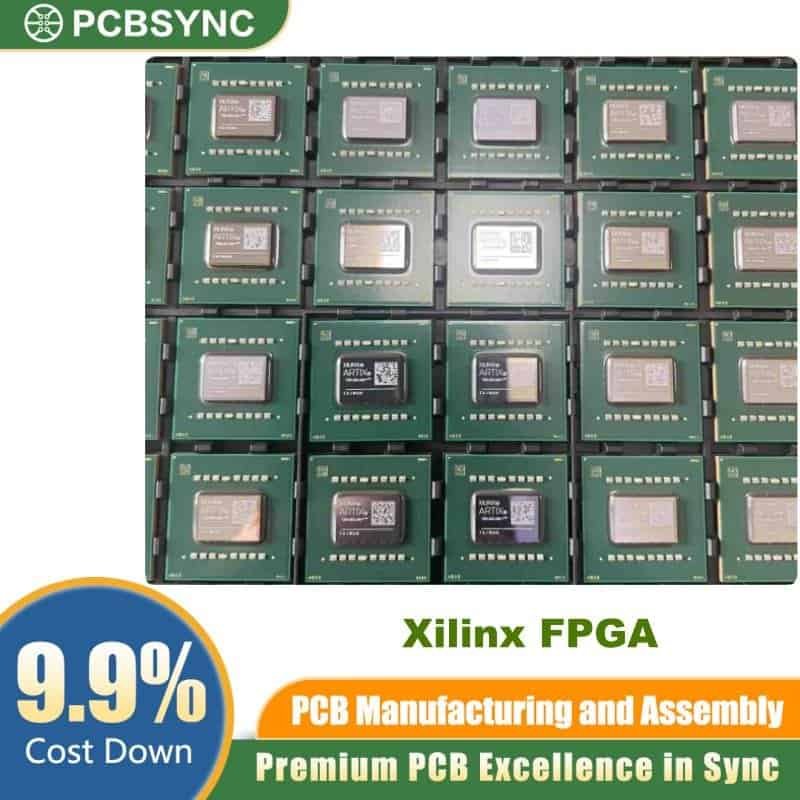
For a wide range of programmable logic solutions, explore the full selection of Xilinx FPGA devices.
What Is the XC3S2000-4FG676I? Overview and Key Features
The XC3S2000-4FG676I is part of the Spartan-3 FPGA family, which was specifically architected to deliver maximum logic capacity at the lowest possible cost per gate. The “2000” in the part number refers to approximately 2 million equivalent system gates, making this one of the larger devices in the Spartan-3 lineup.
Part Number Breakdown
Understanding the naming convention helps engineers quickly identify device characteristics:
| Segment |
Value |
Meaning |
| XC3S |
— |
Spartan-3 Family |
| 2000 |
2,000K |
Equivalent System Gates |
| -4 |
Speed Grade 4 |
Slower speed grade (lower power) |
| FG |
— |
Fine-pitch Ball Grid Array (FBGA) package |
| 676 |
676 |
Number of balls in the BGA package |
| I |
Industrial |
Temperature range: –40°C to +100°C |
XC3S2000-4FG676I Full Technical Specifications
Core Logic Resources
| Parameter |
Specification |
| Equivalent System Gates |
2,000,000 |
| Logic Cells |
46,080 |
| CLB Slices |
20,480 |
| CLB Flip-Flops |
40,960 |
| Maximum Distributed RAM |
320 Kb |
| Block RAM |
720 Kb (20 × 18K blocks) |
| Dedicated Multipliers (18×18) |
40 |
| Digital Clock Managers (DCMs) |
4 |
I/O and Packaging
| Parameter |
Specification |
| Maximum User I/O |
489 |
| Package Type |
FBGA (Fine-pitch BGA) |
| Package Code |
FG676 |
| Ball Count |
676 |
| Package Dimensions |
27 mm × 27 mm |
Electrical and Timing
| Parameter |
Specification |
| Speed Grade |
-4 |
| Core Voltage (VCCINT) |
1.2 V |
| I/O Voltage (VCCO) |
1.2 V – 3.3 V |
| Maximum System Clock |
~200 MHz (speed-grade dependent) |
Environmental & Reliability
| Parameter |
Specification |
| Temperature Grade |
Industrial (I) |
| Operating Temperature |
–40°C to +100°C |
| RoHS Compliance |
Yes |
| MSL (Moisture Sensitivity Level) |
MSL 3 |
XC3S2000-4FG676I vs. Other Spartan-3 Devices
Choosing the right device requires understanding where the XC3S2000-4FG676I sits within the Spartan-3 family. The table below compares it against sibling devices.
| Device |
System Gates |
CLB Slices |
Block RAM |
Max User I/O |
DCMs |
| XC3S200 |
200K |
1,920 |
56 Kb |
141 |
2 |
| XC3S400 |
400K |
3,584 |
72 Kb |
264 |
2 |
| XC3S1000 |
1M |
7,680 |
432 Kb |
391 |
4 |
| XC3S2000 |
2M |
20,480 |
720 Kb |
489 |
4 |
| XC3S4000 |
4M |
28,672 |
1,728 Kb |
489 |
4 |
| XC3S5000 |
5M |
33,280 |
1,872 Kb |
489 |
4 |
The XC3S2000 occupies the mid-to-upper range of the Spartan-3 lineup, offering a strong balance between logic density, memory, and DSP resources for its price point.
Speed Grade Comparison: -4 vs. -5 vs. -4I
The “-4” speed grade designation affects maximum operating frequency and setup/hold times. Here is how it compares to other available speed grades for the XC3S2000:
| Speed Grade |
Max Frequency (approx.) |
Typical Use Case |
| -4 |
~175–200 MHz |
Cost/power-sensitive designs |
| -5 |
~200–225 MHz |
Performance-critical designs |
| -4I (Industrial) |
Same as -4, –40°C to 100°C |
Industrial/harsh environments |
The XC3S2000-4FG676I uses the -4I variant, combining the -4 speed grade with extended industrial temperature range.
Supported I/O Standards
The XC3S2000-4FG676I supports a broad array of single-ended and differential I/O standards, making it highly interoperable with other system components.
Single-Ended Standards
| Standard |
VCCO Range |
| LVCMOS 3.3V |
3.3 V |
| LVCMOS 2.5V |
2.5 V |
| LVCMOS 1.8V |
1.8 V |
| LVCMOS 1.5V |
1.5 V |
| LVTTL |
3.3 V |
| PCI 3.3V |
3.3 V |
Differential Standards
| Standard |
Description |
| LVDS |
Low-Voltage Differential Signaling |
| RSDS |
Reduced Swing Differential Signaling |
| Mini-LVDS |
Compact low-power differential |
| BLVDS |
Bus LVDS |
| HSTL |
High-Speed Transceiver Logic |
Digital Clock Manager (DCM) Capabilities
The four on-chip DCMs are one of the most powerful features of the XC3S2000-4FG676I. They provide flexible, low-jitter clock management without external PLLs.
DCM Functions
- Clock Multiplication and Division – Generate frequencies that are integer multiples or fractions of the input clock
- Phase Shifting – Shift output clock phase in fine steps (fixed or dynamic)
- Clock Deskew – Eliminate clock distribution delay for zero-skew operation
- Spread Spectrum Clocking – Reduce EMI in consumer and industrial designs
- Frequency Synthesis – Generate precise output frequencies via DFS (Digital Frequency Synthesis)
Block RAM Architecture
The 720 Kb of on-chip Block RAM is organized as 20 individual 36 Kb dual-port RAM blocks (configurable as two independent 18 Kb blocks). This on-chip memory is essential for applications including FIFOs, lookup tables, and local data buffering.
Block RAM Configuration Options
| Configuration |
Depth × Width |
| 16K × 2 |
Single 18 Kb mode |
| 8K × 4 |
— |
| 4K × 9 |
With parity bit |
| 2K × 18 |
— |
| 1K × 36 |
Full 36 Kb mode |
| 512 × 72 |
With parity |
Embedded Multiplier Resources
The 40 dedicated 18×18 hardwired multipliers accelerate DSP functions such as filters, transforms, and arithmetic-heavy control loops without consuming CLB fabric. Each multiplier accepts two 18-bit signed or unsigned inputs and delivers a 36-bit output.
Applications for Embedded Multipliers
- FIR/IIR digital filters
- Fourier Transform (FFT) engines
- PID control algorithms
- Video and image processing pipelines
- Motor control (field-oriented control, SVPWM)
Typical Applications for the XC3S2000-4FG676I
The industrial-grade temperature range and high logic density make this FPGA suitable for a wide variety of embedded and industrial designs.
Industrial & Automation
- Programmable Logic Controllers (PLC) co-processors
- Motor drive and servo control
- Machine vision pre-processing
- Industrial Ethernet (EtherCAT, PROFINET) interfaces
- Safety and monitoring systems
Communications & Networking
- Protocol conversion bridges (UART, SPI, I²C, CAN)
- Packet processing engines
- Multi-channel serial interfaces
- Wireless baseband processing
Defense & Aerospace
- Ruggedized signal processing (industrial-temp qualification)
- Sensor fusion and data aggregation
- Radar and sonar pre-processing
Consumer & Medical Electronics
- Imaging and video pipeline control
- Test and measurement instrumentation
- Medical device control planes
XC3S2000-4FG676I Ordering Information
| Parameter |
Value |
| Manufacturer |
AMD (Xilinx) |
| Part Number |
XC3S2000-4FG676I |
| Family |
Spartan-3 |
| Series |
Spartan®-3 |
| Package |
FBGA-676 |
| Mounting Type |
Surface Mount |
| Operating Temperature |
–40°C to +100°C (Industrial) |
| Moisture Sensitivity Level |
MSL 3 |
| RoHS Status |
RoHS Compliant |
| Distributor Example |
DigiKey P/N: XC3S2000-4FG676I-ND |
Design & Development Tools
Xilinx (AMD) provides a complete ecosystem for designing with the XC3S2000-4FG676I:
Software Tools
| Tool |
Purpose |
| Xilinx ISE Design Suite |
Legacy design flow (HDL synthesis, P&R, bitstream generation) |
| ISim |
HDL simulation included with ISE |
| ChipScope Pro |
On-chip debugging and logic analysis |
| XPower Analyzer |
Power estimation and analysis |
Hardware Development
| Item |
Description |
| Spartan-3 Starter Kit |
Xilinx evaluation board with XC3S200/500 |
| JTAG Platform Cable USB II |
In-circuit programming and debugging |
| iMPACT |
Bitstream download and device configuration tool |
Note: Because the Spartan-3 family uses the legacy ISE toolchain (not Vivado), designers targeting new designs should evaluate Spartan-7 or Artix-7 devices for long-term software support.
PCB Design Considerations for the FG676 BGA Package
The 676-ball FBGA package requires careful PCB design to ensure reliable soldering and signal integrity.
PCB Layout Guidelines
| Parameter |
Recommendation |
| PCB Layer Count |
6–8 layers minimum recommended |
| Ball Pitch |
1.0 mm |
| Pad Diameter (SMD) |
0.55 mm |
| Solder Mask Opening |
Non-Solder Mask Defined (NSMD) preferred |
| Via Strategy |
Via-in-pad or dogbone fanout for inner balls |
| Decoupling Caps |
100 nF per VCCINT/VCCO pin, located within 1–2 mm |
| Thermal Relief |
Avoid on power planes for BGA pads |
Power Supply Requirements
| Supply Rail |
Voltage |
Notes |
| VCCINT |
1.2 V |
Core logic supply |
| VCCO (Bank x) |
1.2–3.3 V |
I/O bank supply (per bank) |
| VCCAUX |
2.5 V |
Auxiliary supply for DCMs, DCI |
| GND |
0 V |
Common ground reference |
Frequently Asked Questions (FAQ)
What is the XC3S2000-4FG676I used for?
The XC3S2000-4FG676I is used as a programmable logic device in industrial control, communications, signal processing, and embedded systems applications where a mid-to-high gate count FPGA with extended temperature operation is required.
What is the difference between XC3S2000-4FG676I and XC3S2000-4FG676C?
The only difference is the temperature range. The “I” suffix denotes Industrial grade (–40°C to +100°C), while the “C” suffix denotes Commercial grade (0°C to +85°C). All other electrical specifications are identical.
Is the XC3S2000-4FG676I still in production?
The Spartan-3 family has reached end-of-life for new designs, though devices remain available through authorized distributors. For new designs, AMD recommends evaluating Spartan-7 (XC7S) or Artix-7 (XC7A) as modern replacements.
What programming software does the XC3S2000-4FG676I use?
The XC3S2000-4FG676I is programmed using Xilinx ISE Design Suite (versions up to 14.7). Vivado does not support Spartan-3 devices.
Can the XC3S2000-4FG676I be used in automotive applications?
No. For automotive-qualified FPGAs, consider AMD/Xilinx automotive-grade devices (XA-series). The XC3S2000-4FG676I is rated for industrial temperatures but does not carry AEC-Q100 qualification.
Summary
The XC3S2000-4FG676I remains a reliable and well-understood FPGA solution for engineers who need 2 million gates of logic density in a compact 676-ball BGA package with guaranteed operation across the full industrial temperature range of –40°C to +100°C. Its combination of 46,080 logic cells, 720 Kb of block RAM, 40 hardwired multipliers, and 4 DCMs makes it capable of handling complex parallel processing tasks that microcontrollers cannot efficiently address.
While new designs should weigh the long-term toolchain considerations of the legacy ISE platform, the XC3S2000-4FG676I continues to be an excellent choice for sustaining production designs, industrial retrofits, and applications where the Spartan-3 architecture’s proven reliability is a requirement.