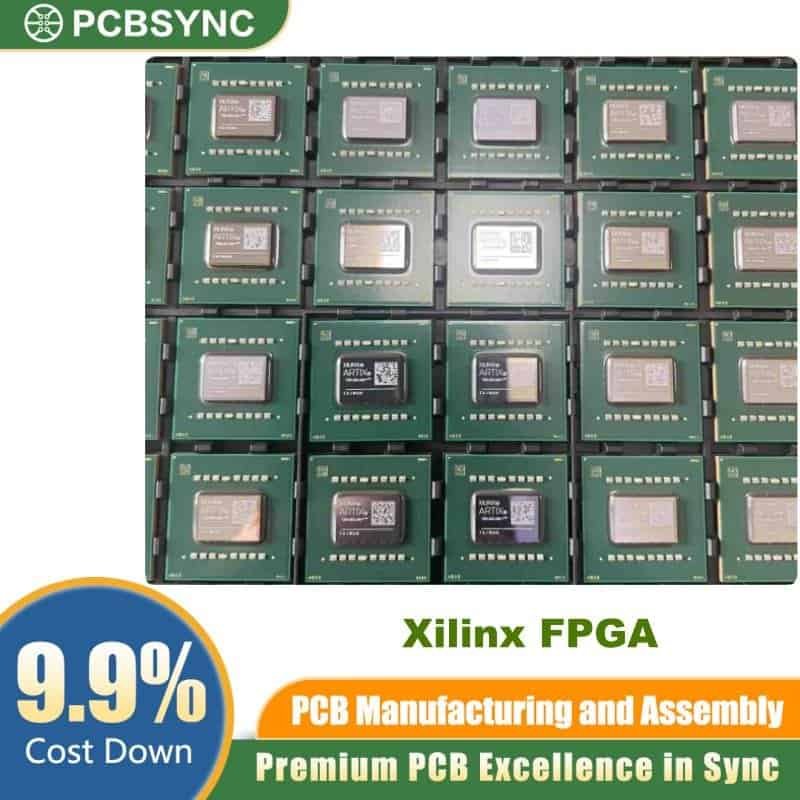
The XC3S2000-4FGG456C is a high-performance, cost-optimized field-programmable gate array (FPGA) from AMD Xilinx’s Spartan-3 family. Designed for high-volume, cost-sensitive applications, this device delivers 2,000,000 system gates, 456-pin Fine-Pitch Ball Grid Array (FBGA) packaging, and a –4 speed grade — making it one of the most capable devices in the Spartan-3 series. Whether you are developing embedded systems, digital signal processing pipelines, or communications hardware, the XC3S2000-4FGG456C offers an exceptional balance of density, speed, and affordability.
For engineers seeking a proven, production-ready Xilinx FPGA, the XC3S2000-4FGG456C remains a highly relevant and widely used component in modern electronic design.
XC3S2000-4FGG456C Overview and Key Specifications
The XC3S2000-4FGG456C belongs to the Spartan-3 family, introduced by Xilinx (now AMD) and targeted at mainstream and high-volume FPGA applications. It combines programmable logic density with embedded RAM and multiplier blocks that are essential for DSP and data-processing applications.
Quick Reference Table
| Parameter |
Value |
| Manufacturer |
AMD (Xilinx) |
| Part Number |
XC3S2000-4FGG456C |
| Family |
Spartan-3 |
| System Gates |
2,000,000 |
| Logic Cells |
46,080 |
| CLB Array |
96 × 72 |
| CLB Flip-Flops |
46,080 |
| Distributed RAM |
720 Kbits |
| Block RAM |
720 Kbits |
| Dedicated Multipliers (18×18) |
40 |
| DCMs (Digital Clock Managers) |
4 |
| Maximum User I/O |
489 |
| Speed Grade |
–4 |
| Package |
FGG456 (Fine-Pitch BGA, 456-pin) |
| Operating Voltage (VCCINT) |
1.2 V |
| Temperature Range |
0°C to +85°C (Commercial) |
| Mounting Type |
Surface Mount |
| RoHS Compliant |
Yes |
Understanding the Part Number: XC3S2000-4FGG456C
Decoding the part number helps engineers quickly identify device characteristics at a glance.
| Segment |
Meaning |
| XC |
Xilinx Commercial product |
| 3S |
Spartan-3 family |
| 2000 |
2,000,000 system gates |
| -4 |
Speed grade (–4 is the fastest in this family) |
| FGG |
Fine-Pitch Ball Grid Array (FBGA) package type |
| 456 |
456 total package pins |
| C |
Commercial temperature range (0°C to +85°C) |
Detailed Technical Specifications
Logic Resources
The XC3S2000-4FGG456C provides substantial programmable logic resources for complex digital designs. Its Configurable Logic Block (CLB) architecture is based on Xilinx’s 4-input LUT (Look-Up Table) slices, each capable of implementing arbitrary logic functions or acting as distributed RAM or shift registers.
| Resource |
Specification |
| System Gates |
2,000,000 |
| Logic Cells |
46,080 |
| CLB Rows × Columns |
96 × 72 |
| Maximum Distributed RAM |
720 Kbits |
| Flip-Flops (CLB) |
46,080 |
Memory Resources
| Memory Type |
Capacity |
| Distributed RAM |
720 Kbits |
| Block RAM (18 Kbit each) |
720 Kbits total (40 blocks) |
| Total On-Chip RAM |
1,440 Kbits |
DSP and Clock Resources
| Resource |
Count |
| Dedicated 18×18 Multipliers |
40 |
| Digital Clock Managers (DCMs) |
4 |
| Global Clock Lines |
24 |
I/O and Package Specifications
| Parameter |
Value |
| Package Type |
FGG456 (Fine-Pitch BGA) |
| Total Package Pins |
456 |
| Maximum User I/O Pins |
489* |
| I/O Standards Supported |
LVCMOS, LVTTL, SSTL, HSTL, LVDS, BLVDS, LVPECL, and more |
| Differential I/O Pairs |
Up to 40 |
Note: The 489 figure refers to theoretical maximum across the package; actual usable I/O depends on bank configuration and voltage settings.
Power Supply Requirements
| Supply Rail |
Voltage |
| VCCINT (Core) |
1.2 V |
| VCCO (I/O Banks) |
1.2 V – 3.3 V (bank-configurable) |
| VCCAUX (Auxiliary) |
2.5 V |
Package Information: FGG456 Fine-Pitch BGA
The FGG456 package is a 456-ball Fine-Pitch Ball Grid Array with a 1.0 mm ball pitch. This compact BGA format is well-suited for space-constrained PCB designs, offering high pin density in a relatively small package footprint.
| Package Attribute |
Detail |
| Package Type |
Fine-Pitch Ball Grid Array (FBGA) |
| Total Balls |
456 |
| Ball Pitch |
1.0 mm |
| Body Size |
23 mm × 23 mm |
| Height (Nominal) |
~2.26 mm |
| Mounting |
Surface Mount Technology (SMT) |
| PCB Pad Recommendation |
NSMD (Non-Solder Mask Defined) preferred |
Speed Grade –4: Performance Characteristics
The –4 speed grade is the fastest speed grade available in the Spartan-3 2000K device, offering the best propagation delay and clock-to-output performance. This makes the XC3S2000-4FGG456C ideal for timing-critical designs where maximum system clock frequencies are required.
| Performance Metric |
Typical Value (–4 Speed Grade) |
| Maximum System Clock (Fmax) |
~200 MHz (design-dependent) |
| Minimum CLK-to-Out (TPCKO) |
~3.5 ns |
| Setup Time (TSETUP) |
~0.5 ns |
| DCM Output Jitter |
< 200 ps |
| Internal Logic Delay (per LUT) |
~0.6 ns |
Actual performance depends on design complexity, routing, and operating conditions.
Supported I/O Standards
The XC3S2000-4FGG456C supports a comprehensive set of I/O voltage standards, enabling seamless interfacing with a wide variety of memory devices, processors, and communication interfaces.
| I/O Standard |
Description |
| LVCMOS3.3 / LVCMOS2.5 / LVCMOS1.8 |
General-purpose logic levels |
| LVTTL |
3.3 V TTL-compatible |
| SSTL2 / SSTL3 |
Stub-Series Terminated Logic for DDR memory |
| HSTL |
High-Speed Transceiver Logic |
| LVDS |
Low-Voltage Differential Signaling |
| BLVDS |
Bus LVDS for multi-driver buses |
| LVPECL |
Low-Voltage Positive ECL |
| GTL / GTL+ |
Gunning Transceiver Logic |
Digital Clock Manager (DCM) Capabilities
The four on-chip DCMs provide powerful clock management features, eliminating the need for external clock conditioning circuits in most designs.
- Clock multiplication and division — Generate any frequency from a reference clock
- Phase shifting — Fine or coarse phase adjustment of output clocks
- Duty-cycle correction — Ensure 50% duty cycle on output clocks
- Deskew — Eliminate clock distribution delay for zero-skew internal clocking
- Spread-spectrum clock support — Reduce EMI in consumer and industrial applications
Typical Applications for the XC3S2000-4FGG456C
The combination of high logic density, dedicated DSP multipliers, flexible I/O, and fast speed grade makes the XC3S2000-4FGG456C suitable for a broad range of embedded and digital applications.
Application Domains
| Application Area |
Use Case Examples |
| Embedded Systems |
Soft-core processors (MicroBlaze, PicoBlaze), SoC prototyping |
| Digital Signal Processing |
FIR/IIR filters, FFT engines, audio/video processing |
| Communications |
Ethernet MAC/PHY bridge, serial protocol controllers |
| Industrial Control |
Motor control, sensor fusion, PLCs |
| Test & Measurement |
Logic analyzers, pattern generators, data capture |
| Consumer Electronics |
Display controllers, image processing pipelines |
| Aerospace & Defense (COTS) |
System prototyping, digital pre-processing |
| Education & Research |
FPGA development kits, digital design courses |
Comparing XC3S2000-4FGG456C to Other Spartan-3 Devices
The Spartan-3 family covers a range of gate densities. Here is how the XC3S2000 fits within the broader family:
| Device |
System Gates |
Logic Cells |
Block RAM |
Multipliers |
Max User I/O |
| XC3S50 |
50K |
1,728 |
72 Kbits |
4 |
124 |
| XC3S200 |
200K |
4,320 |
216 Kbits |
12 |
173 |
| XC3S400 |
400K |
8,064 |
288 Kbits |
16 |
264 |
| XC3S1000 |
1,000K |
17,280 |
432 Kbits |
24 |
391 |
| XC3S2000 |
2,000K |
46,080 |
720 Kbits |
40 |
489 |
| XC3S4000 |
4,000K |
62,208 |
864 Kbits |
96 |
633 |
| XC3S5000 |
5,000K |
74,880 |
1,872 Kbits |
104 |
633 |
The XC3S2000 occupies a strong mid-range position — offering significantly more resources than entry-level devices while remaining cost-effective compared to the top-tier Spartan-3 devices.
Design Tools and Programming Support
The XC3S2000-4FGG456C is fully supported by AMD Xilinx’s design toolchain, and is also compatible with popular third-party EDA environments.
Supported Tools
| Tool |
Notes |
| Xilinx ISE Design Suite |
Primary recommended toolchain for Spartan-3 |
| Vivado Design Suite |
Not natively supported (use ISE for Spartan-3) |
| ModelSim / Questa |
RTL and gate-level simulation |
| Synplify Pro |
Third-party synthesis |
| Mentor Precision |
Third-party synthesis and optimization |
| ChipScope Pro |
On-chip debug via JTAG |
Configuration Methods
The XC3S2000-4FGG456C supports multiple configuration modes to suit different system requirements:
- Master Serial — Single SPI Flash (e.g., Xilinx Platform Flash XCF)
- Slave Serial — Controlled by an external processor or CPLD
- Master Parallel (SelectMAP) — Fast byte-wide configuration
- Slave Parallel (SelectMAP) — Used in multi-FPGA systems
- JTAG — Boundary scan and in-circuit programming via IEEE 1149.1
PCB Design Considerations
When designing a PCB for the XC3S2000-4FGG456C in FGG456 BGA packaging, several best practices should be followed.
Power Supply Decoupling
- Place 100 nF ceramic decoupling capacitors on every VCCINT, VCCO, and VCCAUX pin as close to the BGA balls as possible
- Use bulk capacitors (10 µF or 47 µF tantalum or ceramic) near the power entry point
- Provide separate power planes for VCCINT (1.2 V) and VCCO (bank-dependent voltage)
Signal Integrity
- Keep differential pair (LVDS, BLVDS) traces equal-length and matched impedance (~100 Ω differential)
- Use proper series termination for single-ended high-speed signals
- Minimize stubs and vias on critical data and clock paths
BGA Fanout Strategy
- Use a 6-layer or higher PCB stackup for efficient BGA via fanout
- Via-in-pad or dogleg routing is commonly used for 1.0 mm pitch BGAs
- Follow Xilinx PCB design guidelines (Xilinx UG271) for Spartan-3 BGA devices
Ordering Information
| Parameter |
Detail |
| Full Part Number |
XC3S2000-4FGG456C |
| Manufacturer |
AMD (Xilinx) |
| DigiKey Part Number |
122-1522-ND |
| Package |
FGG456 (456-ball FBGA, 23×23 mm, 1.0 mm pitch) |
| Speed Grade |
–4 (Fastest) |
| Temperature Grade |
Commercial (0°C to +85°C) |
| RoHS Status |
RoHS Compliant |
| Lead Finish |
Pb-Free |
| Moisture Sensitivity Level (MSL) |
3 (168-hour floor life) |
Related Part Numbers
| Part Number |
Difference |
| XC3S2000-5FGG456C |
Slower speed grade (–5) |
| XC3S2000-4FGG456I |
Industrial temperature (–40°C to +100°C) |
| XC3S2000-4FT256C |
Smaller package (256-pin ThinBGA) |
| XC3S2000-4PQ208C |
Through-hole compatible PQFP208 package |
Frequently Asked Questions (FAQ)
Q: What is the difference between XC3S2000-4FGG456C and XC3S2000-5FGG456C? The only difference is the speed grade. The –4 variant operates at higher frequencies and has shorter propagation delays, making it preferable for timing-critical designs. The –5 variant is slower but may be more available and less expensive in certain markets.
Q: Is the XC3S2000-4FGG456C still in production? The Spartan-3 family has reached end-of-life (EOL) status at AMD Xilinx, but the XC3S2000-4FGG456C remains widely available through authorized distributors and authorized excess inventory channels for maintenance and production continuity purposes.
Q: Can I use Vivado to design for the XC3S2000-4FGG456C? No. The Spartan-3 family is only supported in Xilinx ISE Design Suite (version 14.7 is the final release). Vivado does not support Spartan-3 devices.
Q: What soft-core processors can run on this FPGA? The XC3S2000 can implement Xilinx MicroBlaze (32-bit soft processor) and PicoBlaze (8-bit soft processor). With 46,080 logic cells and 40 dedicated multipliers, it has ample resources to run a complete embedded system including peripherals.
Q: What programming cable is needed? Xilinx Platform Cable USB II (HW-USB-II-G) or compatible JTAG programmers such as Digilent JTAG-SMT2 are recommended for JTAG-based programming and debugging.
Summary
The XC3S2000-4FGG456C is a proven, feature-rich FPGA that continues to serve engineers in embedded processing, DSP, communications, and industrial applications. Its 2 million system gates, 40 dedicated multipliers, 720 Kbits of block RAM, four DCMs, and up to 489 user I/O pins — all in a compact 456-ball FBGA package — make it a compelling choice for production designs that require high logic density without moving to a premium device tier. With –4 speed grade performance and full support for industry-standard I/O interfaces, the XC3S2000-4FGG456C remains one of the most sought-after parts in the Spartan-3 lineup.