Inquire: Call 0086-755-23203480, or reach out via the form below/your sales contact to discuss our design, manufacturing, and assembly capabilities.
Quote: Email your PCB files to Sales@pcbsync.com (Preferred for large files) or submit online. We will contact you promptly. Please ensure your email is correct.
Notes: For PCB fabrication, we require PCB design file in Gerber RS-274X format (most preferred), *.PCB/DDB (Protel, inform your program version) format or *.BRD (Eagle) format. For PCB assembly, we require PCB design file in above mentioned format, drilling file and BOM. Click to download BOM template To avoid file missing, please include all files into one folder and compress it into .zip or .rar format.
Capacitor Temperature Ratings: Operating Ranges Explained for Reliable PCB Design
Bench testing is a comfortable environment. Room temperature, regulated supply, clean signals, no vibration. It is also one of the least representative operating conditions your production hardware will ever see. A power supply mounted inside an industrial enclosure near a motor drive runs at 70–85°C ambient. An automotive ECU under the hood sees –40°C cold starts and 125°C soak temperatures in the same service life. An outdoor LED driver in a tropical climate operates at 60°C ambient with solar heating driving internal temperatures higher still.
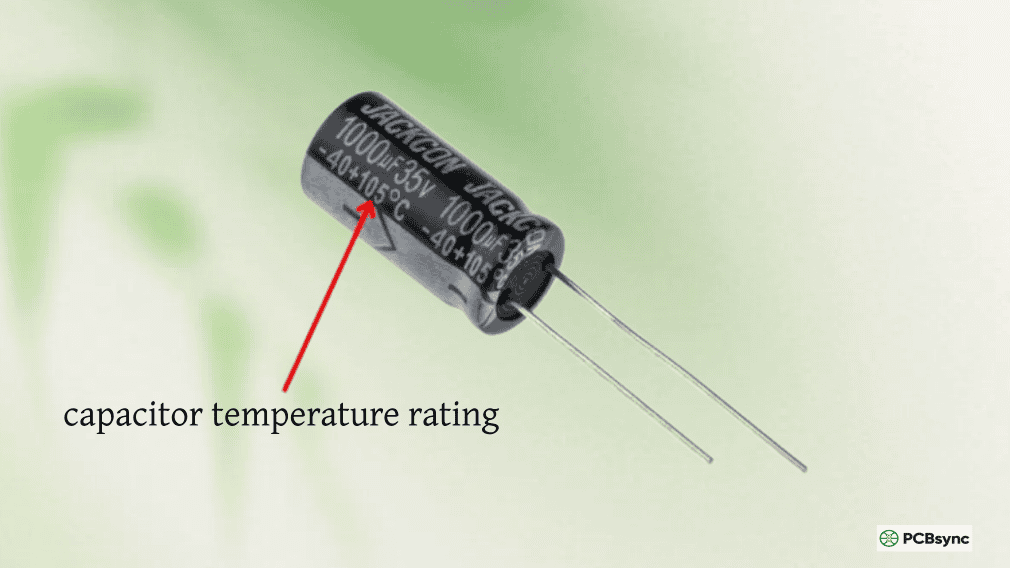
The capacitor temperature rating is the specification that determines whether a component you selected at room temperature still performs — or even survives — across the full thermal range of its deployment environment. It affects not just whether the capacitor mechanically survives extreme temperatures, but whether its capacitance value remains within specification, whether its leakage current stays acceptable, whether its ESR stays low enough to avoid thermal runaway, and whether its service life meets the system design target.
Engineers who treat temperature ratings as a checkbox — “the component is rated to 85°C and my environment is 70°C so I’m fine” — regularly discover the nuance they missed when boards fail in the field at conditions that were technically within the rated range. This guide covers what capacitor temperature ratings mean for each dielectric technology, the specific failure modes that temperature drives, the code systems used on ceramic capacitors, and the derating practices that translate a rated range into a reliable design margin.
What Capacitor Temperature Ratings Actually Define
The Three Temperature Parameters Every Datasheet Specifies
A complete capacitor temperature rating encompasses three distinct thermal parameters that together define the usable operating envelope:
Minimum Operating Temperature (T_min): The lowest temperature at which the capacitor meets its specified electrical parameters. Below this temperature, capacitance may decrease, ESR may increase dramatically, and in some cases (particularly certain electrolytic types) the electrolyte may become viscous enough to effectively disable the component.
Maximum Operating Temperature (T_max): The highest temperature at which continuous operation is permitted while meeting electrical specifications and achieving rated service life. This is the temperature that most engineers focus on and the one most commonly compromised in thermally challenging deployments.
Temperature Coefficient (TC): The rate of change of capacitance per degree Celsius across the operating range, expressed in ppm/°C or as a percentage change over the rated range. This parameter directly determines frequency stability in timing and RF circuits and filter accuracy in precision signal processing.
These three parameters interact with the application environment to define actual reliability margins. A capacitor rated to 85°C maximum operating temperature with a 5000-hour life rating, deployed in an environment where its body temperature reaches 80°C, has a significantly smaller thermal margin than it might appear — particularly once self-heating from ripple current is added to the ambient temperature.
Core Temperature vs. Ambient Temperature: A Critical Distinction
The temperature that matters for capacitor reliability is the temperature of the capacitor’s internal active elements — the dielectric and, for electrolytics, the electrolyte — not the ambient temperature of the surrounding air. The difference between ambient and core temperature is driven by:
Ripple current self-heating: Power dissipated by ripple current flowing through ESR heats the capacitor internally. For an electrolytic with 100mΩ ESR carrying 1A RMS ripple current, internal dissipation is P = I² × ESR = 100mW — enough to raise internal temperature several degrees above ambient.
Conduction from adjacent components: Power MOSFETs, transformer cores, and bridge rectifiers on the same PCB radiate heat that raises the ambient temperature seen by nearby capacitors. A bulk electrolytic mounted 5mm from a hot transformer can run 20–30°C above the board-level ambient.
Enclosure effects: Capacitors inside sealed enclosures experience higher temperatures than the external ambient because convective cooling is limited. A component at 25°C external ambient may sit in a 65°C internal enclosure temperature in a poorly ventilated design.
The practical rule: always calculate the worst-case capacitor core temperature by adding ripple current self-heating and thermal proximity effects to the maximum ambient, then evaluate that number against the rated maximum temperature with appropriate margin.
Ceramic Capacitor Temperature Rating Codes: EIA and IEC Systems
EIA Temperature Code System for Class I Ceramics
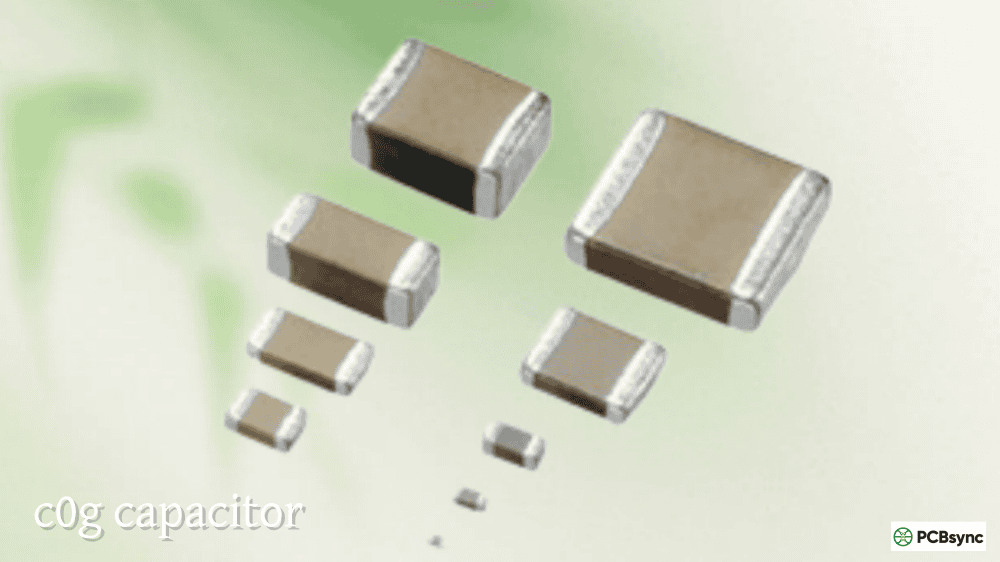
Class I ceramics (COG/NP0 being the most important) use a three-character EIA code that specifies minimum temperature, maximum temperature, and temperature coefficient tolerance. Understanding this code is essential for precision circuit work.
Code Position
Character
Meaning
1st (Low temp)
C
–55°C
1st (Low temp)
Z
+10°C
2nd (High temp)
G
+30°C
2nd (High temp)
H
+85°C
2nd (High temp)
R
+125°C
3rd (TC tolerance)
G
±30 ppm/°C
3rd (TC tolerance)
H
±60 ppm/°C
3rd (TC tolerance)
P
±150 ppm/°C
The ubiquitous “COG” designation (also written C0G) thus specifies: C = –55°C low end, 0 = a TC slope code (0 ppm/°C nominal slope), G = ±30 ppm/°C tolerance. This is the tightest standard temperature coefficient available in mass-production ceramics and the mandatory choice for timing, precision filter, and RF circuit capacitors.
EIA Temperature Code System for Class II Ceramics
Class II ceramics (X7R, X5R, X7S, Y5V, etc.) use a different three-character system: the first character is a letter specifying minimum temperature, the second is a number specifying maximum temperature, and the third is a letter specifying the maximum capacitance change over the rated range.
First Character
Min Temperature
Second Character
Max Temperature
Third Character
Max ΔC
X
–55°C
4
+65°C
P
±10%
Y
–30°C
5
+85°C
R
±15%
Z
+10°C
6
+105°C
S
±22%
7
+125°C
T
+22%/–33%
8
+150°C
U
+22%/–56%
9
+200°C
V
+22%/–82%
From this table: X7R means –55°C minimum temperature, +125°C maximum temperature, ±15% maximum capacitance change over the full range. X5R means –55°C to +85°C with ±15% change. Y5V means –30°C to +85°C with an extraordinarily loose +22%/–82% change — capacitance can drop to 18% of its nominal value at temperature extremes, making Y5V entirely unsuitable for any circuit where capacitance accuracy matters.
The ±15% capacitance change specification for X7R deserves context in filter and timing applications: a 100nF X7R used as a timing capacitor can present anywhere from 85nF to 115nF over its temperature range, producing a corresponding ±15% variation in timing interval or filter corner frequency. COG’s ±30 ppm/°C over the same range produces less than ±0.5% change from –55°C to +125°C — two orders of magnitude better.
Temperature Rating by Capacitor Dielectric Technology
Aluminum Electrolytic Capacitor Temperature Ratings
Aluminum electrolytic capacitors are the technology most acutely limited by their temperature rating. The rated maximum temperature — typically 85°C for standard grade, 105°C for high-temperature grade, and 125°C for specialized automotive and industrial types — directly determines the service life, because electrolyte evaporation rate is exponentially dependent on temperature. The Arrhenius relationship approximately doubles the degradation rate for every 10°C of temperature increase.
Grade
Rated T_max
Typical Rated Life
Life at T_max –10°C
Applications
Standard 85°C
+85°C
1,000–2,000 hrs
~2,000–4,000 hrs
Non-critical consumer
High-temp 105°C
+105°C
3,000–10,000 hrs
~6,000–20,000 hrs
Industrial, switching PSUs
Long-life 105°C
+105°C
5,000–15,000 hrs
~10,000–30,000 hrs
Long-life industrial
Automotive 125°C
+125°C
1,000–3,000 hrs
~2,000–6,000 hrs
Under-hood automotive
For most switching power supply and industrial control applications, the 105°C grade is the minimum acceptable specification — not a premium option. Using 85°C-rated electrolytics in a switching power supply where the cap body temperature reaches 75°C under load leaves a 10°C margin that is consumed entirely by ripple current self-heating in a moderately loaded design, effectively operating the capacitor at or above its rated temperature and reducing service life to the base rated hours.
Film Capacitor Temperature Ratings
Metallized film capacitors offer generally wider and more stable temperature operating ranges than electrolytics, though the specific range depends on the dielectric polymer:
Polypropylene’s –200 ppm/°C temperature coefficient is worth understanding practically. A 100nF PP capacitor in a timing circuit at –40°C versus +85°C experiences a 125°C range — producing a capacitance shift of 125 × 200 ppm = 25,000 ppm = 2.5%. For most timing applications this is acceptable and predictable. More importantly, polypropylene’s capacitance changes linearly and stably with temperature, making it possible to design temperature compensation if needed — unlike X7R ceramics whose temperature characteristic is nonlinear and hysteretic.
Tantalum Capacitor Temperature Ratings
Solid tantalum capacitors are rated to either +85°C or +125°C depending on the series, with a T_min of –55°C. Tantalum dielectric is notably stable with temperature — capacitance changes less than ±15% over the full –55°C to +125°C range in most series, making tantalum more stable than X7R ceramics over temperature for bulk bypass applications. However, the 50% voltage derating rule for MnO₂ tantalum becomes even more critical at elevated temperatures, where the dielectric’s vulnerability to voltage-stress-induced leakage current increases.
Temperature Ratings in High-Reliability and Automotive Applications
AEC-Q200 and Automotive Grade Capacitor Temperature Requirements
Automotive applications present the most demanding capacitor temperature rating requirements in mainstream electronics design. Under-hood environments regularly see temperatures from –40°C cold soak to +125°C or higher near engine and exhaust components. Interior passenger compartment electronics face –40°C to +85°C. Battery management systems in EVs have their own thermal profiles depending on cooling architecture.
AEC-Q200 qualification defines stress tests and acceptance criteria for passive components intended for automotive use. Capacitors targeting automotive qualification must demonstrate parametric stability across the full rated temperature range after thermal shock cycling, humidity exposure, and extended high-temperature storage — not just at room temperature.
Automotive Environment
T_min
T_max
Required Cap Grade
Under-hood (near engine)
–40°C
+125°C
AEC-Q200 Grade 1
Under-hood (near exhaust)
–40°C
+150°C
AEC-Q200 Grade 0
Passenger compartment
–40°C
+85°C
AEC-Q200 Grade 2
Battery management (EV)
–40°C
+105°C
AEC-Q200 Grade 1
Wheel / brake zone
–40°C
+150°C
AEC-Q200 Grade 0
Selecting non-automotive-qualified capacitors for automotive designs to reduce BOM cost is a false economy. AEC-Q200 qualification represents traceability to test data demonstrating the component performs within specification under the combined temperature, humidity, vibration, and voltage stress conditions of the automotive environment — data that simply doesn’t exist for commercial-grade components.
Industrial Temperature Requirements: IEC 60068 Test Series
For industrial electronics, the IEC 60068 test standard series defines environmental test methods for temperature stress, thermal shock, and damp heat cycling. Capacitors used in industrial automation, motor drives, power conversion, and outdoor equipment are typically characterized against IEC 60068-2-1 (cold), IEC 60068-2-2 (dry heat), and IEC 60068-2-14 (thermal shock) test methods. Specifying capacitors that have been qualified to these test conditions provides assurance that parametric performance is verified under realistic deployment stress rather than inferred from room-temperature datasheets.
PCB Layout and Thermal Management for Capacitor Temperature Compliance
Layout decisions have a direct and often underestimated impact on the temperature that capacitors actually operate at in a finished product. These principles apply consistently across technologies:
Maintain thermal separation from high-dissipation components. Switching MOSFETs, transformer cores, power inductors, and bridge rectifiers are heat sources that elevate the local ambient temperature seen by adjacent capacitors. Keep bulk electrolytics at least 5–10mm from high-dissipation components on the PCB, and route copper pours to avoid conducting heat toward capacitor mounting areas.
Electrolytic vent orientation matters. Aluminum electrolytic capacitors vent pressure through the score mark on the top of the can. Mounting them with the vent facing a hot component, a heat sink, or a board surface reduces thermal dissipation from the vent end and increases core temperature. Wherever possible, orient electrolytic capacitors with their vent in free air.
Thermal via use under ceramic capacitors on hot nodes. For high-value MLCCs on power nodes where the PCB copper carries significant current and thus runs warm, thermal vias to internal copper layers can either help (dissipating heat away from the component) or hurt (conducting heat up from a hot inner layer to the component). Simulate the thermal path before assuming vias are beneficial.
Use the manufacturer’s thermal impedance data for electrolytic life calculation. Reputable electrolytic capacitor manufacturers publish thermal resistance data (θ_ca — degrees C per watt from core to ambient) that allows calculation of core temperature from ripple current, ESR, and ambient. Panasonic, Nichicon, and Rubycon publish this data; use it for any design where service life is a specification rather than an aspiration.
For detailed parametric data on capacitor temperature ratings, EIA code systems, and dielectric-specific temperature performance across all major capacitor families, the Capacitor reference at PCBSync provides comprehensive coverage to support accurate component selection.
Useful Resources for Capacitor Temperature Rating and Thermal Design
Resource
Description
Link
Murata Temperature Characteristic Guide
Detailed X7R, X5R, COG temperature coefficient data and curves
Frequently Asked Questions About Capacitor Temperature Ratings
Q1: What does X7R mean on a ceramic capacitor?
X7R is an EIA temperature characteristic code for Class II ceramic capacitors. Breaking it down: X specifies a minimum operating temperature of –55°C, 7 specifies a maximum operating temperature of +125°C, and R specifies that the capacitance change over this full range will not exceed ±15% of the nominal value at room temperature. It is one of the most widely used ceramic dielectric codes, offering a practical balance of temperature range, capacitance density, and reasonable (though not precision) temperature stability. X7R is appropriate for general bypass, decoupling, and filtering applications but is unsuitable for timing circuits, precision filters, or RF applications where capacitance accuracy and stability are required.
Q2: What is the difference between 85°C and 105°C rated electrolytic capacitors?
The difference is not merely 20 degrees of temperature headroom — it represents a fundamental difference in electrolyte formulation, electrode treatment, and manufacturing quality that results in dramatically different service life under identical operating conditions. A 105°C-rated low-impedance electrolytic in a switching power supply application at 70°C ambient will typically survive 15,000–30,000 hours depending on ripple current loading. An 85°C-rated standard-grade electrolytic under the same conditions may deliver only 3,000–6,000 hours. For any industrial, commercial, or long-life consumer design — which is to say, most serious engineering projects — 105°C-rated capacitors are the appropriate baseline specification, not a premium addition.
Q3: Can I use a capacitor rated to 85°C in an application that reaches 85°C?
Technically yes, but the component will be operating at its thermal limit, achieving rated life only if it never exceeds 85°C core temperature — which requires that ambient temperature plus ripple current self-heating plus thermal radiation from adjacent components sum to exactly 85°C or less. In practice, there is always thermal uncertainty, manufacturing variation in ripple current, and seasonal variation in ambient conditions that push real-world temperatures above the calculated worst case. Using a 105°C-rated capacitor in an 85°C environment provides genuine thermal margin that translates directly into extended service life and improved production reliability. The cost difference between 85°C and 105°C-rated electrolytics in most value ranges is minimal.
Q4: Why does capacitance change with temperature in ceramic capacitors?
In Class I ceramics (COG/NP0), capacitance changes with temperature because the dielectric constant of the ceramic material has a small but predictable temperature dependence — the linear temperature coefficient of approximately 0 ±30 ppm/°C for COG. This is a stable, predictable, nearly linear relationship. In Class II ceramics (X7R, X5R), the dielectric material is ferroelectric — it exhibits spontaneous electric polarization that is strongly temperature-dependent. As temperature changes, the ferroelectric domain structure reorganizes, significantly altering the dielectric constant and thus the capacitance. This produces the larger, nonlinear, hysteretic capacitance-temperature characteristic (±15% for X7R) that makes Class II ceramics unsuitable for precision timing or frequency-determining circuit positions.
Q5: How do I calculate the actual service life of an electrolytic capacitor at my operating temperature?
The industry-standard approach uses the Arrhenius equation adapted for electrolytic capacitor life:
L = L_rated × 2^((T_rated – T_operating) / 10)
Where L_rated is the manufacturer’s rated life at rated temperature T_rated, and T_operating is the actual core temperature (ambient plus self-heating). For a capacitor rated at 5,000 hours at 105°C, operating at 75°C core temperature: L = 5,000 × 2^((105–75)/10) = 5,000 × 2³ = 40,000 hours. Operating at 95°C: L = 5,000 × 2^((105–95)/10) = 5,000 × 2¹ = 10,000 hours. The factor-of-2-per-10°C rule is an approximation — more accurate calculations use the manufacturer’s specific activation energy constant, which Nichicon, Panasonic, and Rubycon publish with their long-life series datasheets.
Capacitor Temperature Rating Is a Design Variable, Not a Datasheet Footnote
The capacitor temperature rating determines not just whether a component survives in its application but how long it survives, how stable its parameters remain over the deployed temperature range, and whether its capacitance, ESR, and leakage values stay within the bounds your circuit requires throughout the product’s service life.
Choosing 105°C-rated electrolytics as the default rather than 85°C, specifying COG ceramics where temperature coefficient matters, understanding that X7R ±15% over temperature is a real performance variation that affects filter accuracy and timing precision, applying the Arrhenius life calculation for any design with a defined service life target — these are design practices that cost very little at specification time and return significant value in field reliability, warranty performance, and product reputation.
Inquire: Call 0086-755-23203480, or reach out via the form below/your sales contact to discuss our design, manufacturing, and assembly capabilities.
Quote: Email your PCB files to Sales@pcbsync.com (Preferred for large files) or submit online. We will contact you promptly. Please ensure your email is correct.
Notes: For PCB fabrication, we require PCB design file in Gerber RS-274X format (most preferred), *.PCB/DDB (Protel, inform your program version) format or *.BRD (Eagle) format. For PCB assembly, we require PCB design file in above mentioned format, drilling file and BOM. Click to download BOM template To avoid file missing, please include all files into one folder and compress it into .zip or .rar format.