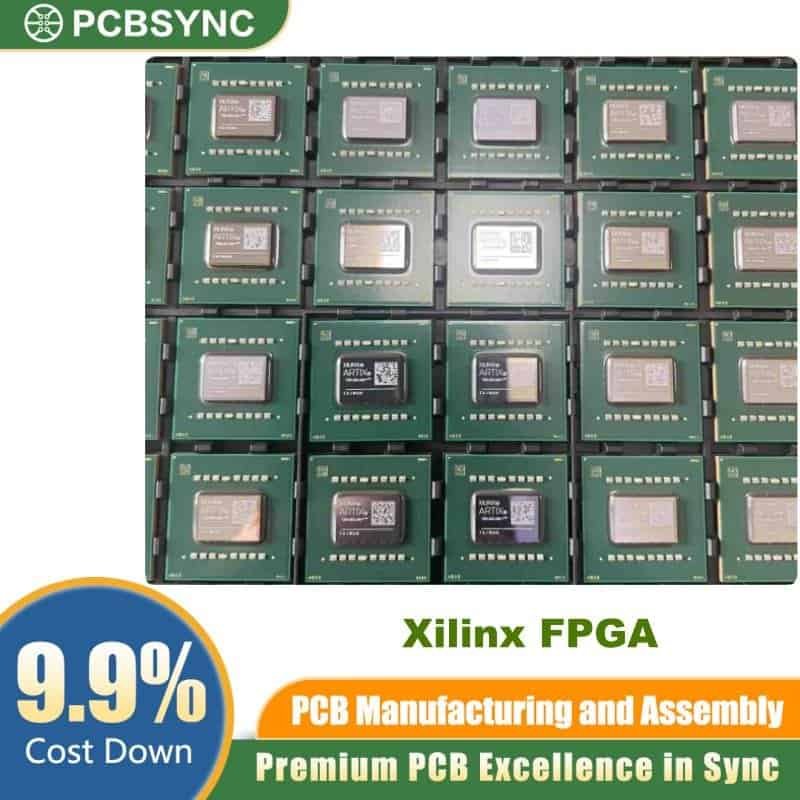
The XC3S2000-4FGG676I is a high-capacity, industrial-grade Field Programmable Gate Array (FPGA) from Xilinx (now AMD), belonging to the proven Spartan-3 family. Designed for cost-sensitive, high-volume applications that demand robust logic density and reliable operation across extended temperature ranges, this device is a trusted choice for embedded systems, communications, and industrial control design engineers worldwide.
What Is the XC3S2000-4FGG676I?
The XC3S2000-4FGG676I is part of Xilinx’s Spartan-3 series of Xilinx FPGA devices — a generation engineered specifically to deliver maximum logic density at the lowest possible cost per logic cell. The “2000” in the part number refers to 2,000,000 system gates, making it one of the larger devices in the Spartan-3 family. The “4” indicates a speed grade of -4 (the slowest/most affordable speed grade), the “FGG676” refers to the Fine-pitch Ball Grid Array (FBGA) 676-ball package, and the “I” suffix designates industrial temperature range operation (-40°C to +100°C).
XC3S2000-4FGG676I Key Specifications
The table below summarizes the most critical electrical, physical, and functional specifications for the XC3S2000-4FGG676I.
| Parameter |
Specification |
| Manufacturer |
AMD (Xilinx) |
| Part Number |
XC3S2000-4FGG676I |
| FPGA Family |
Spartan-3 |
| System Gates |
2,000,000 |
| Logic Cells |
46,080 |
| CLB Slices |
20,480 |
| Distributed RAM (bits) |
720,000 |
| Block RAM (bits) |
720,000 |
| Multiplier Blocks (18×18) |
40 |
| Digital Clock Managers (DCMs) |
8 |
| Maximum User I/O Pins |
489 |
| Package |
FBGA-676 (FGG676) |
| Package Dimensions |
27mm × 27mm |
| Ball Pitch |
1.00 mm |
| Speed Grade |
-4 |
| Core Voltage (VCCINT) |
1.2V |
| I/O Voltage (VCCO) |
1.2V – 3.3V |
| Operating Temperature |
–40°C to +100°C (Industrial) |
| Process Technology |
90 nm |
XC3S2000-4FGG676I Package and Pinout Overview
FGG676 Ball Grid Array Package
The FGG676 package is a Fine-pitch Ball Grid Array with 676 total solder balls arranged in a 26×26 matrix, with a 1.00 mm pitch. This compact footprint provides a large number of user I/O pins (up to 489) while keeping board area requirements manageable.
| Package Attribute |
Detail |
| Package Type |
FBGA (Fine Ball Grid Array) |
| Total Balls |
676 |
| Ball Matrix |
26 × 26 |
| Ball Pitch |
1.00 mm |
| Body Size |
27 mm × 27 mm |
| Height (max) |
2.32 mm |
| RoHS Compliant |
Yes |
| Lead Finish |
Pb-Free (SnAgCu) |
Spartan-3 Architecture: Internal Block Overview
Configurable Logic Blocks (CLBs)
The XC3S2000 contains 20,480 slices organized into 5,120 CLBs. Each CLB contains 4 slices, and each slice contains two 4-input Look-Up Tables (LUTs), two flip-flops, dedicated carry logic, and wide function multiplexers. This architecture provides exceptional flexibility for implementing arithmetic, control, and datapath logic.
| Logic Resource |
XC3S2000 |
| CLBs |
5,120 |
| Slices per CLB |
4 |
| Total Slices |
20,480 |
| LUTs (4-input) |
40,960 |
| Flip-Flops |
40,960 |
| Maximum Distributed RAM |
720 Kbits |
Block RAM (BRAM)
The device features 20 dedicated block RAM tiles, each providing 18 Kbits of true dual-port synchronous SRAM — totaling 360 Kbits (or 720 Kbits when counting both read and write ports). BRAMs are ideal for FIFOs, lookup tables, and frame buffers.
| BRAM Feature |
Detail |
| Number of BRAM Tiles |
20 |
| Capacity per Tile |
18 Kbits |
| Total BRAM Capacity |
360 Kbits |
| Port Configuration |
True Dual-Port |
| Aspect Ratios |
16K×1, 8K×2, 4K×4, 2K×9, 1K×18 |
Dedicated Multiplier Blocks
Forty 18×18-bit hardware multiplier blocks are embedded in the device, enabling high-throughput DSP and signal processing operations without consuming CLB resources.
Digital Clock Managers (DCMs)
Eight on-chip DCMs provide flexible clock management capabilities including frequency synthesis, phase shifting, and deskew. This makes the XC3S2000 well suited for multi-clock-domain designs and clock domain crossing applications.
I/O Features and Supported Standards
I/O Bank Architecture
The XC3S2000-4FGG676I provides 489 user-configurable I/O pins organized into multiple independently powered I/O banks. Each bank can be powered at a different VCCO voltage, enabling the device to interface directly with 1.2V, 1.5V, 1.8V, 2.5V, and 3.3V logic families without external level shifters.
Supported I/O Standards
| I/O Standard |
Voltage |
Application |
| LVCMOS33 |
3.3V |
General-purpose logic |
| LVCMOS25 |
2.5V |
Low-voltage interfaces |
| LVCMOS18 |
1.8V |
Modern SoC interfacing |
| LVCMOS15 |
1.5V |
DDR memory logic |
| LVCMOS12 |
1.2V |
Ultra-low-voltage logic |
| LVTTL |
3.3V |
Legacy TTL-compatible |
| LVDS |
Differential |
High-speed serial |
| RSDS |
Differential |
Display/video |
| HSTL |
1.5V / 1.8V |
Memory bus interfaces |
| SSTL |
2.5V / 3.3V |
SDRAM / DDR interfaces |
| PCI |
3.3V |
PCI bus compliance |
Power Requirements
Voltage Rails
The XC3S2000-4FGG676I requires two primary supply voltages:
| Supply Rail |
Voltage |
Purpose |
| VCCINT |
1.2V |
Core logic power |
| VCCO |
1.2V – 3.3V |
I/O bank power (per bank) |
| VCCAUX |
2.5V |
Auxiliary circuits (DCMs, DCI) |
Careful power sequencing is recommended: VCCAUX and VCCINT should be applied before or simultaneously with VCCO rails.
Configuration Modes
The XC3S2000-4FGG676I supports multiple configuration modes to suit different system architectures:
| Mode |
Description |
| Master Serial |
From serial PROM (e.g., Xilinx SPI Flash) |
| Slave Serial |
Controlled by external host processor |
| Master SelectMAP |
Parallel byte-wide from PROM |
| Slave SelectMAP |
Parallel byte-wide from host CPU |
| JTAG |
Boundary scan, debug, and in-system programming |
| Master SPI |
Direct from SPI Flash memory |
Industrial Temperature Grade: The “I” Suffix Explained
The “I” suffix in XC3S2000-4FGG676I designates industrial temperature grade, meaning the device is characterized and guaranteed to operate correctly over the full range of –40°C to +100°C (junction temperature). This contrasts with the commercial “C” suffix parts, which are rated only from 0°C to 85°C. Industrial-grade parts like this one are essential for:
- Outdoor or uncontrolled-environment deployments
- Automotive adjacent electronics (non-safety-critical)
- Industrial automation and control systems
- Telecom infrastructure and networking equipment
- Military and aerospace ground support systems
Typical Application Areas for XC3S2000-4FGG676I
The XC3S2000-4FGG676I is used across a broad range of industries and application domains:
| Industry |
Typical Applications |
| Industrial Automation |
PLC logic controllers, motor drives, sensor fusion |
| Communications |
Protocol bridges, line cards, multi-channel UARTs |
| Consumer Electronics |
Display controllers, image processing pipelines |
| Medical Devices |
Signal acquisition front-ends, waveform generators |
| Embedded Systems |
Soft-core processor (MicroBlaze) implementations |
| Test & Measurement |
Pattern generators, logic analyzers, ATE systems |
| Defense / Aerospace |
Ground support electronics, SIGINT preprocessing |
Ordering Information
| Field |
Value |
| Manufacturer Part Number |
XC3S2000-4FGG676I |
| Manufacturer |
AMD (Xilinx) |
| DigiKey Part Number |
122-1505-ND |
| Packaging |
Tray |
| RoHS Status |
RoHS Compliant |
| Export Control |
EAR99 (check current ECCN before export) |
| Moisture Sensitivity Level |
MSL 3 (168 hours floor life) |
Comparable Devices and Alternatives
If the XC3S2000-4FGG676I is unavailable or a different configuration is required, consider these closely related alternatives:
| Part Number |
Gates |
Package |
Speed Grade |
Temp Grade |
Key Difference |
| XC3S2000-4FGG676C |
2M |
FBGA-676 |
-4 |
Commercial |
0°C to +85°C |
| XC3S2000-5FGG676I |
2M |
FBGA-676 |
-5 (faster) |
Industrial |
Higher speed grade |
| XC3S1500-4FGG320I |
1.5M |
FBGA-320 |
-4 |
Industrial |
Fewer gates, smaller package |
| XC3S4000-4FGG900I |
4M |
FBGA-900 |
-4 |
Industrial |
Higher gate count |
| XC3S2000-4FT256I |
2M |
FTBGA-256 |
-4 |
Industrial |
Fewer I/Os, smaller package |
Design Resources and Support
Xilinx (AMD) provides extensive documentation and design tools for the Spartan-3 family:
- ISE Design Suite – Legacy design flow (Schematic, VHDL, Verilog, System Generator)
- XAPP Application Notes – Reference designs for common interfaces (DDR, PCI, Ethernet)
- UG331 – Spartan-3 Family User Guide – Complete architectural reference
- DS099 – Spartan-3 Data Sheet – Electrical characteristics and timing
- BSDL Files – For JTAG boundary scan testing
- IBIS Models – For signal integrity simulation
Frequently Asked Questions (FAQ)
What does the “-4” speed grade mean on the XC3S2000-4FGG676I?
The “-4” speed grade indicates the device’s relative timing performance. In the Spartan-3 family, “-4” is the slowest available speed grade (followed by -5). A slower speed grade is typically less expensive, consumes slightly less dynamic power, and is suitable for designs that do not require maximum clock frequencies. Most Spartan-3 applications run well within the timing budgets of the -4 grade.
Is the XC3S2000-4FGG676I pin-compatible with other Spartan-3 devices?
Yes, within the same package footprint (FGG676), the XC3S2000 is pin-compatible with other Spartan-3 devices in the FGG676 package, including the XC3S1500 and XC3S4000, enabling density migration without PCB redesign.
What configuration memory is recommended for this FPGA?
Xilinx recommends using the XCF family of Platform Flash PROMs or standard SPI Flash memories (e.g., 32 Mbit) for configuration. The XC3S2000 configuration bitstream is approximately 15 Mbits.
What soft-core processors can run on this device?
The XC3S2000-4FGG676I has sufficient logic resources to implement Xilinx MicroBlaze soft processors, as well as third-party cores like PicoBlaze. Multiple MicroBlaze instances can be instantiated for multi-processor embedded designs.
Summary
The XC3S2000-4FGG676I delivers a compelling combination of logic density (2 million system gates, 20,480 slices), rich memory resources (720 Kbits BRAM + 720 Kbits distributed RAM), dedicated DSP multipliers, and flexible clock management — all in an industrial-temperature-rated FBGA-676 package. Its broad I/O standard support, multiple configuration modes, and compatibility with Xilinx’s mature ISE toolchain make it a dependable choice for embedded control, communications, and signal processing applications that demand field-proven reliability at a cost-effective price point.