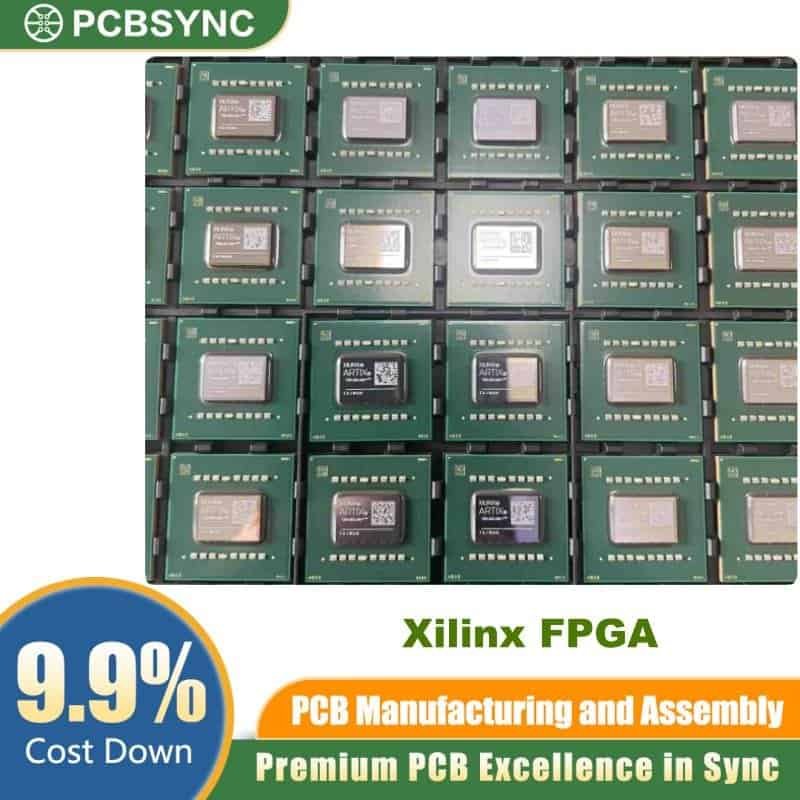
The XC2S200-6FGG1114C is a high-density, cost-effective Field Programmable Gate Array (FPGA) from Xilinx’s Spartan-II family. Designed for commercial-temperature applications, this device combines 200,000 system gates, 5,292 logic cells, and a massive 1,114-pin Fine-Pitch Ball Grid Array (FBGA) package — making it one of the most capable and I/O-rich configurations in the entire Spartan-II lineup. Whether you are designing embedded systems, telecommunications infrastructure, industrial controllers, or signal processing platforms, the XC2S200-6FGG1114C delivers the performance and flexibility engineers demand.
For engineers sourcing Xilinx programmable logic solutions, you can explore the full range of options at Xilinx FPGA.
What Is the XC2S200-6FGG1114C? Understanding the Part Number
Before diving into specifications, it helps to decode the part number:
| Field |
Value |
Meaning |
| XC2S |
XC2S |
Xilinx Spartan-II Series |
| 200 |
200 |
200,000 System Gates |
| -6 |
-6 |
Speed Grade (Commercial) |
| FGG |
FGG |
Fine-Pitch Ball Grid Array Package |
| 1114 |
1114 |
Number of Package Pins |
| C |
C |
Commercial Temperature Range (0°C to +85°C) |
This naming convention immediately tells experienced engineers that this part occupies the top of the Spartan-II gate density range, is qualified for commercial temperature environments, and ships in a large 1,114-ball BGA format that maximizes available I/O bandwidth.
XC2S200-6FGG1114C Key Specifications at a Glance
Core Device Specifications
| Parameter |
Value |
| Family |
Xilinx Spartan-II |
| Part Number |
XC2S200-6FGG1114C |
| System Gates |
200,000 |
| Logic Cells |
5,292 |
| CLB Array |
28 × 42 (1,176 CLBs) |
| Max System Frequency |
263 MHz |
| Core Supply Voltage |
2.5V |
| Technology Node |
0.18 µm |
| Package |
1,114-Pin FBGA (FGG1114) |
| Temperature Range |
Commercial (0°C to +85°C) |
| Speed Grade |
-6 |
Memory Resources
| Memory Type |
Capacity |
| Block RAM (Total) |
57,344 bits |
| Distributed RAM (SelectRAM™) |
75,264 bits |
| Block RAM Blocks |
14 |
| RAM per LUT |
16 bits |
Configuration File Size
| Device |
Configuration Bits |
| XC2S15 |
197,696 |
| XC2S50 |
559,200 |
| XC2S100 |
781,216 |
| XC2S200 |
1,335,840 |
XC2S200-6FGG1114C Architecture Overview
Configurable Logic Blocks (CLBs)
The XC2S200-6FGG1114C uses a regular and flexible array of Configurable Logic Blocks (CLBs) arranged in a 28-column by 42-row matrix, totaling 1,176 CLBs. Each CLB contains two slices, and each slice includes two 4-input Look-Up Tables (LUTs), two D-type flip-flops or level-sensitive latches, and dedicated carry logic. This architecture supports complex combinational and registered logic without consuming excess routing resources.
Input/Output Blocks (IOBs) and I/O Standards
The XC2S200-6FGG1114C, housed in the 1,114-pin FGG package, offers the maximum number of user I/O pins available in the Spartan-II family. Each IOB contains three registers — one input, one output, and one tri-state — all sharing a common clock. The device supports 16 selectable I/O standards, including:
| I/O Standard |
Description |
| LVTTL |
Low-Voltage TTL (3.3V) |
| LVCMOS2 |
Low-Voltage CMOS (2.5V) |
| PCI |
PCI Bus Interface |
| GTL / GTL+ |
Gunning Transceiver Logic |
| SSTL2 / SSTL3 |
Stub Series Terminated Logic |
| CTT |
Center-Tap Terminated |
| AGP |
Accelerated Graphics Port |
| HSTL Class I / II |
High-Speed Transceiver Logic |
This wide I/O standard support makes the XC2S200-6FGG1114C exceptionally flexible for multi-voltage, multi-protocol board designs.
Block RAM Architecture
The device includes 14 block RAM tiles, each containing a fully synchronous, dual-ported 4,096-bit SRAM. Each port can be independently configured for different data widths, and independent control signals (clock enable, write enable, address) are available per port. This dual-port capability enables efficient data transfer between concurrent processing engines running inside the FPGA fabric.
Delay-Locked Loops (DLLs)
Four Delay-Locked Loops (DLLs), one at each corner of the die, provide advanced clock management. Each DLL can eliminate clock insertion delay, multiply or divide input clock frequencies, and perform phase shifting. When chained, two DLLs can generate a wide variety of derived clock frequencies from a single reference input — a critical capability for complex multi-clock designs.
XC2S200-6FGG1114C Configuration Modes
The XC2S200-6FGG1114C supports multiple configuration modes, giving designers flexibility in how they program the device during system startup.
| Configuration Mode |
CCLK Direction |
Data Width |
Serial DOUT |
| Master Serial |
Output |
1-bit |
Yes |
| Slave Serial |
Input |
1-bit |
Yes |
| Slave Parallel |
Input |
8-bit |
No |
| Boundary-Scan (JTAG) |
N/A |
1-bit |
No |
During configuration, all I/O pins remain in a high-impedance state until the device is fully programmed. The JTAG boundary-scan mode also allows in-system testing and debugging per IEEE 1149.1 standards.
XC2S200-6FGG1114C vs. Other Spartan-II Variants
Comparison of FGG1114C Versus Other XC2S200 Packages
| Part Number |
Package |
Pins |
User I/Os |
Temperature |
| XC2S200-6FG256C |
FBGA |
256 |
176 |
Commercial |
| XC2S200-6FGG456C |
FBGA |
456 |
284 |
Commercial |
| XC2S200-6FGG1114C |
FBGA |
1,114 |
Maximum |
Commercial |
| XC2S200-5FG456I |
FBGA |
456 |
284 |
Industrial |
The 1,114-pin variant is selected when designs require maximum I/O count — for example, parallel bus interfaces, high-channel-count data acquisition systems, or applications requiring simultaneous multi-port connectivity.
Spartan-II Family Device Comparison
| Device |
System Gates |
Logic Cells |
CLB Array |
Block RAM (bits) |
| XC2S15 |
15,000 |
432 |
8 × 12 |
16,384 |
| XC2S50 |
50,000 |
1,728 |
16 × 24 |
32,768 |
| XC2S100 |
100,000 |
2,700 |
20 × 30 |
40,960 |
| XC2S150 |
150,000 |
3,888 |
24 × 36 |
49,152 |
| XC2S200 |
200,000 |
5,292 |
28 × 42 |
57,344 |
Top Applications for the XC2S200-6FGG1114C FPGA
Telecommunications and Baseband Processing
The XC2S200-6FGG1114C’s 263 MHz maximum clock frequency and extensive logic resources make it well-suited for baseband signal processing in wireless infrastructure. It can implement digital filters, FFT engines, and FEC coders efficiently within its CLB array and block RAM.
Industrial Automation and Control
With 2.5V core operation and support for a wide array of I/O standards, the device integrates cleanly with both legacy and modern industrial interfaces. Its programmability allows the same hardware platform to be updated in the field without board replacement — a significant operational advantage.
High-Speed Data Acquisition
The large I/O count of the FGG1114 package enables direct connection to multi-channel ADC/DAC arrays. Combined with the dual-ported block RAM, the device can buffer, process, and stream sampled data in real time with low latency.
Embedded Vision and Image Processing
The 57,344 bits of block RAM and 75,264 bits of distributed RAM provide sufficient on-chip storage for line buffers and small frame caches in embedded imaging pipelines. The DLLs allow precise pixel clock generation and phase alignment.
Prototyping and ASIC Replacement
The Spartan-II series was specifically positioned as an ASIC replacement platform. The XC2S200-6FGG1114C provides the gate density, reprogrammability, and 0.18 µm process efficiency needed to replace custom mask-programmed ASICs in cost-sensitive, high-volume designs.
Development Tools for the XC2S200-6FGG1114C
The XC2S200-6FGG1114C is supported by Xilinx ISE Design Suite, the legacy toolchain for Spartan-II and other older Xilinx device families. Key tools include:
| Tool |
Function |
| ISE Project Navigator |
Project management and synthesis |
| XST (Xilinx Synthesis Technology) |
RTL synthesis |
| ModelSim / ISim |
Functional and timing simulation |
| IMPACT |
Device programming and boundary-scan |
| PlanAhead (Legacy) |
Floorplanning and constraint management |
Note that Vivado Design Suite does not support Spartan-II devices. Designers must use ISE for all design, simulation, and implementation tasks targeting the XC2S200-6FGG1114C.
Ordering Information and Compliance
Part Number Breakdown
| Segment |
Meaning |
| XC2S200 |
Spartan-II, 200K gates |
| -6 |
Commercial speed grade |
| FGG |
Fine-pitch BGA package type |
| 1114 |
Pin count |
| C |
Commercial temperature (0°C to +85°C) |
Key Compliance Notes
The XC2S200-6FGG1114C is available in a standard (non-Pb-free) packaging configuration. For RoHS-compliant designs, verify the availability of the “G” suffix Pb-free variant with your authorized distributor. Always consult the latest Xilinx/AMD Product Change Notices (PCNs) and Product Discontinuation Notices (PDNs) for current lifecycle status.
Frequently Asked Questions About the XC2S200-6FGG1114C
What is the maximum operating frequency of the XC2S200-6FGG1114C?
The device is rated at a maximum system frequency of 263 MHz, with internal routing architectures capable of supporting system-level clock rates up to approximately 200 MHz depending on design complexity and routing congestion.
Is the XC2S200-6FGG1114C still in production?
The Spartan-II family has reached end-of-life status. Designers should verify current availability through authorized AMD/Xilinx distributors or component brokers. For new designs, migration to a supported Xilinx/AMD device family is strongly recommended.
What software do I need to program the XC2S200-6FGG1114C?
You need Xilinx ISE Design Suite (version 14.x or earlier) to synthesize, implement, and generate bitstreams for Spartan-II devices. Vivado does not support this device family.
Can the XC2S200-6FGG1114C be used in industrial temperature applications?
The “C” suffix designates the commercial temperature range (0°C to +85°C). For industrial temperature operation (−40°C to +85°C), look for the “I” suffix variant such as XC2S200-5FGG1114I.
How is the XC2S200-6FGG1114C configured?
The device can be configured via Master Serial, Slave Serial, Slave Parallel, or JTAG boundary-scan modes. Configuration data is stored externally in a PROM or flash memory and loaded at power-on.
Summary: Why Choose the XC2S200-6FGG1114C?
The XC2S200-6FGG1114C remains a highly capable FPGA for designs requiring a proven, cost-efficient programmable logic solution. Its combination of 200,000 system gates, 5,292 logic cells, 57,344 bits of block RAM, four DLLs, multi-standard IOBs, and the expansive 1,114-pin FBGA package provides exceptional design headroom. From industrial control to signal processing and ASIC replacement, this device continues to serve embedded engineers who need reliable, reprogrammable logic at a competitive cost.