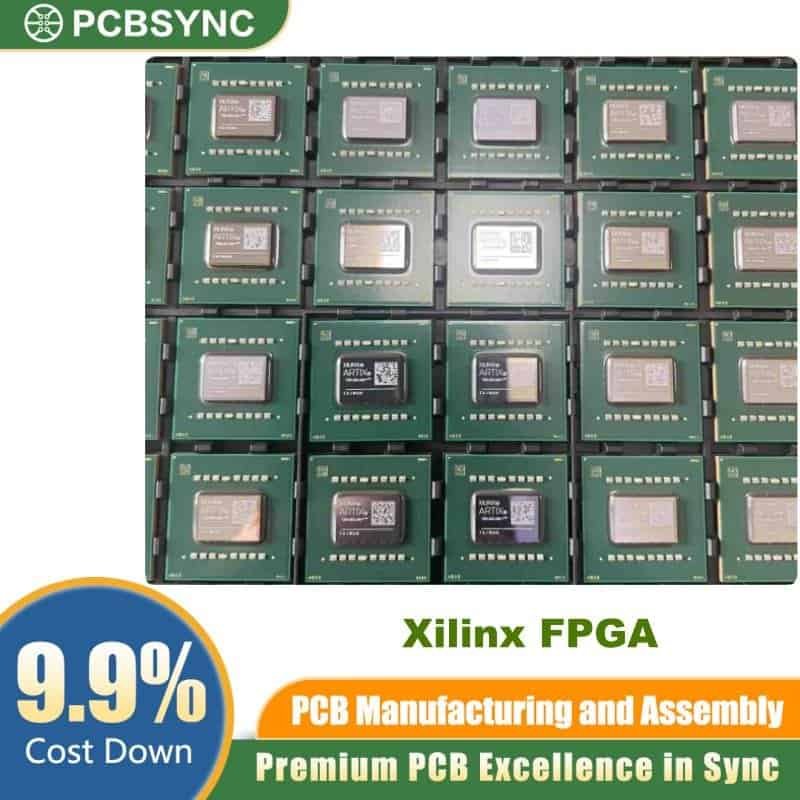
The XC3S200-4TQ144I is a high-performance Field-Programmable Gate Array (FPGA) from Xilinx (now AMD), belonging to the industry-proven Spartan-3 family. Designed for cost-sensitive, high-volume applications, the XC3S200-4TQ144I delivers 200,000 system gates, a 630 MHz clock frequency, and 90nm process technology — all housed in a compact 144-pin TQFP package. Whether you’re building embedded systems, industrial controllers, or consumer electronics, the XC3S200-4TQ144I offers the flexibility and performance to accelerate your design cycle.
Explore the complete range of Xilinx FPGA solutions to find the right device for your project needs.
What Is the XC3S200-4TQ144I?
The XC3S200-4TQ144I is a member of Xilinx’s Spartan-3 FPGA series — a family of programmable logic devices engineered to replace mask-programmed ASICs at a fraction of the cost and development time. Built on a 90nm process node and operating at a 1.2V core voltage, this device combines dense logic resources with flexible I/O configuration, making it an ideal choice for designers seeking a balance between cost-effectiveness and capability.
The “-4” speed grade indicates a reliable mid-range timing performance suitable for a wide range of digital logic and signal processing applications. The “I” suffix denotes the Industrial temperature range (–40°C to +100°C), making the XC3S200-4TQ144I well-suited for demanding environments.
XC3S200-4TQ144I Key Specifications
Core Logic Resources
| Parameter |
Value |
| System Gates |
200,000 |
| Logic Cells |
4,320 |
| Configurable Logic Blocks (CLBs) |
480 |
| Slices per CLB |
4 |
| Flip-Flops |
3,840 |
| 4-Input LUTs |
3,840 |
| Maximum Distributed RAM (bits) |
30,720 |
Memory & Embedded Resources
| Parameter |
Value |
| Block RAM (bits) |
216,000 |
| Block RAM Blocks |
12 |
| Dedicated Multipliers (18×18) |
12 |
| Digital Clock Managers (DCMs) |
4 |
I/O & Package Details
| Parameter |
Value |
| Package |
144-Pin TQFP (LQFP) |
| Package Dimensions |
20 × 20 mm |
| User I/O Pins |
97 |
| I/O Banks |
4 |
| Differential I/O Pairs |
40 |
| Maximum I/O Voltage |
3.3V |
Electrical & Timing Characteristics
| Parameter |
Value |
| Core Voltage (VCCINT) |
1.2V |
| I/O Voltage (VCCO) |
1.2V – 3.3V |
| Maximum Clock Frequency |
630 MHz |
| CLB-Max Combinatorial Delay |
0.61 ns |
| Speed Grade |
–4 |
| Technology Node |
90nm |
| Temperature Range |
–40°C to +100°C (Industrial) |
XC3S200-4TQ144I Part Number Breakdown
Understanding the Xilinx part numbering system helps you select the right variant for your design.
| Segment |
Meaning |
| XC3S |
Xilinx Spartan-3 Family |
| 200 |
200K System Gates |
| -4 |
Speed Grade (–4) |
| TQ |
TQFP Package Type |
| 144 |
144 Pin Count |
| I |
Industrial Temperature Grade (–40°C to +100°C) |
Features & Highlights of the XC3S200-4TQ144I
High-Density Programmable Logic
The XC3S200-4TQ144I integrates 480 Configurable Logic Blocks (CLBs), each containing four slices. Every slice includes a 4-input Look-Up Table (LUT) and a D flip-flop, enabling the implementation of complex Boolean functions, shift registers, and distributed RAM structures. With 200,000 equivalent system gates, this device handles substantial logic complexity in a small footprint.
Digital Clock Management (DCM)
Four built-in Digital Clock Managers provide precise clock synthesis, deskewing, and phase shifting capabilities. The DCMs eliminate clock distribution delays and support multiple frequency domains within a single design — a critical feature for synchronous digital systems.
Embedded Block RAM
Twelve 18Kb block RAM modules deliver a total of 216,000 bits of on-chip storage. These dual-port memories can be configured as FIFOs, lookup tables, or data buffers, significantly reducing the need for external memory in many applications.
Flexible I/O Standards Support
The 97 user-configurable I/O pins support a broad range of single-ended and differential I/O standards, including LVCMOS, LVTTL, SSTL, HSTL, and LVDS. This multi-standard compatibility simplifies interfacing with processors, memories, ADCs, DACs, and communication buses.
On-Site Reconfigurability
As an FPGA, the XC3S200-4TQ144I is fully reconfigurable in the field. Design updates, bug fixes, and feature additions can be deployed without any hardware replacement — a significant advantage over traditional ASICs.
ASIC Replacement Advantage
The XC3S200-4TQ144I eliminates the high non-recurring engineering (NRE) costs and long fabrication cycles associated with custom ASICs. Designers benefit from faster time-to-market, lower development risk, and full hardware programmability.
XC3S200-4TQ144I Configuration & Programming
Supported Configuration Modes
| Mode |
Description |
| Master Serial |
External serial PROM drives configuration |
| Slave Serial |
External processor controls configuration |
| Master SPI |
Configuration from standard SPI Flash memory |
| Slave SelectMAP (Parallel) |
High-speed configuration for system integration |
| JTAG |
IEEE 1149.1 boundary scan and in-system programming |
The JTAG interface supports both device configuration and boundary scan testing, making it the most common choice for in-circuit programming during development and production.
Recommended Configuration Devices
- Xilinx XCF02S / XCF04S Platform Flash
- Standard 3.3V SPI Flash (in SPI mode)
- Microcontroller-driven UART or SPI interfaces
Supported I/O Standards
| I/O Standard |
Type |
Voltage |
| LVCMOS33 |
Single-Ended |
3.3V |
| LVCMOS25 |
Single-Ended |
2.5V |
| LVCMOS18 |
Single-Ended |
1.8V |
| LVCMOS15 |
Single-Ended |
1.5V |
| LVTTL |
Single-Ended |
3.3V |
| SSTL2 / SSTL3 |
Single-Ended |
2.5V / 3.3V |
| HSTL |
Single-Ended |
1.5V |
| LVDS |
Differential |
2.5V |
| LVPECL |
Differential |
3.3V |
| BLVDS |
Differential |
2.5V |
XC3S200-4TQ144I Applications
The XC3S200-4TQ144I is widely deployed across multiple industries due to its combination of logic density, low cost, and industrial-grade reliability.
Industrial Automation
Motor control logic, PLC I/O expansion, fieldbus interfaces (CAN, RS-485), and sensor data acquisition systems benefit from the device’s reconfigurable logic and robust I/O.
Embedded Systems & SoC Designs
Used as a co-processor or glue logic alongside microcontrollers and DSPs, the XC3S200-4TQ144I offloads parallel processing tasks that CPUs handle inefficiently.
Communications & Networking
Protocol bridging (UART, SPI, I²C, CAN), physical layer interfaces, and packet framing logic are common use cases in communications hardware.
Signal Processing
The twelve 18×18 dedicated multipliers enable efficient implementation of FIR filters, FFT cores, and other DSP algorithms without consuming CLB resources.
Consumer Electronics
Set-top boxes, smart displays, and IoT gateways leverage the Spartan-3’s low power and compact packaging for always-on logic functions.
Medical & Test Equipment
High-reliability data acquisition, waveform generation, and custom protocol interfaces in medical imaging and laboratory instruments.
Aerospace & Defense
Industrial temperature grade (–40°C to +100°C) ensures operation in harsh environments common in avionics and defense electronics.
Comparison: XC3S200-4TQ144I vs Similar Spartan-3 Devices
| Part Number |
System Gates |
Logic Cells |
User I/O |
Package |
Temp Grade |
| XC3S200-4TQ144I |
200K |
4,320 |
97 |
144-TQFP |
Industrial |
| XC3S200-4FT256I |
200K |
4,320 |
173 |
256-FTBGA |
Industrial |
| XC3S400-4TQ144I |
400K |
8,064 |
97 |
144-TQFP |
Industrial |
| XC3S50-4TQ144I |
50K |
1,728 |
97 |
144-TQFP |
Industrial |
| XC3S200-4TQ144C |
200K |
4,320 |
97 |
144-TQFP |
Commercial |
The XC3S200-4TQ144I is the preferred choice when 97 I/Os are sufficient and industrial temperature performance is required in a cost-effective TQFP package.
Development Tools & Software Support
Xilinx ISE Design Suite
The primary development environment for Spartan-3 devices. Supports HDL design entry (VHDL, Verilog), synthesis, implementation, and bitstream generation. ISE version 14.7 is the final release supporting Spartan-3 devices.
IP Core Library
Xilinx provides a comprehensive library of free and licensed IP cores for common functions including:
- UART, SPI, I²C controllers
- Ethernet MAC (via EMAC core)
- Memory controllers (DDR, SRAM)
- DSP cores (FIR, FFT)
- PicoBlaze soft processor (8-bit, royalty-free)
- MicroBlaze soft processor (32-bit)
Simulation Tools
The XC3S200-4TQ144I is supported by industry-standard simulators including ModelSim, Vivado Simulator (for verification), and ISIM bundled with ISE.
Power Consumption Overview
The XC3S200-4TQ144I is engineered for low-power operation, with a 1.2V core supply that significantly reduces dynamic power compared to earlier FPGA generations.
| Supply Rail |
Voltage |
Typical Current |
| VCCINT (Core) |
1.2V |
Design-dependent |
| VCCO (I/O Banks) |
1.2V – 3.3V |
Design-dependent |
| VCCAUX (Auxiliary) |
2.5V |
~10 mA (typical) |
Power consumption scales with operating frequency, toggle rates, and I/O loading. Use the Xilinx XPower Analyzer tool within ISE for accurate power estimation during the design phase.
Ordering Information & Product Status
| Attribute |
Detail |
| Manufacturer |
AMD (formerly Xilinx) |
| Part Number |
XC3S200-4TQ144I |
| Family |
Spartan-3 |
| Package |
144-Pin TQFP (LQFP) |
| Speed Grade |
–4 |
| Temperature Grade |
Industrial (–40°C to +100°C) |
| RoHS Status |
Not Compliant (legacy product) |
| Product Status |
Obsolete / End-of-Life |
| DigiKey Part Number |
122-1462-ND |
Note: The XC3S200-4TQ144I has been declared obsolete by AMD/Xilinx. While inventory may be available through authorized distributors and brokers, designers starting new projects should evaluate migration to the Spartan-6, Artix-7, or Spartan-7 families for long-term availability.
Recommended Replacement / Migration Path
| Replacement Device |
Family |
Gates |
I/O |
Package |
Advantage |
| XC6SLX9-2TQG144I |
Spartan-6 |
~9K LUTs |
102 |
144-TQFP |
Modern 45nm, lower power |
| XC7S15-1FTGB196I |
Spartan-7 |
2K LUTs |
100 |
196-FTBGA |
Latest 28nm technology |
| XC7A15T-1CPG132I |
Artix-7 |
2K LUTs |
106 |
132-CPG |
High performance, more resources |
Frequently Asked Questions (FAQ)
Q: What is the XC3S200-4TQ144I used for? The XC3S200-4TQ144I is used in embedded systems, industrial automation, communications, consumer electronics, and signal processing applications where programmable logic, flexible I/O, and reconfigurability are required.
Q: What does the “I” suffix mean in XC3S200-4TQ144I? The “I” denotes the Industrial temperature grade, specifying operation across a range of –40°C to +100°C — suitable for harsh or outdoor environments.
Q: What programming software is used for the XC3S200-4TQ144I? The Xilinx ISE Design Suite (version 14.7) is the recommended tool for designing and programming the XC3S200-4TQ144I. It supports VHDL, Verilog, and schematic entry.
Q: Is the XC3S200-4TQ144I still in production? No. The XC3S200-4TQ144I has been designated as obsolete by AMD/Xilinx. It may still be available through authorized distributors and component brokers, but new designs should consider migrating to a current-generation Xilinx FPGA family.
Q: What is the difference between XC3S200-4TQ144I and XC3S200-4TQG144I? Both are essentially the same device. The “G” in XC3S200-4TQG144I typically indicates a RoHS-compliant (lead-free) version of the same FPGA, whereas the XC3S200-4TQ144I is the standard (non-RoHS) variant.
Q: How many I/O pins does the XC3S200-4TQ144I have? The XC3S200-4TQ144I provides 97 user-configurable I/O pins across 4 I/O banks, out of a total of 144 physical package pins.
Summary
The XC3S200-4TQ144I remains a capable and well-documented FPGA for legacy design support and industrial applications. With 200K system gates, 4,320 logic cells, 12 block RAM modules, 12 dedicated multipliers, and 4 DCMs — all in a 144-pin TQFP package — it continues to serve embedded and signal processing applications where reconfigurable hardware is essential. Its industrial temperature grade and extensive ecosystem of design tools make it straightforward to implement and maintain.
For new designs, evaluate current Spartan-6 or Artix-7 alternatives to ensure long-term component availability and access to the latest Vivado design tools.