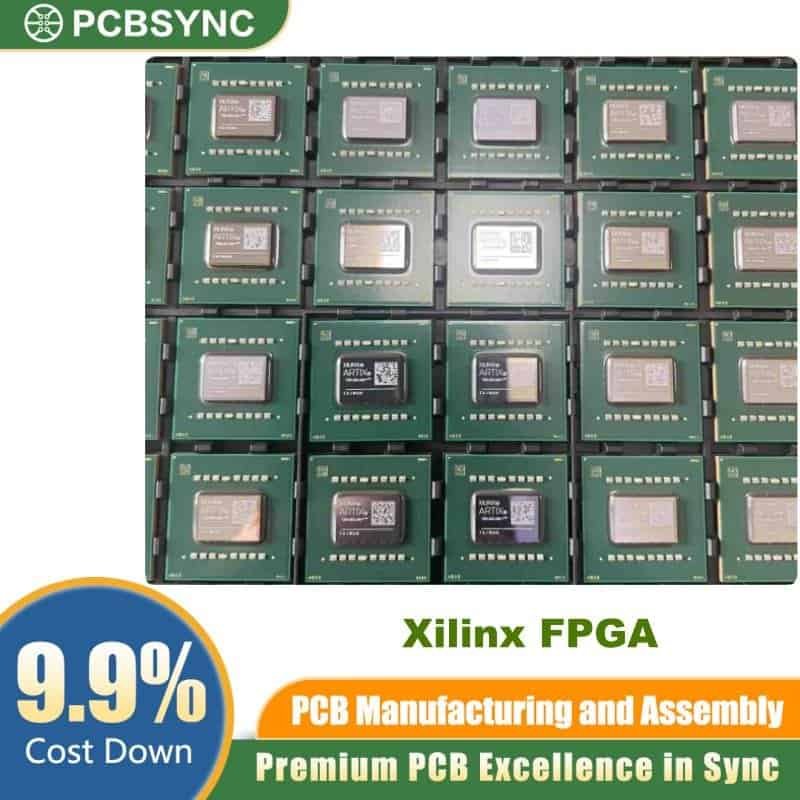
The XC3S200-4TQG144I is a high-performance, cost-optimized field-programmable gate array (FPGA) from the Xilinx Spartan-3 family, now distributed under AMD. Designed for high-volume, cost-sensitive applications, this device delivers powerful programmable logic in a compact 144-pin Thin Quad Flat Pack (TQFP) package. Whether you’re developing embedded systems, digital signal processing circuits, or communications interfaces, the XC3S200-4TQG144I offers an ideal blend of logic density, speed, and affordability.
For a broader selection of programmable logic solutions, explore Xilinx FPGA options available today.
What Is the XC3S200-4TQG144I?
The XC3S200-4TQG144I belongs to AMD’s (formerly Xilinx) Spartan-3 FPGA series, a family engineered to deliver maximum logic capacity per dollar. The “200” in the part number indicates approximately 200,000 system gates, while the “-4” denotes a speed grade of -4 (standard performance), “TQG144” specifies the 144-pin TQFP package, and the “I” suffix indicates the industrial temperature range (-40°C to +85°C).
This device is manufactured on a 90nm process technology and supports a wide array of design applications, including motor control, data acquisition, protocol bridging, and more.
XC3S200-4TQG144I Key Specifications
| Parameter |
Value |
| Manufacturer |
AMD (Xilinx) |
| Part Number |
XC3S200-4TQG144I |
| FPGA Family |
Spartan-3 |
| Number of Logic Cells |
4,320 |
| System Gates (Equivalent) |
~200,000 |
| Distributed RAM (bits) |
55,296 |
| Block RAM (bits) |
216,000 (12 x 18K blocks) |
| Multiplier Blocks (18×18) |
12 |
| DCM (Digital Clock Manager) |
4 |
| Maximum User I/O |
97 |
| Package Type |
TQFP (Thin Quad Flat Pack) |
| Package Code |
TQG144 |
| Pin Count |
144 |
| Speed Grade |
-4 |
| Operating Temperature |
-40°C to +85°C (Industrial) |
| Core Voltage (VCCINT) |
1.2V |
| I/O Voltage (VCCO) |
1.2V – 3.3V |
| Process Technology |
90nm |
| RoHS Compliant |
Yes |
XC3S200-4TQG144I Detailed Feature Overview
Logic Resources and Programmable Fabric
The XC3S200-4TQG144I provides 4,320 logic cells organized into Configurable Logic Blocks (CLBs). Each CLB contains four slices, and each slice includes two 4-input Look-Up Tables (LUTs) and two flip-flops. This architecture enables efficient implementation of combinatorial and sequential logic, finite state machines, and arithmetic functions.
With 97 maximum user I/Os, designers have substantial flexibility in connecting the FPGA to external memory, sensors, communication buses, and display interfaces.
Embedded Memory Architecture
| Memory Type |
Capacity |
Count |
| Distributed SelectRAM |
55,296 bits |
Distributed across CLBs |
| Block RAM (BRAM) |
216,000 bits |
12 x 18K blocks |
| Total On-Chip Memory |
~271 Kbits |
— |
The block RAM supports true dual-port operation at up to 18-bit width per port, making it well-suited for FIFOs, lookup tables, and data buffering applications. Distributed RAM leverages the LUT structure for small, fast, synchronous storage without consuming dedicated block resources.
Digital Clock Management (DCM)
The XC3S200-4TQG144I includes four Digital Clock Managers (DCMs), which provide:
- Clock frequency synthesis and multiplication/division
- Phase shifting (0°, 90°, 180°, 270°)
- Deskewing for zero propagation delay
- Dynamic reconfiguration of clock parameters
DCMs allow designers to generate multiple clock domains from a single reference clock, enabling complex synchronous and asynchronous system designs.
Dedicated Multiplier Blocks
| Feature |
Specification |
| Multiplier Blocks |
12 |
| Multiplier Width |
18 x 18 bits |
| Output Width |
36 bits |
The 12 dedicated 18×18 hardware multipliers enable high-speed multiply-accumulate (MAC) operations, supporting DSP algorithms, FIR/IIR filters, and signal processing pipelines without consuming CLB resources.
I/O Standards Supported
The XC3S200-4TQG144I supports a comprehensive range of I/O voltage standards across its banks:
| I/O Standard |
Voltage Level |
| LVCMOS |
1.2V, 1.5V, 1.8V, 2.5V, 3.3V |
| LVTTL |
3.3V |
| LVDS |
Differential |
| SSTL |
2.5V, 3.3V |
| HSTL |
1.5V, 1.8V |
| PCI |
3.3V |
This multi-standard I/O flexibility allows the FPGA to interface directly with a wide variety of devices, including DDR memory, processors, sensors, and communication peripherals.
Package and Mechanical Specifications
TQG144 Package Details
| Parameter |
Value |
| Package Type |
TQFP (Thin Quad Flat Pack) |
| Body Size |
20mm x 20mm |
| Lead Count |
144 |
| Lead Pitch |
0.5mm |
| Package Height |
1.4mm (max) |
| Lead Finish |
Matte Tin (RoHS compliant) |
| Mounting Type |
Surface Mount |
The 144-pin TQFP package is a standard surface-mount footprint, compatible with standard PCB manufacturing processes. Its 0.5mm pitch demands careful PCB layout and fine-pitch soldering capability, but it is well within the range of most professional PCB assembly processes.
Temperature and Power Specifications
Industrial Temperature Grade (“I” Suffix)
| Parameter |
Value |
| Operating Temperature Range |
-40°C to +85°C |
| Storage Temperature Range |
-55°C to +125°C |
| Junction Temperature (Tj max) |
85°C (industrial) |
The industrial-grade “I” suffix is critical for designs deployed in demanding environments such as industrial automation, outdoor equipment, automotive support electronics, and military-adjacent commercial systems where extended temperature operation is required.
Power Supply Requirements
| Supply Rail |
Voltage |
Purpose |
| VCCINT |
1.2V |
Core logic power |
| VCCO (per bank) |
1.2V – 3.3V |
I/O buffer power |
| VCCAUX |
2.5V |
Auxiliary circuits, DCM, DLL |
The low 1.2V core voltage contributes to reduced static and dynamic power consumption compared to older Spartan-2 devices, making the XC3S200-4TQG144I suitable for power-sensitive embedded applications.
XC3S200-4TQG144I Ordering and Identification
Part Number Breakdown
| Position |
Code |
Meaning |
| XC |
XC |
Xilinx (AMD) FPGA |
| 3S |
3S |
Spartan-3 Family |
| 200 |
200 |
~200K system gate equivalent |
| -4 |
-4 |
Speed grade (standard) |
| TQ |
TQ |
TQFP package type |
| G |
G |
Lead-free (RoHS) |
| 144 |
144 |
144-pin count |
| I |
I |
Industrial temperature (-40°C to +85°C) |
Related Part Numbers (Same Die, Different Package or Grade)
| Part Number |
Package |
Pins |
Temp Grade |
Speed Grade |
| XC3S200-4TQG144C |
TQFP |
144 |
Commercial (0°C to +85°C) |
-4 |
| XC3S200-4PQG208I |
PQFP |
208 |
Industrial |
-4 |
| XC3S200-4FTG256I |
BGA |
256 |
Industrial |
-4 |
| XC3S200-5TQG144I |
TQFP |
144 |
Industrial |
-5 (faster) |
Typical Applications for XC3S200-4TQG144I
The XC3S200-4TQG144I excels in a broad range of embedded and industrial applications:
Embedded System Design
- Processor integration: Implements soft-core processors such as MicroBlaze or PicoBlaze for custom embedded computing
- Peripheral expansion: Adds custom I/O controllers (UART, SPI, I2C, GPIO) to processor-based systems
- Glue logic replacement: Consolidates discrete TTL/CMOS logic into a single programmable device
Digital Signal Processing (DSP)
- FIR/IIR digital filters: Leverages dedicated multiplier blocks and block RAM for high-throughput filter implementations
- FFT and spectral analysis: Processes real-time data streams in audio, video, and sensor applications
- Waveform generation: Produces precise digital waveforms for test and measurement equipment
Communications and Interfaces
- Protocol bridging: Converts between SPI, I2C, UART, and parallel interfaces
- Multi-channel I/O: Handles multiple concurrent serial or parallel data streams
- Ethernet MAC support: Implements lightweight network interface logic for embedded connectivity
Industrial and Control Systems
- Motor control: Generates PWM signals and processes encoder feedback for servo and stepper motor drives
- PLC logic replacement: Implements ladder logic or function block diagrams in programmable hardware
- Data acquisition: Captures and pre-processes analog-to-digital converter data in real time
Development Tools and Support
Xilinx ISE Design Suite
The XC3S200-4TQG144I is supported by the Xilinx ISE Design Suite (specifically ISE 14.7, the final release for Spartan-3 devices). ISE provides:
- HDL synthesis (VHDL, Verilog, System Verilog)
- Place and route with timing analysis
- iMPACT programmer and configuration manager
- CORE Generator for IP core instantiation
Note: ISE is a legacy toolchain. Xilinx Vivado does not support Spartan-3 devices. ISE 14.7 remains freely available from AMD’s website and is the correct tool for this device.
Simulation and Verification
| Tool |
Compatibility |
| ModelSim (Mentor) |
Full functional and timing simulation |
| ISIM (Xilinx) |
Integrated simulation within ISE |
| Active-HDL |
Supported via third-party flow |
Configuration and Programming
The XC3S200-4TQG144I supports multiple configuration modes:
| Configuration Mode |
Interface |
Description |
| Master Serial |
SPI Flash |
Self-loads from external SPI/serial PROM |
| Slave Serial |
External master |
Controlled by host processor |
| Slave Parallel (SelectMAP) |
8-bit parallel |
High-speed configuration by host |
| JTAG |
Boundary scan |
In-circuit programming and debug |
For production use, a dedicated Xilinx XCF02S or XCF04S Platform Flash device can store the bitstream and automatically configure the FPGA at power-up.
Design Considerations and PCB Layout Guidelines
Decoupling and Power Integrity
- Place 100nF ceramic decoupling capacitors (X5R or X7R, 0402 or 0603) on every VCCO and VCCINT pin as close to the package as possible
- Add 10µF bulk decoupling per power rail to handle transient demands during configuration
- Separate VCCAUX (2.5V) supply should have independent filtering to prevent DCM jitter
PCB Layout Tips for TQG144
- Use a minimum 4-layer PCB with dedicated power and ground planes
- Route high-speed I/O signals with controlled impedance (50Ω single-ended, 100Ω differential)
- Avoid routing signals beneath the FPGA die area to reduce noise coupling
- Ensure via-in-pad or short stub vias for power delivery pins
Configuration Pin Requirements
| Pin |
Function |
Recommended Connection |
| PROG_B |
Program initiation |
Pulled high via 10kΩ, with bypass capacitor |
| DONE |
Configuration complete indicator |
LED or status register input |
| M0, M1, M2 |
Mode select pins |
Tie per desired configuration mode |
| INIT_B |
Initialization status |
Open-drain, pull up externally |
Compliance and Environmental Data
| Attribute |
Status |
| RoHS Compliance |
Yes (Lead-free, “G” suffix) |
| Halogen-Free |
Yes |
| REACH Compliance |
Compliant |
| Conflict Minerals (3TG) |
Documented |
| MSL (Moisture Sensitivity Level) |
MSL 3 |
| Peak Reflow Temperature |
260°C (per IPC/JEDEC J-STD-020) |
Comparison: XC3S200 vs. Other Spartan-3 Devices
| Feature |
XC3S50 |
XC3S200 |
XC3S400 |
XC3S1000 |
| Logic Cells |
1,728 |
4,320 |
8,064 |
17,280 |
| Block RAM (Kbits) |
72 |
216 |
288 |
432 |
| Multipliers (18×18) |
4 |
12 |
16 |
24 |
| Max User I/O |
124 |
97–124* |
264 |
391 |
| DCMs |
2 |
4 |
4 |
4 |
| Packages Available |
VQ100, CP132 |
TQ144, PQ208, FT256 |
PQ208, FT256, FG320 |
FG320, FG400 |
*Maximum I/O varies by package; TQG144 provides up to 97 user I/Os
The XC3S200 occupies the mid-range tier of the Spartan-3 family — offering significantly more resources than the entry-level XC3S50 while remaining cost-effective compared to the XC3S400 and larger devices.
Frequently Asked Questions (FAQ)
Q: What is the difference between XC3S200-4TQG144I and XC3S200-4TQG144C?
The only difference is the temperature grade. The “I” suffix indicates industrial operation (-40°C to +85°C), while the “C” suffix indicates commercial operation (0°C to +85°C). Both are electrically identical in all other respects.
Q: Can I use Vivado to program the XC3S200-4TQG144I?
No. Xilinx Vivado does not support Spartan-3 devices. You must use Xilinx ISE 14.7, which is the last version of ISE and remains freely downloadable from AMD’s website.
Q: Is the XC3S200-4TQG144I in production?
The Spartan-3 family is in a last-buy / mature product lifecycle phase. It remains available through authorized distributors such as Digi-Key, Mouser, and Avnet, but new designs should consider migrating to Spartan-6 or Artix-7 for better long-term availability.
Q: What configuration PROM is compatible with the XC3S200-4TQG144I?
The Xilinx XCF02S (2Mb) or XCF04S (4Mb) Platform Flash PROMs are commonly used. Third-party SPI Flash devices (e.g., Winbond, Macronix, Spansion) are also supported in SPI configuration mode.
Q: What is the bitstream size for the XC3S200?
The configuration bitstream for the XC3S200 is approximately 1.047 Mbit (about 131 KB), which fits comfortably in a 2Mb (XCF02S) configuration PROM.
Summary
The XC3S200-4TQG144I is a proven, cost-effective FPGA solution from the Xilinx Spartan-3 family, offering 200K system gates, 4,320 logic cells, 12 hardware multipliers, 216Kbits of block RAM, and 4 DCMs in a compact 144-pin TQFP package. Its industrial temperature rating makes it well-suited for demanding environments, and its broad I/O standard support ensures compatibility with virtually any system interface.
While the Spartan-3 family is in a mature lifecycle phase, the XC3S200-4TQG144I remains widely available and continues to serve as a reliable choice for volume production, legacy system maintenance, and cost-driven embedded designs.