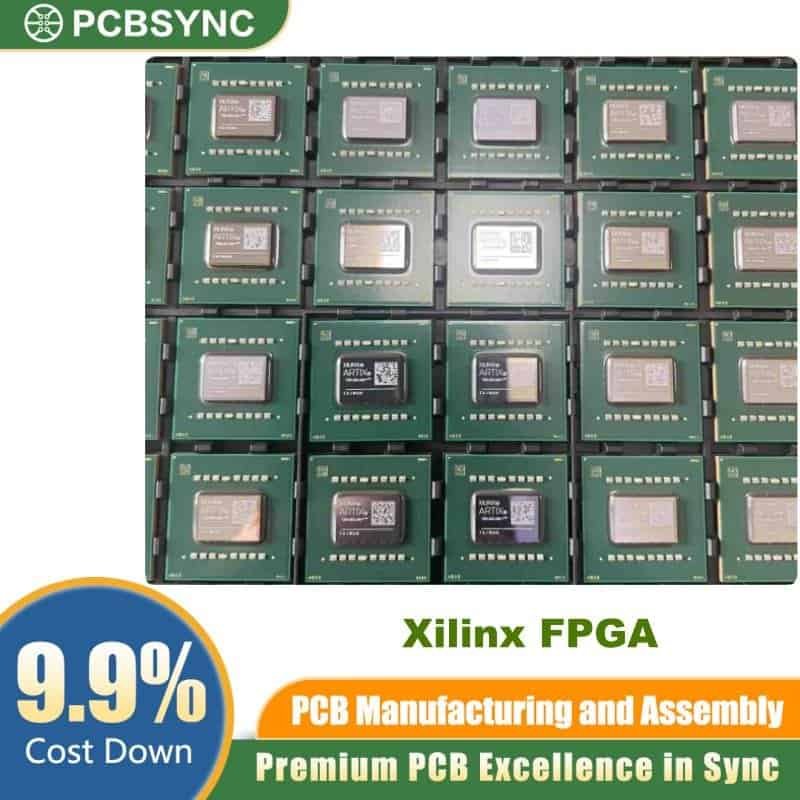
The XC3S4000-5FGG676C is a high-performance, cost-efficient Field-Programmable Gate Array (FPGA) from Xilinx’s (now AMD) Spartan®-3 family. Featuring 4 million system gates, 62,208 logic cells, and a 676-pin Fine-pitch Ball Grid Array (FBGA) package, the XC3S4000-5FGG676C is built on 90nm process technology and operates at a 1.2V core supply. The “-5” speed grade designation makes this one of the fastest variants in its family, making it an ideal choice for demanding, high-volume consumer electronics and industrial applications.
If you are searching for a proven, cost-effective Xilinx FPGA with rich I/O capabilities and deep on-chip memory, this device deserves serious consideration.
What Is the XC3S4000-5FGG676C?
The XC3S4000-5FGG676C belongs to the Spartan-3 generation of FPGAs, a family specifically designed to address high-volume, price-sensitive applications without sacrificing logic density or performance. The Spartan-3 architecture draws extensively from Xilinx’s Virtex-II platform, inheriting its advanced routing fabric, dedicated multiplier blocks, and flexible I/O standards while delivering them at a fraction of the cost.
The “XC3S4000” designation indicates 4,000,000 system gates. The “-5” suffix denotes the fastest commercial speed grade. “FGG676” refers to the 676-ball Fine-pitch Ball Grid Array package, and the trailing “C” confirms Commercial temperature range (0°C to +85°C junction temperature).
XC3S4000-5FGG676C Key Specifications
General Device Overview
| Parameter |
Value |
| Manufacturer |
Xilinx (AMD) |
| Part Number |
XC3S4000-5FGG676C |
| FPGA Family |
Spartan-3 |
| System Gates |
4,000,000 |
| Equivalent Logic Cells |
62,208 |
| Process Technology |
90nm |
| Core Supply Voltage (VCCINT) |
1.2V |
| Speed Grade |
-5 (Fastest Commercial) |
| Operating Temperature |
0°C to +85°C (Commercial) |
| Package Type |
676-Pin Fine-pitch BGA (FGG676) |
| Packaging |
Tray |
| RoHS Compliance |
See manufacturer documentation |
Logic and Memory Resources
| Resource |
Quantity |
| Configurable Logic Blocks (CLBs) |
6,912 |
| 4-input LUTs |
55,296 |
| Flip-Flops / Registers |
55,296 |
| Total Block RAM |
1,872 Kbits (216 kB) |
| Total Distributed RAM |
Up to 520 Kbits |
| Dedicated 18×18 Multipliers |
96 |
| Digital Clock Managers (DCMs) |
4 |
| Maximum Frequency |
630 MHz |
I/O and Interface Capabilities
| Parameter |
Value |
| User I/O Pins |
489 |
| Maximum Data Rate per I/O |
622+ Mb/s |
| Single-Ended I/O Standards |
18 |
| Differential I/O Standards |
8 (incl. LVDS, RSDS) |
| Signal Swing Range |
1.14V to 3.465V |
| DDR/DDR2 SDRAM Support |
Up to 333 Mb/s |
| Digitally Controlled Impedance (DCI) |
Yes |
| JTAG Boundary Scan |
IEEE 1149.1 / 1532 |
| Global Clock Lines |
8 |
Decoding the Part Number: XC3S4000-5FGG676C
Understanding the part number helps engineers quickly identify the exact device variant:
| Field |
Code |
Meaning |
| Device Family |
XC3S |
Xilinx Spartan-3 |
| Gate Count |
4000 |
4,000,000 System Gates |
| Speed Grade |
-5 |
Fastest commercial grade |
| Package Code |
FGG |
Fine-pitch Ball Grid Array |
| Ball Count |
676 |
676 solder balls |
| Temp. Grade |
C |
Commercial (0°C to +85°C) |
Spartan-3 Family Architecture Overview
Configurable Logic Blocks (CLBs)
Each CLB in the XC3S4000 contains four slices, and each slice includes two 4-input Look-Up Tables (LUTs), two storage elements (flip-flops or latches), and dedicated carry and arithmetic logic. The LUTs can also be configured as small distributed RAM or shift registers, giving designers maximum flexibility when implementing control logic, data paths, or small FIFOs.
Block RAM (BRAM)
The XC3S4000-5FGG676C provides 1,872 Kbits of total block RAM organized as true dual-port memories. Each block RAM can be independently configured as 16K×1, 8K×2, 4K×4, 2K×9, 1K×18, or 512×36 memory arrays. This makes the device well-suited for packet buffering, lookup tables, and embedded processor data storage.
Dedicated Multipliers
Ninety-six dedicated 18×18-bit signed multipliers are embedded in the silicon, enabling high-throughput DSP operations such as FIR filtering, FFT processing, and video scaling — all without consuming CLB resources.
Digital Clock Managers (DCMs)
Four on-chip DCMs provide clock skew elimination, frequency synthesis, and high-resolution phase shifting. This allows the XC3S4000-5FGG676C to derive multiple clock domains from a single reference oscillator, a critical capability for multi-protocol interfaces and multi-rate signal processing.
SelectIO™ Technology and I/O Standards
Supported Single-Ended I/O Standards
The XC3S4000-5FGG676C supports 18 single-ended signaling standards through Xilinx’s SelectIO™ technology:
| Standard Type |
Examples |
| LVTTL / LVCMOS |
1.2V, 1.5V, 1.8V, 2.5V, 3.3V |
| HSTL |
Class I, II, III, IV |
| SSTL |
SSTL2 Class I/II, SSTL18 Class I/II |
| PCI / PCI-X |
33 MHz / 66 MHz |
| GTL / GTLP |
Open-drain termination standards |
Differential I/O Standards
Eight differential standards are supported, including LVDS (Low-Voltage Differential Signaling) and RSDS (Reduced Swing Differential Signaling). These enable high-speed point-to-point links with excellent noise immunity, ideal for display interfaces, backplane communication, and high-speed data acquisition.
Package Information: 676-Pin FBGA (FGG676)
Physical Package Details
| Parameter |
Value |
| Package Type |
Fine-pitch Ball Grid Array (FBGA) |
| Total Ball Count |
676 |
| Ball Pitch |
1.0 mm |
| Package Body Size |
27 mm × 27 mm |
| Mounting Type |
Surface Mount (SMD) |
| Solder Ball Composition |
Pb-free (check specific marking) |
The 676-ball FBGA package is a compact, surface-mount solution that provides excellent thermal performance and signal integrity. With a 1.0 mm ball pitch, it is compatible with standard PCB manufacturing processes, making it suitable for high-density board designs.
XC3S4000-5FGG676C Operating Conditions
Recommended DC Operating Conditions
| Parameter |
Min |
Typical |
Max |
Unit |
| Core Supply Voltage (VCCINT) |
1.14 |
1.20 |
1.26 |
V |
| Auxiliary Voltage (VCCAUX) |
2.375 |
2.50 |
2.625 |
V |
| I/O Supply Voltage (VCCO) |
Depends on I/O standard |
— |
3.465 |
V |
| Junction Temperature |
0 |
— |
+85 |
°C |
Typical Applications for the XC3S4000-5FGG676C
The XC3S4000-5FGG676C is a versatile device suited for a wide range of applications:
Consumer Electronics
The Spartan-3 family was purpose-built for consumer-oriented applications where cost per gate is a key metric. The XC3S4000 variant is commonly deployed in digital television set-top boxes, DVD players, projectors, and home theater systems where complex real-time video and audio processing is required.
Broadband Access and Home Networking
With 489 user I/O pins and support for a broad set of I/O signaling standards, the XC3S4000-5FGG676C integrates well into DSL modems, cable modem termination systems (CMTS), and Ethernet switching equipment. The device’s dedicated 18×18 multipliers accelerate the forward error correction (FEC) and QAM demodulation algorithms commonly used in broadband access equipment.
Industrial Control and Automation
In industrial settings, the XC3S4000-5FGG676C serves as a flexible glue logic platform, protocol bridge, or custom peripheral controller in PLCs, motor drives, and data acquisition systems. The device’s reprogrammability allows firmware updates in the field without PCB redesign.
Embedded Processing
The XC3S4000-5FGG676C supports the Xilinx MicroBlaze™ soft processor core, enabling full SoC implementations with custom peripherals, interrupt controllers, and memory interfaces — all within a single FPGA die.
Communications Infrastructure
The device supports multi-protocol backplane and chip-to-chip interfaces using its HSTL, SSTL, and LVDS I/O standards. It fits naturally into line cards, FPGAs for protocol processing, and network equipment requiring low latency and high fan-out.
XC3S4000-5FGG676C vs. Related Spartan-3 Variants
| Part Number |
Gates |
Logic Cells |
I/O Pins |
Package |
Speed Grade |
Temp Grade |
| XC3S2000-4FGG456C |
2M |
46,080 |
489 |
456 FBGA |
-4 |
Commercial |
| XC3S4000-4FGG676C |
4M |
62,208 |
489 |
676 FBGA |
-4 |
Commercial |
| XC3S4000-5FGG676C |
4M |
62,208 |
489 |
676 FBGA |
-5 |
Commercial |
| XC3S4000-4FGG900C |
4M |
62,208 |
616 |
900 FBGA |
-4 |
Commercial |
| XC3S5000-4FGG900C |
5M |
74,880 |
633 |
900 FBGA |
-4 |
Commercial |
The “-5” speed grade in the XC3S4000-5FGG676C means it delivers the highest timing performance available in the XC3S4000 commercial temperature range, making it the preferred choice for designs with tight timing closure requirements.
Design Tools and Software Support
Xilinx ISE Design Suite
The XC3S4000-5FGG676C is fully supported by Xilinx ISE Design Suite, which includes synthesis, placement and routing, timing analysis, and configuration file generation. ISE WebPACK™ is a free version supporting smaller Spartan-3 devices, while ISE Design Suite Professional covers the full XC3S4000.
Third-Party EDA Support
The device is also supported by leading third-party EDA tools, including Synopsys Synplify, Mentor Precision RTL, and Cadence Encounter, giving design teams flexibility in their implementation flow.
Configuration and Programming
| Configuration Mode |
Description |
| Master Serial |
FPGA drives configuration clock |
| Slave Serial |
External source drives clock |
| Master SelectMAP (x8) |
Parallel byte-wide configuration |
| Slave SelectMAP (x8) |
External controller drives interface |
| JTAG (IEEE 1149.1) |
Boundary scan / debug access |
Ordering and Availability Information
| Attribute |
Detail |
| Manufacturer Part Number |
XC3S4000-5FGG676C |
| DigiKey Part Number |
122-1612-ND |
| Manufacturer |
Xilinx Inc. (AMD) |
| Series |
Spartan-3 |
| Package / Case |
676-FBGA |
| Mounting |
Surface Mount |
| Packaging |
Tray |
| Operating Temperature |
0°C ~ 85°C |
Frequently Asked Questions (FAQ)
What does the “-5” speed grade mean on the XC3S4000-5FGG676C?
The “-5” speed grade indicates the fastest timing performance available in the commercial temperature range for this device family. A lower negative number (e.g., -4) is slower. Choosing the “-5” variant provides more timing margin and is preferred for high-frequency designs requiring tight setup and hold time compliance.
What is the difference between XC3S4000-5FGG676C and XC3S4000-4FGG676C?
The two parts are functionally identical in terms of logic capacity, I/O count, and package. The only difference is the speed grade: the “-5” version supports higher clock frequencies and has tighter propagation delays, while the “-4” version is slightly slower and typically lower in cost.
Is the XC3S4000-5FGG676C RoHS compliant?
Compliance depends on the specific date code and manufacturing lot. The “C” suffix indicates commercial temperature grade but does not specify lead-free status. Always confirm with your authorized distributor and check the device markings for the specific lot.
What configuration memory is compatible with the XC3S4000-5FGG676C?
Xilinx Platform Flash PROMs (XCF08P, XCF16P, XCF32P) and SPI flash devices are commonly used for non-volatile configuration storage. The XC3S4000 bitstream requires approximately 11.8 Mbits of configuration memory.
Can the XC3S4000-5FGG676C run a soft processor?
Yes. The device supports the MicroBlaze™ 32-bit soft processor core. A fully featured MicroBlaze system with cache, UART, and GPIO peripherals can be implemented comfortably within the XC3S4000’s 62,208 logic cells.
Summary
The XC3S4000-5FGG676C is a mature, well-documented, and production-proven FPGA that continues to serve mission-critical designs across consumer electronics, industrial automation, and communications. Its combination of 4 million system gates, 489 user I/O pins, 96 dedicated multipliers, 1,872 Kbits of block RAM, and the highest “-5” commercial speed grade — all packaged in a compact 676-ball FBGA — makes it one of the most capable mid-range FPGAs in the Spartan-3 generation.
Whether you are maintaining an existing design or exploring cost-effective options for a new development, the XC3S4000-5FGG676C remains a reliable and accessible choice from the Xilinx Spartan-3 portfolio.