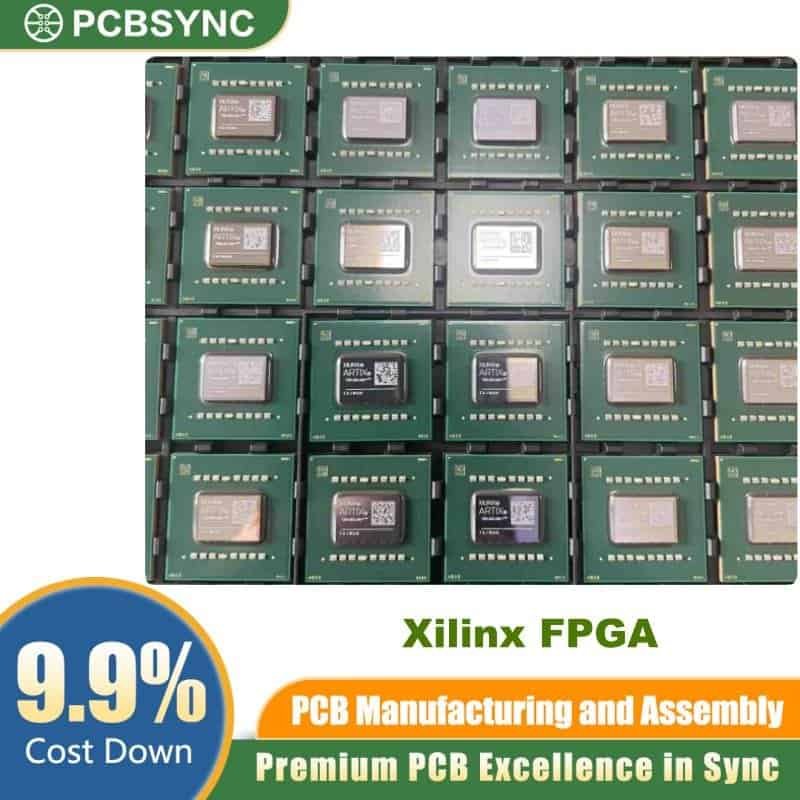
The XC3S400-4FTG256C is a high-performance, cost-optimized field-programmable gate array (FPGA) from Xilinx (now AMD). Part of the Spartan-3 family, this device delivers 400,000 system gates in a compact 256-ball Fine-pitch BGA (FTBGA) package. Whether you are designing embedded systems, digital signal processing circuits, or high-speed communication interfaces, the XC3S400-4FTG256C offers an outstanding balance of logic density, I/O flexibility, and power efficiency.
What Is the XC3S400-4FTG256C?
The XC3S400-4FTG256C is a member of the Xilinx FPGA Spartan-3 product family — a generation specifically engineered for cost-sensitive, high-volume applications. The part number breaks down as follows:
| Part Number Segment |
Meaning |
| XC3S |
Xilinx Spartan-3 family |
| 400 |
400,000 equivalent system gates |
| -4 |
Speed grade –4 (fastest in the Spartan-3 lineup) |
| FTG |
Fine-pitch Thin Ball Grid Array (FTBGA) package |
| 256 |
256 solder ball count |
| C |
Commercial temperature range (0°C to +85°C) |
XC3S400-4FTG256C Key Specifications
The table below summarizes the most important electrical and physical characteristics of the XC3S400-4FTG256C.
| Parameter |
Value |
| Manufacturer |
AMD (Xilinx) |
| Series |
Spartan-3 |
| Part Number |
XC3S400-4FTG256C |
| System Gates |
400,000 |
| Logic Cells |
8,064 |
| CLB Slices |
3,584 |
| Flip-Flops |
7,168 |
| Distributed RAM |
56 Kb |
| Block RAM |
288 Kb (8× 18 Kb blocks) |
| Multipliers (18×18-bit) |
16 |
| DCM Clocking Blocks |
4 |
| Maximum User I/O |
141 |
| Speed Grade |
–4 (fastest) |
| Package |
FTG256 (Fine-pitch TBGA) |
| Package Size |
17 mm × 17 mm |
| Ball Pitch |
1.0 mm |
| Core Voltage (VCCINT) |
1.2 V |
| I/O Voltage (VCCIO) |
1.2 V – 3.3 V |
| Temperature Range |
Commercial: 0°C to +85°C |
| RoHS Compliant |
Yes |
| Moisture Sensitivity Level |
MSL 3 |
XC3S400-4FTG256C: Detailed Feature Overview
Logic Resources and Configurable Logic Blocks (CLBs)
The XC3S400-4FTG256C contains 3,584 CLB slices, each composed of two 4-input Look-Up Tables (LUTs) and two flip-flops. This architecture enables efficient implementation of combinational logic, counters, state machines, and complex arithmetic functions. With 8,064 logic cells equivalent, the device can handle medium-complexity digital designs without the cost overhead of higher-density FPGAs.
Block RAM and Distributed Memory
The FPGA provides 288 Kb of dedicated block RAM organized as eight 18 Kb dual-port BRAM blocks. These are ideal for implementing FIFOs, lookup tables, small buffers, and embedded memory arrays. In addition, 56 Kb of distributed RAM can be inferred from unused LUT resources, giving designers flexible on-chip storage options.
Embedded Multipliers for DSP
Sixteen 18×18-bit hardware multipliers are embedded directly in silicon, enabling efficient implementation of digital filters, fast Fourier transforms (FFTs), and other multiply-accumulate (MAC) operations without consuming CLB resources. This makes the XC3S400-4FTG256C suitable for light DSP workloads.
Digital Clock Managers (DCMs)
Four Digital Clock Manager (DCM) blocks provide on-chip clock synthesis, multiplication, division, phase shifting, and skew elimination. DCMs allow designers to derive multiple clock domains from a single input reference, supporting complex synchronous system designs.
I/O Banks and Voltage Standards
The XC3S400-4FTG256C supports 141 user I/O pins across multiple I/O banks, each configurable to different I/O voltage standards. The device supports a wide range of single-ended and differential standards.
Supported I/O Standards
| Standard Type |
Supported Standards |
| Single-Ended |
LVTTL, LVCMOS 3.3V / 2.5V / 1.8V / 1.5V / 1.2V |
| Differential |
LVDS, LVPECL, BLVDS, RSDS |
| Legacy |
PCI (3.3V), GTL, GTL+, HSTL, SSTL |
XC3S400-4FTG256C Package and PCB Design Considerations
FTG256 Package Details
The FTG256 package is a Fine-pitch Thin Ball Grid Array (FTBGA) with 256 solder balls arranged in a 16×16 matrix. Its compact 17 mm × 17 mm footprint and 1.0 mm ball pitch make it well-suited for space-constrained PCB designs.
| Package Parameter |
Value |
| Package Type |
Fine-pitch Thin BGA (FTBGA) |
| Ball Count |
256 |
| Ball Array |
16 × 16 |
| Package Dimensions |
17 mm × 17 mm |
| Ball Pitch |
1.0 mm |
| Thickness |
~1.7 mm |
PCB Layout Recommendations
- Use 4–6 layer PCBs with dedicated ground and power planes for signal integrity.
- Place 100 nF decoupling capacitors on every VCCINT and VCCIO supply pin, as close to the balls as possible.
- Route VCCINT (1.2 V) and VCCIO traces with adequate copper width to handle current loads.
- Follow Xilinx FTBGA PCB design guidelines for via-in-pad and anti-pad dimensions.
- Perform signal integrity simulation on high-speed I/O lines operating above 100 MHz.
XC3S400-4FTG256C vs. Other Spartan-3 Devices
Understanding where the XC3S400 sits within the Spartan-3 family helps engineers select the right device.
| Device |
System Gates |
Logic Cells |
Block RAM |
Max I/O |
Package Options |
| XC3S50 |
50,000 |
1,728 |
72 Kb |
124 |
VQ100, CP132, TQ144 |
| XC3S200 |
200,000 |
4,320 |
216 Kb |
141 |
VQ100, CP132, TQ144, FT256 |
| XC3S400 |
400,000 |
8,064 |
288 Kb |
141 |
FT256, TQ144 |
| XC3S1000 |
1,000,000 |
17,280 |
432 Kb |
391 |
FT256, FG320, FG456 |
| XC3S1500 |
1,500,000 |
29,952 |
576 Kb |
487 |
FG320, FG456, FG676 |
| XC3S4000 |
4,000,000 |
62,208 |
1,728 Kb |
784 |
FG676, FG900 |
The XC3S400-4FTG256C occupies a sweet spot for designs that outgrow the XC3S200 in logic density but do not yet need the higher cost and power of the XC3S1000.
Typical Applications for the XC3S400-4FTG256C
The XC3S400-4FTG256C is widely used across a broad range of industries and applications:
Industrial and Embedded Control
- Motor control and servo drive interfaces
- PLC I/O expansion and custom logic controllers
- Real-time sensor data aggregation
Communications and Networking
- Protocol bridging (SPI, I²C, UART, CAN)
- Serializer/deserializer (SerDes) glue logic
- Packet processing and switching fabrics
Digital Signal Processing
- Audio and video codec acceleration
- FIR/IIR digital filter implementation
- Custom waveform generation
Test and Measurement
- Logic analyzer front-end capture
- Stimulus/response pattern generators
- BIST (Built-In Self-Test) controllers
Consumer Electronics Prototyping
- Display controller and interface logic
- Custom peripheral emulation
- Rapid hardware prototyping and validation
Programming and Configuration
The XC3S400-4FTG256C supports several configuration modes:
| Configuration Mode |
Description |
| Master Serial |
FPGA reads bitstream from an external SPI Flash |
| Slave Serial |
External controller streams bitstream into FPGA |
| Master Parallel (SelectMAP) |
Byte-wide parallel configuration bus |
| JTAG |
IEEE 1149.1 boundary scan and in-system programming |
Configuration bitstream storage requires an external serial Flash device (e.g., Xilinx XCFxxS Platform Flash or SPI NOR Flash). The JTAG interface supports in-circuit debug using Xilinx ChipScope Pro or third-party JTAG tools.
Development Tool Support
| Tool |
Purpose |
| Xilinx ISE Design Suite 14.7 |
Synthesis, place-and-route, bitstream generation |
| ModelSim / ISIM |
RTL simulation |
| ChipScope Pro |
In-circuit logic analysis |
| iMPACT |
Programming and device configuration |
Note: The XC3S400-4FTG256C is not supported in Vivado. Use Xilinx ISE Design Suite 14.7 (the final ISE release) for all Spartan-3 design work.
Power Consumption and Thermal Management
Typical Power Estimates
| Supply Rail |
Voltage |
Typical Current |
Notes |
| VCCINT |
1.2 V |
50–150 mA |
Depends on logic activity |
| VCCIO Bank 0–3 |
1.2 – 3.3 V |
20–80 mA per bank |
Depends on I/O standard and loading |
| VCCAUX |
2.5 V |
10–20 mA |
Powers JTAG, DCM, I/O buffers |
Use the Xilinx XPower Estimator (XPE) tool to obtain accurate power estimates based on your specific design and toggle rates.
Thermal Characteristics
| Parameter |
Value |
| Junction-to-Ambient Thermal Resistance (θJA) |
~17°C/W (still air) |
| Maximum Junction Temperature (TJ) |
85°C (commercial) |
| Recommended Operating Ambient |
0°C to 70°C |
For designs running at full utilization and maximum speed, ensure adequate airflow or heatsink attachment to the BGA package to keep junction temperatures within specification.
Ordering Information
| Parameter |
Detail |
| Full Part Number |
XC3S400-4FTG256C |
| Manufacturer |
AMD (Xilinx) |
| DigiKey Part Number |
122-1447-ND |
| Package |
FTG256 (FTBGA-256) |
| Temperature Grade |
Commercial (0°C to +85°C) |
| RoHS Status |
RoHS Compliant |
| Lifecycle Status |
Not Recommended for New Designs (NRND) — still widely available |
Availability Note: While the XC3S400-4FTG256C is classified as NRND (Not Recommended for New Designs), it remains widely available through authorized distributors and is extensively used in production maintenance and legacy system support.
Frequently Asked Questions (FAQ)
What is the difference between XC3S400-4FTG256C and XC3S400-4FTG256I?
The only difference is the temperature range. The “C” suffix denotes Commercial grade (0°C to +85°C), while the “I” suffix indicates Industrial grade (–40°C to +100°C). For applications in harsh environments or wide temperature ranges, select the “I” variant.
Is the XC3S400-4FTG256C compatible with 3.3 V logic?
Yes. The VCCIO supply for each I/O bank can be set to 3.3 V to support LVCMOS33 and LVTTL logic levels, making it directly compatible with most 3.3 V microcontrollers and peripherals.
What Flash device should I use to store the configuration bitstream?
Xilinx recommends the XCF02S (2 Mb) or XCF04S (4 Mb) Platform Flash devices. Alternatively, a standard SPI NOR Flash (e.g., Winbond W25Q16) can be used in Master SPI configuration mode.
Can I use the XC3S400 with modern Vivado software?
No. Vivado does not support the Spartan-3 family. You must use Xilinx ISE Design Suite 14.7, which is freely downloadable from AMD’s website.
Summary
The XC3S400-4FTG256C is a proven, reliable FPGA that delivers 400,000 system gates, 141 user I/Os, 288 Kb of block RAM, and 16 hardware multipliers in a compact 17 mm × 17 mm BGA package. Its speed grade –4 rating makes it the highest-performance option in the FTG256 package for Spartan-3 designs. While classified as NRND, it remains a popular choice for legacy system maintenance, low-cost prototyping, and educational projects.
For engineers looking for a well-documented, cost-effective programmable logic solution with broad tool support and extensive community resources, the XC3S400-4FTG256C continues to deliver exceptional value.