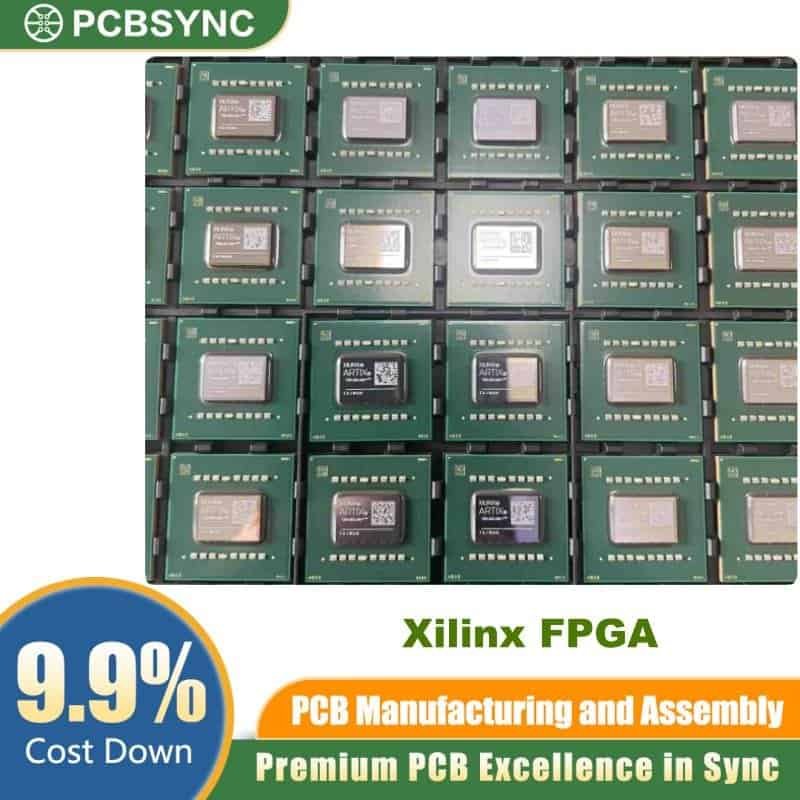
The XC3S400-4PQG208I is a high-performance, cost-optimized field-programmable gate array (FPGA) from AMD Xilinx, part of the widely deployed Spartan-3 family. Designed for high-volume applications that demand efficient logic density and reliable operation across industrial temperature ranges, this device remains a popular choice for embedded systems, communications, and signal processing designs. If you are sourcing a Xilinx FPGA for your next project, understanding the full specifications of this component is essential.
What Is the XC3S400-4PQG208I?
The XC3S400-4PQG208I combines 400,000 system gates with a rich set of embedded resources in a compact 208-pin Plastic Quad Flat Pack (PQFP) package. It belongs to Xilinx’s Spartan-3 generation — a family engineered specifically to deliver the highest logic density per dollar. The “4” in the part number refers to the speed grade (–4 being the slowest/most economical), the “PQG208” designates the 208-lead PQFP package, and the “I” suffix confirms its Industrial temperature range (–40°C to +85°C).
XC3S400-4PQG208I Key Specifications
General Device Parameters
| Parameter |
Value |
| Manufacturer |
AMD (Xilinx) |
| Part Number |
XC3S400-4PQG208I |
| Series |
Spartan-3 |
| Logic Cells |
8,064 |
| System Gates |
400,000 |
| CLB Array (Rows × Columns) |
22 × 16 |
| Total CLBs |
352 |
| Flip-Flops |
7,168 |
| Max Distributed RAM (bits) |
56,192 |
Memory Resources
| Memory Type |
Capacity |
| Block RAM (18K bits each) |
16 × 18Kb = 288 Kbits total |
| Distributed RAM |
56,192 bits |
| Shift Registers |
Supported via SRL16 |
I/O and Packaging
| Parameter |
Value |
| Package Type |
PQFP (Plastic Quad Flat Pack) |
| Package Code |
PQG208 |
| Total Pins |
208 |
| Maximum User I/O Pins |
141 |
| I/O Standards Supported |
LVTTL, LVCMOS, SSTL, HSTL, PCI, GTL |
| Differential I/O Pairs |
Yes (LVDS, RSDS, PPDS) |
Performance and Power
| Parameter |
Value |
| Speed Grade |
–4 (Commercial slowest) |
| Core Voltage (VCCINT) |
1.2V |
| I/O Voltage (VCCO) |
1.2V – 3.3V |
| Operating Temperature |
–40°C to +85°C (Industrial) |
| Configuration Modes |
Master Serial, Slave Serial, Master Parallel, JTAG |
DSP and Clock Resources
| Parameter |
Value |
| Multipliers (18×18 bit) |
16 |
| Digital Clock Managers (DCMs) |
4 |
| Global Clock Inputs |
24 |
| Max Frequency (internal logic) |
Up to ~200 MHz (speed-grade dependent) |
XC3S400-4PQG208I Detailed Feature Overview
#### Configurable Logic Blocks (CLBs)
Each CLB in the Spartan-3 device contains four slices, and each slice contains two 4-input look-up tables (LUTs), two storage elements (flip-flops or latches), dedicated carry logic, and wide-function multiplexers. This architecture enables efficient implementation of arithmetic, control, and state-machine logic.
#### Embedded Block RAM
The 16 dedicated block RAMs, each 18Kb in size, provide 288 Kbits of true dual-port synchronous memory. Each block RAM can be configured as various widths and depths, supporting applications such as FIFOs, lookup tables, and embedded processor instruction memory.
#### DSP Multipliers
The 16 dedicated 18×18-bit multipliers allow high-throughput digital signal processing without consuming CLB resources. They are ideal for filters, FFT butterflies, and motor control algorithms.
#### Digital Clock Managers (DCMs)
Four on-chip DCMs provide clock multiplication, division, phase shifting, and deskewing. Each DCM eliminates clock distribution skew and enables flexible multi-clock domain designs — critical for high-speed communication interfaces and synchronous memory controllers.
#### SelectIO Technology
The XC3S400-4PQG208I supports Xilinx SelectIO™ technology across all 141 user I/O pins. It is compatible with a broad range of single-ended and differential I/O standards, enabling interfaces to DDR/DDR2 SDRAM, SRAM, Flash, FPGAs, ASICs, and general-purpose logic.
#### JTAG Boundary Scan
Full IEEE 1149.1 JTAG boundary scan support simplifies board-level testing and in-system programming, reducing manufacturing test complexity.
XC3S400-4PQG208I Ordering and Part Number Breakdown
Understanding the part number helps avoid ordering errors:
| Field |
Code |
Meaning |
| Family |
XC3S |
Spartan-3 Series |
| Gates |
400 |
400K System Gates |
| Speed Grade |
-4 |
Speed Grade –4 (slowest, most cost-effective) |
| Package |
PQG |
Plastic Quad Flat Pack (PQFP) |
| Pin Count |
208 |
208 total pins |
| Temperature |
I |
Industrial (–40°C to +85°C) |
XC3S400-4PQG208I vs. Other Spartan-3 Variants
| Part Number |
Gates |
Package |
I/O Pins |
Temp Range |
Speed Grade |
| XC3S400-4PQG208C |
400K |
PQFP-208 |
141 |
Commercial (0°C to +85°C) |
–4 |
| XC3S400-4PQG208I |
400K |
PQFP-208 |
141 |
Industrial (–40°C to +85°C) |
–4 |
| XC3S400-5PQG208I |
400K |
PQFP-208 |
141 |
Industrial |
–5 (faster) |
| XC3S200-4PQG208I |
200K |
PQFP-208 |
141 |
Industrial |
–4 |
| XC3S1000-4FTG256I |
1M |
FBGA-256 |
173 |
Industrial |
–4 |
Note: The “I” suffix is critical when ordering for industrial or automotive-adjacent applications where temperature excursions below 0°C are possible.
Typical Applications for XC3S400-4PQG208I
The XC3S400-4PQG208I is deployed across a wide range of industries and application types:
#### Industrial Automation
- PLC I/O expansion and glue logic
- Motor control with PWM generation
- Real-time sensor data acquisition
#### Communications and Networking
- Protocol bridging (SPI, I²C, UART, CAN)
- Packet processing and header parsing
- Line card interfaces
#### Embedded and Consumer Electronics
- Co-processor acceleration for microcontrollers
- Video timing controller and OSD generation
- Custom peripheral IP integration
#### Test and Measurement
- Pattern generators and logic analyzers
- High-speed data capture and buffering
- Instrument front-end interface logic
Configuration Methods
The XC3S400-4PQG208I supports multiple configuration modes depending on system requirements:
| Mode |
Description |
Common Use Case |
| Master Serial |
FPGA reads bitstream from serial Flash |
Low pin-count, space-constrained PCBs |
| Slave Serial |
External controller drives bitstream |
Daisy-chain multi-FPGA systems |
| Master Parallel |
FPGA reads byte-wide parallel Flash |
Fast configuration startup |
| Boundary Scan (JTAG) |
IEEE 1149.1 via TDI/TDO/TMS/TCK |
In-system programming and debug |
PCB Design Considerations
When designing a PCB around the XC3S400-4PQG208I in the 208-pin PQFP package, consider the following best practices:
- Decoupling capacitors: Place 100nF ceramic capacitors on every VCCINT and VCCO power pin, as close to the package as possible.
- Power planes: Provide separate, low-impedance planes for VCCINT (1.2V) and each VCCO bank voltage.
- Thermal management: The 208-pin PQFP has an exposed thermal pad under some variants; verify the package datasheet for die attach and thermal resistance values.
- Configuration interface: Use dedicated series resistors (typically 33–47Ω) on JTAG lines to prevent overshoot on high-frequency TCK signals.
- I/O bank assignment: Group I/Os requiring the same VCCO voltage into the same bank to avoid multi-voltage bank conflicts.
Development Tools and Software Support
The XC3S400-4PQG208I is supported by AMD Xilinx’s ISE Design Suite (the legacy toolchain for Spartan-3). Key tools include:
| Tool |
Purpose |
| ISE Project Navigator |
RTL design entry, synthesis, implementation |
| XST (Xilinx Synthesis Technology) |
Logic synthesis from VHDL/Verilog |
| iMPACT |
Device programming via JTAG or iSP |
| ChipScope Pro |
In-system logic analyzer for debug |
| PlanAhead |
Floorplanning and timing closure |
Note: ISE is a legacy tool no longer under active development. New designs should consider migrating to newer Xilinx/AMD families (e.g., Spartan-7, Artix-7) supported by Vivado Design Suite.
Compliance and Certifications
| Standard |
Status |
| RoHS Compliance |
Available in RoHS-compliant variants |
| MSL (Moisture Sensitivity Level) |
MSL 3 |
| ESD Sensitivity |
Class 2 (HBM), Class B (CDM) |
| Lead-Free (Pb-Free) |
Yes (Pb-Free variants available) |
Frequently Asked Questions (FAQ)
Q: What is the difference between XC3S400-4PQG208I and XC3S400-4PQG208C? The only difference is the operating temperature range. The “I” suffix indicates Industrial grade (–40°C to +85°C), while “C” is Commercial grade (0°C to +85°C). For applications in outdoor, automotive-adjacent, or harsh environments, always select the “I” variant.
Q: Can I use Vivado to program the XC3S400-4PQG208I? No. The Spartan-3 family is only supported by Xilinx ISE Design Suite (version 14.7 is the final release). Vivado does not support pre-7-series devices.
Q: What Flash device is recommended for configuration? Xilinx Platform Flash devices (e.g., XCF01S, XCF02S) are the traditional pairing. Standard SPI or parallel NOR Flash compatible with Xilinx configuration timing may also be used.
Q: Is the XC3S400-4PQG208I still in production? The Spartan-3 family is in an extended life / longevity phase. While AMD Xilinx continues to support existing customers, new designs should evaluate the Spartan-7 or Artix-7 families for improved performance and toolchain support.
Summary
The XC3S400-4PQG208I delivers a compelling combination of 400,000 system gates, 16 block RAMs, 16 dedicated multipliers, 4 DCMs, and 141 user I/Os — all in a widely available 208-pin PQFP footprint — with industrial temperature reliability. Whether you are maintaining an existing production design or evaluating legacy Spartan-3 resources for a cost-sensitive application, this device remains a well-understood, deeply documented solution with broad ecosystem support.