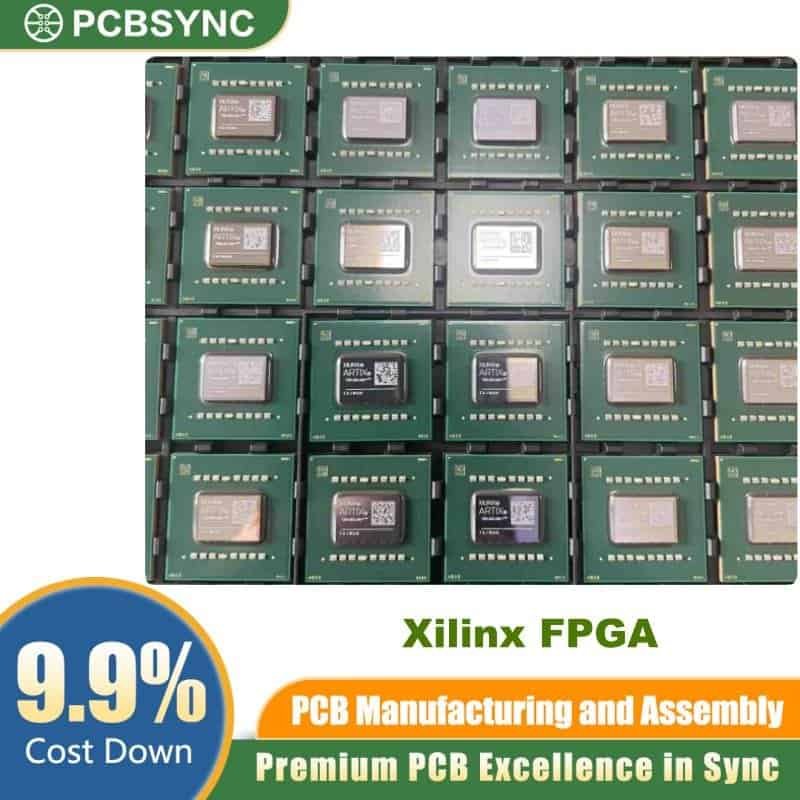
The XC3S400-5PQG208C is a high-performance, cost-optimized field-programmable gate array (FPGA) from Xilinx (now AMD). Part of the Spartan-3 family, this device is engineered to deliver impressive logic density, flexible I/O, and reliable operation for a wide range of embedded and digital design applications. Whether you are designing communication interfaces, industrial controllers, or consumer electronics, the XC3S400-5PQG208C offers an excellent balance of performance, power, and price.
What Is the XC3S400-5PQG208C?
The XC3S400-5PQG208C is a member of the Xilinx Spartan-3 FPGA series — one of the most widely deployed Xilinx FPGA product lines in the industry. The “400” in the part number refers to the 400K system gate count, while “5” denotes the speed grade, “PQG208” specifies the 208-pin Plastic Quad Flat Pack (PQFP) package, and “C” indicates the commercial temperature range (0°C to +85°C).
This FPGA is ideal for engineers who need a proven, programmable logic platform that integrates seamlessly into production PCB designs with well-established design toolchains.
Key Specifications at a Glance
| Parameter |
Value |
| Manufacturer |
AMD / Xilinx |
| Part Number |
XC3S400-5PQG208C |
| Series |
Spartan-3 |
| Logic Cells |
8,064 |
| System Gates |
400,000 |
| Flip-Flops |
7,168 |
| Distributed RAM |
56 Kb |
| Block RAM |
288 Kb (8 x 18Kb blocks) |
| Multipliers (18×18) |
16 |
| DCMs (Digital Clock Managers) |
4 |
| Max I/O Pins |
141 |
| Package |
PQFP-208 (PQG208) |
| Temperature Range |
0°C to +85°C (Commercial) |
| Speed Grade |
-5 |
| Supply Voltage (VCCINT) |
1.2V |
| Supply Voltage (VCCO) |
1.2V – 3.3V |
| Operating Frequency |
Up to ~200 MHz (depending on design) |
| Process Technology |
90 nm |
| RoHS Compliant |
Yes |
XC3S400-5PQG208C: Detailed Feature Breakdown
Logic Resources
The XC3S400-5PQG208C contains 8,064 logic cells organized into Configurable Logic Blocks (CLBs). Each CLB consists of four slices, and each slice contains two 4-input Look-Up Tables (LUTs) and two flip-flops. This structure enables efficient implementation of complex combinational and sequential logic.
| Resource |
Quantity |
| CLBs |
1,152 (16 x 72 array) |
| Slices |
3,584 |
| 4-input LUTs |
7,168 |
| Flip-Flops |
7,168 |
| Maximum Distributed RAM |
56 Kb |
Memory Resources
The device includes 288 Kb of block RAM organized as eight 18 Kb dual-port block RAM primitives. These can be configured as single-port or dual-port memories, FIFOs, or shift registers, making them versatile for buffering and data storage tasks.
| Memory Type |
Size |
| Block RAM (total) |
288 Kb |
| Block RAM primitives |
8 x 18 Kb |
| Distributed RAM (max) |
56 Kb |
Digital Signal Processing (DSP) Resources
For signal processing and arithmetic-intensive applications, the XC3S400-5PQG208C includes 16 dedicated 18×18 hardware multipliers. These multipliers accelerate DSP functions such as filtering, FFT computation, and digital communications without consuming CLB logic resources.
Clock Management
Four Digital Clock Managers (DCMs) are embedded in the device. DCMs support clock multiplication, division, phase shifting, and duty-cycle correction. This capability simplifies clocking strategies in designs with multiple clock domains.
| Feature |
Details |
| Number of DCMs |
4 |
| Clock multiply/divide |
Yes |
| Phase shift |
Yes |
| Duty-cycle correction |
Yes |
I/O Interface Capabilities
The XC3S400-5PQG208C supports up to 141 user I/O pins in the PQG208 package. The I/O banks are flexible and support a wide range of single-ended and differential I/O standards.
Supported I/O Standards
| Standard |
Type |
| LVCMOS 3.3V / 2.5V / 1.8V / 1.5V |
Single-ended |
| LVTTL |
Single-ended |
| PCI 3.3V |
Single-ended |
| LVDS |
Differential |
| RSDS |
Differential |
| BLVDS |
Differential |
| HSTL Class I / II |
Single-ended |
| SSTL 2 / 3 |
Single-ended |
Package Information: PQG208 (PQFP-208)
The PQG208 package is a 208-pin Plastic Quad Flat Pack. Its large lead count and standard 0.5 mm pitch make it compatible with conventional PCB assembly processes, including surface-mount technology (SMT). The package dimensions and thermal characteristics are summarized below.
| Parameter |
Value |
| Package Type |
PQFP (Plastic Quad Flat Pack) |
| Pin Count |
208 |
| Lead Pitch |
0.5 mm |
| Body Size |
28 mm × 28 mm |
| Mounting Style |
Surface Mount |
| Height (seated) |
3.4 mm (max) |
| Thermal Resistance (θJA) |
~35°C/W (still air) |
Operating Conditions
Absolute Maximum Ratings
| Parameter |
Min |
Max |
| VCCINT Supply Voltage |
-0.5V |
+1.32V |
| VCCO Supply Voltage |
-0.5V |
+4.0V |
| Storage Temperature |
-65°C |
+150°C |
Recommended Operating Conditions
| Parameter |
Min |
Typical |
Max |
| VCCINT |
1.14V |
1.2V |
1.26V |
| VCCO (3.3V bank) |
3.135V |
3.3V |
3.465V |
| Ambient Temperature (Commercial) |
0°C |
— |
+85°C |
Configuration Methods
The XC3S400-5PQG208C supports multiple configuration modes, providing design flexibility for production and prototyping environments.
| Mode |
Description |
| Master Serial |
External serial configuration PROM (e.g., Xilinx XCFxxS) |
| Slave Serial |
Configured by an external processor or FPGA |
| Master SelectMAP |
Parallel configuration via 8-bit SelectMAP bus |
| Slave SelectMAP |
Controlled by host processor |
| JTAG |
In-circuit programming and debugging via IEEE 1149.1 |
| Master SPI |
Serial Flash via SPI interface |
Typical Applications
The XC3S400-5PQG208C is suited for a broad range of applications across multiple industries. Its logic capacity, DSP resources, and flexible I/O make it a solid choice wherever a programmable, mid-density logic solution is needed.
Industrial and Embedded Systems
- Motor control interfaces
- Industrial communication protocols (UART, SPI, I²C, CAN)
- Machine vision pre-processing
- PLC and industrial I/O expansion
Communications and Networking
- Serial protocol bridging (RS-232, RS-485)
- Ethernet MAC implementation
- Low-speed wireless baseband processing
- Data framing and encoding (8b/10b, Manchester)
Consumer Electronics and Education
- FPGA-based educational kits
- Video signal processing
- Audio DSP prototyping
- Gaming and display controller logic
Aerospace and Defense (Non-extreme-temperature variant)
- Command and data handling prototyping
- Interface bridge designs
- Low-density signal processing at commercial grade
Part Number Breakdown
Understanding the Xilinx part number system helps engineers select the right variant for their design requirements.
| Code |
Meaning |
| XC3S |
Spartan-3 FPGA family |
| 400 |
400K system gate equivalent |
| -5 |
Speed grade (higher number = faster) |
| PQG |
PQFP package type |
| 208 |
208 pins |
| C |
Commercial temperature range (0°C to +85°C) |
XC3S400-5PQG208C vs. Similar Spartan-3 Devices
When selecting an FPGA for your design, it helps to compare the XC3S400-5PQG208C against adjacent devices in the Spartan-3 family.
| Part Number |
System Gates |
Logic Cells |
Block RAM |
Multipliers |
Max I/O |
Package |
| XC3S100E-4VQG100C |
100K |
2,160 |
72 Kb |
4 |
63 |
VQG100 |
| XC3S200-5PQG208C |
200K |
4,320 |
216 Kb |
12 |
141 |
PQG208 |
| XC3S400-5PQG208C |
400K |
8,064 |
288 Kb |
16 |
141 |
PQG208 |
| XC3S1000-5FTG256C |
1M |
17,280 |
432 Kb |
24 |
391 |
FTG256 |
| XC3S1500-5FG320C |
1.5M |
29,952 |
648 Kb |
32 |
487 |
FG320 |
The XC3S400-5PQG208C occupies the sweet spot for designs requiring more than entry-level logic capacity but not yet needing the higher cost of a 1M+ gate device.
Design Tools and Software Support
The XC3S400-5PQG208C is fully supported by Xilinx ISE Design Suite, the legacy toolchain for Spartan-3 and other older Xilinx families. While Vivado does not support Spartan-3, ISE remains freely available for legacy design support.
| Tool |
Details |
| Primary Toolchain |
Xilinx ISE Design Suite 14.7 |
| Simulation |
ISim, ModelSim, XSIM |
| Synthesis |
XST (Xilinx Synthesis Technology) |
| IP Core Support |
Xilinx LogiCORE IP catalog |
| JTAG Debugging |
ChipScope Pro Analyzer |
| Constraints |
UCF (User Constraints File) |
Ordering and Availability
| Attribute |
Details |
| Manufacturer Part No. |
XC3S400-5PQG208C |
| DigiKey Part No. |
1951723 |
| Manufacturer |
AMD (Xilinx) |
| Lead-Free / RoHS |
Yes |
| Moisture Sensitivity Level (MSL) |
3 |
| Product Status |
Active (check distributor for latest stock) |
Frequently Asked Questions (FAQ)
What does the “-5” speed grade mean in XC3S400-5PQG208C?
The “-5” speed grade indicates the performance tier of the device. In the Spartan-3 family, higher speed grade numbers correspond to faster devices. The -5 grade offers the best timing performance within the XC3S400 family, making it suitable for higher-frequency designs compared to -4 or -3 speed grades.
Is the XC3S400-5PQG208C RoHS compliant?
Yes. The “C” suffix in the part number combined with the standard packaging denotes a lead-free, RoHS-compliant device. Always verify with your distributor for the latest compliance documentation.
Can the XC3S400-5PQG208C be programmed using JTAG?
Yes, the device fully supports IEEE 1149.1 JTAG for in-circuit configuration and boundary scan testing. This is commonly used during development and prototyping with a Xilinx Platform Cable USB or compatible programmer.
What configuration PROM is compatible with this FPGA?
Xilinx XCFxxS (Platform Flash) PROMs are the standard companion configuration devices for the Spartan-3 family. For the XC3S400, the XCF04S (4 Mb) is typically sufficient to store the bitstream.
Does Vivado support XC3S400-5PQG208C?
No. Vivado does not support the Spartan-3 family. You must use Xilinx ISE Design Suite 14.7 (the final ISE release), which is available as a free download from the AMD/Xilinx website for Windows and Linux.
Summary
The XC3S400-5PQG208C is a mature, reliable, and cost-effective FPGA solution for engineers needing programmable logic at the 400K gate level. With 8,064 logic cells, 288 Kb of block RAM, 16 hardware multipliers, four DCMs, and 141 flexible I/O pins in a PCB-friendly 208-pin PQFP package, this device continues to serve production designs across industrial, communications, and consumer electronics domains. Its strong ecosystem of design tools, reference designs, and application notes makes it an accessible choice for both experienced FPGA designers and those transitioning into programmable logic design.