Inquire: Call 0086-755-23203480, or reach out via the form below/your sales contact to discuss our design, manufacturing, and assembly capabilities.
Quote: Email your PCB files to Sales@pcbsync.com (Preferred for large files) or submit online. We will contact you promptly. Please ensure your email is correct.
Notes: For PCB fabrication, we require PCB design file in Gerber RS-274X format (most preferred), *.PCB/DDB (Protel, inform your program version) format or *.BRD (Eagle) format. For PCB assembly, we require PCB design file in above mentioned format, drilling file and BOM. Click to download BOM template To avoid file missing, please include all files into one folder and compress it into .zip or .rar format.
Node-RED Arduino: Visual IoT Programming for Modern Electronics Projects
As a PCB engineer who’s spent countless hours debugging embedded systems and wrestling with complex code, I can tell you that Node-RED Arduino integration has fundamentally changed how we approach IoT development. Instead of writing hundreds of lines of C++ code for simple sensor monitoring or automation tasks, you can now wire together functional nodes in a visual interface that makes sense at first glance.
The shift from traditional Arduino IDE programming to Node-RED’s flow-based approach isn’t just about convenience—it’s about rethinking how we build connected devices. When you’re managing multiple sensors, actuators, and communication protocols on a custom PCB, Node-RED Arduino becomes your command center for rapid prototyping and deployment.
Node-RED is an open-source flow-based programming tool originally developed by IBM for wiring together hardware devices, APIs, and online services. When combined with Arduino boards, it creates a powerful ecosystem for IoT applications without requiring deep programming expertise.
The beauty of this combination lies in its accessibility. While traditional <a href=”https://pcbsync.com/arduino/”>Arduino</a> programming requires understanding C++ syntax, memory management, and library dependencies, Node-RED lets you drag and drop functional blocks that handle these complexities behind the scenes.
How Node-RED Communicates with Arduino
The connection between Node-RED and Arduino typically happens through three main protocols:
Serial Communication: The most straightforward method where Node-RED reads and writes data through USB serial connection. This works well for direct connections but limits your Arduino’s mobility.
Firmata Protocol: A generic protocol that transforms your Arduino into a controllable peripheral. You upload Firmata firmware once, then control all pins and functions through Node-RED without reprogramming the board.
MQTT Protocol: For networked applications, Arduino connects to an MQTT broker, and Node-RED subscribes to topics. This enables wireless communication and scales beautifully across multiple devices.
Setting Up Your Node-RED Arduino Environment
Getting started requires systematic preparation. From my experience designing custom PCBs with embedded Arduino-compatible microcontrollers, proper setup prevents 90% of troubleshooting headaches later.
System Requirements and Installation
Component
Minimum Requirement
Recommended
Operating System
Windows 10, macOS 10.14, Linux
Latest stable release
Node.js Version
14.x
18.x or 20.x LTS
RAM
512 MB
2 GB or more
Arduino Board
Uno, Nano, Mega
ESP32, ESP8266 for WiFi
USB Ports
1 available
2+ for multiple devices
Installing Node-RED on Windows:
Open PowerShell as administrator and run:
npm install -g –unsafe-perm node-red
Installing on macOS/Linux:
sudo npm install -g –unsafe-perm node-red
After installation, launch Node-RED by typing node-red in your terminal. The server starts on http://localhost:1880 by default.
Essential Node-RED Arduino Nodes
The Node-RED ecosystem includes specialized nodes for Arduino interaction. Install these through the palette manager:
node-red-node-arduino: The official node for Firmata communication. It provides direct pin control and works reliably with standard Arduino boards.
node-red-node-serialport: Critical for custom serial protocols. When you’ve designed a PCB with specialized communication needs, this node handles raw serial data transmission.
node-red-contrib-gpio: For Raspberry Pi GPIO control, useful when combining Arduino with other SBC platforms in complex systems.
node-red-dashboard: Creates instant web-based interfaces for monitoring and controlling your Arduino projects without writing HTML or JavaScript.
Configuring Arduino for Node-RED Control
Before Node-RED can communicate with your Arduino, you need to prepare the board correctly. This varies based on your chosen communication method.
Uploading Firmata Firmware
For most beginners and prototyping scenarios, Firmata offers the fastest path to functionality:
Open Arduino IDE
Navigate to File → Examples → Firmata → StandardFirmata
Select your board type under Tools → Board
Choose the correct COM port
Click Upload
Once Firmata is running, your Arduino becomes a generic I/O device controllable entirely from Node-RED. This approach works brilliantly for testing PCB prototypes where you’re still determining optimal sensor configurations.
Custom Serial Communication Setup
When building production PCBs or devices requiring specific communication protocols, custom serial communication provides better control:
void setup() {
Serial.begin(9600);
pinMode(13, OUTPUT);
}
void loop() {
if (Serial.available() > 0) {
char command = Serial.read();
if (command == ‘1’) {
digitalWrite(13, HIGH);
Serial.println(“LED ON”);
} else if (command == ‘0’) {
digitalWrite(13, LOW);
Serial.println(“LED OFF”);
}
}
}
This Arduino sketch responds to serial commands from Node-RED, giving you precise control over command structure and response formatting.
Building Your First Node-RED Arduino Flow
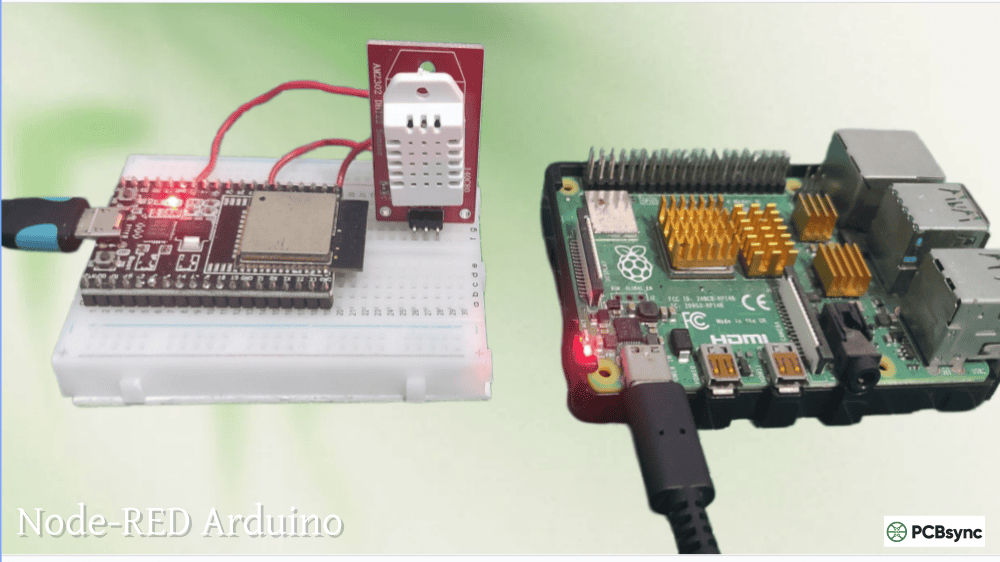
Theory becomes practical knowledge through hands-on implementation. Let’s construct a temperature monitoring system that reads from a DHT22 sensor and displays data on a web dashboard.
Basic Temperature Monitor Flow
The flow architecture consists of:
Input Node: Arduino node configured for analog or digital reading Processing Node: Function node for data transformation and calculation Output Nodes: Debug node for development and dashboard gauge for visualization
In Node-RED’s flow editor, drag an Arduino input node onto the canvas. Double-click to configure:
Board: Select your Arduino’s serial port
Pin: Choose the pin connected to your sensor
Type: Set as analog input for temperature sensors
Connect a function node containing:
var voltage = msg.payload * (5.0 / 1023.0);
var temperatureC = (voltage – 0.5) * 100;
msg.payload = temperatureC;
return msg;
This converts the raw analog reading into Celsius temperature values.
Creating Interactive Dashboards
The dashboard nodes transform raw data into professional interfaces. Add a gauge node and configure:
Property
Value
Purpose
Label
Temperature
Display name
Units
°C
Measurement unit
Range
0-50
Expected value range
Colour Gradient
Blue-Green-Red
Visual temperature indication
Deploy your flow and navigate to http://localhost:1880/ui to see your live temperature gauge updating in real-time.
Once comfortable with basics, Node-RED Arduino enables sophisticated systems that would require extensive traditional programming.
Multi-Sensor Data Logging System
Professional PCB designs often incorporate multiple sensors requiring simultaneous monitoring. Node-RED excels at coordinating these inputs:
Create parallel flows for each sensor, then merge data using a join node. Configure the join node to combine payloads into a single JSON object:
{
“temperature”: 23.5,
“humidity”: 45.2,
“pressure”: 1013.25,
“timestamp”: “2026-02-04T10:30:00Z”
}
Connect this to a file node configured for CSV output, creating automatic data logging without writing complex Arduino SD card routines.
Wireless IoT Control with ESP32
When your PCB design includes ESP32 or ESP8266 modules, MQTT communication unlocks powerful remote control capabilities:
Arduino MQTT Publishing Code:
#include <WiFi.h>
#include <PubSubClient.h>
const char* ssid = “YourWiFi”;
const char* mqtt_server = “broker.hivemq.com”;
WiFiClient espClient;
PubSubClient client(espClient);
void setup() {
WiFi.begin(ssid, password);
client.setServer(mqtt_server, 1883);
}
void loop() {
if (!client.connected()) reconnect();
client.loop();
float sensorValue = analogRead(A0);
char msg[50];
snprintf(msg, 50, “%.2f”, sensorValue);
client.publish(“sensor/data”, msg);
delay(5000);
}
In Node-RED, add an MQTT input node subscribed to sensor/data, process the incoming values, and trigger actions through MQTT output nodes publishing to control/relay topics your ESP32 subscribes to.
Home Automation Integration
Node-RED’s extensive library includes nodes for popular smart home platforms. Integrate Arduino-controlled relays with:
Home Assistant: Direct API calls for seamless integration
Google Home/Alexa: Through MQTT bridges or HTTP endpoints
Symptom: Arduino node shows “disconnected” despite proper port selection
Issue
Cause
Fix
Wrong firmware
Non-Firmata sketch uploaded
Re-upload StandardFirmata
Baud rate mismatch
Node-RED expects 57600, sketch uses different
Verify Firmata uses 57600 baud
Board not responding
Corrupted firmware upload
Reset board and re-upload
Port permissions
Linux USB access denied
Add user to dialout group: sudo usermod -a -G dialout $USER
Performance and Timing Issues
When building real-time control systems on custom PCBs, timing precision matters. Node-RED operates on event-driven architecture, which introduces slight latency compared to bare-metal Arduino code.
For critical timing requirements (under 10ms response), keep time-sensitive operations in Arduino code and use Node-RED for coordination, data aggregation, and user interface tasks.
Optimizing Node-RED Arduino Performance
Professional PCB deployments require reliability beyond prototype standards.
Reducing CPU Load
Node-RED runs on Node.js, which can consume significant resources with complex flows:
Limit debug nodes: Disable or remove debug nodes in production flows
Batch sensor readings: Instead of reading every 100ms, aggregate and transmit every second
Use efficient nodes: Replace heavy function nodes with optimized contributed nodes when available
Persistent Data Storage
For production IoT devices, implement proper data persistence:
Configure SQLite database nodes for local storage without external server dependencies. Create tables matching your sensor structure:
CREATE TABLE sensor_data (
id INTEGER PRIMARY KEY AUTOINCREMENT,
temperature REAL,
humidity REAL,
timestamp DATETIME DEFAULT CURRENT_TIMESTAMP
);
Connect your sensor flows to database insert nodes, ensuring data survives system restarts.
Security Considerations
When deploying Node-RED Arduino systems accessible over networks:
Enable authentication: Edit settings.js to require login credentials
Use HTTPS: Configure SSL certificates for encrypted communication
Implement MQTT security: Use username/password authentication and TLS encryption
Regular updates: Keep Node-RED, Node.js, and contributed nodes updated against vulnerabilities
Useful Resources and Tools
Official Documentation and Downloads
Node-RED Official Website: https://nodered.org/docs/ Complete documentation, tutorials, and community forums
Arduino Official Software: https://www.arduino.cc/en/software Download Arduino IDE for firmware uploads and serial debugging
Firmata GitHub Repository: https://github.com/firmata/arduino Access StandardFirmata firmware and protocol specifications
Recommended Node Packages
node-red-contrib-modbus: Essential for industrial PCB applications using Modbus protocol node-red-dashboard: Creates instant web interfaces (included with most installations) node-red-contrib-influxdb: Time-series database integration for long-term data analysis
Development Tools
Fritzing: Circuit diagram software for documenting Arduino connections (https://fritzing.org) PlatformIO: Advanced IDE supporting multiple boards and frameworks (https://platformio.org) MQTT Explorer: Desktop application for debugging MQTT communication (http://mqtt-explorer.com)
Community and Learning Platforms
Node-RED Forum: https://discourse.nodered.org/ Active community answering technical questions
Arduino Forum – Networking Section: https://forum.arduino.cc/c/18 Discussions on Arduino connectivity and IoT projects
GitHub Examples Repository: https://github.com/node-red/cookbook Curated collection of Node-RED flow examples
Real-World PCB Engineering Applications
In professional PCB design environments, Node-RED Arduino integration solves specific challenges:
Production Testing Automation
When manufacturing custom PCBs, automated testing ensures quality. Node-RED orchestrates test sequences:
Arduino controls test fixture relays and multiplexers
Sensors verify proper PCB component placement
Node-RED logs results to database
Dashboard displays pass/fail statistics in real-time
This reduces manual testing time from minutes to seconds per board.
Environmental Monitoring Systems
Deployed a warehouse monitoring system across 50+ locations using ESP32-based custom PCBs. Each board measures temperature, humidity, and door sensors, transmitting via MQTT. Node-RED aggregates data from all locations, triggers alerts for threshold violations, and generates daily reports—all configured visually without deploying updated firmware to remote devices.
Prototyping and Client Demonstrations
When presenting PCB concepts to clients, Node-RED provides immediate interactivity. Build working demonstrations showcasing sensor integration, control logic, and data visualization without finalizing production firmware. Clients see functional prototypes during early design phases, accelerating approval and reducing revision cycles.
Frequently Asked Questions
Q: Can I use Node-RED Arduino without programming knowledge?
A: Yes, for basic projects. Node-RED’s visual interface handles most logic through configuration rather than coding. However, understanding basic programming concepts helps with troubleshooting and advanced features. The function node requires JavaScript for custom data processing, but many tasks work with pre-built nodes requiring only configuration.
Q: Does Node-RED Arduino work with ESP32 and ESP8266 boards?
A: Absolutely. ESP32 and ESP8266 work excellently with Node-RED, particularly through MQTT or HTTP communication. These boards’ WiFi capabilities enable wireless interaction superior to USB-tethered Arduino boards. Upload appropriate firmware (MQTT client or web server code) and Node-RED communicates over your network. This approach is ideal for IoT applications where the board must operate independently.
Q: What’s the maximum number of Arduino boards I can control from one Node-RED instance?
A: There’s no strict limit—it depends on your system resources and communication method. Through serial connections, you’re limited by available USB ports (USB hubs extend this). Using MQTT or HTTP, dozens of boards can connect simultaneously. I’ve personally managed 30+ ESP32 boards from a single Raspberry Pi running Node-RED without performance issues. Each board publishes to unique MQTT topics for organized communication.
Q: Is Node-RED suitable for commercial product development?
A: Yes, with considerations. Node-RED excels for prototypes, internal tools, and monitoring systems. For consumer products requiring polished interfaces and offline operation, Node-RED may not be ideal. However, it’s perfect for industrial IoT, building automation, and business intelligence applications where flexibility and rapid updates matter more than standalone operation. Many companies use Node-RED as middleware coordinating multiple systems.
Q: How do I backup and version control my Node-RED flows?
A: Node-RED stores flows as JSON files in your user directory (typically ~/.node-red/flows_[hostname].json). Copy this file for backups. For version control, use Git integration through the Projects feature (Settings → Projects → Enable). This allows committing flow changes, branching for experimentation, and collaborative development. Export specific flows as JSON through the menu for sharing or documentation purposes.
Conclusion: The Future of Visual IoT Development
Node-RED Arduino represents a fundamental shift in embedded systems development. As someone who’s transitioned from purely code-based Arduino projects to flow-based architecture, the productivity gains are undeniable. What previously required a full day of coding, debugging, and testing now takes hours with visual programming.
The real power emerges when integrating Arduino with broader systems—databases, web services, cloud platforms, and smart home ecosystems. Node-RED eliminates the friction between these components, letting you focus on solving engineering problems rather than wrestling with integration code.
For PCB engineers, this toolset transforms how we approach connected device design. Prototypes become functional demonstrations faster. Client feedback integrates immediately without firmware recompilation. Production systems update through flow modifications rather than field firmware updates.
Whether you’re building a single temperature monitor or orchestrating a complex multi-sensor industrial system, Node-RED Arduino provides the visual tools to make IoT development accessible, maintainable, and genuinely enjoyable.
Inquire: Call 0086-755-23203480, or reach out via the form below/your sales contact to discuss our design, manufacturing, and assembly capabilities.
Quote: Email your PCB files to Sales@pcbsync.com (Preferred for large files) or submit online. We will contact you promptly. Please ensure your email is correct.
Notes: For PCB fabrication, we require PCB design file in Gerber RS-274X format (most preferred), *.PCB/DDB (Protel, inform your program version) format or *.BRD (Eagle) format. For PCB assembly, we require PCB design file in above mentioned format, drilling file and BOM. Click to download BOM template To avoid file missing, please include all files into one folder and compress it into .zip or .rar format.