Inquire: Call 0086-755-23203480, or reach out via the form below/your sales contact to discuss our design, manufacturing, and assembly capabilities.
Quote: Email your PCB files to Sales@pcbsync.com (Preferred for large files) or submit online. We will contact you promptly. Please ensure your email is correct.
Notes: For PCB fabrication, we require PCB design file in Gerber RS-274X format (most preferred), *.PCB/DDB (Protel, inform your program version) format or *.BRD (Eagle) format. For PCB assembly, we require PCB design file in above mentioned format, drilling file and BOM. Click to download BOM template To avoid file missing, please include all files into one folder and compress it into .zip or .rar format.
Adding true analog output capability to Arduino projects requires dedicated hardware since most Arduino boards lack digital-to-analog converters. As a PCB engineer who’s integrated DACs in countless designs, I’ve found the MCP4725 Arduino combination provides the most accessible solution for generating precise analog voltages. This comprehensive guide explores MCP4725 functionality, I2C interfacing, programming techniques, and practical applications enabling your Arduino to output smooth analog signals from 0V to supply voltage with 12-bit resolution.
The MCP4725 is a single-channel 12-bit digital-to-analog converter manufactured by Microchip Technology. Unlike PWM outputs that rapidly switch between HIGH and LOW to simulate analog voltages, the MCP4725 generates true DC analog voltage output proportional to the digital input value. The 12-bit resolution divides the voltage range into 4,096 discrete steps providing approximately 1.22mV resolution when operating at 5V supply.
From a circuit design perspective, the MCP4725 integrates a resistor-ladder DAC architecture with output buffering. The internal structure converts digital codes to analog voltages through a precise R-2R ladder network. An integrated operational amplifier buffers this voltage providing low output impedance capable of driving external loads directly without additional circuitry.
The I2C interface simplifies Arduino integration requiring only two wires (SDA and SCL) plus power connections. This serial communication method consumes minimal GPIO pins while supporting multiple devices on the same bus through addressing. The integrated EEPROM stores DAC values enabling power-on restoration of previous output voltage, a feature particularly valuable in applications requiring defined startup states.
Linearity: The integral nonlinearity (INL) specification of ±0.5 LSB maximum ensures output voltage remains proportional to input code across the entire range. This linearity proves critical for applications like sensor calibration or precision voltage references where distortion creates measurement errors.
Temperature Stability: Temperature coefficient of ±50 ppm/°C means output voltage shifts approximately 0.005% per degree Celsius. For most Arduino applications operating in controlled environments, this drift remains negligible. Precision applications requiring better stability need external reference sources or temperature compensation.
Update Rate: The DAC can theoretically update at 200kHz with fast-mode I2C (400kHz). Practical Arduino implementations achieve 10-50kHz update rates limited by Wire library overhead and code execution time. This speed supports audio frequency generation up to several kHz before aliasing becomes problematic.
MCP4725 Pinout and Connections
The typical MCP4725 breakout module includes six essential connections:
Standard Pin Functions
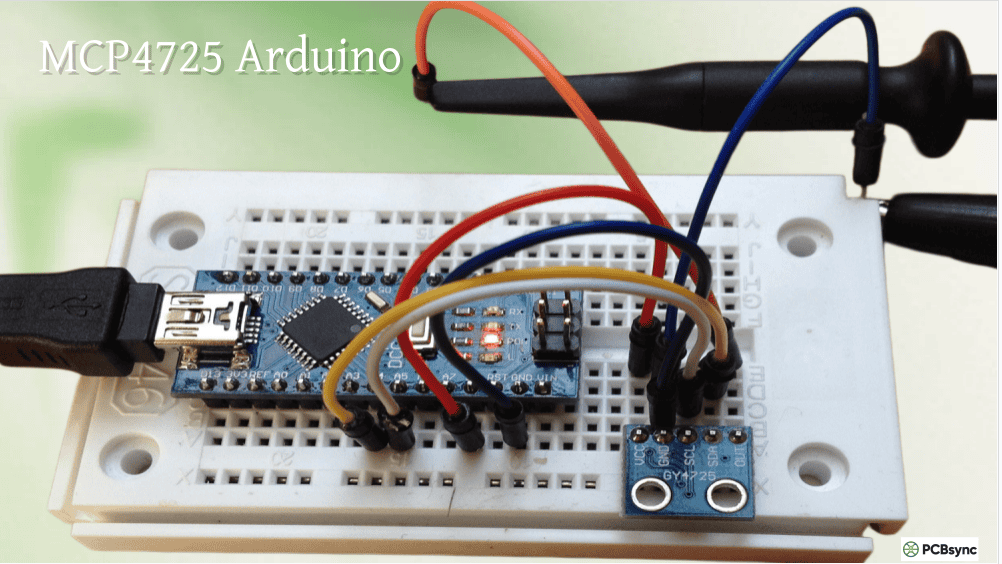
VDD (Power Supply): Connect to Arduino 5V or 3.3V depending on your system voltage. The MCP4725 operates across this range making it compatible with both standard and low-voltage Arduino variants.
GND (Ground): Common ground connection to Arduino GND pin. Ensure solid ground connection preventing voltage reference errors affecting output accuracy.
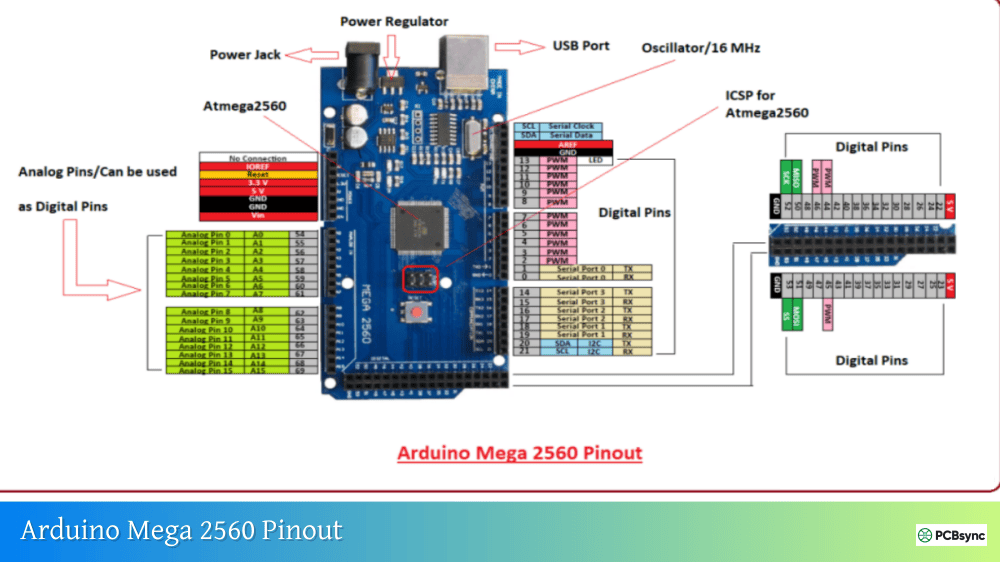
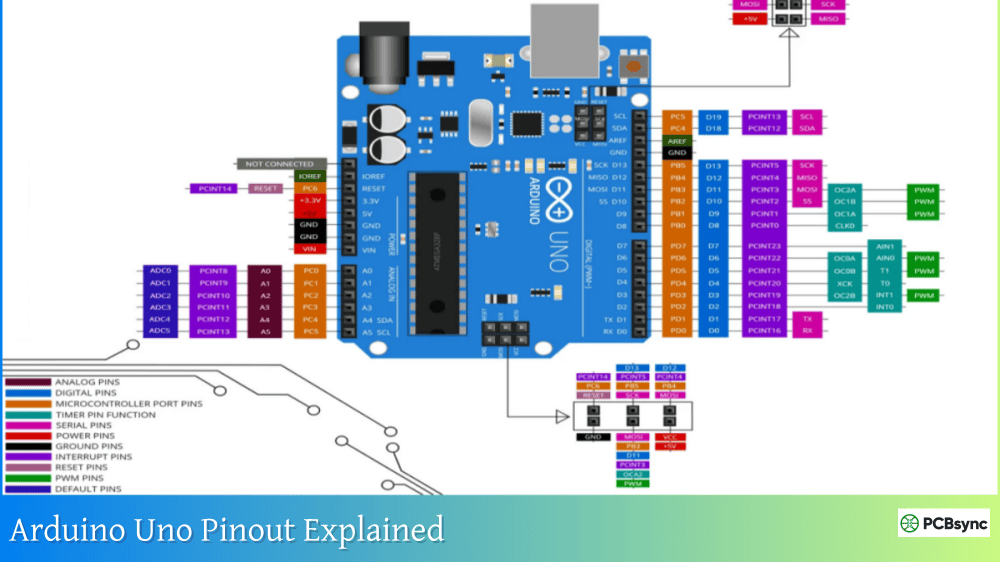
SDA (I2C Data): Serial data line for I2C communication. Connect to Arduino’s SDA pin (A4 on Uno, 20 on Mega, dedicated SDA pin on newer boards). Integrated 10kΩ pull-up resistor on most breakout boards eliminates need for external pull-ups.
SCL (I2C Clock): Serial clock line for I2C communication. Connect to Arduino’s SCL pin (A5 on Uno, 21 on Mega, dedicated SCL pin on newer boards). Pull-up resistor included on breakout modules.
A0 (Address Select): Optional address configuration pin. When unconnected or grounded, I2C address is 0x60 or 0x62 depending on manufacturer configuration. Connecting to VDD changes address to 0x61 or 0x63 enabling two MCP4725 modules on same I2C bus.
VOUT (Analog Output): The DAC output pin providing analog voltage from 0V to VDD based on programmed digital value. This pin can source up to 25mA enabling direct connection to high-impedance loads or buffered interfacing to lower impedance devices.
Optional Terminal Block
Many MCP4725 breakout boards include footprint for 3.5mm terminal block providing VOUT and GND connections. This professional connector simplifies permanent installations where screw terminals prove more reliable than header pins for field wiring.
Wiring MCP4725 to Arduino
Standard connections follow I2C protocol conventions:
Basic Arduino Uno Connection
MCP4725 VDD → Arduino 5V
MCP4725 GND → Arduino GND
MCP4725 SDA → Arduino A4
MCP4725 SCL → Arduino A5
MCP4725 A0 → Arduino GND (or leave unconnected)
MCP4725 VOUT → Your analog load or measurement point
This configuration uses default I2C address (typically 0x60 or 0x62 depending on manufacturer). The A0 pin determines address variation within the manufacturer’s allocated range.
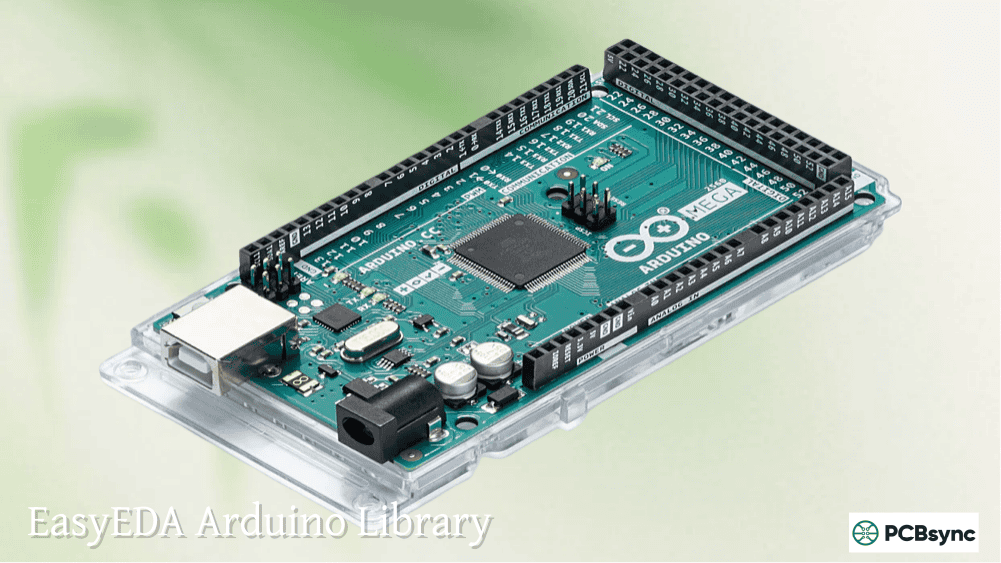
Arduino Mega 2560 Connections
The Mega uses different pins for I2C communication:
MCP4725 SDA → Arduino Pin 20
MCP4725 SCL → Arduino Pin 21
Power and ground connections remain identical. Always verify I2C pin assignments for your specific Arduino board variant as they differ across the family.
Multiple MCP4725 Modules
Connecting two modules requires address differentiation:
Module 1: A0 pin to GND (Address 0x60/0x62) Module 2: A0 pin to VDD (Address 0x61/0x63)
Both modules share VDD, GND, SDA, and SCL connections. Software addresses each independently using their unique I2C addresses. This configuration enables dual-channel analog output from single Arduino using just two I2C pins.
Programming MCP4725 with Arduino
The Adafruit MCP4725 library simplifies DAC control providing high-level functions abstracting I2C communication complexity:
Library Installation
Install through Arduino IDE Library Manager:
Open Arduino IDE
Navigate to Sketch → Include Library → Manage Libraries
Search “Adafruit MCP4725”
Click Install
Alternatively, download from GitHub and manually install as ZIP file through Sketch → Include Library → Add .ZIP Library.
Basic DAC Output Example
#include <Wire.h>
#include <Adafruit_MCP4725.h>
Adafruit_MCP4725 dac;
void setup() {
Serial.begin(9600);
// Initialize DAC with I2C address
dac.begin(0x60); // Try 0x60, 0x61, 0x62, or 0x63
Serial.println(“MCP4725 initialized”);
}
void loop() {
// Set DAC output to 2.5V (50% of 5V)
// 2048 = middle of 12-bit range (4096 / 2)
dac.setVoltage(2048, false);
Serial.println(“Output: 2.5V”);
delay(1000);
// Set DAC output to 1.25V (25% of 5V)
dac.setVoltage(1024, false);
Serial.println(“Output: 1.25V”);
delay(1000);
}
The setVoltage() function accepts two parameters:
value: DAC code from 0-4095 (12-bit)
writeEEPROM: Boolean determining EEPROM storage (false for temporary, true for persistent)
Setting writeEEPROM to true stores the value in non-volatile memory. On next power-up, the DAC restores this voltage automatically. Use this feature sparingly as EEPROM has limited write cycles (1 million minimum).
Generating Triangle Waveform
#include <Wire.h>
#include <Adafruit_MCP4725.h>
Adafruit_MCP4725 dac;
void setup() {
dac.begin(0x60);
}
void loop() {
// Rising edge: 0V to VDD
for(uint16_t i = 0; i < 4096; i++) {
dac.setVoltage(i, false);
delayMicroseconds(100); // Adjust for frequency
}
// Falling edge: VDD to 0V
for(uint16_t i = 4095; i > 0; i–) {
dac.setVoltage(i, false);
delayMicroseconds(100);
}
}
This code generates triangle wave output. The delay between updates determines frequency. Reducing delay increases frequency but excessive speed causes waveform distortion as DAC settling time and I2C communication overhead become limiting factors.
Sine Wave Generation Using Lookup Table
#include <Wire.h>
#include <Adafruit_MCP4725.h>
Adafruit_MCP4725 dac;
// 256-point sine wave lookup table (0-4095 range)
const uint16_t sineWave[256] PROGMEM = {
2048, 2098, 2148, 2198, 2248, 2298, 2348, 2398,
// … (complete sine wave table)
2148, 2098, 2048
};
void setup() {
dac.begin(0x60);
}
void loop() {
for(int i = 0; i < 256; i++) {
uint16_t value = pgm_read_word(&sineWave[i]);
dac.setVoltage(value, false);
delayMicroseconds(100);
}
}
The PROGMEM directive stores lookup table in flash memory rather than RAM conserving limited SRAM on Arduino. The sine wave table pre-calculates values improving execution speed compared to real-time trigonometric computation.
Voltage Calculation and Conversion
Understanding the relationship between digital values and output voltage enables precise control:
Digital-to-Voltage Conversion Formula
Output Voltage = (Digital Value / 4095) × VDD
Examples with 5V supply:
Digital Value 0 → 0V output
Digital Value 2048 → 2.5V output (50%)
Digital Value 4095 → 5.0V output (100%)
Voltage-to-Digital Conversion
When generating specific target voltage:
Digital Value = (Target Voltage / VDD) × 4095
Example: Generate 3.3V output with 5V supply Digital Value = (3.3V / 5.0V) × 4095 = 2702
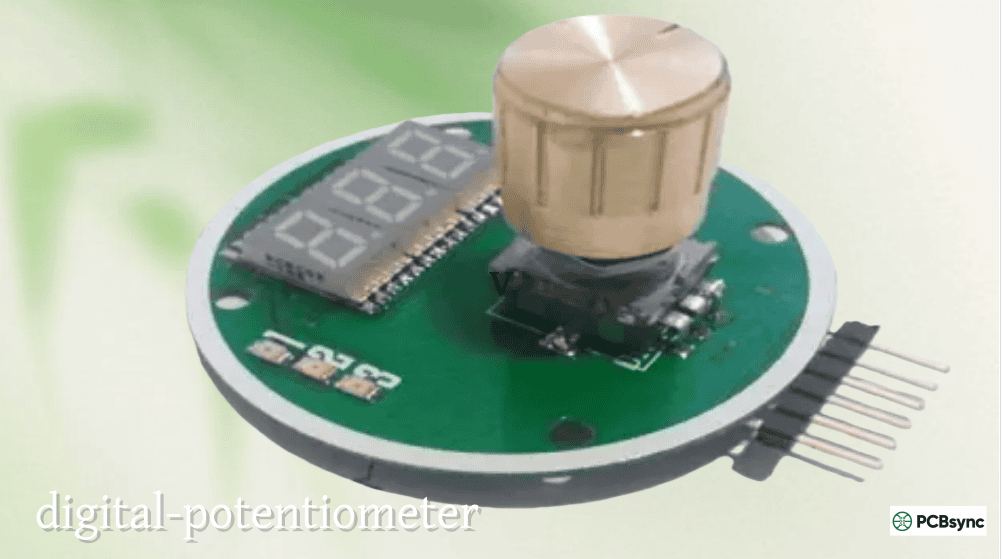
This application converts potentiometer rotation into precise voltage output useful for calibrating sensors or setting bias voltages in analog circuits.
Audio Tone Generator
Generate audio frequency tones through speaker or amplifier:
While not high-fidelity audio, this demonstrates DAC capability for simple tone generation. The update rate limits maximum frequency but produces recognizable musical notes.
LED Brightness Control
Achieve smooth LED dimming impossible with PWM at low frequencies:
#include <Wire.h>
#include <Adafruit_MCP4725.h>
Adafruit_MCP4725 dac;
void setup() {
dac.begin(0x60);
}
void loop() {
// Smooth fade up
for(uint16_t i = 0; i < 4096; i += 10) {
dac.setVoltage(i, false);
delay(5);
}
// Smooth fade down
for(uint16_t i = 4096; i > 0; i -= 10) {
dac.setVoltage(i, false);
delay(5);
}
}
Connect LED between VOUT and GND with appropriate current-limiting resistor. Calculate resistor value ensuring LED current remains under 20mA for safe DAC operation.
EEPROM Management and Power-On Behavior
The integrated EEPROM provides non-volatile storage for DAC values:
Writing to EEPROM
// Write value to EEPROM for power-on restoration
dac.setVoltage(2048, true); // Second parameter true enables EEPROM write
Important Considerations:
EEPROM writes take ~25-50ms compared to ~1ms for RAM-only writes
Limited to 1 million write cycles minimum
Avoid frequent EEPROM updates in loops
Use EEPROM storage only for configuration values
Recommended EEPROM Usage Pattern
void setup() {
dac.begin(0x60);
// Write default voltage only once during setup
dac.setVoltage(2048, true); // Store 2.5V as default
}
void loop() {
// Runtime changes without EEPROM writes
uint16_t value = analogRead(A0) * 4;
dac.setVoltage(value, false); // Fast RAM-only update
delay(100);
}
This pattern writes EEPROM once during initialization establishing power-on default then uses fast RAM updates during operation preserving EEPROM longevity.
Solutions: Scan I2C bus identifying actual address using I2C scanner sketch. Verify SDA/SCL connections including continuity check. Measure VDD at module confirming 5V ±0.2V. Try different address values (0x60, 0x61, 0x62, 0x63) in begin() function.
Noisy or Unstable Output
Symptoms: Output voltage fluctuates or contains ripple.
Solutions: Add 10μF capacitor between VOUT and GND close to output pin filtering high-frequency noise. Ensure common ground between Arduino and load. Reduce load current below 20mA or add buffer amplifier for higher current requirements. Place 0.1μF ceramic capacitor across VDD-GND pins near MCP4725.
Slow Update Rate
Symptoms: DAC output changes sluggishly or waveforms appear distorted.
Solutions: Increase I2C speed to 400kHz adding Wire.setClock(400000); in setup(). Minimize delays between setVoltage() calls. Consider RobTillaart MCP4725 library offering speed optimizations over Adafruit library. Pre-calculate lookup tables avoiding real-time computation.
Essential Resources for MCP4725 Projects
Resource Type
Description
Access
Microchip MCP4725 Datasheet
Official specifications
Microchip website PDF
Adafruit MCP4725 Library
Popular Arduino library
Arduino Library Manager
RobTillaart MCP4725 Library
Alternative optimized library
GitHub repository
Adafruit Breakout Board
Pre-made module with pull-ups
Adafruit Industries
SparkFun Breakout Board
Alternative breakout option
SparkFun Electronics
Downloadable Resources:
Example Sketches Collection: Tested code examples for voltage control, waveform generation, and sensor interfacing ready for modification and expansion.
Sine Wave Lookup Tables: Pre-calculated tables for various sample counts (64, 128, 256 points) optimizing memory usage versus waveform smoothness.
I2C Scanner Sketch: Diagnostic tool identifying connected I2C devices and their addresses simplifying troubleshooting.
Frequently Asked Questions
Q: Can I use MCP4725 with 3.3V Arduino boards?
A: Yes, the MCP4725 operates from 2.7V-5.5V supply voltage. When powered from 3.3V, output voltage ranges from 0V-3.3V. The I2C interface includes level shifters on most breakout boards supporting both 3.3V and 5V logic levels. Verify your specific breakout board specifications confirming voltage compatibility before connecting.
Q: Why does my DAC output voltage not reach exactly 0V or VDD?
A: The MCP4725 output remains within millivolts of true rail-to-rail performance but may not reach absolute 0V or VDD due to output buffer limitations. Datasheet specifies output voltage swings to VDD-10mV maximum and GND+10mV minimum. For applications requiring true ground reference, use op-amp buffer with negative supply rail. For precision applications, calibrate output measuring actual voltage at endpoints adjusting digital values compensating for offset.
Q: How fast can I update the MCP4725 output?
A: Theoretical maximum with 400kHz I2C approaches 50-100kHz update rate. Practical Arduino implementations achieve 5-20kHz limited by Wire library overhead, code execution, and DAC settling time. For audio applications, 10kHz update rate produces signals up to ~3-4kHz before aliasing becomes problematic. Higher speeds require optimized libraries or direct I2C register manipulation bypassing Wire library overhead.
Q: Can I drive motors or high-power loads directly from VOUT?
A: No, the VOUT pin maximum current of 25mA suits only high-impedance loads like op-amp inputs, LED indicators (with resistor), or MOSFET gates. For motor control or power applications, use VOUT to control external driver circuits. Connect VOUT to MOSFET gate or transistor base driving higher current loads. For precision current sources, VOUT feeds voltage-controlled current source circuits.
Q: What’s the difference between Adafruit and RobTillaart MCP4725 libraries?
A: Adafruit library provides simple intuitive interface ideal for beginners with excellent documentation and examples. RobTillaart library offers advanced features including percentage-based control, faster I2C modes, and multiple device management optimized for performance. For basic applications, Adafruit library suffices. Complex projects requiring maximum speed or managing multiple DACs benefit from RobTillaart’s optimizations and extended functionality.
Maximizing MCP4725 Arduino Integration
The MCP4725 Arduino combination transforms digital microcontroller platforms into systems capable of generating precision analog voltages. Understanding DAC principles, I2C communication, and practical limitations enables reliable implementations across diverse applications from audio synthesis to precision instrumentation.
Start with simple voltage output projects verifying basic functionality before advancing to waveform generation or complex control systems. Test DAC linearity measuring output at various digital values confirming accuracy meets application requirements. This validation prevents debugging challenges later when integration complexity increases.
For production designs, consider external buffering when driving low-impedance loads or requiring higher current capacity. The modest 25mA output capability limits direct interfacing but enables controlling external amplifiers and drivers economically. Rail-to-rail op-amps in unity-gain configuration provide excellent buffering maintaining DAC precision while supplying hundreds of milliamps.
The EEPROM feature proves invaluable for applications requiring defined power-on states. Storing calibration values or default configurations in non-volatile memory eliminates initialization code complexity and ensures consistent startup behavior across power cycles. Manage EEPROM writes carefully preserving endurance for multi-year operational lifetimes.
Inquire: Call 0086-755-23203480, or reach out via the form below/your sales contact to discuss our design, manufacturing, and assembly capabilities.
Quote: Email your PCB files to Sales@pcbsync.com (Preferred for large files) or submit online. We will contact you promptly. Please ensure your email is correct.
Notes: For PCB fabrication, we require PCB design file in Gerber RS-274X format (most preferred), *.PCB/DDB (Protel, inform your program version) format or *.BRD (Eagle) format. For PCB assembly, we require PCB design file in above mentioned format, drilling file and BOM. Click to download BOM template To avoid file missing, please include all files into one folder and compress it into .zip or .rar format.