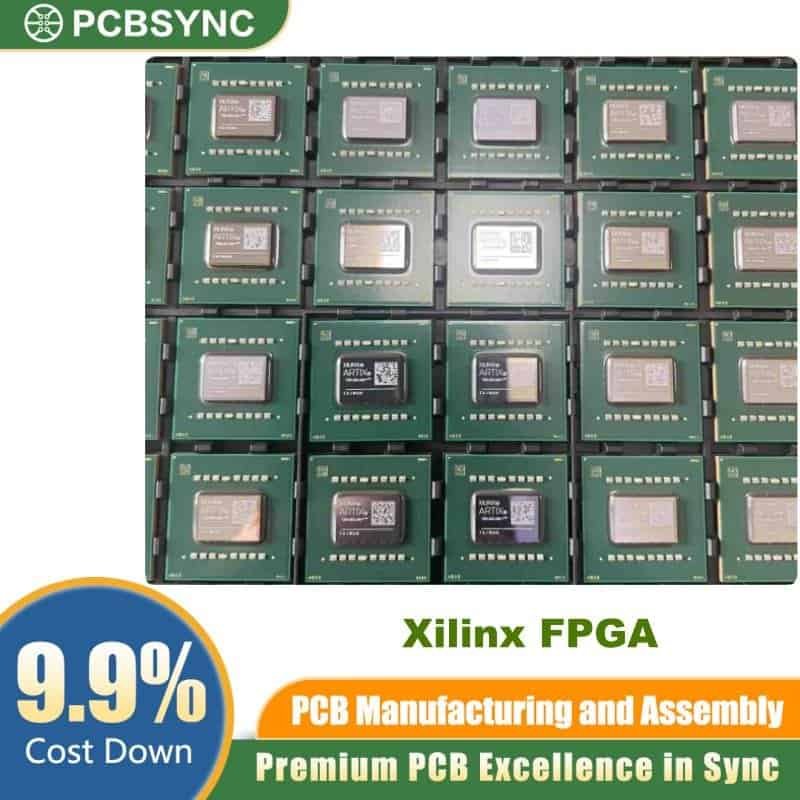
The XC3S1000-4FG256C is a high-performance, cost-optimized Field Programmable Gate Array (FPGA) from AMD Xilinx, part of the widely deployed Spartan-3 family. Designed for high-volume, cost-sensitive applications, this device delivers 1,000,000 system gates in a compact 256-ball Fine-pitch Ball Grid Array (FBGA) package. Whether you are developing embedded systems, industrial controllers, communications equipment, or consumer electronics, the XC3S1000-4FG256C offers a compelling combination of logic density, I/O flexibility, and embedded memory.
For engineers evaluating Xilinx FPGA solutions, this device remains a proven, in-production choice with broad toolchain support and an extensive design ecosystem.
XC3S1000-4FG256C: Key Specifications at a Glance
| Parameter |
Value |
| Manufacturer |
AMD Xilinx |
| Part Number |
XC3S1000-4FG256C |
| Family |
Spartan-3 |
| System Gates |
1,000,000 |
| Logic Cells |
17,280 |
| CLB (Configurable Logic Blocks) |
1,920 |
| CLB Slices |
7,680 |
| Flip-Flops |
15,360 |
| Distributed RAM (bits) |
120,000 |
| Block RAM (bits) |
432,000 |
| Multipliers (18×18) |
24 |
| DCMs (Digital Clock Managers) |
4 |
| Maximum User I/O |
173 |
| Package |
FG256 (FBGA, 256-ball) |
| Package Dimensions |
17mm × 17mm |
| Ball Pitch |
1.0mm |
| Speed Grade |
-4 |
| Operating Voltage (VCCINT) |
1.2V |
| I/O Voltage (VCCO) |
1.2V – 3.3V |
| Temperature Range |
Commercial (0°C to +85°C) |
| Configuration Interface |
Master Serial, Slave Serial, SelectMAP, JTAG |
| RoHS Compliance |
Yes (C suffix = Commercial, lead-free) |
What Does XC3S1000-4FG256C Mean? Part Number Decoded
Understanding the part number breakdown helps engineers select the exact variant needed:
| Code |
Meaning |
| XC |
Xilinx Programmable Device |
| 3S |
Spartan-3 Family |
| 1000 |
1,000,000 Equivalent System Gates |
| 4 |
Speed Grade (-4 is the slowest / most economical) |
| FG |
Fine-pitch BGA package type |
| 256 |
256 solder balls |
| C |
Commercial temperature range (0°C to +85°C) |
XC3S1000-4FG256C Architecture & Logic Resources
Configurable Logic Blocks (CLBs) and Slices
The XC3S1000-4FG256C features 1,920 CLBs, each composed of four slices. Each slice contains two 4-input Look-Up Tables (LUTs) and two storage elements (flip-flops or latches), yielding a total of 7,680 slices and 15,360 flip-flops. This architecture enables efficient implementation of complex sequential and combinational logic across a wide range of designs.
Embedded Block RAM
The device provides 432 Kbits of dedicated block RAM organized as 24 × 18Kbit RAM blocks. Each block can be configured as a true dual-port RAM with independent read and write widths, making it ideal for FIFOs, lookup tables, and on-chip data buffering.
Distributed RAM
An additional 120 Kbits of distributed RAM is implemented within the LUT fabric, providing fast, single-cycle access for small, frequently accessed data structures.
Hardware Multipliers
24 dedicated 18×18-bit hardware multipliers are embedded on-chip, enabling high-throughput DSP operations such as digital filters and signal processing pipelines without consuming CLB resources.
Digital Clock Managers (DCMs)
Four DCMs provide precise clock synthesis, phase shifting, and frequency division/multiplication. This allows the device to generate multiple on-chip clock domains from a single external reference, simplifying PCB design and reducing jitter.
I/O Capabilities and Supported Standards
User I/O and Banks
The XC3S1000-4FG256C offers up to 173 user I/O pins organized into multiple independently configurable I/O banks. Each bank supports a separate VCCO supply voltage, allowing mixed-voltage interfaces on a single device.
Supported I/O Standards
| I/O Standard |
Description |
| LVCMOS 3.3V / 2.5V / 1.8V / 1.5V / 1.2V |
Low-voltage CMOS logic |
| LVTTL |
Low-voltage TTL (3.3V) |
| SSTL 2 / SSTL 18 |
Stub-series terminated logic |
| HSTL Class I / Class III |
High-speed transceiver logic |
| LVDS / LVDS_25 |
Low-voltage differential signaling |
| RSDS |
Reduced swing differential signaling |
| PCI / PCI-X (3.3V) |
PCI bus compatible signaling |
This broad I/O standard support makes the XC3S1000-4FG256C suitable for interfacing with DDR/DDR2 memory, high-speed serial links, microprocessors, and standard bus interfaces.
FG256 Package Information
| Package Attribute |
Detail |
| Package Type |
Fine-pitch Ball Grid Array (FBGA) |
| Ball Count |
256 |
| Body Size |
17mm × 17mm |
| Ball Pitch |
1.0mm |
| Height (Max) |
2.45mm |
| PCB Mounting |
Surface-mount (SMD) |
| Soldering |
Compatible with standard lead-free reflow profiles |
The compact FG256 package allows high-density PCB placement while still providing adequate I/O for most mid-range designs. The 1.0mm ball pitch is achievable with standard PCB manufacturing capabilities.
Speed Grade -4: Performance Characteristics
The -4 speed grade represents the standard (slowest) speed bin in the Spartan-3 family. While it has lower maximum operating frequency compared to -5 variants, it offers excellent value for cost-sensitive designs that do not require the highest clock speeds.
| Timing Parameter |
Typical Value (Speed Grade -4) |
| Maximum System Clock (Fmax) |
~200+ MHz (application dependent) |
| Combinational Logic Delay |
~0.6 ns per logic level |
| Block RAM Access Time |
~2.5 ns |
| Setup Time (Flip-Flop) |
~0.53 ns |
| Clock-to-Output Time |
~1.1 ns |
| DCM Output Jitter |
< 200 ps (typical) |
Note: Exact timing values depend on the design, P&R implementation, and operating conditions. Refer to the Xilinx DS099 Spartan-3 data sheet for authoritative timing parameters.
Power Consumption Overview
| Supply Rail |
Voltage |
Typical Current |
Description |
| VCCINT |
1.2V |
50–300 mA (design dependent) |
Core logic supply |
| VCCO (I/O Banks) |
1.2V – 3.3V |
Varies by I/O activity |
I/O output drivers |
| VCCAUX |
2.5V |
~10–25 mA |
Auxiliary logic, DCMs |
The total power consumption of the XC3S1000-4FG256C is highly dependent on design utilization, switching activity, and clock frequency. Xilinx’s XPower Estimator tool should be used for accurate power budgeting in production designs.
Configuration Modes
The XC3S1000-4FG256C supports four configuration modes, allowing flexibility in production programming and system bring-up:
| Mode |
Description |
Typical Use |
| Master Serial (SPI) |
Device reads configuration data from external serial Flash |
Standalone / single-board systems |
| Slave Serial |
External controller streams configuration bitstream |
Multi-FPGA systems |
| SelectMAP (Parallel) |
8-bit or 16-bit parallel configuration bus |
Fast configuration, processor-managed |
| JTAG (Boundary Scan) |
IEEE 1149.1 JTAG interface |
In-system programming and debug |
XC3S1000-4FG256C vs. Other Spartan-3 Variants
| Feature |
XC3S200 |
XC3S400 |
XC3S1000 |
XC3S2000 |
| System Gates |
200K |
400K |
1,000K |
2,000K |
| CLB Slices |
1,920 |
3,584 |
7,680 |
15,360 |
| Block RAM (Kbits) |
216 |
288 |
432 |
720 |
| Multipliers (18×18) |
12 |
16 |
24 |
40 |
| DCMs |
4 |
4 |
4 |
4 |
| Max User I/O |
141 |
264 |
391 (full pkg) |
565 |
| FG256 User I/O |
— |
141 |
173 |
— |
The XC3S1000 occupies the mid-range of the Spartan-3 family, offering substantially more logic and memory than entry-level parts while remaining cost-effective for volume production.
Ordering Information and Variants
| Part Number |
Package |
Speed Grade |
Temperature |
Notes |
| XC3S1000-4FG256C |
FG256 |
-4 |
Commercial (0–85°C) |
Standard variant |
| XC3S1000-5FG256C |
FG256 |
-5 |
Commercial (0–85°C) |
Higher speed grade |
| XC3S1000-4FG256I |
FG256 |
-4 |
Industrial (-40–100°C) |
Extended temp |
| XC3S1000-4FT256C |
FTG256 |
-4 |
Commercial |
Tape & reel packaging |
| XC3S1000-4FG456C |
FG456 |
-4 |
Commercial |
Larger package, more I/O |
The “C” suffix denotes the Commercial temperature range. The “I” suffix indicates Industrial temperature range.
Development Tools and Software Support
The XC3S1000-4FG256C is supported by AMD Xilinx’s ISE Design Suite (the primary toolchain for Spartan-3 devices). Key tools include:
- ISE Project Navigator – RTL design entry and synthesis
- XST (Xilinx Synthesis Technology) – HDL synthesis engine
- ISim / ModelSim – Behavioral and post-route simulation
- IMPACT / iMPACT – Device programming and JTAG configuration
- XPower Estimator – Power analysis and estimation
- PlanAhead – Floorplanning and physical design
Third-party synthesis tools including Synopsys Synplify and Mentor Precision RTL also fully support the XC3S1000 device family.
Typical Applications for XC3S1000-4FG256C
The XC3S1000-4FG256C is widely used across diverse industries due to its logic density, embedded memory, and rich I/O support:
| Application Area |
Example Use Cases |
| Industrial Automation |
PLC controllers, motor drive interfaces, sensor fusion |
| Communications |
Protocol bridges, line cards, data concentrators |
| Embedded Systems |
MicroBlaze soft-processor SoC implementations |
| Test & Measurement |
Data acquisition front-ends, signal conditioning |
| Consumer Electronics |
Display controllers, set-top box logic, audio DSP |
| Automotive |
Gateway controllers, diagnostic interfaces (non-safety-critical) |
| Medical Devices |
Imaging signal processing, patient monitoring interfaces |
| Aerospace / Defense |
Protocol adapters, legacy interface modernization |
Why Choose the XC3S1000-4FG256C?
- Proven, Mature Technology – The Spartan-3 family has millions of units deployed globally, with an extensive body of reference designs, application notes, and community support.
- Cost-Optimized for Volume Production – Spartan-3 devices were specifically architected for high-volume, cost-sensitive production environments.
- Rich On-Chip Resources – 432 Kbits block RAM, 24 hardware multipliers, and 4 DCMs enable sophisticated designs without external components.
- Flexible I/O Standards – Supports both single-ended and differential I/O standards across independently configurable voltage banks.
- Small Form Factor – The 17×17mm FG256 package fits into space-constrained PCB designs.
- MicroBlaze Soft-Processor Support – Run a 32-bit RISC processor entirely within the FPGA fabric for embedded applications.
- Long Product Lifecycle – AMD Xilinx maintains production support for Spartan-3 devices, ensuring long-term supply availability for deployed systems.
Frequently Asked Questions (FAQ)
Q: What is the difference between XC3S1000-4FG256C and XC3S1000-4FTG256C? A: The XC3S1000-4FTG256C is the tape-and-reel packaging variant of the same die. The core silicon, electrical specifications, and pinout are identical. The difference is purely in how the parts are packaged for pick-and-place assembly.
Q: Is the XC3S1000-4FG256C RoHS compliant? A: Yes. The “C” commercial suffix parts from AMD Xilinx are manufactured using lead-free solder ball materials and are RoHS 2 compliant.
Q: Can the XC3S1000-4FG256C run a soft-core processor? A: Yes. The device has sufficient logic and block RAM to implement a MicroBlaze 32-bit soft processor with peripherals, including UART, SPI, I²C, and GPIO.
Q: What configuration Flash memory is compatible with this FPGA? A: Common choices include the Xilinx XCF platform Flash family, Spansion S25FL series SPI Flash, and Micron M25P series SPI Flash. The configuration bitstream size for the XC3S1000 is approximately 2.8 Mbits.
Q: What is the maximum operating temperature for the XC3S1000-4FG256C? A: The commercial-grade “C” suffix part is rated from 0°C to +85°C junction temperature. For operation in harsher environments, the industrial “I” suffix variant supports -40°C to +100°C.
Summary
The XC3S1000-4FG256C remains one of the most deployed mid-range FPGAs in its class. With 1 million system gates, 432 Kbits of block RAM, 24 dedicated multipliers, and 173 user I/Os in a compact 256-ball BGA package, it delivers the resources needed for complex digital designs at a competitive cost point. Its support for multiple configuration modes, broad I/O voltage standards, and extensive toolchain ecosystem make it an accessible and reliable choice for engineers across industries.
Whether you are prototyping a new design or sourcing parts for an established production system, the XC3S1000-4FG256C offers the performance, flexibility, and long-term availability that demanding applications require.