Inquire: Call 0086-755-23203480, or reach out via the form below/your sales contact to discuss our design, manufacturing, and assembly capabilities.
Quote: Email your PCB files to Sales@pcbsync.com (Preferred for large files) or submit online. We will contact you promptly. Please ensure your email is correct.
Notes: For PCB fabrication, we require PCB design file in Gerber RS-274X format (most preferred), *.PCB/DDB (Protel, inform your program version) format or *.BRD (Eagle) format. For PCB assembly, we require PCB design file in above mentioned format, drilling file and BOM. Click to download BOM template To avoid file missing, please include all files into one folder and compress it into .zip or .rar format.
The VL53L0X Arduino combination has become my go-to solution for precision distance measurement in robotics and automation projects. Unlike ultrasonic sensors that struggle with angled surfaces and soft materials, this Time-of-Flight (ToF) sensor uses an invisible laser to measure distances with remarkable accuracy. Whether you’re building a parking assistant, drone altitude sensor, or gesture recognition system, this guide covers everything from basic wiring to advanced multi-sensor configurations.
The VL53L0X from STMicroelectronics operates on a fundamentally different principle than traditional ultrasonic or IR proximity sensors. Inside the tiny package sits a 940nm VCSEL (Vertical-Cavity Surface-Emitting Laser) emitter and a SPAD (Single Photon Avalanche Diode) array receiver. The sensor fires an infrared laser pulse, then precisely measures the time required for photons to bounce back from the target surface.
This Time-of-Flight approach offers significant advantages. The measurement doesn’t depend on the target’s color or reflectivity the way analog IR sensors do, and it doesn’t suffer from the echo problems that plague ultrasonic sensors in enclosed spaces. The 940nm wavelength is completely invisible to human eyes, making it safe for consumer applications.
ST calls their implementation “FlightSense” technology, and they’ve packed the entire ranging engine, including calibration data and distance calculations, into the sensor itself. Your Arduino simply requests a measurement over I2C and receives a distance value in millimeters.
VL53L0X Technical Specifications
Before committing to the VL53L0X for your project, understand what you’re working with:
Parameter
Specification
Operating Voltage
2.6V to 5.5V (module)
Core Voltage
2.8V (internal regulator)
Communication
I2C (up to 400 kHz)
Default I2C Address
0x29
Measurement Range
30mm to 2000mm
Typical Range (Default)
30mm to 1200mm
Long Range Mode
Up to 2000mm
Accuracy
±3% at 1.2m
Field of View
25° cone
Measurement Time
20ms (high speed) to 200ms (high accuracy)
Laser Wavelength
940nm (invisible IR)
Peak Current
40mA
Standby Current
5µA
The effective range depends heavily on ambient light conditions and target reflectivity. Indoors against a white wall, you’ll easily hit 2 meters. Outdoors in bright sunlight against a dark surface, expect significantly reduced range.
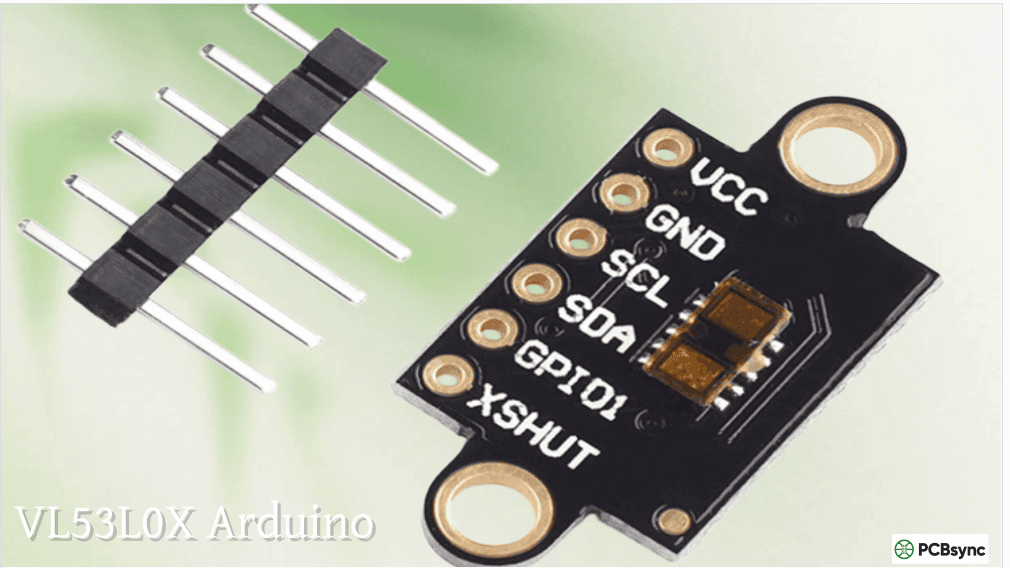
VL53L0X Module Pinout
Most breakout boards expose six pins, though only four are required for basic operation:
Pin
Name
Function
Required
1
VIN
Power Input (2.6-5.5V)
Yes
2
GND
Ground
Yes
3
SCL
I2C Clock
Yes
4
SDA
I2C Data
Yes
5
GPIO1
Interrupt Output
Optional
6
XSHUT
Shutdown Control
Optional*
*The XSHUT pin becomes essential when using multiple sensors on the same I2C bus.
Understanding XSHUT and GPIO1
The XSHUT pin controls the sensor’s power state. Pull it LOW to put the sensor into hardware standby, or leave it floating/HIGH for normal operation. Most modules include a pull-up resistor, so the sensor boots automatically at power-on.
GPIO1 provides a programmable interrupt output. You can configure it to signal when a measurement completes or when a distance threshold is crossed. This enables more efficient polling strategies compared to continuously requesting readings.
Wiring VL53L0X to Arduino
The I2C connection is straightforward. Different Arduino boards use different pins for I2C:
VL53L0X Pin
Arduino Uno/Nano
Arduino Mega
Arduino Leonardo
VIN
5V
5V
5V
GND
GND
GND
GND
SCL
A5
21
3
SDA
A4
20
2
XSHUT
Any digital pin
Any digital pin
Any digital pin
GPIO1
Any interrupt pin
Any interrupt pin
Any interrupt pin
The breakout modules include voltage regulation and level shifting, so 5V Arduino boards work without additional components. If you’re using a 3.3V board like an ESP32 or Teensy, connect VIN to 3.3V instead.
Important: Don’t forget to remove the protective plastic film covering the sensor window before testing. I’ve spent more time than I’d like to admit debugging “faulty” sensors that were just still wrapped.
Installing VL53L0X Arduino Libraries
Two excellent libraries support the VL53L0X. Each has different strengths:
Adafruit VL53L0X Library
Best for beginners and projects requiring interrupt support. Install via Library Manager:
Open Arduino IDE
Navigate to Sketch → Include Library → Manage Libraries
Search for “Adafruit VL53L0X”
Install the library and any requested dependencies
Maximum range is limited to about 1.2 meters in the default configuration.
Pololu VL53L0X Library
Offers access to long-range mode (up to 2 meters) and more configuration options. Install similarly through Library Manager by searching “VL53L0X Pololu”.
Basic VL53L0X Arduino Code
Here’s a working sketch using the Adafruit library:
#include “Adafruit_VL53L0X.h”
Adafruit_VL53L0X lox = Adafruit_VL53L0X();
void setup() {
Serial.begin(115200);
while (!Serial) {
delay(1);
}
Serial.println(“VL53L0X Distance Sensor Test”);
if (!lox.begin()) {
Serial.println(“Failed to initialize VL53L0X”);
while(1);
}
Serial.println(“VL53L0X Ready”);
}
void loop() {
VL53L0X_RangingMeasurementData_t measure;
lox.rangingTest(&measure, false);
if (measure.RangeStatus != 4) {
Serial.print(“Distance: “);
Serial.print(measure.RangeMilliMeter);
Serial.println(” mm”);
} else {
Serial.println(“Out of range”);
}
delay(100);
}
The RangeStatus value of 4 indicates a “phase failure,” meaning no valid return signal was detected. This typically happens when the target is too far away or the surface absorbs too much of the laser energy.
Long Range Mode with Pololu Library
For distances beyond 1.2 meters, the Pololu library provides access to the sensor’s extended range capabilities:
int distance = sensor.readRangeSingleMillimeters();
if (sensor.timeoutOccurred()) {
Serial.println(“Timeout”);
} else {
Serial.print(“Distance: “);
Serial.print(distance);
Serial.println(” mm”);
}
delay(100);
}
Long range mode trades measurement speed for extended distance detection. The 200ms timing budget significantly slows update rates compared to the default 33ms, so consider whether your application actually needs the extra range.
Using Multiple VL53L0X Sensors
Here’s where things get interesting. The VL53L0X has a fixed default I2C address of 0x29, but you can change it through software. The catch: the address change doesn’t survive a power cycle. You must reconfigure addresses at every startup using the XSHUT pins.
The procedure works like this:
Hold all sensors in reset by pulling all XSHUT pins LOW
If you need more than a handful of sensors and don’t want to dedicate GPIO pins to each XSHUT, consider using a TCA9548A I2C multiplexer. This approach lets you keep all sensors at the default address while switching between isolated I2C channels.
VL53L0X vs HC-SR04: Which Distance Sensor Should You Choose?
This comparison comes up constantly in robotics forums. Both sensors have valid use cases:
Feature
VL53L0X
HC-SR04
Technology
Time-of-Flight Laser
Ultrasonic
Range
30mm – 2000mm
20mm – 4000mm
Accuracy
±3%
±3mm
Field of View
25°
~30°
Angular Response
Excellent
Poor at angles
Transparent Objects
Cannot detect
Can detect
Soft Materials
Detects well
May absorb sound
Interface
I2C
Digital GPIO
Price
~$4-8
~$1-2
Ambient Light Sensitivity
Yes
No
When to Choose VL53L0X
The VL53L0X excels at measuring distances to angled surfaces. Ultrasonic sensors fail badly when the target isn’t perpendicular because sound reflects away from the receiver. The laser-based VL53L0X handles 30-degree angles without issue, making it ideal for wall-following robots that need to detect orientation.
The narrow 25° beam provides focused measurements directly in front of the sensor, which is perfect when you need to know the distance to a specific point rather than the nearest object in a general area.
When to Choose HC-SR04
Ultrasonic sensors don’t care about ambient light. The VL53L0X can struggle outdoors in direct sunlight, while the HC-SR04 works regardless of lighting conditions. Ultrasonic sensors also detect glass and transparent plastics that are invisible to optical sensors.
For longer range applications or extreme budget constraints, the HC-SR04 remains a solid choice.
Troubleshooting Common VL53L0X Problems
Sensor Not Detected on I2C Bus
Run an I2C scanner sketch first. If nothing appears at address 0x29, check your wiring. On Arduino Mega, remember that I2C uses pins 20 and 21, not A4 and A5.
Verify the module has power by checking for 2.8V at the VCC test point if your module has one. Some modules include a power LED that should illuminate.
Readings Show 8190 or 65535
The value 8190 typically indicates interference from strong ambient light. Try shading the sensor or reducing the measurement timing budget. A reading of 65535 often means the sensor has experienced a communication error or isn’t properly initialized.
Erratic Readings at Close Range
The VL53L0X has a minimum reliable range of approximately 30mm. Objects closer than this produce unreliable data. If you need to measure closer distances, consider the VL6180X, which handles 5mm to 200mm.
Interference Between Multiple Sensors
Even with different I2C addresses, closely spaced VL53L0X sensors can experience optical crosstalk if their beams overlap. Angle the sensors slightly apart or add physical barriers between them.
Yes. The 940nm infrared laser operates at Class 1 levels, meaning it’s safe under all conditions of normal use. The beam is invisible to human eyes, and the power level is too low to cause damage even with direct exposure. However, don’t stare directly into the emitter through optical instruments.
Can the VL53L0X measure through glass?
The sensor can work behind a protective cover glass, but it requires calibration to compensate for reflections at the glass surface. ST provides application notes on cover glass calibration. Standard window glass typically blocks too much of the signal for reliable operation.
What’s the maximum number of VL53L0X sensors I can use with one Arduino?
Theoretically, you can use many sensors since you can assign any I2C address from 0x01 to 0x7F. Practically, you’re limited by available GPIO pins for XSHUT control and the I2C bus capacitance. Most projects successfully run 4-8 sensors. For more, use an I2C multiplexer like the TCA9548A, which supports up to 8 sensors per multiplexer.
Why does my VL53L0X give wrong readings on black objects?
Dark surfaces absorb more laser energy, reducing the return signal strength. The sensor may report “out of range” even at close distances. Long range mode helps somewhat by increasing sensitivity, but extremely dark or matte black surfaces remain challenging for all optical distance sensors.
Can I use the VL53L0X outdoors?
Yes, but with limitations. Direct sunlight contains significant infrared energy that can overwhelm the sensor’s receiver. Performance degrades substantially in bright outdoor conditions. For outdoor applications, consider adding a physical sunshade or using the sensor during overcast conditions or at night.
Wrapping Up
The VL53L0X Arduino pairing delivers precise, reliable distance measurements that ultrasonic sensors simply can’t match in many scenarios. The I2C interface keeps wiring simple, the libraries handle the complex ranging calculations internally, and the compact module size fits almost anywhere.
For robotics applications requiring wall-following or obstacle detection at varying angles, the VL53L0X is the clear winner over traditional alternatives. Just keep its limitations in mind: ambient light sensitivity and challenges with very dark or transparent objects.
Start with a single sensor and the Adafruit library to learn the basics, then expand to multiple sensors or long-range mode as your project demands.
Inquire: Call 0086-755-23203480, or reach out via the form below/your sales contact to discuss our design, manufacturing, and assembly capabilities.
Quote: Email your PCB files to Sales@pcbsync.com (Preferred for large files) or submit online. We will contact you promptly. Please ensure your email is correct.
Notes: For PCB fabrication, we require PCB design file in Gerber RS-274X format (most preferred), *.PCB/DDB (Protel, inform your program version) format or *.BRD (Eagle) format. For PCB assembly, we require PCB design file in above mentioned format, drilling file and BOM. Click to download BOM template To avoid file missing, please include all files into one folder and compress it into .zip or .rar format.