Inquire: Call 0086-755-23203480, or reach out via the form below/your sales contact to discuss our design, manufacturing, and assembly capabilities.
Quote: Email your PCB files to Sales@pcbsync.com (Preferred for large files) or submit online. We will contact you promptly. Please ensure your email is correct.
Notes: For PCB fabrication, we require PCB design file in Gerber RS-274X format (most preferred), *.PCB/DDB (Protel, inform your program version) format or *.BRD (Eagle) format. For PCB assembly, we require PCB design file in above mentioned format, drilling file and BOM. Click to download BOM template To avoid file missing, please include all files into one folder and compress it into .zip or .rar format.
Monitoring ultraviolet radiation matters for health applications, weather stations, and environmental sensing projects. The UV Sensor Arduino combination provides accessible measurement of invisible UV rays that affect human skin and various materials.
After building several UV index meters and integrating these sensors into outdoor monitoring systems, I’ve learned the nuances of each sensor type and their practical limitations. This guide covers the popular UV sensor options, wiring configurations, and code examples to get reliable ultraviolet measurements.
Ultraviolet light occupies the electromagnetic spectrum between visible light and X-rays, with wavelengths from approximately 10nm to 400nm. For practical measurement with Arduino sensors, three UV bands matter:
UV Band
Wavelength Range
Characteristics
UVA
315-400 nm
Tanning rays, reaches Earth’s surface
UVB
280-315 nm
Burning rays, partially absorbed by ozone
UVC
100-280 nm
Germicidal, blocked by atmosphere
Most Arduino UV sensors detect UVA and UVB wavelengths since UVC from the sun doesn’t reach Earth’s surface. The UV Index, developed by Canadian scientists in 1992 and standardized by the World Health Organization, provides a standardized scale for expressing UV intensity relative to skin damage potential.
UV Index Scale and Health Guidelines
The UV Index directly correlates to sunburn risk:
UV Index
Exposure Level
Protection Required
0-2
Low
Minimal protection needed
3-5
Moderate
Wear sunscreen, seek shade at midday
6-7
High
Reduce sun exposure 10am-4pm
8-10
Very High
Extra protection essential
11+
Extreme
Avoid outdoor exposure
Building a UV meter with Arduino lets you monitor real-time conditions rather than relying on weather forecasts that may not reflect your specific location and time.
Popular UV Sensors for Arduino Projects
Several UV sensor modules work with Arduino, each with distinct characteristics:
ML8511 UV Sensor
The ML8511 from ROHM Semiconductor detects 280-390nm wavelengths covering UVB and most of UVA spectrum. It outputs an analog voltage linearly proportional to UV intensity (mW/cm²), making it straightforward to interface with Arduino’s ADC.
Specification
Value
Detection Range
280-390 nm
Output Type
Analog voltage
Output Range
1.0V (no UV) to 2.8V (15 mW/cm²)
Supply Voltage
3.3V
Current Consumption
300 µA (typical)
GUVA-S12SD UV Sensor
The GUVA-S12SD is a Schottky-type photodiode sensitive to 200-370nm wavelengths. Modules typically include an op-amp to convert the nanoampere photocurrent into a readable voltage signal.
Specification
Value
Detection Range
200-370 nm
Output Type
Analog voltage
Response Time
<0.5 seconds
Supply Voltage
2.7-5.5V
Operating Temperature
-30°C to +85°C
VEML6075 Digital UV Sensor
The VEML6075 provides separate UVA and UVB channel readings via I2C interface. Built-in calibration registers simplify UV Index calculation.
Specification
Value
UVA Detection
320-410 nm
UVB Detection
280-315 nm
Interface
I2C
I2C Address
0x10
Resolution
16-bit
Supply Voltage
1.7-3.6V
LTR-390UV Digital UV Sensor
The LTR-390UV offers both ambient light and UV sensing modes with I2C communication. It provides direct UV Index calculation support.
Specification
Value
UV Detection
280-430 nm
Interface
I2C
I2C Address
0x53
Gain Options
1×, 3×, 6×, 9×, 18×
Supply Voltage
2.5-3.6V
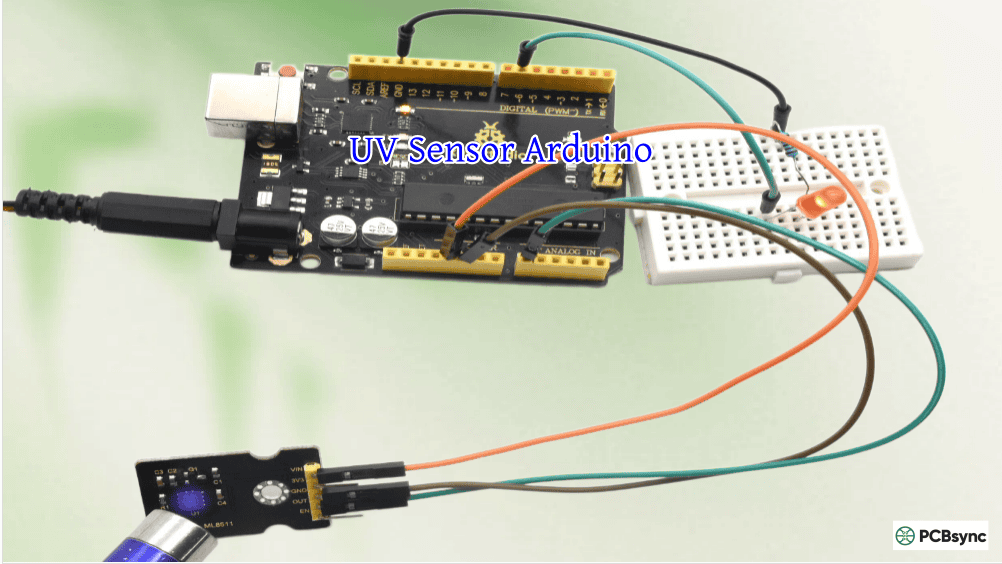
Wiring ML8511 to Arduino
The ML8511 requires careful attention to the 3.3V reference for accurate readings:
ML8511 Pin
Arduino UNO
Notes
VIN
3.3V
Power supply
GND
GND
Common ground
OUT
A0
Analog output
EN
3.3V
Enable pin (tie high)
3.3V
A1
Reference voltage for calibration
Connecting the Arduino 3.3V pin to an analog input (A1) allows using it as a precise reference voltage, improving measurement accuracy regardless of variations in VCC.
ML8511 Arduino Code Example
This code reads UV intensity and calculates the UV Index:
The GUVA-S12SD module has a simpler three-wire connection:
GUVA-S12SD Pin
Arduino UNO
Notes
VCC
5V
Power supply
GND
GND
Common ground
OUT
A0
Analog output (0-1V typical)
GUVA-S12SD Arduino Code Example
This code converts sensor voltage to UV Index:
void setup() {
Serial.begin(9600);
Serial.println(“GUVA-S12SD UV Sensor”);
}
void loop() {
int sensorValue = analogRead(A0);
float voltage = sensorValue * (5.0 / 1023.0);
// Convert voltage to UV Index
// Based on sensor datasheet: ~0.1V per UV Index point
float uvIndex = voltage / 0.1;
Serial.print(“Voltage: “);
Serial.print(voltage, 3);
Serial.print(” V UV Index: “);
Serial.println(uvIndex, 1);
delay(1000);
}
Note that GUVA-S12SD modules vary in amplification circuitry. Some “purple” PCB variants have excessive gain making them unsuitable for outdoor sunlight measurement. Check your specific module’s output range.
Using Digital UV Sensors (VEML6075)
Digital sensors like the VEML6075 communicate via I2C and include onboard UV Index calculation:
#include <Wire.h>
#include “Adafruit_VEML6075.h”
Adafruit_VEML6075 uv = Adafruit_VEML6075();
void setup() {
Serial.begin(9600);
Serial.println(“VEML6075 UV Sensor”);
if (!uv.begin()) {
Serial.println(“Sensor not found!”);
while (1);
}
Serial.println(“Sensor initialized”);
}
void loop() {
Serial.print(“UVA: “);
Serial.print(uv.readUVA());
Serial.print(” UVB: “);
Serial.print(uv.readUVB());
Serial.print(” UV Index: “);
Serial.println(uv.readUVI());
delay(1000);
}
Install the Adafruit VEML6075 library through the Arduino Library Manager before uploading.
UV Sensor Comparison Table
Choosing the right sensor depends on your project requirements:
Feature
ML8511
GUVA-S12SD
VEML6075
LTR-390UV
Interface
Analog
Analog
I2C
I2C
UV Bands
UVA+UVB
UVA+UVB
UVA, UVB separate
UVA+UVB
UV Index Calculation
Manual
Manual
Built-in
Built-in
Power Consumption
300 µA
Low
100 µA
110 µA
Price Range
$3-5
$2-4
$5-8
$5-8
Complexity
Low
Low
Medium
Medium
Analog sensors work well for simple projects where approximate UV levels suffice. Digital sensors provide better accuracy and separate UVA/UVB measurements for more sophisticated applications.
Calibration and Accuracy Considerations
Consumer-grade UV sensors have inherent limitations. The relationship between sensor output and true UV Index depends on several factors:
Spectral response curves differ from the erythemal action spectrum used to define UV Index. Sensors respond to all wavelengths in their detection range, while UV Index weights different wavelengths according to their skin damage potential.
Cosine response affects readings at angles. Professional UV meters use diffusers to ensure accurate measurements regardless of sun angle. Most hobby sensors lack this feature.
Temperature affects semiconductor sensor performance. Outdoor measurements in hot conditions may drift from calibrated values.
For relative measurements and trend monitoring, these sensors work adequately. For absolute UV Index values matching weather service reports, expect ±1-2 index points variance.
Practical Project: UV Index Meter with Display
Combine the UV sensor with an OLED display for a portable UV meter:
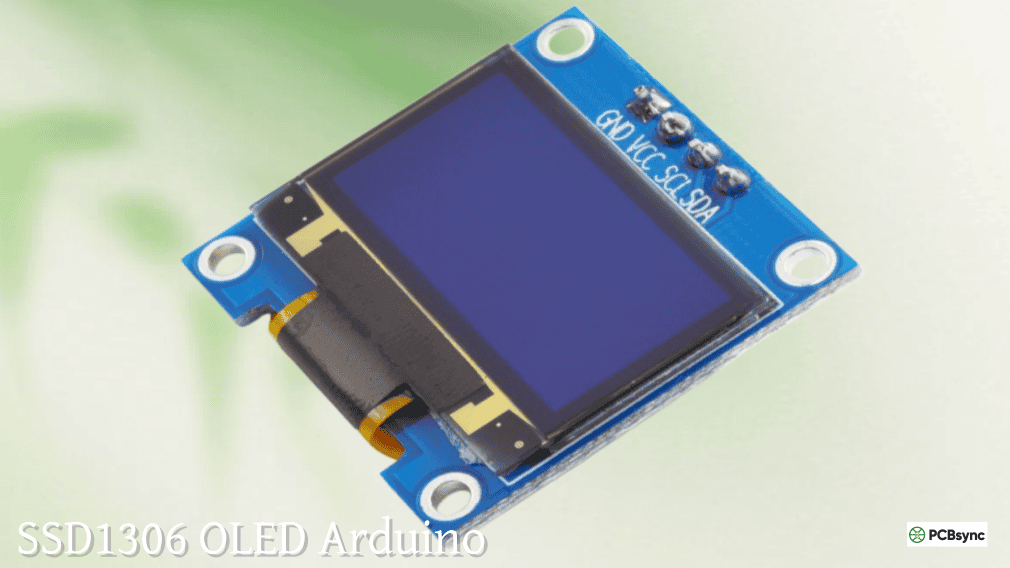
Wire an SSD1306 OLED (I2C) alongside your chosen UV sensor. The OLED connects to the same I2C bus (SDA/SCL) as digital UV sensors, or independently if using analog sensors.
Add a visual indicator showing exposure risk level based on measured UV Index. Color-coded warnings (green/yellow/orange/red) help users quickly assess protection needs.
Consider battery operation for portability. Both analog UV sensors and the microcontroller can operate from a single lithium battery with appropriate regulation.
Troubleshooting Common Issues
Readings Always Zero or Very Low
Verify sensor orientation—the detecting element must face the UV source. Indoor lighting produces minimal UV; test outdoors in sunlight.
Saturated or Maximum Readings
Some module variants have excessive amplification. Reduce gain if adjustable, or use a different module designed for outdoor intensity levels.
Inconsistent Values
Average multiple readings to reduce noise. Ensure stable power supply and secure connections. Rapid fluctuations may indicate wiring issues.
Readings Don’t Match Weather Reports
Weather service UV Index represents calculated values based on solar angle, ozone, and cloud cover. Your sensor measures actual incident UV at your specific location. Some variance is expected.
Which UV sensor is most accurate for Arduino projects?
Digital sensors like the VEML6075 and LTR-390UV provide better accuracy due to built-in calibration and separate UVA/UVB channels. The LTR-390UV specifically includes UV Index calculation algorithms validated against reference instruments.
Can I measure UV from artificial sources like UV LEDs?
Yes, these sensors detect UV from any source within their wavelength range. UV LEDs typically emit in the UVA band (365-405nm). Ensure the sensor’s detection range covers your specific UV source wavelength.
Why do my readings differ from weather app UV Index?
Weather apps report forecast values based on solar calculations, not actual measurements. Your sensor measures real conditions at your location, which may differ due to cloud cover, reflective surfaces, or local atmospheric conditions.
How do I protect the sensor for outdoor use?
Use UV-transparent enclosures or position the sensor under a quartz or borosilicate glass cover. Standard glass and plastic block significant UV radiation and will cause low readings. PTFE diffusers improve angular response while protecting the sensor.
Can these sensors detect UVC for germicidal lamp monitoring?
The GUVA-S12SD has sensitivity down to 200nm, covering UVC wavelengths. However, UVC measurements require careful safety protocols—direct UVC exposure damages eyes and skin rapidly. Ensure proper shielding when working with UVC sources.
Building Effective UV Monitoring Systems
The UV Sensor Arduino combination enables practical ultraviolet measurement for health monitoring, weather stations, and material testing applications. Analog sensors like the ML8511 and GUVA-S12SD offer simplicity, while digital options like the VEML6075 provide enhanced accuracy and separate UVA/UVB data.
Start with the basic code examples to verify sensor operation, then integrate displays and data logging for complete UV monitoring solutions. Remember that hobby-grade sensors provide useful relative measurements but may not match laboratory-calibrated instruments in absolute accuracy.
Meta Description:
“Learn to measure ultraviolet light with UV Sensor Arduino projects. Compare ML8511, GUVA-S12SD, and VEML6075 sensors with wiring diagrams, code examples, and UV Index calculation.”
Inquire: Call 0086-755-23203480, or reach out via the form below/your sales contact to discuss our design, manufacturing, and assembly capabilities.
Quote: Email your PCB files to Sales@pcbsync.com (Preferred for large files) or submit online. We will contact you promptly. Please ensure your email is correct.
Notes: For PCB fabrication, we require PCB design file in Gerber RS-274X format (most preferred), *.PCB/DDB (Protel, inform your program version) format or *.BRD (Eagle) format. For PCB assembly, we require PCB design file in above mentioned format, drilling file and BOM. Click to download BOM template To avoid file missing, please include all files into one folder and compress it into .zip or .rar format.