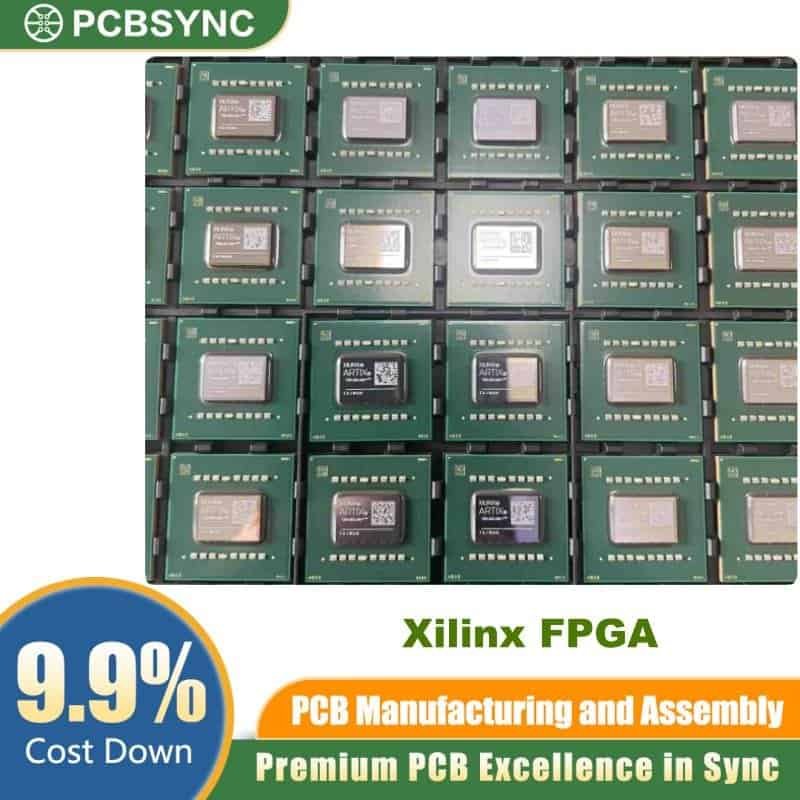
The XC3S1000-4FGG456I is a high-performance, cost-optimized Field Programmable Gate Array (FPGA) from the Xilinx Spartan-3 family, now under the AMD portfolio. Designed for high-volume, cost-sensitive applications, this IC delivers 1 million system gates in a compact 456-pin Fine-Pitch Ball Grid Array (FBGA) package — making it an ideal choice for embedded systems, communications hardware, industrial control, and consumer electronics.
Whether you are an experienced hardware engineer or a design team sourcing reliable Xilinx FPGA components, the XC3S1000-4FGG456I offers an excellent balance of logic density, I/O count, and power efficiency in a proven industrial-grade configuration.
XC3S1000-4FGG456I Key Specifications at a Glance
| Parameter |
Value |
| Manufacturer |
AMD (Xilinx) |
| Part Number |
XC3S1000-4FGG456I |
| Family |
Spartan-3 |
| Number of System Gates |
1,000,000 (1M) |
| Logic Cells (CLBs) |
17,280 |
| Number of CLB Slices |
1,920 |
| Total RAM Bits |
442,368 |
| User I/O Pins |
333 |
| Package |
456-Pin FBGA (Fine-Pitch Ball Grid Array) |
| Package Dimensions |
23mm × 23mm |
| Process Technology |
90nm |
| Core Supply Voltage |
1.14V – 1.26V (nominal 1.2V) |
| Speed Grade |
-4 |
| Max Clock Frequency |
630 MHz |
| Operating Temperature |
–40°C to +100°C (TJ) |
| Temperature Grade |
Industrial (I) |
| Mounting Type |
Surface Mount |
| RoHS Compliance |
Lead-free (FGG variant) |
What Is the XC3S1000-4FGG456I? Overview and Family Context
The XC3S1000-4FGG456I belongs to Xilinx’s Spartan-3 FPGA family — an eight-member series spanning densities from 50,000 to 5,000,000 system gates. The Spartan-3 family was architected as a cost-optimized successor to the Spartan-IIE, incorporating key advancements from the Virtex-II platform to deliver greater logic resources, expanded on-chip RAM, improved clock management, and higher I/O density.
At the XC3S1000 density level, designers receive 1 million system gates backed by 17,280 logic cells and 333 user I/Os — enough resources to implement a wide range of real-world digital systems without stepping up to more expensive device families.
The “4” in the part number denotes the speed grade (-4), which is the standard commercial/industrial speed offering for this family. The “FGG456” indicates the 456-ball Fine-Pitch BGA package with lead-free (G = green/RoHS compliant) solder balls. The trailing “I” designates the Industrial temperature grade, supporting junction temperatures from –40°C to +100°C — making this part suitable for rugged, extended-range deployments.
XC3S1000-4FGG456I Detailed Electrical and Logic Specifications
Logic and Fabric Resources
| Resource |
XC3S1000 |
| System Gates |
1,000,000 |
| Equivalent Logic Cells |
17,280 |
| CLB Slices |
7,680 |
| CLB Flip-Flops |
15,360 |
| Maximum Distributed RAM (bits) |
120,960 |
| Block RAMs (18Kb each) |
24 |
| Total Block RAM Capacity (bits) |
432,000+ |
| Dedicated Multipliers (18×18) |
24 |
| Digital Clock Managers (DCMs) |
4 |
I/O and Packaging Specifications
| Parameter |
Value |
| User I/O Count |
333 |
| Differential I/O Pairs |
166 |
| Package Type |
456-Ball FBGA (Fine-Pitch BGA) |
| Package Body Size |
23mm × 23mm |
| Ball Pitch |
1.0mm |
| Voltage Standards Supported |
LVCMOS, LVTTL, HSTL, SSTL, LVDS, RSDS, BLVDS, GTL, GTL+ |
Power and Timing Specifications
| Parameter |
Value |
| Core Voltage (VCCINT) |
1.14V – 1.26V |
| I/O Voltage (VCCO) |
1.2V – 3.3V (bank-configurable) |
| Speed Grade |
-4 (standard industrial grade) |
| Maximum System Clock |
630 MHz |
| Configuration Options |
JTAG, Master Serial, Slave Serial, Master Parallel (SelectMAP) |
Part Number Decoder: Understanding XC3S1000-4FGG456I
Breaking down this part number helps engineers confirm they are ordering exactly the right component for their application:
| Field |
Code |
Meaning |
| Product Family |
XC3S |
Spartan-3 Series |
| Density |
1000 |
1 Million System Gates |
| Speed Grade |
4 |
Standard Speed (-4) |
| Package Base |
FG |
Fine-Pitch Ball Grid Array (FBGA) |
| Lead-Free Designation |
G |
Green / RoHS-compliant solder balls |
| Pin Count |
456 |
456 Total Solder Balls |
| Temperature Grade |
I |
Industrial (–40°C to +100°C TJ) |
The industrial temperature grade (“I”) distinguishes this part from the commercial grade (“C”) variant, making the XC3S1000-4FGG456I the preferred choice for systems deployed in harsh or thermally variable environments.
Spartan-3 Family Comparison: Where Does XC3S1000 Fit?
The table below shows how the XC3S1000 compares within the broader Spartan-3 family, helping designers select the right density for their application:
| Device |
System Gates |
Logic Cells |
Block RAM (bits) |
Max I/O |
Multipliers |
| XC3S50 |
50,000 |
1,728 |
72,000 |
124 |
4 |
| XC3S200 |
200,000 |
4,320 |
216,000 |
173 |
12 |
| XC3S400 |
400,000 |
8,064 |
288,000 |
264 |
16 |
| XC3S1000 |
1,000,000 |
17,280 |
432,000 |
391 |
24 |
| XC3S1500 |
1,500,000 |
29,952 |
576,000 |
487 |
32 |
| XC3S2000 |
2,000,000 |
46,080 |
720,000 |
565 |
40 |
| XC3S4000 |
4,000,000 |
62,208 |
1,728,000 |
712 |
96 |
| XC3S5000 |
5,000,000 |
74,880 |
1,872,000 |
784 |
104 |
The XC3S1000 in a 456-pin FBGA package supports 333 user I/Os out of a maximum of 391, providing ample connectivity for most embedded and communications applications.
Key Features of the XC3S1000-4FGG456I FPGA
Advanced Logic Architecture
The Spartan-3 logic fabric is built on four-input Look-Up Tables (LUTs) with dedicated flip-flops, carry-chain logic, and wide-function multiplexers. Each CLB (Configurable Logic Block) contains four slices, and each slice contains two LUT/FF pairs — enabling efficient implementation of complex arithmetic, state machines, and pipelined data paths.
Embedded Block RAM
With 24 dedicated 18Kbit Block RAMs totaling over 430Kbits of on-chip memory, the XC3S1000 supports dual-port access patterns, FIFO operations, and distributed memory architectures — without consuming precious logic resources.
Dedicated Hardware Multipliers
The 24 hardened 18×18-bit multiplier blocks deliver high-throughput DSP performance for signal processing, filtering, and arithmetic-intensive applications. Combined with BlockRAM, these enable full MAC (multiply-accumulate) pipelines within the FPGA fabric.
Digital Clock Managers (DCMs)
Four Digital Clock Managers provide on-chip clock synthesis, multiplication, division, deskew, and phase shifting — enabling precise multi-clock domain designs with minimal external components.
Flexible Multi-Standard I/O
The XC3S1000-4FGG456I supports a broad range of single-ended and differential I/O standards across independently configurable voltage banks, including LVCMOS 3.3V/2.5V/1.8V/1.5V, LVTTL, LVDS, HSTL, and SSTL — making it highly adaptable to system-level signaling requirements.
Configuration Flexibility
The device supports multiple configuration modes: JTAG-based in-system programming, Master Serial mode (via external Flash), Slave Serial mode, and parallel SelectMAP mode for fast configuration in production environments.
Typical Applications for XC3S1000-4FGG456I
The XC3S1000-4FGG456I is well-suited for a wide range of embedded and digital design applications:
| Application Category |
Use Case Examples |
| Embedded Processing |
Soft-core processors (MicroBlaze, PicoBlaze), custom CPU implementations |
| Communications |
Protocol bridges, UART/SPI/I2C controllers, Ethernet MAC cores |
| Industrial Control |
Motor control, PLC logic, sensor fusion, safety monitoring |
| Consumer Electronics |
Set-top box logic, display controllers, audio/video processing |
| Test & Measurement |
Pattern generators, logic analyzers, data acquisition front-ends |
| Automotive |
In-vehicle networking, ADAS interface logic (extended temp grade) |
| Image Processing |
Video scaling, filtering, frame buffering |
Industrial Grade Advantages: Why Choose the “I” Temperature Variant?
The “I” suffix on XC3S1000-4FGG456I signifies Industrial temperature grade operation, with guaranteed functionality across a junction temperature range of –40°C to +100°C (TJ). This is significantly broader than the commercial “C” grade, which is typically rated to 85°C TJ.
Industrial-grade devices undergo more extensive characterization and testing, making them the correct choice for:
- Outdoor or uncontrolled-environment deployments
- Automotive and transportation systems
- Industrial automation and control equipment
- Military and defense peripherals (lower tier)
- Telecommunications infrastructure
Development Tools and Software Support
Designs targeting the XC3S1000-4FGG456I can be developed using the following Xilinx/AMD tools:
| Tool |
Description |
| ISE Design Suite |
Legacy tool, fully supported for Spartan-3 devices |
| Vivado (Reference) |
Not directly targeted at Spartan-3; ISE is recommended |
| CORE Generator |
IP core generation for common functions (FIFO, RAM, etc.) |
| ChipScope Pro |
In-system logic analysis and debugging |
| iMPACT |
Device programming via JTAG |
| PlanAhead |
Floorplanning and constraint-driven design |
For new designs, Xilinx recommends using ISE Design Suite 14.7 — the final and most stable release supporting Spartan-3 devices — available as a free download from the AMD/Xilinx website.
Ordering Information and Compatible Part Numbers
| Part Number |
Package |
I/O Count |
Temp Grade |
Lead-Free |
| XC3S1000-4FGG456I |
456 FBGA (23×23mm) |
333 |
Industrial |
Yes |
| XC3S1000-4FG456I |
456 FBGA (23×23mm) |
333 |
Industrial |
No (SnPb) |
| XC3S1000-4FGG456C |
456 FBGA (23×23mm) |
333 |
Commercial |
Yes |
| XC3S1000-4FGG320I |
320 FBGA |
280 |
Industrial |
Yes |
| XC3S1000-4FGG676I |
676 FBGA |
391 |
Industrial |
Yes |
The XC3S1000-4FGG456I is the lead-free, industrial-grade version of the 456-pin package — the most widely specified variant for new industrial and embedded designs.
Why the XC3S1000-4FGG456I Remains a Relevant Choice
Despite being part of a mature process node (90nm), the XC3S1000-4FGG456I continues to be specified in new and legacy designs for several compelling reasons:
Long supply availability: The Spartan-3 family has been in production for over 15 years, with established supply chains and distributor inventory. It is well-suited for applications where long-term procurement continuity is critical.
Cost efficiency: At this price point, the XC3S1000 delivers more logic resources per dollar than most alternatives in its gate density class, particularly for designs that do not require the latest high-speed serial transceivers or advanced power management.
Proven reliability: With millions of units deployed across industrial, communications, and consumer markets globally, the XC3S1000 has an extensive field reliability track record.
Extensive ecosystem: A large community of engineers and an abundance of IP cores, reference designs, and application notes are available for this device, reducing development risk and time-to-market.
Frequently Asked Questions (FAQ)
Q: What is the difference between XC3S1000-4FGG456I and XC3S1000-4FG456I? The “FGG” variant uses lead-free (RoHS-compliant) solder balls, while the “FG” variant uses traditional tin-lead (SnPb) solder. Both have identical electrical performance. The “FGG” is required for designs targeting RoHS compliance in Europe and many other markets.
Q: Is the XC3S1000-4FGG456I still in production? This device carries a “Last Time Buy” status at major distributors like DigiKey, indicating it is in an end-of-life phase. Engineers should verify availability and consider stocking buffer inventory for long-term production requirements.
Q: Can I replace the XC3S1000-4FGG456I with a newer Spartan-6 or Spartan-7 device? Migration to newer families is possible but requires redesign effort, as pin assignments, IP cores, and tool flows differ. AMD provides migration guides for those considering a path to Spartan-6 (XC6S family) or Spartan-7 (XC7S family).
Q: What configuration memory is compatible with the XC3S1000-4FGG456I? Common choices include the Xilinx Platform Flash (XCF series) or standard SPI/Parallel NOR Flash devices. Xilinx Application Note XAPP502 covers configuration storage options in detail.
Q: What programming cable do I need for JTAG configuration? The Xilinx Platform Cable USB II (HW-USB-II-G) or compatible third-party JTAG cables supporting the Xilinx JTAG protocol are compatible with this device.