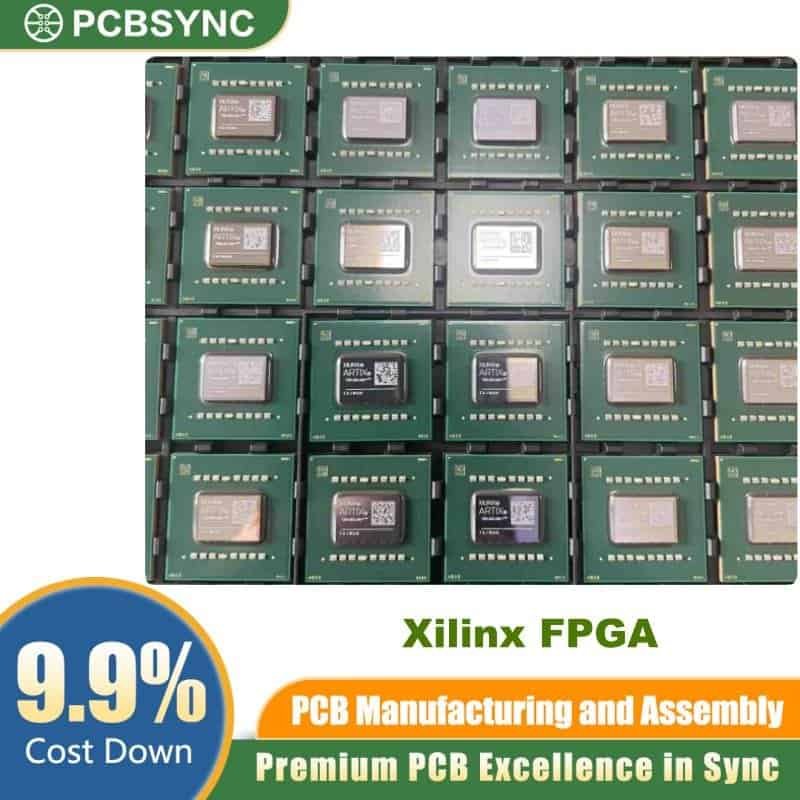
The XC3S1000-4FTG256C is a high-performance, cost-optimized Xilinx FPGA from the Spartan-3 family, manufactured by AMD (formerly Xilinx). Designed for high-volume, logic-intensive applications, this device delivers 1,000,000 system gates in a compact 256-ball Fine-pitch Ball Grid Array (FTBGA) package. Whether you’re developing embedded systems, communications equipment, or digital signal processing solutions, the XC3S1000-4FTG256C offers an optimal balance of performance, density, and cost efficiency.
XC3S1000-4FTG256C Key Specifications at a Glance
| Parameter |
Value |
| Manufacturer |
AMD (Xilinx) |
| Part Number |
XC3S1000-4FTG256C |
| Series |
Spartan-3 |
| Package Type |
256-Ball FTBGA (Fine Pitch BGA) |
| System Gates |
1,000,000 |
| Logic Cells |
17,280 |
| CLB Slices |
7,680 |
| Block RAM |
432 Kbits (24 blocks × 18 Kbits) |
| Multipliers (18×18) |
24 |
| DCMs (Digital Clock Managers) |
4 |
| I/O Standards Supported |
22+ |
| User I/O Pins |
391 |
| Speed Grade |
-4 (commercial, slowest grade) |
| Operating Temperature |
0°C to +85°C (Commercial) |
| Supply Voltage (VCC INT) |
1.2V |
| Supply Voltage (VCC AUX) |
3.3V |
| RoHS Compliant |
Yes |
| Lead Free |
Yes |
What Is the XC3S1000-4FTG256C? – Product Overview
The XC3S1000-4FTG256C belongs to Xilinx’s Spartan-3 FPGA family, a series widely recognized for delivering ASIC-like performance at low cost. The “XC3S1000” designation indicates the Spartan-3 device with 1 million system gates, while “-4” refers to the commercial speed grade, “FTG256” denotes the 256-ball Fine Pitch BGA package, and “C” specifies the commercial temperature range (0°C to 85°C).
This FPGA is built on a 90nm process technology, enabling high logic density with low power consumption — a critical combination for battery-powered, space-constrained, or cost-sensitive designs.
XC3S1000-4FTG256C Logic Architecture & Internal Resources
Configurable Logic Blocks (CLBs)
The XC3S1000-4FTG256C features 7,680 slices arranged in 1,920 CLBs. Each CLB contains four slices, and each slice includes:
- Two 4-input Look-Up Tables (LUTs)
- Two flip-flops (D-type with synchronous/asynchronous reset and set)
- Fast carry logic for arithmetic operations
- Wide function multiplexers
This architecture supports efficient implementation of combinational logic, sequential circuits, shift registers, and distributed RAM.
Block RAM (BRAM)
| BRAM Resource |
Quantity |
Capacity per Block |
Total Capacity |
| Block RAM Tiles |
24 |
18 Kbits |
432 Kbits |
| True Dual-Port RAM |
24 |
18 Kbits |
432 Kbits |
The block RAMs are true dual-port memories, allowing simultaneous read/write access from two independent ports — ideal for FIFOs, LUT-based memory, and on-chip data storage in DSP pipelines.
Dedicated Multipliers
The device includes 24 dedicated 18×18-bit multipliers, enabling hardware-accelerated multiply-accumulate (MAC) operations for:
- Digital Signal Processing (DSP) algorithms
- FIR and IIR filters
- FFT computation
- Video and image processing
Digital Clock Managers (DCMs)
Four integrated DCMs provide advanced clock management:
- Clock multiplication and division
- Phase shifting (0° to 359° in fine increments)
- Clock deskewing
- Frequency synthesis
This makes the XC3S1000-4FTG256C highly suitable for multi-clock-domain designs and synchronous interfaces requiring precise timing.
XC3S1000-4FTG256C Package & Pinout Details
Package Specifications
| Package Attribute |
Detail |
| Package Code |
FTG256 |
| Package Type |
Fine Pitch Ball Grid Array (FTBGA) |
| Ball Count |
256 |
| Body Size |
17mm × 17mm |
| Ball Pitch |
1.0mm |
| User I/O Pins |
391 (across all banks) |
| I/O Banks |
8 |
| Differential I/O Pairs |
Up to 120 |
The 256-ball BGA footprint is compact and PCB-friendly, making it a strong choice for applications where board space is at a premium. The 1.0mm ball pitch is compatible with standard PCB manufacturing processes.
I/O Bank Organization
The XC3S1000-4FTG256C organizes its I/Os into 8 independent I/O banks, each capable of supporting a different I/O voltage standard. This multi-voltage I/O capability simplifies interfacing with mixed-voltage systems.
Supported I/O Standards – XC3S1000-4FTG256C Interface Compatibility
| I/O Standard Category |
Supported Standards |
| Single-Ended |
LVCMOS 1.2V, 1.5V, 1.8V, 2.5V, 3.3V; LVTTL; PCI; GTL; GTL+ |
| Differential |
LVDS, LVPECL, BLVDS, ULVDS, RSDS |
| Legacy |
PCI (33MHz/66MHz at 3.3V) |
| High-Speed |
HSTL Class I/II/III/IV; SSTL-2 Class I/II; SSTL-18 Class I/II |
This broad I/O standard support allows the XC3S1000-4FTG256C to interface with DDR/DDR2 SDRAM, high-speed serial buses, single-ended logic, and legacy PCI systems without external level-shifting circuitry.
XC3S1000-4FTG256C Power Supply Requirements
Core and Auxiliary Power
| Supply Rail |
Voltage |
Function |
| VCCINT |
1.2V |
Powers internal logic core |
| VCCAUX |
3.3V |
Powers auxiliary circuits (DCMs, config logic) |
| VCCO (per bank) |
1.2V – 3.3V |
Powers I/O buffers (independently per bank) |
The low 1.2V core voltage significantly reduces static and dynamic power consumption compared to older FPGA generations, making the XC3S1000-4FTG256C well-suited for power-budget-constrained designs.
Configuration Methods for XC3S1000-4FTG256C
The XC3S1000-4FTG256C supports multiple configuration interfaces for maximum design flexibility:
| Configuration Mode |
Interface |
Use Case |
| Master Serial |
SPI Flash |
Lowest cost, self-loading from external SPI ROM |
| Slave Serial |
External controller |
Processor or CPLD-driven loading |
| Master Parallel (SelectMAP) |
8-bit parallel |
Faster configuration from parallel flash or microcontroller |
| Slave Parallel (SelectMAP) |
8-bit parallel |
System-controlled parallel loading |
| JTAG (IEEE 1149.1) |
4-wire JTAG |
In-circuit debug and programming |
Configuration data is stored externally — typically in a Xilinx Platform Flash PROM or standard SPI NOR Flash. The JTAG interface also enables partial reconfiguration and boundary scan testing.
XC3S1000-4FTG256C Performance Characteristics
Speed Grade “-4” Explained
The “-4” speed grade is the slowest commercial grade in the Spartan-3 family. This designation means:
- Lower maximum clock frequency compared to -5 or -6 speed grades
- Lower cost — ideal for applications without strict timing requirements
- Fully functional for the vast majority of embedded, control, and DSP applications operating below 150MHz
Typical performance benchmarks for the -4 speed grade include:
| Performance Metric |
Typical Value |
| Maximum CLB-to-CLB delay |
~8ns |
| DCM output jitter |
< 200ps |
| Block RAM access time |
~4–5ns |
| I/O setup time (LVCMOS) |
~2–3ns |
Typical Applications of the XC3S1000-4FTG256C
The XC3S1000-4FTG256C is a versatile FPGA suitable for a wide range of end applications:
Embedded Systems & SoC Design
Implement soft-core processors (MicroBlaze, PicoBlaze) alongside custom logic peripherals to create complete system-on-chip solutions without the cost of a custom ASIC.
Digital Signal Processing (DSP)
The 24 dedicated 18×18 multipliers and 432 Kbits of BRAM make this FPGA ideal for real-time FIR filtering, FFT engines, and audio/video processing pipelines.
Communications & Networking
Support for differential I/O standards (LVDS, BLVDS) and high-speed HSTL/SSTL makes the XC3S1000-4FTG256C suitable for high-speed serial communication interfaces, Ethernet MAC implementations, and protocol bridging.
Industrial Control & Automation
The large logic capacity and flexible I/O enable implementation of motor control, sensor fusion, real-time state machines, and custom bus interfaces.
Prototyping & ASIC Emulation
With 1 million system gates, this device is frequently used for pre-silicon ASIC verification and prototype validation in development labs.
Consumer Electronics
Cost-optimized production quantities and RoHS compliance make the XC3S1000-4FTG256C suitable for consumer products including set-top boxes, industrial displays, and IoT gateways.
XC3S1000-4FTG256C vs. Comparable Spartan-3 Devices
| Feature |
XC3S500E |
XC3S1000 |
XC3S1600E |
XC3S2000 |
| System Gates |
500K |
1,000K |
1,600K |
2,000K |
| Logic Slices |
4,656 |
7,680 |
14,752 |
19,512 |
| Block RAM (Kbits) |
360 |
432 |
648 |
720 |
| Dedicated Multipliers |
20 |
24 |
36 |
40 |
| DCMs |
4 |
4 |
8 |
8 |
| Max User I/O |
232 |
391 |
376 |
489 |
The XC3S1000 hits the sweet spot between density and cost, offering significantly more resources than the 500E while remaining more affordable than the 1600E and 2000.
Ordering Information & Part Number Breakdown
XC3S1000-4FTG256C Decoding Guide
| Field |
Code |
Meaning |
| Family |
XC3S |
Spartan-3 Series |
| Density |
1000 |
1,000,000 system gates |
| Speed Grade |
-4 |
Commercial speed grade (slowest) |
| Package |
FTG256 |
256-ball Fine Pitch BGA, 17×17mm |
| Temperature |
C |
Commercial (0°C to +85°C) |
Related Part Numbers
| Part Number |
Speed Grade |
Package |
Temperature |
| XC3S1000-4FTG256C |
-4 |
FTG256 |
Commercial |
| XC3S1000-5FTG256C |
-5 |
FTG256 |
Commercial |
| XC3S1000-4FGG320C |
-4 |
FGG320 |
Commercial |
| XC3S1000-4FGG456C |
-4 |
FGG456 |
Commercial |
| XC3S1000-4FTG256I |
-4 |
FTG256 |
Industrial (-40°C to +85°C) |
Design Tools & Software Support
The XC3S1000-4FTG256C is fully supported by Xilinx ISE Design Suite (the legacy toolchain for Spartan-3 devices). Key tools include:
- ISE Project Navigator – RTL design entry, synthesis, and implementation
- PlanAhead – Floorplanning and timing closure
- ChipScope Pro – In-system debug via JTAG
- CORE Generator – IP core generation (memory controllers, PCIe, UART, etc.)
- iMPACT – JTAG-based programming and configuration
Note: The Spartan-3 family is not supported by Xilinx Vivado Design Suite. Use ISE 14.7 (the final ISE release) for all XC3S1000-4FTG256C designs.
Compliance & Quality
| Compliance Standard |
Status |
| RoHS |
Compliant |
| REACH |
Compliant |
| Lead-Free |
Yes (Pb-Free) |
| Moisture Sensitivity Level (MSL) |
MSL 3 |
| JTAG Boundary Scan |
IEEE 1149.1 compliant |
Why Choose the XC3S1000-4FTG256C?
The XC3S1000-4FTG256C remains a proven, reliable choice for engineers needing substantial FPGA resources in a standard BGA package at a highly competitive price point. Its combination of 7,680 slices, 24 dedicated multipliers, 432 Kbits of block RAM, and 4 DCMs in the compact 17×17mm FTG256 footprint continues to make it relevant for both new designs and long-running production programs.
For teams building embedded systems, DSP accelerators, or protocol bridges where timing margins are comfortable and cost control is essential, the XC3S1000-4FTG256C delivers outstanding value with Xilinx’s well-established Spartan-3 ecosystem.